- Study Abroad
- / gre
- / reading comprehension
GRE Reading Comprehension: Tips and Strategies


Author
02-09-2024

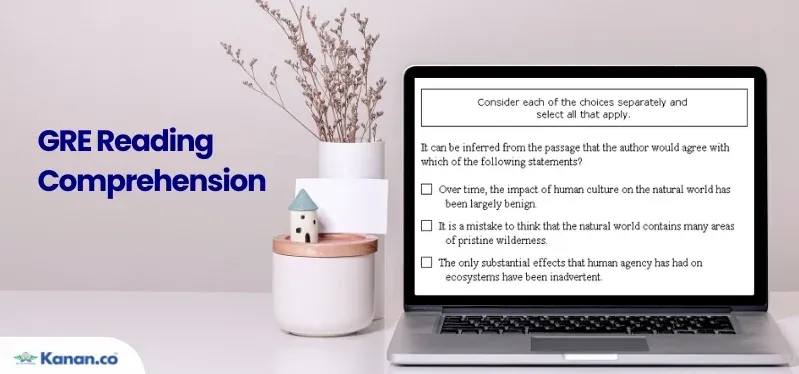
GRE Reading Comprehension (RC) is the most crucial part of the GRE Verbal Reasoning section, accounting for 50-55% of the total verbal score. The GRE RC section includes 5-7 passages, each ranging from one to five paragraphs in length, with 1- 4 questions per passage. These passages assess test-takers’ ability to read and comprehend prose typical of graduate-level studies.
Enhancing your reading comprehension skills can significantly boost your verbal score. It's important to note that simply reading newspapers is not sufficient for mastering comprehension skills, as this is more casual reading. Instead, critical reading skills are necessary to tackle the complex vocabulary and jargon in GRE passages. You must carefully analyze each detail, understand the author's message, and draw inferences.
Common topics for GRE RC include Arts and Humanities, Biological Sciences, Physical Sciences, Social Sciences, Business, and everyday topics. You don’t need expert knowledge in these areas to perform well; strong English skills and a robust vocabulary are key. This article will discuss the types of GRE RC questions, provide practice questions with answers, and offer tips and strategies.
GRE Reading Comprehension Question Types
Reading comprehension is a very important part of GRE verbal reasoning. The questions asked are based on 3 types namely
|
Multiple Choice Questions - Select One Answer Choice This is the traditional multiple choice questions, where you will be provided with 5 answers choices for a question. You need to select “Only One” answer out of 5 answer choices. A circle or oval boxes are given beside the answer choices. Multiple Choice Questions - Select one or more Answer Choices In this type of multiple choice question, you are given 3 answers. You are expected to select 1, 2 or all the 3 answers if they are matching. Full marks are given only if all the correct answer choices are selected. Partial credits are not given for partial correct answers. The answer choices will have square boxes to differentiate them from multiple choice single answer passages. Select-in-Passage Select-in-passage is a new sub question type, unique to the GRE, where you need to highlight the sentences in the passage which best addresses the question. This is a computer based test as the sentences are highlighted on clicking. If you opt for a paper based test, then this section will be replaced by the multiple choice answers. |
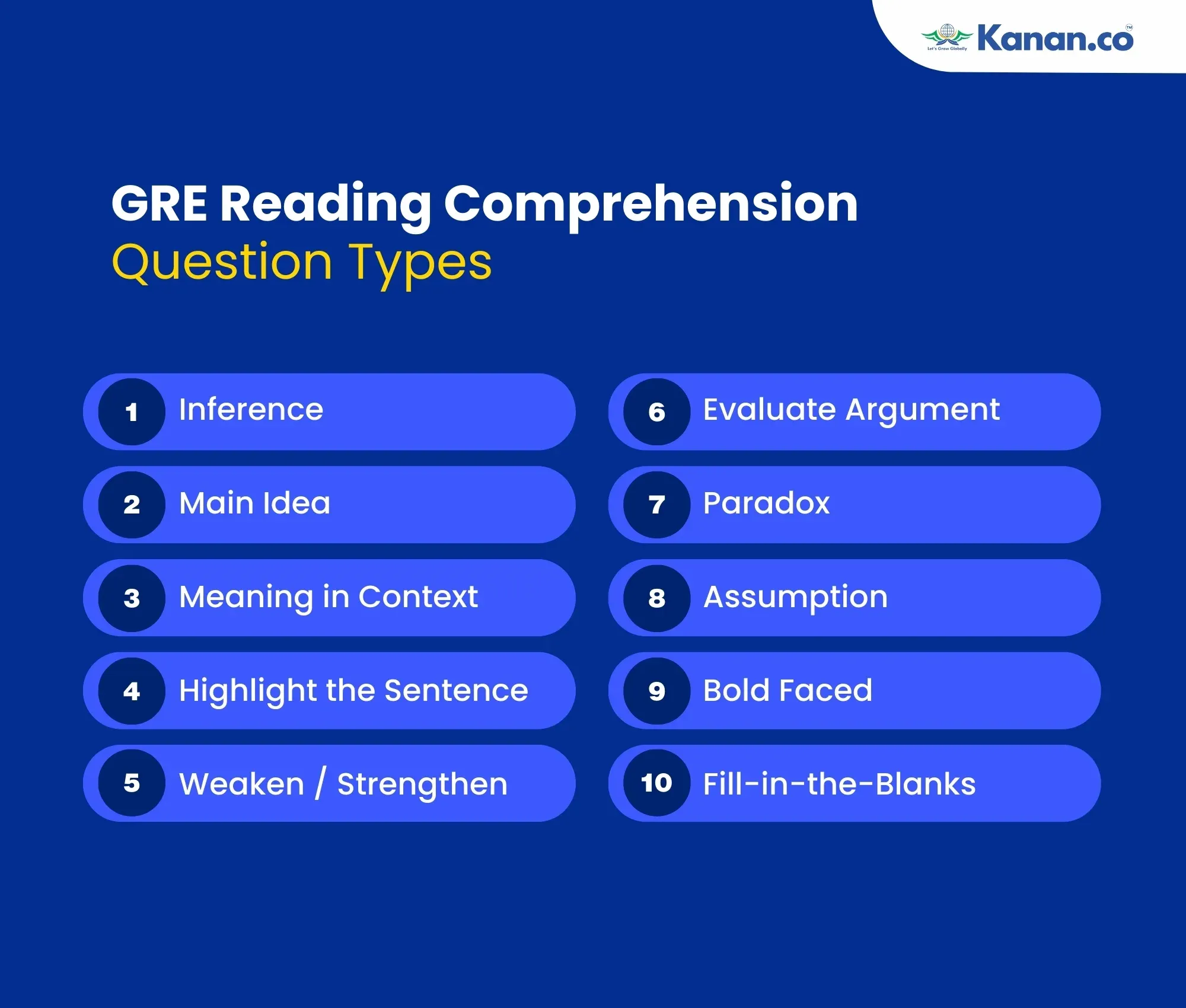
The GRE Reading comprehension passages and questions will be asked based on two question types: Paragraph Argument passages (also called critical reasoning passages) and Non-Paragraph Argument Reading Comprehension questions.
Non-Paragraph Argument Reading Comprehension
The four most common type of non-paragraph argument reading comprehension are:
- Main idea
- Inference
- Meaning in the context
- Highlight the sentence
Main Idea
The main idea is the most straightforward question type, where you will be asked to identify the ‘main idea’ or the ‘big picture’ or ‘dominant theme’ of the passage. You will also be asked to identify the primary purpose, intended audience and scope of the passage. To clear this section you need to skim the passage and identify/understand the main idea of the passage. Practice is the key to tackle these types of questions.
Inference
Inference questions are the most common question type asked in the GRE RC. These questions require you to draw inferences based on the information that you’ve read. Sometimes, you must identify implied conclusions from clear statements, while other times, you need to infer conclusions that the author suggests indirectly. To answer these questions correctly, rely solely on the evidence rather than your own knowledge. Inferences should be based on the possibilities rather than certainties and should not include any assumptions or speculations.
Meaning in the Context
GRE Verbal is a vocabulary-driven assessment and all three sections—Reading Comprehension, Sentence Equivalence, and Text Completion—demand a strong vocabulary to succeed. Specifically, in Reading Comprehension, "meaning in context" questions require an advanced academic vocabulary. The RC questions focus on the rare or less-commonly-used definitions. For these questions, you are given a passage and must determine the meaning of a word based on its context. To find the correct meaning, first, focus on the sentence where the word appears. If needed, look at the surrounding sentences or the entire passage to understand the context.
Highlight the Sentence
RC highlighting the sentence is one of the trickier question types. You will be given one or more paragraphs and the test-taker will be asked to select the sentence in a paragraph that serves a specific purpose. Rather than writing the possible answer, you need to find the answer from the text and highlight it. Your focus should be on the passage that deals specifically with the questions asked and answer the question based on that. Skim the passage to know where to find different points.
Paragraph Argument Reading Comprehension
Paragraph argument questions are focused on analyzing arguments made within a paragraph. These types of questions consist of premises also called facts and a conclusion. You will be asked to identify the conclusion or the gap between premises and conclusion. There are six types of paragraph argument question types, where all are fundamentally the same.
- Weaken/Strengthen
- Evaluate Argument
- Paradox
- Assumption
- Bold-Faced
- Fill-in-the-blanks
All you need to do is analyze the passage-length argument and answer the questions.
Bolster/Undermine (Weaken/Strengthen)
In this type of question, you will be asked to identify a point from the passage that would strengthen or weaken the argument provided by the author. The answer choices always display new facts that are not given in the original passage. You will also be asked to select a new fact that will make the argument stronger if true or a fact that will weaken an argument if true.
Evaluate Argument
In this question type, you are asked to find out the gap in logic or a missing information piece without which it is difficult to assess whether the argument is correct or not. Basically, you will have to find out additional information necessary to determine if the argument is valid or not.
Paradox
You can identify the paradox type of question, if the passage has statements that appear to be contradictory. The statement presented in the passage can be self-contradictory or absurd, but in reality expresses a possible truth. You need to choose an additional fact (not in the original passage) that would explain the passage’s contradiction.
Assumption
Assumption questions are similar to evaluating arguments questions in a few ways. The passage given for the assumption question will have an information gap, like evaluate argument questions. Test-takers need to find what assumptions are implied by the author, which are not directly stated in the passage.
Bold Faced
Bold Faced questions are asked in the general RC passages. This involves highlighting two sentences in the passage, where you have to identify the purpose of the two sentences and the relationship they have between each other and with the paragraph.
Fill-in-the Blank
This Fill-in-the-Blank is the least common Paragraph Argument question type. As the name suggests, you need to select an answer that completes the blank space at the end of the argument. You need to choose the most appropriate conclusion that suits the blanks.
GRE Reading Comprehension Practice Questions
Passage 1
Question 1 is based on the following passage.
It was supposed that Tezcatlipoca had guided the Nahua, and especially the people of Tezcuco, from a more northerly climb to the valley of Mexico. But he was not a mere local deity of Tezcuco, his worship being widely celebrated throughout the country. His exalted position in the Mexican pantheon seems to have won him special reverence as a god of fate and fortune. The place he took as the head of the Nahua pantheon brought him many attributes which were quite foreign to his original character. Fear and a desire to exalt their tutelar deity will impel the devotees of a powerful god to credit him with any or every quality, so that there is nothing remarkable in the spectacle of the heaping of every possible attribute, human or divine, upon Tezcatlipoca when we recall the supreme position he occupied in Mexican mythology. His priestly caste far surpassed in power and in the breadth and activity of its propaganda the priesthoods of the other Mexican deities.
Summary / Paraphrase
The passage is about a pre-Columbian Mexican deity, Tezcatlipoca. The main idea is that Tezcatlipoca held an especially exalted place in the pantheon of Mexican gods. The major points are (a) Tezcatlipoca was supposed The passage is about a pre-Columbian Mexican deity, Tezcatlipoca. The main idea is that Tezcatlipoca held attributes because his worshipers feared him and wished to praise him. A minor point suggests that the author to have guided his people to the valley of Mexico (b) Tezcatlipoca was credited with a tremendous range of beliefs the way that the Nahua worshipped Tezcatlipoca can be generalized to other peoples. The purpose of the passage is to explain Tezcatlipoca's position in the Mexican pantheon.
Question
1. Select the sentence in the passage that predicts the likelihood that a leader will need to deviate from his initial intentions.
Answer to Question 1:
The correct answer is "The place he took as the head of the Nahua pantheon brought him many attributes which were quite foreign to his original character". In this case, Texcatlipoca is assumed by his followers to have attributes that are foreign to him. Because followers or believers have various needs, they will expect a variety and, perhaps, conflicting ideas to do what the leader can accomplish. The leader is fated to disappoint some of his constituents, at least until he can develop the attributes that they assume he possesses.
Passage 2
Question 2 is based on the following passage
A pleasant and elevated spot being fixed upon, Sheddad dispatched a hundred chiefs to collect skilled artists and workmen from all countries. He also commanded the monarchs of Syria and Ormus to send him all their jewels and precious stones. Forty camel-loads of gold, silver, and jewels were daily used in the building, which contained a thousand spacious quadrangles of many thousand rooms. When finished, Sheddad marched to view it. Suddenly a voice like thunder heard, and Sheddad, looking up, beheld a personage of majestic figure and stern aspect, who said, "I am the angel of death, commissioned to seize thy impure soul." Sheddad exclaimed, "Give me leisure to enter the garden," and was descending from his horse, when the seizure of life snatched away his impure spirit, and he fell dead upon the ground. At the same time, lightning flashed and destroyed the whole army of the infidel, and the rose garden of Irim became concealed from the sight of man.
Passage 2-Summary / Paraphrase
The passage tells the story of Sheddad. The main idea is that although Sheddad was very powerful, he was struck down by a divine force for his impurity. The major points are (a) that Sheddad used his power to construct a lavish garden and (b) that before he had the opportunity to enjoy his garden, he was struck dead for his "impure soul". The purpose of the passage is to warn the reader that no amount of worldly power and wealth can save a bad man.
Question
Select only one answer choice
2. Which of the following is an explanation for concealing the rose garden of Irim from the sight of man?
- To prevent theft of the precious metals and gems used in its construction
- To reserve its spectacular beauty for God and His angels
- To prevent Sheddad's heirs from claiming it as their own
- As a preventive against using the riches of other countries to promote oneself
- As a moral lesson about the sin of excessive pride
Answer to Question 2
The correct answer is E. Shaddad has built a garden to rival the beauty of heaven and has assembled his slaves and courtiers to view it. In the construction of this garden, Shaddad has angered God, who sends the angel of death to take Shaddad's life before he can see the fruits of his labour. Shaddad's pride has caused his downfall, making E the correct answer. There is no evidence in the story to suggest that others might steal the precious metals and jewels, so A is not correct. God and the angels have no need for a beautiful garden on earth, making B an incorrect choice. Based on the words of the angel of death, one cannot presume that the garden was hidden to prevent Shaddad's heirs from claiming it, eliminating C as a correct answer. It appears that Shaddad used the resources of other countries for hundreds of years; if preventing that were the object of the lesson, it likely would have happened before the construction had been completed. D is incorrect.
Passage 3
Questions 3 to 5 are based on the following passage.
By the 1890s Social Darwinist ideas were popular and were making themselves felt, influencing social policies in the United States and elsewhere. Social Darwinism saw human society as based on a struggle for survival, in which the superior, the fittest, would triumph and the inferior would be swept to the wayside. It was more or less the ancient "predator ethic" - the idea that might make right, that the strong are entitled to oppress the weak - dressed up in pseudoscientific clothes. If the uggle for survival was the way of the world, then it was only natural that human society should operate in the same way. Social Darwinism also dovetailed with racist thinking: American
supremacy notions and German militarism.
Passage 3-Summary / Paraphrase
The passage is about Social Darwinism. The main idea is that Social Darwinism was used to justify oppressive and racist views and policies. The major points are (a) that Social Darwinism is nothing more than the notion that "might makes right" dressed in a quasi-scientific guise and (b) Social Darwinism was used to justify segregation and a belief in a master race. The purpose of the passage is to explain Social Darwinism and how it was used to justify racist ideologies.
Question 3. Select the sentence that explains how humans justified the tenets of social Darwinism.
Answer to Question 3
The correct answer is "If the struggle for survival was the way of the world, then it was only natural that human society should operate in the same way".This sentence is an example of conditional logic. Social Darwinists assumed that if this condition exists in the animal world, then it must also exist in the human world.
Consider each of the three choices separately and select all that apply.
Question 4. Based on your understanding of predator ethic, select the events or actions that are examples of such behaviour.
- Cyber-bullying
- Involuntary commitment to a mental institution
- The Holocaust
Answer to Question 4
Both A and C are correct. Bullies adopt the role of predator when they select those who are weak in some way as targets of rumours or harmful insults. The Nazis used predation in the late 1930's and early 1940's to round up Jews, homosexuals, gypsies, and others that they considered inferior in an attempt to prevent sullying the Aryan race. Involuntary commitment could be the result of a count proceeding that relies on expert testimony and is not necessarily a predatory action.
Select only one answer choice
Question 5. The use of the word "dovetailed" in the context of this passage most closely matches which of the following definitions?
- Coincided with
- Deviated from
- Fit together
- Having a series of indentations suggesting dovetails
- Split apart
Answer to Question 5:
The correct answer is C. A dovetail is a type of joint used in carpentry to make pieces of wood fit together smoothly. Social Darwinism fit well with segregationists' ideas that white people were The correct answer is C. A dovetail is a type of joint used in carpentry to make pieces of wood fit superior to black people and so had the right to repress them. Coincided implies that the two ideas imply that segregationists did not agree with the idea of social Darwinism. D is a definition used to occur at the same time rather than one idea being used to justify the other. Deviated would heraldry, and the definition in E suggests disagreement.
Passage 4
Question 6 is based on the following passage
The aim of this little work is, therefore, limited to the gathering of such facts and phenomena a serve to throw light upon the nature of the magic powers with which man is undoubtedly endowed Its end will be attained if it succeeds in showing that he actually does possess powers which are n subject to the general laws of nature, but more or less independent of space and time, and which ye make themselves known partly by appeals to the ordinary senses and partly by peculiar phenomenon the result of their activity. These higher powers, operating exclusively through the spirit of man, an part of his nature, which has much in common with that of the Deity, since he was created by God His own image," and the Lord "breathed into his nostrils the breath of life and man became a living soul.
Passage 4-Summary/Paraphrase
The passage is about supernatural powers for humans. The main idea is that, since man is created in God's image, man too must possess supernatural abilities. The major point is that the work from which the passages use other words, that humans have supernatural powers. The purpose of the passage is to serve as a primer for excerpted hopes to demonstrate that humans possess powers "not subject to the general laws of nature demonstrating that humans are capable of possessing magical abilities.
Select only one answer choice
Question 6. Based on the information in this passage, what makes it likely that the author will find it difficult to conduct an objective investigation?
- His belief in God
- His preconceived idea that man has magical powers
- The lack of previous research on the subject
- The refusal of the church to cooperate in his endeavour
- The likelihood that the public will scoff at his ideas
Answer to Question 6:
B is the correct answer. The author states his conviction that man is undoubtedly endowed with magic powers. This belief may lead him to make the facts fit his theory, which is contrary to objective, The correct answer is B. His belief in God should not be an impediment, as many who conduct scientific research also believe in God, making A an incorrect answer choice. The reader cannot tell from the information presented here if there is little or no research on this topic, eliminating C as the correct answer choice. The reader cannot assume that the church will not cooperate, nor that the public will scoff at his ideas, making both D and E incorrect.
Passage 5
Question 7 is based on the following passage
I must confess, though, that I am a bibliophile with War books. Any book about the Great War is good enough for me. I am to that class of literature what little boys are to stamps. Yes, I know the dread implication. I am aware of the worm in the mind; that I probe a wound; that I surrender to an impulse to peer into the darkness of the pit; that I encourage a thought which steals in with the quiet of midnight, and that it keeps me awake while the household sleeps. I know I consort with ghosts in a region of evil. I get the horrors, and I do not repel them. For some reason I like those ghosts. Most of them have no names for me, but I count them as old friends of mine; and where should I meet them again, at night, but amid the scenes we knew.
Passage 5-Summary/Paraphrase
The passage is about the author's fascination with books about WWI. The main idea is that although the author is aware that his fascination may seem horrific, he is nonetheless unable to resist it. The major point is that the author feels comfortable in the setting and characters of the war, however appalling the war itself may have been. The purpose of the passage is confessional: the author is admitting the oddities of his fascination while justifying and affirming it.
Question 7. Select the sentence that suggests that the writer may be performing a cathartic act in this passage.
Answer to Question 7:
The correct answer is "I must confess, though, that I am a bibliophile with War books".Confession is generally a form of catharsis. One may confess to a priest or someone he/she has harmed in the past. In this case, the author thinks that others may find his love of war books strange as the author, himself, was most likely a witness to the horrors about which he reads. By revealing his love of these books, he has eliminated the necessity to keep it a secret and probably feels relieved.
Passage 6
Questions 8 and 9 are based on the following passage.
Out we drove at last. It was December, but by luck we found a halcyon morning which had got lost in the year's procession. It was a Sunday morning, and it had not been ashore. It was still virgin, bearing a vestal light. It had not been soiled yet by any suspicion of this trampled planet, this muddy star, which its innocent and tenuous rays had discovered in the region of night. I thought it still was regarded as a lucky find there. Its light was tremulous, as if with joy and eagerness. I met this discovering morning as your ambassador while you still slept, and betrayed not, I hope, any greyness and bleared satiety of ours to its pure, frail, and lucid regard. That was the last good service I did before leaving you quite. I was glad to see how well our old earth did meet such a light, as though it had no difficulty in looking at the day in the face. The world was miraculously renewed.
Passage 6-Summary / Paraphrase
The passage is about morning as a metaphor for renewal. The main idea is that, although the author is apparently rather world weary, the beauty of the morning renews some sense of hope in the world. The main points contrast (a) the freshness and innocence of the morning to (b) the sense of the world as "trampled" and the characters as 'grey' and 'sated'. The purpose of the passage is to contrast the author's general state of mind with the symbolic purity of the morning.
Select only one answer choice
Question 8. In the context of this passage, which of the following is the best definition for "lucid"?
- Easily understood
- Shining or bright
- Rational or sane
- Clear, transparent
- Evident
Answer to Question 8:
The correct answer is B. The narrator is speaking about morning and the manner in which it is regarding this portion of the earth early in the day.
Consider each of the three choices separately and select all that apply.
Question 9. Select the statement that can replace the second sentence of the passage without altering the overall meaning of the author's words.
- Although it was December, we were fortunate to discover tranquil weather that seemed a better fit for a warmer month
- It was December, and we discovered a holiday celebration that we had neglected to observe earlier in the year
- Because it was December, we felt as carefree on that morning as we had in the summer months
Answer to Question 9:
The correct answer is A. When the author says that this particular morning must have got lost in t year's progression, he implies that it should have occurred earlier in the year. Halcyon, when describing weather, means calm, or peaceful, or tranquil. A is the only answer that includes both of these descriptors of the day in question. There is no suggestion of a holiday celebration, making B an incorrect choice. The author mentions nothing about the emotions or attitudes of the “we” in the passage. He is describing the morning rather than people. C is not the correct choice.
Passage 7
Questions 10 and 11 are based on the following passage
Friends - This lecture has been delivered under these circumstances: I visit a town or city, and try to arrive there early enough to see the postmaster, the barber, the keeper of the hotel, the principal of the schools, and the ministers of some of the churches, and then go into some of the factories and stores, and talk with the people, and get into sympathy with the local conditions of that town or city and see what has been their history, what opportunities they had, and what they had failed to do - and every town fails to do something- and then go to the lecture and talk to those people about the subjects which applied to their locality. "Acres of Diamonds"- the idea - has continuously been precisely the same as he does in his own environment, with his own skill, with his own energy, and with his own same. The idea is that in this country of ours every man has the opportunity to make more of himself than he does in his own environment, with his own skill, with his own energy, and with his own friends.
Passage 7 - Summary / Paraphrase
The passage is about the author's strategy for speaking to local populations. The main idea is that the author always attempts to learn some particulars about the place where he is going to speak before overlaying the particulars with a more general theme. The major points are (a) that the author speaks to various townsfolk to The passage is about the author's strategy for speaking to local populations. The main idea is that the author modifies his speech with its general themes of civic pride with certain specific features. The purpose of the find out about their town, what they are proud of, and where they see failures and (b) that the author then passage is to reveal the author's way of addressing each town. The rhetoric suggests that the author may be somewhat cynical about his vocation.
Select only one answer choice
Question 10. Based on the information in this passage, select the word that best describes his delivering his presentation, "Acres of Diamonds".
- Information
- Confirmation
- Innovation
- Motivation
- Intimidation
Answer to Question 10:
The correct answer is D. The purpose of his presentation is to help the residents realize their potential for improvement. He aims to motivate them, making D the best answer. The writer gathers information in order to confirm what he believes about the inhabitants of towns everywhere. He hopes that their behavior will become new or innovative. There is nothing in this passage that he attempts to intimidate them or cause fear. He desires to use what he knows to motivate them to realize their full potential. D is the correct answer.
Select only one answer choice
Question 11. What is the relationship of the last two sentences to the preceding portion of the passage?
- They invalidate the process of the writer's visiting local officials and work places.
- They contrast the universality of the idea with the specificity of the points for each town or city.
- They cast aspersions on the officials and townsfolk that he has visited.
- They summarize the information that he has discovered from his visits to officials and work places.
- They support the assumption of failure on the part of the town's inhabitants.
Answer to Question 11:
The correct answer is B. The writer's basic assumption is that, although each town has its unique characteristics, they all fail in the same way. The last two sentences provide the general idea that he uses to illuminate the specific failure of the town he is visiting. B is the correct answer. A is incorrect because he uses those visits to tailor his presentation. There is no indication that he looks down on the people in positions of power in the town, making C incorrect as well. This passage is an overview of his process and reveals nothing specific about any town, eliminating D as a possible answer. The lecture focuses on possibilities, not failures. E is incorrect.
Passage 8
Questions 12 and 13 are based on the following passage
Nowhere is there anything just like them. In his best work - and his tales of the great metropolis are his best - he is unique. The soul of his art is unexpectedness. Humour at every turn there is, and sentiment and philosophy and surprise. One never may be sure of himself. The end is always a sensation. No foresight may predict it, and the sensation is always genuine. Whatever else O. Henry was, he was an artist, a master of plot and diction, a genuine humorist, and a philosopher. His weakness lay in the very nature of his art. He was an entertainer bent only on amusing and surprising his reader. Everywhere is brilliant, but too often it is joined to cheapness; art, yet art merging swiftly into caricature. Like Harte, he cannot be trusted. Both writers on the whole may be said to have lowered the standards of American literature, since both worked on the surface of life with theatrical intent and always without moral background, O. Henry moves, but he never lifts.
GRE Score Range Explained
The passage is about O. Henry. The main idea is that although O. Henry was a superb literary craftsman, his work is gimmicky and lacking in depth. The major points are (a) O. Henry was a unique and skillful writer (b) that his work favours sensation and surprise over genuine substance and (c) that he can be accused of lowering the overall standards of American literature. The main purpose of the passage is to severely critique O. Henry's works while giving some credit for certain topical skill.
Select only one answer choice
Question 12. Consider the words of this critic and select the word or phrase that best identifies what is missing from O. Henry's writing.
- Tension
- Style
- Subtlety
- Plot
- Conflict resolution
Answer to Question 12
The correct answer is C. The writer's use of words like caricature and cheapness describe the overall effect of O. Henry's writing, and they point to a lack of subtlety, making C the correct choice. The critic states that the reader can never be sure of himself, indicating that the stories do create tension, eliminating A as the correct answer. The writer of this passage deals with O. Henry's style extensively, so B is not the correct answer. The writer also provides information about plot elements, so it would be incorrect to assume that plot is a weakness; D is not correct. There is too little information here to select conflict resolution, answer E, as a weakness.
Consider each of the three choices separately and select all that apply
Question 13. Which of the following statements, if true, would have altered this critic's opinion of both O. Henry's and Harte's literary endeavors?
- The readers of the stories crafted by Harte and O. Henry is left with a sense of satisfaction.
- Harte's and O. Henry's stories continue to appear in secondary school anthologies.
- The themes in the works of both writers provide significant insight into the motivations of human behaviour
Answer to Question 13:
Both A and C are correct choices. The author of this passage implies that both writers entertain but fail to reach the level of important literature. Their writing lacks a moral background. Answer B does not provide enough information to justify a change in the critics' opinions. One would need to know the reason for the authors' inclusion in those anthologies.
Passage 9
Questions 14 to 19 are based on the following passage
Men's ideas root pretty far back. Their religious creeds are very old. By means of interest and hope and largely fear, they manage to hang on to the old, even when they know it is not true. The idea of man's importance came in the early history of the human race. He looked out on the earth, and of course he thought it was flat! It looks flat, and he thought it was. He saw the sun, and he formed the conception that somebody moved it out every morning and pulled it back in at night. He saw the moon, and he had the opinion that somebody pulled that out at sundown and took it in the morning. He saw the stars, and all there was about the stars was, "He made the stars also." They were just "also." They were close by, and they were purely for man to look at, about like diamonds in the shirt bosoms of people who like them.
This was not an unreasonable idea, considering what they had to go on. The people who still believe it have no more to go on. Blind men can't be taught to see or deaf people to hear. The primitive people thought that the stars were right nearby and just the size they seemed to be. Of course now we know that some of them are so far away that light travelling at nearly 286,000 miles a second is several million light years away from the earth, and some of them are so large that our sun, even, would be a fly-speck to them. The larger the telescopes the more of them we see, and the imagination can't compass the end of them. It is just humanly possible that somewhere amongst the infinite number of infinitely larger and more important specks of mud in the universe there might be some organisms of matter that are just as intelligent as our people on the earth. So to have the idea that all of this was made for man gives man a great deal of what Weber and Field used to call "Proud flesh."
Man can't get conceited from what he knows today, and he can't get it from what intellectual people ever knew. You remember, in those days the firmament was put in to divide the water below from the water above. They didn't know exactly what it was made of, but they knew what it was. Heaven was up above the firmament. They knew what it was, because Jacob had seen the angels going up and down on a ladder. Of course, a ladder was the only transportation for such purposes known to Jacob. If he had been dreaming now, they would have been going up in a flying machine and coming down in the same way. Our conceptions of things root back; and that, of course, is the reason for our crude religions, our crude laws, our crude ideas, and our exalted opinion of the human race.
Passage 9-Summary / Paraphrase
The passage is a critique of the human race's self-importance. The main idea is that people have always tended to view the world with an erroneous belief in their own importance and that this way of looking at things continues to influence important aspects of our beliefs. The major points are (a) people hold on to old, outmoded beliefs for fear of the unknown (b) that out of ignorance, people formed all manner of wrong beliefs about the nature of their world, tending to privilege things relatively close at hand (c) that modern science has proven the bulk of our earlier beliefs wrong and destroyed our ability to hold ourselves above the rest of creation (d) our tendency to hold onto the old is the reason for our "crude religions, our crude laws, our crude and our exalted opinion of the human race." There is a minor point that uses the story of Jacob's ladder to illustrate our way of understanding the world according to our most current knowledge. The purpose of the passage is to give the author's view of why we maintain older beliefs in the face of countervailing evidence.
Select only one answer choice
Question 14. In the context of this passage, which of the following definitions most closely fits the use of the word "crude" in the last sentence of the passage?
Lacking in intellectual subtlety, perceptivity
Unrefined or natural
Lacking finish, polish, or completeness
Lacking culture, refinement, tact
Undisguised; blunt
Answer to Question 14:
The best choice is A. B refers to resources in their natural state, such as crude oil. C could describe a creative product like an essay or a hand-made piece of furniture. D and E describe behavior rather than beliefs and ideas.
Select only one answer choice
Question 15. What purpose is served by the author's using the speed of light in the second paragraph?
- To reveal the author's level of education
- To demonstrate how man's understanding of the universe has increased
- To help the reader understand the context of the passage
- To explain how distant the stars actually are
- To show the value of telescopes
Answer to Question 15:
The correct answer is B. The writer is contrasting what man knew in the past with what he now knows to be true. B is the correct answer. The writer is not attempting to show off his own level of The correct answer is B. The writer is contrasting what man knew in the past with what he now has education or intelligence, nor is he touting the value of telescopes, eliminating both A and E as correct choices. Answer D is what he is telling the reader but not why. The figure does nothing to enhance the words surrounding it; C is incorrect.
Select only one answer choice
Question 16. What does the author's use of the words "blind" and "deaf" in the second paragraph reveal about his attitude toward his topic?
- They make evident his optimism for the human race
- They demonstrate his fear for the human race
- They show his scorn for members of the human race
- They reveal his feelings of superiority over other men
- They reinforce his sense of hopelessness about science in general
Answer to Question 16:
The correct answer is C. The writer has a low regard for those who refuse to revise their opinions and ideas despite the availability of new information, making C the correct choice. There is nothing in the The correct answer is C. The writer has a low regard for those who refuse to revise their opinions and passage that leads the reader to believe that the writer has any optimism for the human race, so A is incorrect. He does not speculate about the future of the human race, nor reveal any fears about that future, making B the wrong answer. The writer does not tout his own beliefs, so does not express hopelessness in its desire to hold on to old ideas, but it is overshadowed by his contempt for them. E is not superior over others, eliminating D as the correct answer. The writer may feel that humankind is hopeless in its desire to hold onto old ideas, but it is overshadowed by his concept for them. E is not the best answer.
Consider each of the three choices separately and select all that apply
Question 17. Which of the following is akin to the story of Jacob's ladder?
- President Kennedy's declaration that the United States would send a man to the moon by the end of the 1960's
- The belief that the Earth is the centre of the universe
- Columbus' calling the natives of the New World Indians
Answer to Question 17:
All of the answers are acceptable choices based on the premise that the people in question were basing their statements or beliefs on what they had to go on. President Kennedy probably could not. All of the answers are acceptable choices based on the premise that the people in question have imagined the day that scientists would say that human travel to Mars is likely. Until advances in astronomy and physics and mathematics evolved, it was reasonable to assume that everything revolved around the Earth. Columbus believed that he had found a shorter route to India and, logically, called the inhabitants of the New World Indians.
Consider each of the three choices separately and select all that apply.
Question 18. What does the author imply when he says at the beginning of the third paragraph that man can't get conceited from what he knows today?
- Man has failed to make significant progress in knowledge
- Man's current knowledge will be made insignificant by the knowledge of future generations
- The knowledge that man possesses is not used for the advancement of the human race
Answer to Question 18:
B is the best answer choice. The author suggests that, at each stage of history, men thought that they had discovered all of the answers only to be proven wrong by successive generations. The same is true for man today. The next best answer is just around the corner. The writer does not suggest that man has made no progress despite his fondness for old ideas. A is not a good answer choice. Although the author expresses contempt for those who cling to old ideas, he does mention the way in which new technology has created new, beneficial understanding, making C an incorrect choice.
Question 19. Select the sentence that supports the author's opinion that man is conceited.
Answer to Question 19
The correct answer is "So to have the idea that all of this was made for man gives man a great deal of what Weber and Field used to call "Proud flesh.""Conceitedness comes from having a high opinion of oneself. The idea that the universe and everything in it was created for man's comfort and/or amusement is the height of conceitedness.
Passage 10
Question 20 is based on the following passage
Is human nature intrinsically good or inherently evil? One of the most prominent and influential arguments for the latter was put forward by the British political philosopher Thomas Hobbes. In his seminal work, Leviathan, Hobbes established his theory of the social contract, in which he claimed that humans without government exist in a state of nature where each individual has a right to everything, engendering a "war against all". This environment creates a constant fear of death and prevents humans from both obtaining and hoping for the necessities needed to survive. It is only through the establishment of a civil society by way of a social contract that individuals are able to unite and thrive collectively. For Hobbes, society is what tames and controls the ultimately selfish and corrupt natural state of the human being.
Passage 10-Summary / Paraphrase
The passage is about the political philosophy of Thomas Hobbes. The main idea is that Hobbes developed a theory in which humans are seen as naturally inclined to do evil and require a government to reign in their naturally evil tendencies. The main points are: (a) that Hobbes believes that in a state of nature, humans are engulfed in perpetual state of conflict (b) that Hobbes believes that only in civil society governed by a social contract are humans able to escape the evils of their "natural" condition. A minor point, the mention of the age-old debate between whether human nature is inherently good or bad, is used to introduce the discussion of Hobbes' ideas. The purpose of the passage is to briefly summarize Hobbes' political thought: although the passage presents a potentially controversial matter, the author avoids any indication of bias and merely presents the content.
Question 20. Select the sentence that best illustrates Hobbes' view on human nature.
Answer to Question 20
“For Hobbes, society is what tames and controls the ultimately selfish and corrupt natural state of the human being”.
Download GRE Reading Comprehension Practice PDF for practice.
Tips & Strategies to approach GRE Reading Comprehension
If you’re preparing for the GRE, the most common tip is enhancing your vocabulary and comprehension skills by reading popular publications such as The New York Times, The Economist, MIT Technology Review, and The Guardian. Developing these skills will help you tackle the reading comprehension section, which includes passages of varying lengths. For shorter passages, read carefully and focus on keywords. For longer passages, use strategies like skimming, paraphrasing, and reading the first and last paragraphs to grasp the main ideas more efficiently. Now let’s see tips in detail to ace the reading comprehension section.
Determine what the passage is about
As you begin reading a passage, aim to identify its main topic. Look for clues that reveal the central idea. Look out for clues to find the main idea of the passage with which you can easily answer the broader questions regarding what the passage is trying to convey. It's important to determine what the passage is discussing, its scope, and its purpose.
Skim the passage
Skimming is a reading technique to quickly identify the main ideas under time constraint, when the given subject is unfamiliar. This is also called speed reading, which is a most effective way to remember several key points. Pay attention to how the passage is structured while skimming; this will help you know where to look for specific answers. Although this approach won't give you a full understanding, you can always read specific lines more closely when necessary.
Sum up the information
After skimming the passage, it's crucial to summarize the information and retain it in your memory. This technique is especially helpful for those who struggle to maintain concentration while reading. The goal isn't to memorize every word, but rather to know where to locate the answers. If paragraph numbers aren't provided, try breaking the text into smaller sections to make the information easier to remember.
Look for keywords
While skimming the passage, focus on key details such as names, dates, places, and important terms. This helps you remember these elements more easily and allows you to answer related questions efficiently. If questions pertain to these keywords, you'll know precisely where to find the answers. This technique can significantly save you time.
Understand the questions
After skimming the passage and noting important keywords, read carefully and understand the questions. A clear understanding of the questions will enable you to search for answers more effectively within the allotted time. For multiple-choice questions, review all the answer options to eliminate incorrect choices. Other question formats might require you to identify the main idea, draw conclusions, make inferences, or predict what happens next based on the passage's content. Read each question carefully and make educated guesses to find the best answers.
Answer like a Critical Thinker
To answer reading comprehension questions, apply your critical thinking skills. This involves reading the passage to understand it thoroughly and answer questions accurately. Pay attention to how each paragraph connects with others and how the passage as a whole conveys its meaning. Evaluate the arguments presented and gather supporting evidence for the questions. Developing these skills will help you become a proficient GRE-critical reader.
How to approach the GRE Reading Comprehension section?
Here are a few techniques where we have discussed how you can approach the GRE reading comprehension questions in your main exams.
Step 1: Read the passages smartly
To answer the questions effectively, use a strategic approach to locate answers efficiently within the time constraints. For longer passages, start by reading the first and last paragraphs to grasp the context. Then, examine the first and last sentences of the intervening paragraphs. This method provides a comprehensive overview of the passage.
Step 2: Rephrase the question stem to understand better
The question stem, which is the content before the answer choices, provides crucial information about the question. First, read the passage and then the question stem to understand the question type. Knowing the type of question helps you formulate a better strategy for finding the answer. Read the question stem carefully to identify what it asks about—such as where, when, who, or what. If you don’t understand, you may struggle to find the answer in the passage. Rephrase the question to make it easier to locate the answer when you revisit the passage.
Step 3: Review each answer
Another approach to save time and filter down the correct answer option is to review each answer option. You should carefully read each answer and eliminate the ones that contradict or not supported by the passage. ETS will trick you by keeping such GRE distractions in the answer choices. To avoid confusion, review each answer choice carefully.
Step 4: Read back to the question stem
Once you have finalized the answer choice, get back to your question stem. Verify whether your answer choice corresponds to the question asked. Do not lock an answer till you find evidence to support it. The answer choices might be too extreme, might have assumed too much, it can be beyond the scope of the passage, too broad or the statement can be true, but not supporting the question. Hence you need to read back to the question stem to confirm your answer against the question before confirming it.
What are the challenges in understanding the GRE Reading Passages?
Since the GRE reading comprehension is the most important part of the GRE verbal section, the passages can be a bit complicated and the questions will not be direct. The below are the challenges you can face while attempting the questions.
1. The passages might have complex vocabulary
The passages might have a complex vocabulary and jargon. To overcome this, you must develop the GRE Vocabulary to learn new words and meanings. Also, you can use the context clues to understand the words meaning using their surrounding texts.
2. The text may be dense and abstract
Passages might be dense, abstract, or theoretical, or the topic might be dry to understand. To overcome this, you can break the passage into small chunks and summarize it in your own words. You can also look out for examples where you can understand the concepts using examples.
3. The topic might be unfamiliar
The topic given in the passage might be unfamiliar to you, covering a wide range of subjects. You need to read a variety of subject topics to become familiar with different subjects. Even if you get an unfamiliar topic, be calm and try to understand the concepts.
4. The passages might be lengthy
Another important challenge is that the passages might be lengthy. You can get passages with even 4-5 paragraphs. It may be tiring and intimidating to read such lengthy passages within a short time. To overcome this, you can use skimming techniques to grasp the essence, divide it into small portions or annotate, take notes, and summarize in your own words.
5. Understanding implicit meanings
The passages might have some hidden meanings, and you have to read between the lines to understand them. To overcome this, you can practice inference type of questions, which are solvable based on the evidence given in the passage.
To conclude, GRE reading comprehension is a crucial and high-scoring component of the GRE Verbal test. Having covered the types of questions, strategies for answering them, and common challenges faced by test-takers, you should now have a clear approach for tackling this section. Practice as many reading comprehension passages as you can. For expert guidance and additional practice, you can enroll in our Kanan.Co’s GRE coaching program.

About Author Gayathri Nagarajan
Gayathri, a trusted study-abroad expert, with expertise in standardized tests like IELTS, TOEFL, PTE, GRE, and GMAT. With a strong tech background from SASTRA University, she excels in software testing and has a passion for content writing and digital marketing. She aids students in finding the perfect academic fit, offering guidance on course selection, LOR and SOP writing. She remains up-to-date with the latest trends in higher education, delivering credible, accurate information on international education, including courses and test prep materials. As a trusted Study abroad expert at Kanan International, explore her latest blogs and articles for comprehensive insights into studying abroad and realizing your academic aspirations.
Kanan.co is a trusted study abroad consultancy offering comprehensive services, resources, and solutions for students and education institutions. We support students at every stage of their global education journey, ensuring a smooth and guided experience. Along with test preparation for IELTS, GRE, TOEFL, and SAT, we provide expert services such as SOP writing, visa guidance, accommodation support, scholarship assistance, and education loan support. Our expertise and commitment to excellence make us a reliable partner for students pursuing international education.
Sign Up for a Free GRE Demo Class!
Ace GRE Quant & Verbal with 320+ Score — Join Us!








Global Headquarters
Kanan Int EdTech Inc
320 Bay Street, Suite 321 (Spaces), Toronto ON, Canada M5B 1N9
Indian Headquarters
Kanan International Pvt. Ltd.
D-wing, 2nd Floor, Trident Complex, Ellora Park Vadiwadi Road, Vadodara, Gujarat 390007
IT/ Digital Campus
Kanan International Pvt. Ltd
Old, New No 3, 2nd Floor, 1A, Dr Sadasivam Rd, T. Nagar, Chennai, Tamil Nadu 600017
Our branches
- Bardoli
- Bharuch
- Chennai
- Dehradun
- Gurugram
- Himatnagar
- Karnal
- Nadiad
- Navsari
- Palanpur
- Rajkot
- Vadodara
- Valsad
- Vallabh Vidyanagar
- Vapi
Study Abroad
Test Prep
Top Universities
Consultants
IELTS Centers
GRE Centers
TOEFL Centers
SAT Centers
Language Courses in Vadodara
Study Abroad Calculators
Featured Blogs
Study Abroad Consultants in Chennai
Study Abroad Consultants in Surat
Study Abroad Consultants in Navsari
Study Abroad Consultants in Bardoli
Study Abroad Consultants in Ahmedabad
Study Abroad Consultants in Anand
Study Abroad Consultants in Khanna
Study Abroad Consultants in Nadiad
Study Abroad Consultants in Vadodara
Study abroad consultants in Valsad
Copyright © 2026 KANAN.CO All rights reserved.