- Study Abroad
- / gre
- / verbal reasoning
Guide to GRE Verbal Reasoning with Practice Tests


Author
30-08-2024

The GRE verbal reasoning section measures your ability to evaluate written material and synthesize information, analyze connections among sentence components, and recognize relationships among words and concepts. The verbal reasoning section of the GRE general test includes three types of questions: Reading Comprehension, Text Completion, and Sentence Equivalence. In the GRE Verbal section, you have approximately 27 questions to complete in 41 minutes. This allows you between 1 and 4 minutes per question, depending on the type.
The GRE Verbal section consists of two subsections, one with 12 questions and the other with 15 questions. It is a computer-adaptive test, meaning the difficulty level and the highest possible score of the second subsection depend on your performance in the first subsection. You have 18 minutes to complete the first subsection and 23 minutes for the second. The types of questions in each subsection are as follows: In Subsection 1, there are 3 Text Completion questions, 4 Sentence Equivalence questions, and 5 Reading Comprehension questions. In Subsection 2, there are 3 to 5 Text Completion questions, 3 to 4 Sentence Equivalence questions, and 7 to 8 Reading Comprehension questions. Check this article completely to understand the question types involved in the GRE verbal reasoning section and also utilize the given practice questions to perform well in the exam.
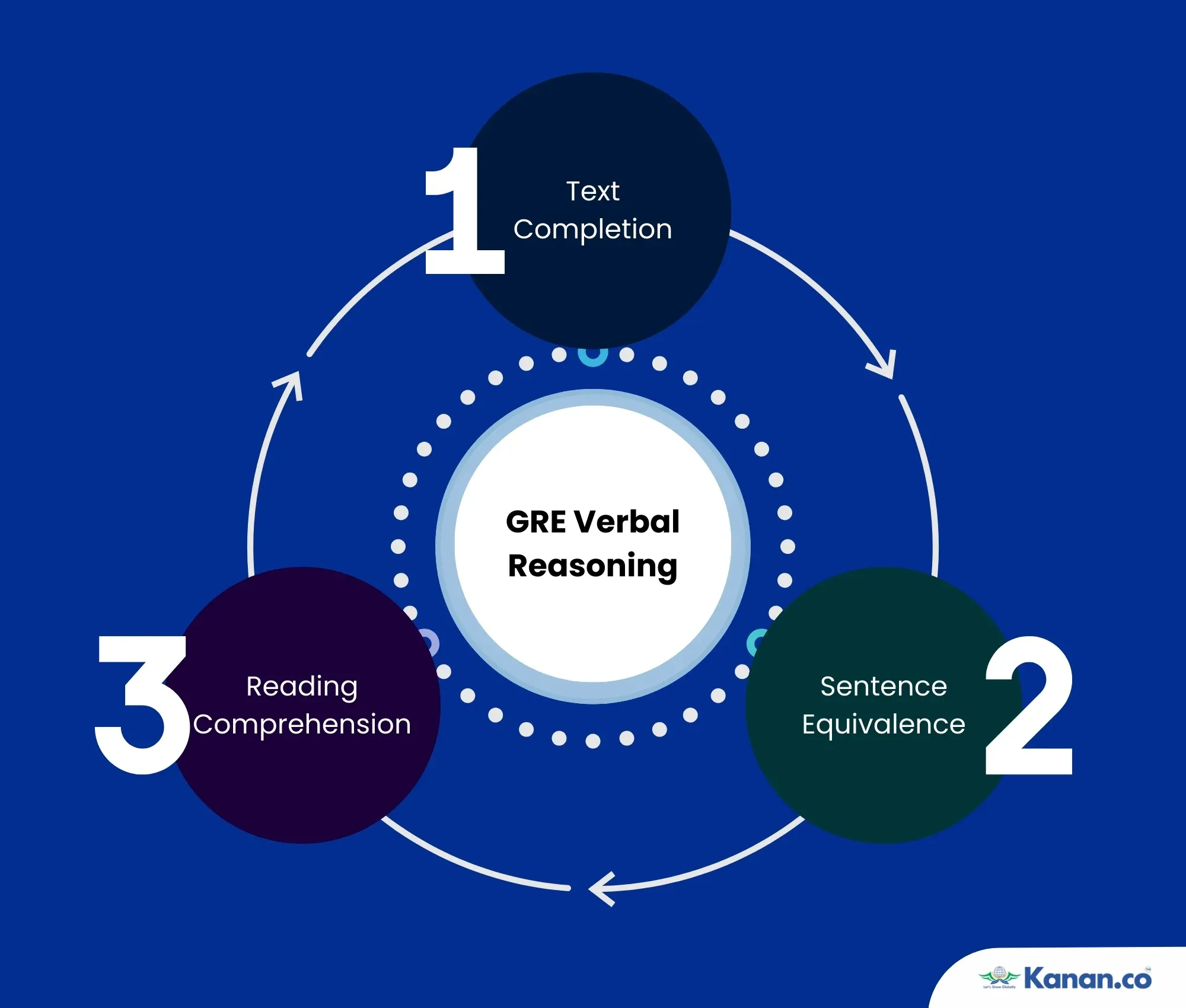
1. Text Completion
GRE Text Completion questions require you to fill in the blanks from a short passage to create a coherent and meaningful sentence. The GRE text completion questions involve single-blank text completion, and multi-blank text completion such as double/two blank text completion, and three blank/triple blank text completion. Each passage consists of 1-5 sentences, with 1-3 blanks per sentence. For sentences with two or three blanks, there will be three answer choices for each blank. For sentences with one blank, there are five answer choices. Each blank has a single correct answer. The answer choices for different blanks function independently, meaning that selecting one answer choice for a blank doesn’t impact the options available for another blank. In the GRE verbal section, you'll encounter approximately 7 Text Completion questions, and you should complete each one in 1 to 1.5 minutes. There is no credit for partially correct answers. To master the text completion questions, develop the interpretation, evaluation, and reasoning of what you’ve read and focus on expanding your vocabulary and using context clues effectively.
GRE Text Completion Practice Questions
Single Blank Text Completion
1. The author's latest novel is a ___ of her previous work, incorporating elements from her earlier stories into a new and compelling narrative.
(A) divergence
(B) culmination
(C) repudiation
(D) travesty
(E) parody
Answer: (B) culmination
Explanation: The phrase "incorporating elements from her earlier stories" suggests that the new work is a coming together or combination of previous elements. "Culmination" fits this context.
Double Blank Text Completion
2. Despite the speaker's (i) ____ demeanor, her presentation was so (ii) ____ that the audience was enthralled.
Blank (i)
(A) amiable
(B) stern
(C) indifferent
Blank (ii)
(D) lackluster
(E) compelling
(F) tedious
Answer:
Blank (i): (B) stern
Blank (ii): (E) compelling
Explanation:
Blank (i): "Stern" is chosen because it indicates a serious or strict demeanor, which contrasts with the presentation's engaging nature.
Blank (ii): "Compelling" is chosen because it suggests that the presentation was interesting and captivating, which explains why the audience was enthralled despite the speaker's stern demeanor.
Triple Blank Text Completion
3. While the experiment was designed to be (i) ____ and yield clear results, the initial data was so (ii) ____ that the researchers were left with more (iii) ____ than they had started with.
Blank (i)
(A) convoluted
(B) straightforward
(C) ambiguous
Blank (ii)
(D) consistent
(E) confusing
(F) enlightening
Blank (iii)
(G) questions
(H) answers
(I) doubts
Answer:
Blank (i): (B) straightforward
Blank (ii): (E) confusing
Blank (iii): (G) questions
Explanation:
Blank (i): The term "Straightforward" indicates that the experiment was designed to be simple and easy to understand, which sets up the contrast with the actual outcome.
Blank (ii): The term "Confusing" describes data that is not clear, making the results unexpected and problematic.
Blank (iii): The term "Questions" shows confusing data would naturally lead to more inquiries rather than resolving issues or providing clear answers.
4. While the manager's style was extremely ___, the employees appreciated his directness and efficiency.
(A) circuitous
(B) autocratic
(C) lenient
(D) oblique
(E) genial
Answer: (B) autocratic
Explanation: The word "autocratic" means having an absolute, authoritative style of leadership, which implies a strict and controlling manner. This fits the description of the manager's style being "extremely" something, indicating an extreme quality.
5. Given the professor's reputation for brilliance in the field of astrophysics, his new book was surprisingly ___, offering little that was innovative or groundbreaking.
(A) pedestrian
(B) esoteric
(C) abstruse
(D) insightful
(E) pioneering
Answer: (A) pedestrian
Explanation: Pedestrian means ordinary or dull. This fits the context because it is surprising that a professor with a brilliant reputation would produce a book that is mundane or lacks innovation. The phrase "offering little that was innovative or groundbreaking" indicates that the book is not up to the expectations of brilliance and creativity. Therefore, "pedestrian" is the correct choice as it directly contrasts with the professor's established reputation for brilliance.
2. Sentence Equivalence
GRE Sentence Equivalence questions require you to determine how a passage should be concluded using partial information. However, they place a greater emphasis on the meaning of the entire sentence. Each question of the GRE sentence equivalence presents a single sentence with one blank and six answer choices. You must select two of the answer choices that result in a complete, coherent sentence, both producing a similar meaning logically. There is no credit for partially correct answers. In the GRE verbal test, you can expect around 6 Sentence Equivalence questions, and you should aim to complete each one in about 1 minute. Similar to Text Completion questions, mastering Sentence Equivalence requires building a strong vocabulary and effectively using context clues.
GRE Sentence Equivalence Practice Questions
6. Although the actor was typically known for his comedic roles, his performance in the drama was unexpectedly ____.
(A) humorous
(B) poignant
(C) moving
(D) amusing
(E) heartwarming
(F) tragic
Answer: (B) poignant, (C) moving
Explanation: The sentence highlights a contrast between the actor's typical comedic roles and his performance in the drama. "Poignant" and "moving" both suggest a performance that evokes strong emotions, fitting the unexpected nature of his role in a drama.
7. The scientist's hypothesis was considered ____ because it challenged the established theories that had been accepted for decades.
(A) innovative
(B) orthodox
(C) unorthodox
(D) conventional
(E) radical
(F) traditional
Answer: (C) unorthodox, (E) radical
Explanation: The sentence indicates that the scientist's hypothesis was significant because it opposed long-standing established theories. This context suggests that the hypothesis was unconventional and deviated from the norm. The term "Unorthodox" means not conforming to what is traditionally accepted, which fits perfectly with the idea of challenging established theories. Similarly, "radical" implies a fundamental departure from traditional beliefs or practices, aligning with the notion of introducing a significant change.
8. The new CEO's approach was ____; he was quick to implement changes and did not hesitate to overturn longstanding policies.
(A) conservative
(B) cautious
(C) decisive
(D) hesitant
(E) bold
(F) tentative
Answer: (C) decisive, (E) bold
Explanation: The description of the new CEO's approach highlights his willingness to make rapid changes and his lack of hesitation in overturning longstanding policies. This suggests a strong, confident approach to leadership. Hence, these terms are the right fit as the word "Decisive" means being able to make decisions quickly and effectively, which fits the CEO's quick implementation of changes. "Bold" implies a willingness to take risks and make significant changes, aligning with the CEO's readiness to overturn established policies.
9. The book's protagonist was known for her ____ nature, often making decisions impulsively without considering the consequences.
(A) cautious
(B) reckless
(C) prudent
(D) impetuous
(E) wary
(F) rash
Answer: (B) reckless, (D) impetuous, (F) rash
Explanation: The sentence describes the protagonist as making impulsive decisions without considering the consequences, indicating a lack of caution. "Reckless" means acting without thinking of the consequences, fitting the protagonist's described behavior. "Impetuous" means acting quickly without thought or care, which aligns with making impulsive decisions. "Rash" means displaying a lack of careful consideration of possible consequences, also fitting the protagonist's impulsive nature. On the other hand, "cautious," "prudent," and "wary" suggest careful consideration and avoidance of risk, which directly contradict the described behavior of the protagonist.
10. The artist's latest exhibition was a ____ success, attracting widespread acclaim and large crowds from the very first day.
(A) modest
(B) quiet
(C) resounding
(D) significant
(E) triumphant
(F) muted
Answer: (C) resounding, (E) triumphant
Explanation: The sentence describes the exhibition as attracting widespread acclaim and large crowds, suggesting a great level of success. "Resounding" means emphatic or unmistakable, indicating a significant and clear success. "Triumphant" means victorious, conveying a notable achievement. These words fit the context of widespread acclaim and large crowds, suggesting a major success.
3. Reading Comprehension
GRE Reading Comprehension questions require you to read and understand the types of prose that are commonly used in graduate school. RC questions come in 2 formats; short passages with 1 paragraph, and long passages with 2–3 paragraphs. You will encounter approximately 14 Reading Comprehension questions and should spend an average of 1–3 minutes reading the passage and 1 minute answering the question.
There are three types of questions: selecting a single answer, selecting multiple correct answers, and selecting a sentence from a passage. Half of the questions on the test are based on passages, each associated with one to six questions. These passages are sourced from both academic and non-academic books and periodicals, covering a variety of subjects including physical sciences, biological sciences, social sciences, business, arts and humanities, and everyday topics. You’re required to answer the questions from any of these topics by understanding the meaning of a particular word and assessing evidence that might support or weaken points made in the passage. Strategic reading and paraphrasing skills are required to answer Reading Comprehension questions.
GRE Reading Comprehension Practice Questions
Questions 11 to 13 are based on this passage.
Reviving the practice of making use of elements of popular music in classical composition, an approach that had been kept in hibernation in the United States of America (USA) during the 1960s period, composer Philip Glass (born 1937) embraced the ethos of most popular music in his compositions. Glass based on two symphonies on music recorded by rock musicians David Bowie and Brian Eno, however, the symphonies' sound is his. Popular components do not display out of place in Glass's classical music place, which from its age-old days has shared some harmonies and rhythms using rock music. But this use of popular elements did not make Glass a composer of popular music. His music journey is not a version of popular music filled to attract classical music lovers; it is high art for listeners steeped in rock rather than the classics.
Select only one answer choice.
11. The passage addresses which of the following issues related to Glass's use of popular elements in his classical compositions?
How it is regarded by listeners who prefer rock to the classics
How it has affected the commercial success of Glass's music
Whether it has contributed to a revival of interest among other composers in using popular elements in their compositions
Whether it has had a detrimental effect on Glass's reputation as a composer of classical music
Whether it has caused certain of Glass's works to be derivative in quality
Consider each of the three choices separately and select all that apply.
Answer: E
Explanation: One of the important points that the passage makes is that when Glass uses popular elements in his music, the result is very much his own creation (it is “distinctively his”). In other words, the music is far from being derivative. Thus one issue that the passage addresses is the one referred to in answer choice E — it answers it in the negative. The passage does not discuss the impact of Glass's use of popular elements on listeners, on the commercial success of his music, on other composers, or on Glass's reputation, so none of Choices A through D is correct. The correct answer is Choice E.
12. The passage suggests that Glass's work displays which of the following qualities?
A return to the use of popular music in classical compositions
An attempt to elevate rock music to an artistic status more closely approximating that of classical music
A long-standing tendency to incorporate elements from two apparently disparate musical styles
Answer: A and C
Explanation: To answer this question, it is important to assess each answer choice independently. Since the passage says that Glass revived the use of popular music in classical compositions, answer choice A is clearly correct. On the other hand, the passage also denies that Glass composes popular music or packages it in a way to elevate its status, so answer choice B is incorrect. Finally, since Glass's style has always mixed elements of rock with classical elements, answer Choice C is correct.
13. Select the sentence that distinguishes two ways of integrating rock and classical music.
Answer with Explanation: Almost every sentence in the passage refers to incorporating rock music in classical compositions, but only the last sentence distinguishes two ways of doing so. It distinguishes between writing rock music in a way that will make it attractive to classical listeners and writing classical music that will be attractive to listeners familiar with rock. Thus the correct answer is the last sentence of the passage.
FAQ
1. How to study for GRE verbal reasoning?
- Use official GRE resources for your preparation.
- Practice with a variety of practice questions and take GRE mock tests.
- Read English literature, articles.
- Watch English movies, news, and TV shows.
- Create daily habits of thinking and speaking in English to enhance fluency and comprehension skills
2. Is GRE verbal hard?
The GRE verbal section is often regarded as the toughest section of the entire GRE exam by many test-takers. GRE verbal reasoning section assesses your skill in analyzing and evaluating written material presented in the form of sentences, paragraphs, and passages.
3. How hard is a 160 verbal GRE?
Achieving a score of 160 on the GRE Verbal section is moderately difficult i.e medium-hard.
4. Is there partial credit for RC questions?
No partial credit is awarded for RC questions. You must answer all options correctly to receive the allocated marks.
5. Are there flashcards for GRE verbal prep?
Yes, there are flashcards available for GRE verbal prep. GRE flashcards are one of the most effective ways to prepare for the test, despite the verbal preparation books and other resources available. To prepare for the GRE verbal section, you can use the free GRE vocabulary flashcards available on the internet on your computer or mobile device.
6. What is the average score of the GRE verbal test?
The average score of the GRE verbal reasoning test is about 151.
7. Should I guess on the GRE Verbal section?
There is no penalty for guessing on the GRE as there is no negative marking for the incorrect answers of the GRE general test.
8. Can I cancel my score report for one section of the GRE test?
No, you cannot cancel the score of one section of the GRE. If you choose to cancel your test scores, all scores for that test date will be canceled.

About Author Arivarasi
Arivarasi is an experienced author with expertise in the study abroad industry and preparing test materials for exams like IELTS, TOEFL, GRE, SAT, PTE, etc. She stays up-to-date with university and college requirements for international students which allows her to provide guidance on course selection, documents like SOP, LOR, and scholarship opportunities. She has written numerous articles on study abroad exams, destinations, universities & colleges requirements, admission procedures, and the entire process of studying abroad. Collaborating with industry experts and counselors, she crafts informative articles that make students take the right decisions.
Kanan.co is a trusted study abroad consultancy offering comprehensive services, resources, and solutions for students and education institutions. We support students at every stage of their global education journey, ensuring a smooth and guided experience. Along with test preparation for IELTS, GRE, TOEFL, and SAT, we provide expert services such as SOP writing, visa guidance, accommodation support, scholarship assistance, and education loan support. Our expertise and commitment to excellence make us a reliable partner for students pursuing international education.
Sign Up for a Free GRE Demo Class!
Ace GRE Quant & Verbal with 320+ Score — Join Us!








Global Headquarters
Kanan Int EdTech Inc
320 Bay Street, Suite 321 (Spaces), Toronto ON, Canada M5B 1N9
Indian Headquarters
Kanan International Pvt. Ltd.
D-wing, 2nd Floor, Trident Complex, Ellora Park Vadiwadi Road, Vadodara, Gujarat 390007
IT/ Digital Campus
Kanan International Pvt. Ltd
Old, New No 3, 2nd Floor, 1A, Dr Sadasivam Rd, T. Nagar, Chennai, Tamil Nadu 600017
Our branches
- Bardoli
- Bharuch
- Chennai
- Dehradun
- Gurugram
- Himatnagar
- Karnal
- Nadiad
- Navsari
- Palanpur
- Rajkot
- Vadodara
- Valsad
- Vallabh Vidyanagar
- Vapi
Study Abroad
Test Prep
Top Universities
Consultants
IELTS Centers
GRE Centers
TOEFL Centers
SAT Centers
Language Courses in Vadodara
SOP Blogs
Featured Blogs
Study Abroad Consultants in Chennai
Study Abroad Consultants in Surat
Study Abroad Consultants in Navsari
Study Abroad Consultants in Bardoli
Study Abroad Consultants in Ahmedabad
Study Abroad Consultants in Anand
Study Abroad Consultants in Khanna
Study Abroad Consultants in Nadiad
Study Abroad Consultants in Vadodara
Study abroad consultants in Valsad
Copyright © 2026 KANAN.CO All rights reserved.