- Study Abroad
- / ielts
- / d printing reading answers
3D printing Reading Answers


Author
19-09-2025


3D printing reading practice test consisting of 13 questions, covering three different types of questions. Each question is accompanied by its respective answer, location in the passage, and a detailed explanation. This article offers a thorough assessment of your comprehension, and provides comprehensive insights that aid in understanding the correct answers.
Given question types are, Label the diagram Questions, Note Completion Questions, and Summary Completion Questions.
Table of contents:
- Solution for 3D printing
- 3D printing IELTS reading practice Test
- Passage
- Questions
- Answers with Explanations
Solution for 3D printing
It is highly recommended to utilise the provided 3D printing reading answers to compare your answers with the provided ones. This practice test will enable you to effectively evaluate your understanding and monitor your progress. By actively engaging in this self-assessment process, you can enhance your learning and improve your overall performance.
Answer Table
| 1. D | 5. B | 9. short time frame | 13. very distant |
| 2. E | 6. surface details | 10. the potential | |
| 3. G | 7. create the structure | 11. mainstream technology | |
| 4. F | 8. to be supported | 12. ambitious |

3D printing IELTS Reading Practice Test - Exam Review
Check out our YouTube Channel to Practice Full-Length IELTS Reading Tests Daily

The 3D printing IELTS reading answers will assist you in improving your abilities and formulating efficient strategies to approach various types of reading questions. By committing yourself to consistent practice, you can work towards achieving your desired band score.
Passage
The reading passage of 3D printing is provided here. Read the whole passage and respond to the questions carefully, and check your responses with 3D printing reading answers with location.
3D printing
Ever wished you could find a pair of shoes to match your outfit? Fancy a pizza but don't want to go out or wait for your delivery service to arrive? Simple. All you need is a 3D home printer. Whilst admittedly not yet mainstream technology, it is only a matter of time until the 3D printer becomes as much a part of the domestic furniture as the statutory TV or the washing machine. Currently, however, the technology remains firmly in the province of geeks and gadget lovers.
The design of the 3D home printer is nevertheless refreshingly simple. Its components are relatively few, and could theoretically be assembled by anyone with a rudimentary knowledge of mechanics and technological know-how. The 3 main elements of the printer are a metal framework which contains the mechanical part of the printer, a printer control board and a PC. The PC is connected via USB to the printer control board, which in turn is connected to the framework of the printer and attached to the side of the latter. During printing, the controlled movement of the extruder motor ensures the correct volume of plastic is used. The extruder motor in turn is connected to a heated extruder or ‘hot end’ that heats the plastic filament during printing. As the heated plastic emerges or is 'extruded' to use the correct terminology, it cools and is arranged in layers to create a solid 3D model.
In order to move the extruder about in 3D space, there are 3 axes, each controlled by motors. The X-axis motor, located in a midway position on the metal framework of the printer, moves the extruder left and right, using a pulley. The two Z-axis motors, which are located on either side of the heated printing bed, move the entire X-axis up and down via two threaded rods. The heated bed of the printer printer, which lies directly underneath the hot end of the extruder, is moved back and forth beneath the extruder by the Y-axis motor located underneath the heated bed. The bed is heated to around 70 degrees Celsius to ensure the newly laid plastic does not wrap as it cools. Overall control of the printer is affected by the printer control board and the PC which contains the programme of the model that is being printed.
Once assembled, in theory it should be possible to print a 3D version of virtually anything. However, comparatively easy as it is to assemble, would-be DIY gadget enthusiasts should be warned that the printer has major technical limitations. The finished product will always have banding and surface detail remaining as evidence of how the model was laid down. In addition, operators of the printer have to be extremely careful not to knock it whilst the machine is in the process of printing, since this will end up in model distortion. Extreme care also has to be taken in the choice of plastic filament which will ultimately create the structure of the model. Some types of plastic may wrap if the temperature is not controlled properly when the melted plastic leaves the nozzle, and later, when it is cooling on the bed. Obviously the 3D model will be the same colour as the plastic filament forming it, but colour limitations can easily be overcome by painting afterwards for a multicolour finish. Another problem is that the plastic structures have to be supported as they are laid down on the heated bed or they will distort or fall away as the plastic cools.
It is virtually certain, however, that such issues will be overcome in future. The innumerable advantages of 3D printers far outweigh any disadvantages and justify time and resources spent on such technology. Firstly, the product can be produced on the spot within a very short time frame, thereby reducing time and cost of manufacturing by traditional means. Secondly, printing objects on a 3D printer removes the need for storage space of items since whatever is required is printed as and when necessary. Finally, despite expensive set-up costs, in the long run, 3D printing works out far cheaper than normal manufacturing processes since there is no longer a need for labour costs.
However, the 3D printer is still very much in its early stages and can be likened to early home computers which in technological hindsight now seem so cumbersome and slow. So far, early experimentations with the new technology have been impressive but not earth-shattering. Nevertheless, in the future that is all set to change. In fact, the potential of 3D printers is jaw-dropping. The most ambitious plan yet for 3D printing has to be in the military field. If all goes to plan, fighter planes will at some, probably very distant, point in the future carry printers on board that during flight will be capable of printing out other fighter planes to replenish the flying squad. Admittedly, it takes a quantum leap of the imagination to accept that a machine that prints out clothing and pizzas will also be able to print out planes. Sceptics, however, should remember that one of the forerunners to the modern computer, designed in the mid-twentieth century, filled an entire room, So, in theory, if we have come so far in a matter of years then who knows what the future may hold for 3D printers?
Questions
Questions 1-5
Label the diagram below.
Choose FIVE answers from the box and write the correct letter, A-G, next to questions 1-5.
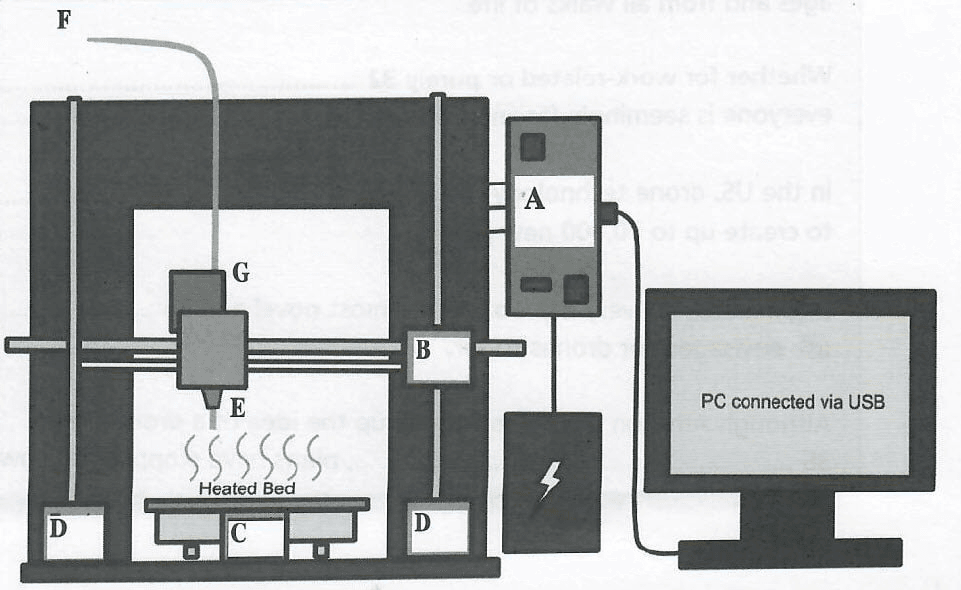
- __________ Z-axis motor
- __________ hot end of extruder
- __________ extruder motor
- __________ plastic filament
- __________ X-axis motor
Questions 6-10
Complete the notes below using NO MORE THAN THREE WORDS from the passage for each answer.
The Pros and Cons of 3D Printers
|
Cons The finished product is far From perfect, exhibiting 6. _________ in addition to banding. In order to 7. _________ desired, extreme care has to be taken in selecting the plastic filaments to be used. It is also necessary for plastic structures 8. __________ during the printing process to avoid distorting the printed model. |
Questions 11-13
Complete the summary below.
Use NO MORE THAN TWO WORDS from the passage for each answer.
|
Whilst 3D printing is far from becoming 11. ___________, so far experiments with the new technology have been promising. Although 3D models have yet to produce anything as 12. ___________ as fighter planes, the foundation for such a technology is in place. For the moment, however, the realisation of such projects remains in the 13. ___________ future. |
Answers For 3D printing With Explanations
Referring to the given 3D printing reading answers with explanations can provide significant advantages when it comes to assessing your performance and enhancing comprehension. These answers, accompanied by detailed explanations, will help you in identifying the correct responses and gaining a deeper understanding of the topic at hand.
(Note: The text in the italics mentions the location and referring lines written in the reading passage.)
1. Answer: D
Explanation: In the 3rd Paragraph, the writers mentioned that, ‘The two Z-axis motors, which are located on either side of the heated printing bed, move the entire X-axis up and down via two threaded rods.’
2. Answer: E
Explanation: In the 3rd Paragraph, the writers mentioned that, ‘The heated bed of the printer, which lies directly underneath the hot end of the extruder, is moved back and forth beneath the extruder by the Y-axis motor located underneath the heated bed.’
3. Answer: G
Explanation: In the 2nd Paragraph, the writers mentioned that, ‘The extruder motor in turn is connected to a heated extruder or ‘hot end’ that heats the plastic filament during printing.’
4. Answer: F
Explanation: In the 2nd Paragraph, the writers mentioned that, ‘The extruder motor in turn is connected to a heated extruder or ‘hot end’ that heats the plastic filament during printing.’
5. Answer: B
Explanation: In the 3rd Paragraph, the writers mentioned that, ‘The X-axis motor, located in a midway position on the metal framework of the printer, moves the extruder left and right, using a pulley.’
6. Answer: surface detail
Explanation: In the 4th Paragraph, the writers mentioned that, ‘The finished product will always have banding and surface detail remaining as evidence of how the model was laid down.’
7. Answer: create the structure
Explanation: In the 4th Paragraph, the writers mentioned that, ‘Extreme care also has to be taken in the choice of plastic filament which will ultimately create the structure of the model.’
8. Answer: to be supported
Explanation: In the 4th Paragraph, the writers mentioned that, ‘Another problem is that the plastic structures have to be supported as they are laid down on the heated bed or they will distort or fall away as the plastic cools.’
9. Answer: short time frame
Explanation: In the 5th Paragraph, the writers mentioned that, ‘Firstly, the product can be produced on the spot within a very short time frame, thereby reducing time and cost of manufacturing by traditional means.’
10. Answer: the potential
Explanation: In the 6th Paragraph, the writers mentioned that, ‘In fact, the potential of 3D printers is jaw-dropping. The most ambitious plan yet for 3D printing has to be in the military field. If all goes to plan, fighter planes will at some, probably very distant, point in the future carry printers on board that during flight will be capable of printing out other fighter planes to replenish the flying squad. Admittedly, it takes a quantum leap of the imagination to accept that a machine that prints out clothing and pizzas will also be able to print out planes.’
11. Answer: mainstream technology
Explanation: In the 1st Paragraph, the writers mentioned that, ‘Whilst admittedly not yet mainstream technology, it is only a matter of time until the 3D printer becomes as much a part of the domestic furniture as the statutory TV or the washing machine.’
12. Answer: ambitious
Explanation: In the 6th Paragraph, the writers mentioned that, ‘The most ambitious plan yet for 3D printing has to be in the military field. If all goes to plan, fighter planes will be at some, probably very distant, point in the future…’
13. Answer: very distant
Explanation: In the 6th Paragraph, the writers mentioned that, ‘If all goes to plan, fighter planes will at some, probably very distant, point in the future carry printers on board that during flight will be capable of printing out other fighter planes to replenish the flying squad.’
Other Reading Tests

About Author Arivarasi
Arivarasi is an experienced author with expertise in the study abroad industry and preparing test materials for exams like IELTS, TOEFL, GRE, SAT, PTE, etc. She stays up-to-date with university and college requirements for international students which allows her to provide guidance on course selection, documents like SOP, LOR, and scholarship opportunities. She has written numerous articles on study abroad exams, destinations, universities & colleges requirements, admission procedures, and the entire process of studying abroad. Collaborating with industry experts and counselors, she crafts informative articles that make students take the right decisions.
Kanan.co is a trusted study abroad consultancy offering comprehensive services, resources, and solutions for students and education institutions. We support students at every stage of their global education journey, ensuring a smooth and guided experience. Along with test preparation for IELTS, GRE, TOEFL, and SAT, we provide expert services such as SOP writing, visa guidance, accommodation support, scholarship assistance, and education loan support. Our expertise and commitment to excellence make us a reliable partner for students pursuing international education.
Free Online Mock Test 2026
Practice our mock test worth Rs. 25000 for Free and know your IELTS score!








Global Headquarters
Kanan Int EdTech Inc
320 Bay Street, Suite 321 (Spaces), Toronto ON, Canada M5B 1N9
Indian Headquarters
Kanan International Pvt. Ltd.
D-wing, 2nd Floor, Trident Complex, Ellora Park Vadiwadi Road, Vadodara, Gujarat 390007
IT/ Digital Campus
Kanan International Pvt. Ltd
Old, New No 3, 2nd Floor, 1A, Dr Sadasivam Rd, T. Nagar, Chennai, Tamil Nadu 600017
Our branches
- Bardoli
- Bharuch
- Chennai
- Dehradun
- Gurugram
- Himatnagar
- Karnal
- Nadiad
- Navsari
- Palanpur
- Rajkot
- Vadodara
- Valsad
- Vallabh Vidyanagar
- Vapi
Study Abroad
Test Prep
Top Universities
Consultants
IELTS Centers
GRE Centers
TOEFL Centers
SAT Centers
Language Courses in Vadodara
Study Abroad Calculators
Featured Blogs
Study Abroad Consultants in Chennai
Study Abroad Consultants in Surat
Study Abroad Consultants in Navsari
Study Abroad Consultants in Bardoli
Study Abroad Consultants in Ahmedabad
Study Abroad Consultants in Anand
Study Abroad Consultants in Khanna
Study Abroad Consultants in Nadiad
Study Abroad Consultants in Vadodara
Study abroad consultants in Valsad
Copyright © 2026 KANAN.CO All rights reserved.