- Study Abroad
- / ielts
- / ancient egypt reading answers
Ancient Egypt Reading Answers


Author
19-09-2025

Ancient Egypt reading practice test comprises 13 questions that involves four different question types. Given question types are, Sentence Completion Questions, Diagram Labelling Questions, True/False or Not Given, and Multiple Choice Question. This article help you to enhance your understanding and facilitate the comprehension of the correct answers. Each question type will help you to develop your solving abilities, and the provided answers with explanations will assist you to find your mistakes as well.
Table of contents:
- Solution for Ancient Egypt
- Ancient Egypt IELTS reading practice Test
- Passage
- Questions
- Answers with Explanations
Solution for Ancient Egypt
We highly recommend using the provided Ancient Egypt Reading Answers to compare them with your own responses. By using this practice test, you can evaluate how well you understand the topic and see how much you enhanced your capabilities. By practising more, you can achieve your desired band score.
Answer Table
| 1. conditions | 5. 481 feet | 9. Not Given | 13. D |
| 2. craftsmen and artists | 6. (the) Queen's Chamber | 10. TRUE | |
| 3. a secure livelihood | 7. (the) air channel(s) | 11. TRUE | |
| 4. (the) Grand Gallery | 8. FALSE | 12. FALSE |

Ancient Egypt IELTS Reading Practice Test - Exam Review
Check out our YouTube Channel to Practice Full-Length IELTS Reading Tests Daily

We’ve given this practice test to challenge your skimming, scanning, reading skills. The provided Ancient Egypt IELTS reading answers will help you to enhance your skills and develop effective strategies for tackling different types of reading questions. Apply proper tricks and methods to solve the questions, and focus on the keywords first while solving it.
Passage
The reading passage of Ancient Egypt is provided here. Read the whole passage and respond to the questions carefully, and check your responses with Ancient Egypt reading answers with location.
Ancient Egypt
The people of ancient Egypt emerged as one of the first Western civilisations. Sustained by the River Nile and protected by vast deserts, the Egyptians lived in comparative security, prosperity and peace for thousands of years. When such conditions exist, civilization and its arts usually flourish. To this day, many of the Egyptian artistic creations display the wealth, splendour and talent of this great civilisation.
Ancient Egypt has been called a land of temples and tombs, and for centuries people have been filled with wonder at the ingenuity of the Egyptians, whose impressive works have withstood the ravages of time so well. Had it not been for the long-lasting nature of their monuments and carved inscriptions in the form of hieroglyphics', much evidence of their activities would have vanished from all historical records. In about 3000 BC, Upper and Lower Egypt were united under the first pharaoh, and generally, from that time until the invasion by Alexander the Great in 332 BC, Egypt prospered as a nation of skilful craftsmen and artists.
The Egyptians were industrious, highly civilised and deeply religious people, who obediently accepted the supreme authority of their pharaohs. The people were content to serve and work for the state in return for a secure livelihood. They considered this earthly life to be a segment in a great cycle, at the end of which everything would be returned to its original form. The richer and more important the person, the more careful and elaborate would be his or her burial, and the stronger and safer the tomb in which they would be buried.
The burial of the dead in the ground was not considered sufficiently safe for kings, queens and court officials, so sunken, sealed tombs were ingeniously constructed to protect personal treasures, food and instructions for the safe conduct of the soul after death. The design of these tombs developed into the stepped pyramid, and finally into the square pyramid that we know today.
There are about 80 ancient pyramids in Egypt. The Great Pyramid at Giza, which King Cheops built as his tomb 5000 years ago, holds the most interest. It stands with two other pyramids on a slight rise overlooking the River Nile. At the centre of the pyramid is the King's Chamber and leading down from there is a long narrow area known as the Grand Gallery. The pyramid covers 13 acres and contains 2,300,000 blocks of limestone, each weighing an average of 1.5 tons. Its pyramidal form has a perfectly square base with sides of 756 feet and a height of 481 feet. Situated directly below the King's Chamber is the Queen's Chamber and there are two air channels leading upwards from the centre of the pyramid to the outside.
Originally the exterior was covered in highly polished limestone slabs, all of which have been stolen over the years. It is estimated that a total of 100,000 men laboured for 20 years to build this gigantic structure, and although architecturally unimportant in design, it has aroused the curiosity of millions of people because of the uncanny accuracy of its measurements and proportions. It reveals the remarkable ingenuity and the great organising ability of the ancient Egyptians.
Near these pyramids stands the Great Sphinx, the origin and purpose of which constitute one of the world's most famous puzzles. Shaped from an outcrop of stone in the form of a human-headed lion, the face is possibly a portrait of King Khafra, the son of Cheops, who was buried in the second largest pyramid. The Sphinx is one of the biggest statues ever made.
The Egyptian people showed reverence towards natural objects such as the lotus flower, the scarab beetle, the falcon, the lion, the sun and the River Nile. All these subjects and many more were used symbolically and conventionally as motifs in low-relief carving and painting. It was the custom of the Egyptians to depict the various parts of the human figure, usually in the most characteristic positions. The head was shown in profile except for the eye, which was represented from the front, the shoulders and a portion of the arms were portrayed from the front, while the hips and legs were side views. Well decoration showed little or no attempt to indicate depth or perspective, except by placing distant objects above near things. It was essentially two-dimensional, and relative size indicated the status of the person, so the pharaoh was the largest figure in the composition.
Egyptian art is characterised by a passion for permanence, a desire to impress by size, and a determination to make each item serve its function without much regard for the whole. It is obvious that art among these people reached a very high level and the strong influence of Egyptian art can be seen in the work of nearby civilisations.
The fortunate discovery and subsequent deciphering in 1822 of the Rosetta Stone, which showed the same laws inscribed both in Egyptian hieroglyphics and the Egyptian demotic, or popular version of their language, as well as the Greek language, eventually gave the key to the meaning of Egyptian inscriptions, and therefore the significance of much Egyptian art.
Questions
Questions 1-3
Complete the sentences below.
Choose NO MORE THAN THREE WORDS from the passage for each answer.
Security and peace are two ________________ that are necessary for a civilization to be successful.
Ancient Egyptians worked as both ______________.
Ordinary Egyptians expected to receive ______________ for their hard work.
Questions 4-7
Label the diagram below.
Choose NO MORE THAN THREE WORDS AND/OR NUMBERS from the passage for each answer.
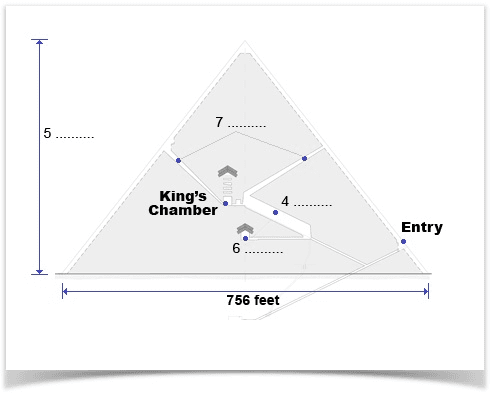
5. _______________
6. _______________
7. _______________
8. _______________
Questions 8-12
Do the following statements agree with the information given in the Reading Passage.
In boxes 8-12 on your answer sheet, write
TRUE if the statement agrees with the information
FALSE if the statement contradicts the information
NOT GIVEN if there is no information on this
8. The surface of the Great Pyramid is covered in polished limestone slabs.
9. King Khafra died before King Cheops.
10. Egyptian carvings were often based on things found in nature.
11. Important characters in Egyptian carvings were bigger than less important characters.
12. Egyptian art was greatly influenced by the art of neighbouring cultures.
Questions 13
Choose the correct Letter, - A, B, C or D.
13. The writer's aim in this passage is to
- describe the construction methods of the pyramids.
- explain the beliefs of the ancient Egyptians.
- offer an interpretation of Egyptian art and sculpture.
- provide an overview of early Egyptian society.
Answers For Ancient Egypt With Explanations
Check the given Ancient Egypt reading answers with explanations, which is given with the appropriate location. This will not only assist you to identify your mistakes, but also will help you to enhance your solving capabilities as it provides better explanation.
(Note: The text in the italics mentions the location and referring lines written in the reading passage.)
1. Answer: conditions
Explanation: In the 1st Paragraph, the writers mentioned that, ‘The people of ancient Egypt emerged as one of the first Western civilisations. Sustained by the River Nile and protected by vast deserts, the Egyptians lived in comparative security, prosperity and peace for thousands of years. When such conditions exist, civilization and its arts usually flourish. To this day, many of the Egyptian artistic creations display the wealth, splendour and talent of this great civilisation.’
2. Answer: craftsmen and artists
Explanation: In the 2nd Paragraph, the writers mentioned that, ‘In about 3000 BC, Upper and Lower Egypt were united under the first pharaoh, and generally, from that time until the invasion by Alexander the Great in 332 BC, Egypt prospered as a nation of skilful craftsmen and artists.’ This implies that the ancient Egyptians engaged in both crafts and artistic pursuits.
3. Answer: a secure livelihood
Explanation: In the 3rd Paragraph, the writers mentioned that, ‘The Egyptians were industrious, highly civilised and deeply religious people, who obediently accepted the supreme authority of their pharaohs. The people were content to serve and work for the state in return for a secure livelihood.’ It states that the ordinary Egyptians worked with the expectation of receiving a secure livelihood as compensation for their hard work and service to the state.
4. Answer: (the) Grand Gallery
Explanation: In the 5th Paragraph, the writers mentioned that, ‘At the centre of the pyramid is the King's Chamber and leading down from there is a long narrow area known as the Grand Gallery.’
5. Answer: 481 feet
Explanation: In the 5th Paragraph, the writers mentioned that, ‘Its pyramidal form has a perfectly square base with sides of 756 feet and a height of 481 feet.’
6. Answer: (the) Queen's Chamber
Explanation: In the 5th Paragraph, the writers mentioned that, ‘Situated directly below the King's Chamber is the Queen's Chamber and there are two air channels leading upwards from the centre of the pyramid to the outside.’
7. Answer: (the) air channel(s)
Explanation: In the 5th Paragraph, the writers mentioned that, ‘Situated directly below the King's Chamber is the Queen's Chamber and there are two air channels leading upwards from the centre of the pyramid to the outside.’
8. Answer: False
Explanation: In the 6th Paragraph, the writers mentioned that, ‘Originally the exterior was covered in highly polished limestone slabs, all of which have been stolen over the years.’ It states that the current state of the Great Pyramid does not have a surface covered in polished limestone slabs.
9. Answer: Not Given
Explanation: There is no related information given here.
10. Answer: True
Explanation: In the 8th Paragraph, the writers mentioned that, ‘The Egyptian people showed reverence towards natural objects such as the lotus flower, the scarab beetle, the falcon, the lion, the sun and the River Nile. All these subjects and many more were used symbolically and conventionally as motifs in low-relief carving and painting. It was the custom of the Egyptians to depict the various parts of the human figure, usually in the most characteristic positions.’ This indicates that Egyptian carvings often drew inspiration from things found in nature.
11. Answer: True
Explanation: In the 8th Paragraph, the writers mentioned that, ‘The head was shown in profile except for the eye, which was represented from the front, the shoulders and a portion of the arms were portrayed from the front, while the hips and legs were side views….It was essentially two-dimensional, and relative size indicated the status of the person, so the pharaoh was the largest figure in the composition….Egyptian art is characterised by a passion for permanence, a desire to impress by size, and a determination to make each item serve its function without much regard for the whole.’ This states that important characters in Egyptian carvings were indeed portrayed as bigger than less important characters. The size difference served as a visual indicator of the individuals' status and hierarchy within the composition.
12. Answer: False
Explanation: In the 9th Paragraph, the writers mentioned that, ‘It is obvious that art among these people reached a very high level and the strong influence of Egyptian art can be seen in the work of nearby civilisations.’ However, this statement suggests that the influence flowed from Egyptian art to neighbouring cultures, rather than the other way around. It does not explicitly mention that Egyptian art was greatly influenced by the art of neighbouring cultures.
13. Answer: D
Explanation: According to the passage, it focuses on various aspects of ancient Egypt, including the emergence of civilization, the people's way of life, their religious beliefs, and the prosperity and peace they experienced. The passage discusses topics such as the Nile River, the pharaohs, the importance of tombs and burial practices, and the significance of Egyptian art. These details collectively offer insights into the broader society and civilization of ancient Egypt. Thus, the answer is D.
Other Reading Tests

About Author Arivarasi
Arivarasi is an experienced author with expertise in the study abroad industry and preparing test materials for exams like IELTS, TOEFL, GRE, SAT, PTE, etc. She stays up-to-date with university and college requirements for international students which allows her to provide guidance on course selection, documents like SOP, LOR, and scholarship opportunities. She has written numerous articles on study abroad exams, destinations, universities & colleges requirements, admission procedures, and the entire process of studying abroad. Collaborating with industry experts and counselors, she crafts informative articles that make students take the right decisions.
Kanan.co is a trusted study abroad consultancy offering comprehensive services, resources, and solutions for students and education institutions. We support students at every stage of their global education journey, ensuring a smooth and guided experience. Along with test preparation for IELTS, GRE, TOEFL, and SAT, we provide expert services such as SOP writing, visa guidance, accommodation support, scholarship assistance, and education loan support. Our expertise and commitment to excellence make us a reliable partner for students pursuing international education.
Free Online Mock Test 2026
Practice our mock test worth Rs. 25000 for Free and know your IELTS score!








Global Headquarters
Kanan Int EdTech Inc
320 Bay Street, Suite 321 (Spaces), Toronto ON, Canada M5B 1N9
Indian Headquarters
Kanan International Pvt. Ltd.
D-wing, 2nd Floor, Trident Complex, Ellora Park Vadiwadi Road, Vadodara, Gujarat 390007
IT/ Digital Campus
Kanan International Pvt. Ltd
Old, New No 3, 2nd Floor, 1A, Dr Sadasivam Rd, T. Nagar, Chennai, Tamil Nadu 600017
Our branches
- Bardoli
- Bharuch
- Chennai
- Dehradun
- Gurugram
- Himatnagar
- Karnal
- Nadiad
- Navsari
- Palanpur
- Rajkot
- Vadodara
- Valsad
- Vallabh Vidyanagar
- Vapi
Study Abroad
Test Prep
Top Universities
Consultants
IELTS Centers
GRE Centers
TOEFL Centers
SAT Centers
Language Courses in Vadodara
Study Abroad Calculators
Featured Blogs
Study Abroad Consultants in Chennai
Study Abroad Consultants in Surat
Study Abroad Consultants in Navsari
Study Abroad Consultants in Bardoli
Study Abroad Consultants in Ahmedabad
Study Abroad Consultants in Anand
Study Abroad Consultants in Khanna
Study Abroad Consultants in Nadiad
Study Abroad Consultants in Vadodara
Study abroad consultants in Valsad
Copyright © 2026 KANAN.CO All rights reserved.