- Study Abroad
- / ielts
- / a stone age approach to exercise reading answers
A Stone Age Approach to Exercise Reading Answers


Author
17-09-2025

Here we have given “a stone age approach to exercise” reading answers along with questions, answers and explanations. This article consists of 14 questions in 5 different types namely- 2 questions as multiple choice, 3 questions as multiple choice, 1 question as multiple choice, 4 questions as short answer questions and 4 questions as true, false or not given.
Check out our YouTube Channel to Practice Full-Length IELTS Reading Tests Daily

Table of contents:
- Solution for A Stone Age Approach to Exercise
- A Stone Age Approach to Exercise IELTS reading practice test
- Passage
- Questions
- Answers with explanations
Solution for A Stone Age Approach to Exercise
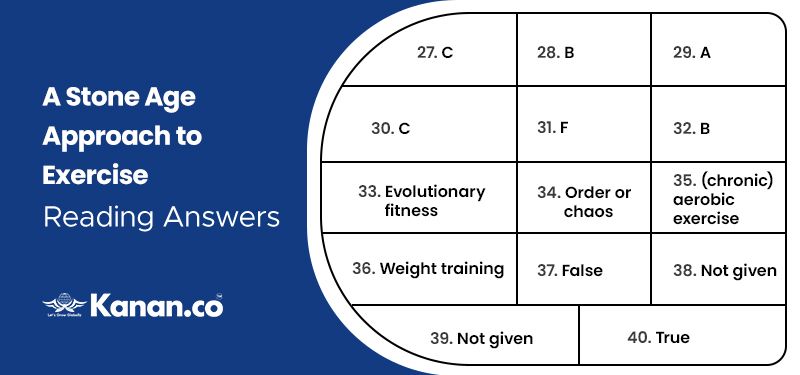
Here we have given the answers for a Stone Age approach to exercise reading answers in the table form.

Answer Table
| 27. C | 30. C | 33. Evolutionary fitness | 36. Weight training | 39. Not given |
| 28. B | 31. F | 34. Order or chaos | 37. False | 40. True |
| 29. A | 32. B | 35. (chronic) aerobic exercise | 38. Not given |
A Stone Age Approach to Exercise IELTS Reading Practice Test - Exam Review
Here we have given A Stone Age Approach to Exercise IELTS reading answers as a sample article for the IELTS reading practice test. This article will help you to crack your exam with a good band score. Go through the given passage to answer the questions.
Passage
We have given A Stone Age Approach to Exercise reading answers with location. Be focused, while reading the passage and answer the questions.
A Stone Age Approach to Exercise reading answers
Forget those long arduous sessions in the gym. If you want to stay fighting fit, try a modern Stone Age workout* instead
- Art De Vany is 62, but physical fitness tests three years ago showed he had the body of a 32-year-old. Although De Vany is sceptical of such assessments, he knows he's in good shape. His former career as a professional baseball player may have something to do with it, but he attributes his physical prowess to an exercise regime inspired by the lifestyles of our Palaeolithic ancestors.
- De Vany's advice to the modern exercise freak is to cut duration and frequency, and increase intensity. Our muscle fibre composition reveals that we are adapted to extreme intensity of effort,' says De Vany, a professor of economics at the Institute of Mathematical Behavioural Sciences at the University of California, Irvine. His approach to fitness combines Darwinian thinking with his interest in chaos theory and complex systems.
- This new science, which De Vany calls evolutionary fitness, is part of growing efforts to understand how the human body has been shaped by evolution, and to use this knowledge to improve our health and fitness. Proponents believe the key lies in the lifestyle of our hunter-gatherer ancestors because, they say, the vast majority of the human genome is still adapted to an ancient rhythm of life which swung between intense periods of activity and long stretches of inertia.
- Across the Palaeolithic age which covers the period between 2.6 million and 10,000 years ago - prey animals were large, fast on their feet, or both. For men, this would have meant lots of walking or jogging to find herds, dramatic sprints, jumps and turns, perhaps violent struggles, and long walks home carrying the kill. Women may not have had such intense exercise, but they would have spent many hours walking to sources of water or food, digging up tubers, and carrying children. If modern hunter-gatherers are anything to go by, men may have hunted for up to four days a week and travelled 15 kilometres or more on each trip. Women may have gathered food every two or three days. There would also have been plenty of other regular physical activities for both sexes such as skinning animals and tool making, and probably dancing.
- Our ancestors must have evolved cardiovascular, metabolic and thermoregulatory systems capable of sustaining high-level aerobic exertion under the hot African sun, according to Loren Cordain of the Human Performance Laboratory at Colorado State University. And given that the Palaeolithic era ended only an evolutionary blink of an eye ago, we ignore its legacy at our peril. (ordain and his colleagues point out that in today's developed societies, inactivity is associated with disease. Contemporary hunter gatherer societies rarely experience these modern killers, they say.
- This is where De Vany's exercise ideas come in. The primary objectives for any exercise and diet programme must be to counter hyper-insulinaemia (chronically elevated insulin) and hypo exertion (wasting of the body's lean mass through inactivity),' he writes in his forthcoming book about evolutionary exercise. Exercise and diet are linked. For example, says De Vany, our appetite control mechanisms work best when our activity mimics that of our ancestors. But he feels that most modern exercise regimes are not hitting the mark.
- De Vany views the body as non-linear and dynamic and says exercise should mix order and chaos. 'Chronic aerobic exercise overstrains the heart, reducing the chaotic variation in the heart rate which is essential to health,' he says. Likewise, most weight training is governed too much by routine and is too time consuming. He gives his own workout a chaotic character with ascending weights and descending repetitions. To these brief but intense gym workouts he adds a wide variety of other activities that vary randomly in intensity and duration. These include roller blading, bicycling, walking, sprinting, tennis, basketball, power walking, hitting softballs and trekking with a grandson on his shoulders.
- He also argues that most people do not train the right muscles for that ultimately attractive and adaptive quality of symmetry. 'Symmetry is a reliable evolutionary clue to health,' he says. Tumours and pathologies produce gross asymmetries, and our love of symmetry reflects the reproductive success of our ancestors, who were sensitive to these clues.' He strives for the X-look- a symmetrical balance of mass in the shoulder girdle, upper chest and back, the calves and lower quads, two of the four large muscles at the front of the thighs. This also makes men look taller, he adds, another reliable evolutionary clue that women use to find good genes'.
- The hunter-gatherer lifestyle indicates that women should exercise only a little less intensely than men, says De Vany. 'Women are opportunistic hunters who go after small game when they come across it. They also climb trees to capture honey and snare birds. And have you ever seen how much work it is to dig out a deep tuber?' Women benefit enormously from strength work, he says. It increases their bone density and they get and stay leaner by building muscle mass. 'Today's women are so weak [compared with their female ancestors].'
- Of course, people vary. De Vany acknowledges that our ancestors were adapted to a variety of terrains and climates. Cordain points out that genetic differences between populations lead to different physical strengths. East Africans, for example, seem to be better endurance runners, West Africans better sprinters. But human genetic similarity greatly outweighs the variations. And because our genes have changed so very little since Palaeolithic times, if you want to be a lean, mean, survival machine why not try exercising like a caveman?
Questions
Questions 27-28
- Choose the appropriate letters A-D and write them in boxes 27-28 on your answer sheet.
27. What do you learn about Art De Vany in the first paragraph?
A) He frequently tests his health.
B) He works as a professional sports player.
C) He is older than he appears to be.
D ) He believes he has inherited a strong body.
28. In the second paragraph. De Vany recommends that people should
A) exercise less frequently.
B) exercise harder but for less time.
C) give their muscles more time to recover from exercise.
D) learn more about how the human body reacts to exercise.
Questions 29 - 31
- Choose THREE letters A-G and write them in boxes 29-31 on your answer sheet.
Which THREE of the following docs the writer highlights when discussing the lifestyle of our Palaeolithic ancestors?
A) the difficulties involved in finding food
B) their size compared to that of modem man
C) the sudden movements required during their daily activities
D) the aggressive nature of their negotiations with others
E) the fact that life was equally energetic for both_exes
F) the predictable frequency of physical activity
G) the long distances between neighbours' homes
Question 32
- Choose the appropriate letter A-D and write it in box 32 on your answer sheet.
32. Cordain compares modem hunter-gatherer societies to Palaeolithic societies in terms of their
A) ability to withstand high temperatures.
B) resistance to certain fatal illnesses.
C) healthy mix of work and leisure activities.
D) refusal to change their way of life.
Questions 33-36
- Using NO MORE THAN THREE WORDS. answer the/allowing questions.
- Write your answers in boxes 33-36 on your answer sheet.
33. What term does De Vany use to describe his approach to physical exercise?
34. Which TWO opposing factors does De Vany say an exercise programme should include'?
35. Which type of activity docs de Vany criticise as being harmful?
36. Which type of exercise does De Vany practise on a regular basis?
Questions 37-40
- Do the following statements agree with the information given in the reading passage?
- In boxes 37-40 on your answer shat write
- TRUE if the statement is true
- FALSE if the statement is false
- NOT GIVEN if the information is not given in the passage
37. Our Palaeolithic ancestors were constantly active.
38. Female exercise programmes should vary according to the shape of the individual.
39. Geographical features have played a role in human physical development.
40. The importance of genetic differences in deciding on an exercise programme is minimal.
Answers for A Stone Age Approach to Exercise with explanation
Here we have given the answers for a stone age approach to exercise reading answers with explanations. This portion will help you to rectify your errors while answering.
27. Answer: C
Explanation: “Art De Vany is 62, but physical fitness tests three years ago showed he had the body of a 32-year-old”. With this line it is clear that Art De Vany is older than he appears to be. Hence the given answer is located in the 1-2 lines of paragraph 1.
28. Answer: B
Explanation: “De Vany's advice to the modern exercise freak is to cut duration and frequency, and increase intensity”. With this line it is clear that De Vany recommends that people should exercise harder but for less time. Hence the given answer is located in the 1-2 lines of paragraph 2.
29. Answer: A
Explanation: “Women may not have had such intense exercise, but they would have spent many hours walking to sources of water or food, digging up tubers, and carrying children”. With this line it is clear that the lifestyle of our Palaeolithic ancestors the difficulties involved in finding food. Hence the given answer is located in the 5-6 lines of paragraph 4.
30. Answer: C
Explanation: “For men, this would have meant lots of walking or jogging to find herds, dramatic sprints, jumps and turns, perhaps violent struggles, and long walks home carrying the kill”. With this line it is clear that the sudden movements required during their daily activities. Hence the given answer is located in the 2-4 lines of paragraph 4.
31. Answer: F
Explanation: “If modern hunter-gatherers are anything to go by, men may have hunted for up to four days a week and travelled 15 kilometres or more on each trip”. With this line it is clear that the predictable frequency of physical activity. Hence the given answer is located in the 7-8 lines of paragraph 4.
32. Answer: B
Explanation: “Our ancestors must have evolved cardiovascular, metabolic and thermoregulatory systems capable of sustaining high-level aerobic exertion under the hot African sun, according to Loren Cordain of the Human Performance Laboratory at Colorado State University”. With this line it is clear that Cordain compares modem hunter-gatherer societies to Palaeolithic societies in terms of their resistance to certain fatal illnesses. Hence the given answer is located in the 1-4 lines of paragraph 5.
33. Answer: Evolutionary fitness
Explanation: “This new science, which De Vany calls evolutionary fitness, is part of growing efforts to understand how the human body has been shaped by evolution, and to use this knowledge to improve our health and fitness”. With this line it is clear that the Evolutionary fitness term De Vany is used to describe his approach to physical exercise. Hence the given answer is located in the 1-3 lines of paragraph 3.
34. Answer: Order or chaos
Explanation: “De Vany views the body as non-linear and dynamic and says exercise should mix order and chaos”. With this line it is clear that Order or chaos are the tWO opposing factors that De Vany says an exercise programme should include. Hence the given answer is located in the 1-2 lines of paragraph 7.
35. Answer: (chronic) aerobic exercise
Explanation: “Chronic aerobic exercise overstrains the heart, reducing the chaotic variation in the heart rate which is essential to health,' he says”. With this line it is clear that chronic aerobic exercise is the type of activity docs de Vany criticized as being harmful. Hence the given answer is located in the 2-3 lines of paragraph 7.
36. Answer: Weight training
Explanation: “ Likewise, most weight training is governed too much by routine and is too time consuming”. With this line it is clear that Weight training is the type of exercise that De Vany practices on a regular basis. Hence the given answer is located in the 3-4 lines of paragraph 7.
37. Answer: False
Explanation: “If modern hunter-gatherers are anything to go by, men may have hunted for up to four days a week and travelled 15 kilometres or more on each trip”. With this line it is clear that the given statement contradicts with given information. Hence the given answer is located in the 7-8 lines of paragraph 4.
38. Answer: Not given
39. Answer: Not given
40. Answer: True
Explanation: “But human genetic similarity greatly outweighs the variations”. With this line it is clear that the importance of genetic differences in deciding on an exercise programme is minimal. Hence the given answer is located in the 5th line of the last paragraph.
Other reading answers

About Author Gayathri Nagarajan
Gayathri, a trusted study-abroad expert, with expertise in standardized tests like IELTS, TOEFL, PTE, GRE, and GMAT. With a strong tech background from SASTRA University, she excels in software testing and has a passion for content writing and digital marketing. She aids students in finding the perfect academic fit, offering guidance on course selection, LOR and SOP writing. She remains up-to-date with the latest trends in higher education, delivering credible, accurate information on international education, including courses and test prep materials. As a trusted Study abroad expert at Kanan International, explore her latest blogs and articles for comprehensive insights into studying abroad and realizing your academic aspirations.
Kanan.co is a trusted study abroad consultancy offering comprehensive services, resources, and solutions for students and education institutions. We support students at every stage of their global education journey, ensuring a smooth and guided experience. Along with test preparation for IELTS, GRE, TOEFL, and SAT, we provide expert services such as SOP writing, visa guidance, accommodation support, scholarship assistance, and education loan support. Our expertise and commitment to excellence make us a reliable partner for students pursuing international education.
Free Online Mock Test 2026
Practice our mock test worth Rs. 25000 for Free and know your IELTS score!








Global Headquarters
Kanan Int EdTech Inc
320 Bay Street, Suite 321 (Spaces), Toronto ON, Canada M5B 1N9
Indian Headquarters
Kanan International Pvt. Ltd.
D-wing, 2nd Floor, Trident Complex, Ellora Park Vadiwadi Road, Vadodara, Gujarat 390007
IT/ Digital Campus
Kanan International Pvt. Ltd
Old, New No 3, 2nd Floor, 1A, Dr Sadasivam Rd, T. Nagar, Chennai, Tamil Nadu 600017
Our branches
- Bardoli
- Bharuch
- Chennai
- Dehradun
- Gurugram
- Himatnagar
- Karnal
- Nadiad
- Navsari
- Palanpur
- Rajkot
- Vadodara
- Valsad
- Vallabh Vidyanagar
- Vapi
Study Abroad
Test Prep
Top Universities
Consultants
IELTS Centers
GRE Centers
TOEFL Centers
SAT Centers
Language Courses in Vadodara
Study Abroad Calculators
Featured Blogs
Study Abroad Consultants in Chennai
Study Abroad Consultants in Surat
Study Abroad Consultants in Navsari
Study Abroad Consultants in Bardoli
Study Abroad Consultants in Ahmedabad
Study Abroad Consultants in Anand
Study Abroad Consultants in Khanna
Study Abroad Consultants in Nadiad
Study Abroad Consultants in Vadodara
Study abroad consultants in Valsad
Copyright © 2026 KANAN.CO All rights reserved.