- Study Abroad
- / ielts
- / what do babies know reading answers
What do babies know? Reading Answers


Author
17-09-2025

In this article we have given what do babies know? Reading answers along with questions, answers and explanations. The given passage has 14 questions in 3 different forms namely- 6 questions as true, false or not given, 5 questions as sentence completion and 3 questions as multiple choice.
Check out our YouTube Channel to Practice Full-Length IELTS Reading Tests Daily

Table of contents:
- Solution for what do babies know?
- What do babies know? IELTS reading practice test
- Passage
- Questions
- Answers with explanations.
Solution for What Do Babies Know?
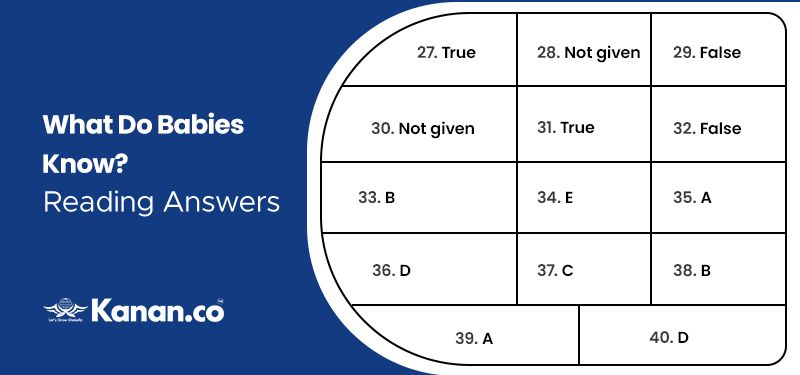
Below, we have given the answers for what do babies know? Reading answers in the table form.

Answer Table
| 27. True | 30. Not given | 33. B | 36. D | 39. A |
| 28. Not given | 31. True | 34. E | 37. C | 40. D |
| 29. False | 32. False | 35. A | 38. B |
What do babies know? IELTS reading practice test - Exam Review
Here we have given what do babies know? IELTS reading answers, as a sample article for the IELTS reading practice test. This article will help you to crack your exam with band scores. Scrutinize the given passage to answer the questions.
Passage
We have given what do babies know? reading answers with location. Be careful while reading the passage and answer the questions.
What do babies know? Reading Answers
- As Daniel Haworth is settled into a high chair and wheeled behind a black screen, a sudden look of worry furrows his 9-month-old brow. His dark blue eyes dart left and right in search of the familiar reassurance of his mother’s face. She calls his name and makes soothing noises, but Daniel senses something unusual is happening. He sucks his fingers for comfort, but, finding no solace, his month crumples, his body stiffens, and he lets rip an almighty shriek of distress. This is the usual expression when babies are left alone or abandoned. Mom picks him up, reassures him, and two minutes later, a chortling and alert Daniel returns to the darkened booth behind the screen and submits himself to baby lab, a unit set up in 2005 at the University of Manchester in northwest England to investigate how babies think.
- Watching infants piece life together, seeing their senses, emotions and motor skills take shape, is a source of mystery and endless fascination—at least to parents and developmental psychologists. We can decode their signals of distress or read a million messages into their first smile. But how much do we really know about what’s going on behind those wide, innocent eyes? How much of their understanding of and response to the world comes preloaded at birth? How much is built from scratch by experience? Such are the questions being explored at baby lab. Though the facility is just 18 months old and has tested only 100 infants, it’s already challenging current thinking on what babies know and how they come to know it.
- Daniel is now engrossed in watching video clips of a red toy train on a circular track. The train disappears into a tunnel and emerges on the other side. A hidden device above the screen is tracking Daniel’s eyes as they follow the train and measuring the diametre of his pupils 50 times a second. As the child gets bored—or “habituated”, as psychologists call the process— his attention level steadily drops. But it picks up a little whenever some novelty is introduced. The train might be green, or it might be blue. And sometimes an impossible thing happens— the train goes into the tunnel one color and comes out another.
- Variations of experiments like this one, examining infant attention, have been a standard tool of developmental psychology ever since the Swiss pioneer of the field, Jean Piaget, started experimenting on his children in the 1920s.
- Piaget’s work led him to conclude that infants younger than 9 months have no innate knowledge of how the world works or any sense of “object permanence” (that people and things still exist even when they’re not seen). Instead, babies must gradually construct this knowledge from experience. Piaget’s “constructivist” theories were massively influential on postwar educators and psychologist, but over the past 20 years or so they have been largely set aside by a new generation of “nativist” psychologists and cognitive scientists whose more sophisticated experiments led them to theorise that infants arrive already equipped with some knowledge of the physical world and even rudimentary programming for math and language. Baby lab director Sylvain Sirois has been putting these smart-baby theories through a rigorous set of tests. His conclusions so far tend to be more Piagetian: “Babies,” he says, “know nothing.”
- What Sirois and his postgraduate assistant Lain Jackson are challenging is the interpretation of a variety of classic experiments begun in the mid-1980s in which babies were shown physical events that appeared to violate such basic concepts as gravity, solidity and contiguity. In one such experiment, by University of Illinois psychologist Renee Baillargeon, a hinged wooden panel appeared to pass right through a box. Baillargeon and M.I.T’s Elizabeth Spelke found that babies as young as 3 1/2 months would reliably look longer at the impossible event than at the normal one. Their conclusion: babies have enough built-in knowledge to recognise that something is wrong.
Sirois does not take issue with the way these experiments were conducted. “The methods are correct and replicable,” he says, “it’s the interpretation that’s the problem.” In a critical review to be published in the forthcoming issue of the European Journal of Developmental Psychology, he and Jackson pour cold water over recent experiments that claim to have observed innate or precocious social cognition skills in infants. His own experiments indicate that a baby’s fascination with physically impossible events merely reflects a response to stimuli that are novel. Data from the eye tracker and the measurement of the pupils (which widen in response to arousal or interest) show that impossible events involving familiar objects are no more interesting than possible events involving novel objects. In other words, when Daniel had seen the red train come out of the tunnel green a few times, he gets as bored as when it stays the same color. The mistake of previous research, says Sirois, has been to leap to the conclusion that infants can understand the concept of impossibility from the mere fact that they are able to perceive some novelty in it. “The real explanation is boring,” he says. - So how do babies bridge the gap between knowing squat and drawing triangles—a task Daniel’s sister Lois, 2 1/2, is happily tackling as she waits for her brother? “Babies have to learn everything, but as Piaget was saying, they start with a few primitive reflexes that get things going,” said Sirois. For example, hardwired in the brain is an instinct that draws a baby’s eyes to a human face. From brain imaging studies we also know that the brain has some sort of visual buffer that continues to represent objects after they have been removed—a lingering perception rather than conceptual understanding. So when babies encounter novel or unexpected events, Sirois explains, “there’s a mismatch between the buffer and the information they’re getting at that moment. And what you do when you’ve got a mismatch is you try to clear the buffer. And that takes attention.” So learning, says Sirois, is essentially the laborious business of resolving mismatches. “The thing is, you can do a lot of it with this wet sticky thing called a brain. It’s a fantastic, statistical-learning machine”. Daniel, exams ended, picks up a plastic tiger and, chewing thoughtfully upon its heat, smiles as if to agree.
Questions
Questions 27-32
- Do the following statements agree with the information given in Reading Passage 3? In boxes 27-32 on you answer sheet, write
- TRUE if the statement is true
- FALSE if the statement is false
- NOT GIVEN if the information is not given in the passage
27. A baby's behavior after being abandoned is not surprising.
28. Parents are over-estimating what babies know.
29. Only 100 experiments have been done but can prove the theories about what we know.
30. Piaget’s theory was rejected by parents in 1920s.
31. Sylvain Sirois’s conclusion on infant cognition is similar to Piaget’s.
32. Sylvain Sirois found serious flaws in the experimental designs by Baillargeon and Elizabeth Spelke.
Questions 33-37
- Complete each sentence with the correct ending, A-E, below.
- Write the correct letter, A-E, in boxes 33-37 on your answer sheet.
33. Jean Piaget thinks infants younger than 9 months won’t know something existing
34. Jean Piaget thinks babies only get the knowledge
35. Some cognitive scientists think babies have the mechanism to learn a language
36. Sylvain Sirois thinks that babies can reflect a response to stimuli that are novel 37. Sylvain Sirois thinks babies’ attention level will drop
A before they are born.
B before they learn from experience.
C when they had seen the same thing for a while.
D when facing the possible and impossible events.
E when the previous things appear again in our lives.
Questions 38-40
- Choose the correct letter, A, B, C or D.
- Write the correct letter in boxes 38-40 on your answer sheet.
38 What can we know about Daniel in the third paragraph?
- Daniel’s attention level rose when he saw a blue train.
- Kid’s attention fell when he was accustomed to the changes.
- Child’s brain activity was monitored by a special equipment.
- Size of the train changed when it came out of the tunnel.
39 What can we know from the writer in the fourth paragraph?
- The theories about what baby knows changed over time.
- Why the experiments that had been done before were rejected.
- Infants have the innate knowledge to know the external environment.
- Piaget’s “constructivist” theories were massively influential on parents.
40 What can we know from the argument of the experiment about the baby in the sixth paragraph?
- Infants are attracted by various colours of the trains all the time.
- Sylvain Sirois accuses misleading approaches of current experiments.
- Sylvain Sirois indicates that only impossible events make children interested.
- Sirois suggests that novel things attract baby’s attention.
Answers for What do babies know? With explanations
We have given the answers for what do babies know? Reading answers with explanations. This section will help you to identify your errors.
27. Answer: True
Explanation: “ He sucks his fingers for comfort, but, finding no solace, his month crumples, his body stiffens, and he lets rip an almighty shriek of distress. This is the usual expression when babies are left alone or abandoned”. With this line it is clear that a baby's behavior after being abandoned is not surprising. Hence the given answer is located in the 5-7 lines of paragraph 1.
28. Answer: Not given
29. Answer: False
Explanation: “Though the facility is just 18 months old and has tested only 100 infants, it’s already challenging current thinking on what babies know and how they come to know it”. With this line it is clear that the given statement contradicts with the given information. Hence the given answer is located in the last 3 lines of paragraph 2.
30. Answer: Not given
31. Answer: True
Explanation: “Baby lab director Sylvain Sirois has been putting these smart-baby theories through a rigorous set of tests. His conclusions so far tend to be more Piagetian: “Babies,” he says, “know nothing”. With this line it is clear that Sylvain Sirois’s conclusion on infant cognition is similar to Piaget’s. Hence the given answer is located in the last 3 lines of paragraph 4.
32. Answer: False
Explanation: “The mistake of previous research, says Sirois, has been to leap to the conclusion that infants can understand the concept of impossibility from the mere fact that they are able to perceive some novelty in it. “The real explanation is boring,” he says”. With this line it is clear that the given statement contradicts with the given information. Hence the given answer is located in the last 4 lines of paragraph 6.
33. Answer: B
Explanation: “Piaget’s work led him to conclude that infants younger than 9 months have no innate knowledge of how the world works or any sense of “object permanence” (that people and things still exist even when they’re not seen)”. With this line it is clear that Jean Piaget thinks infants younger than 9 months won’t know something existing before they learn from experience. Hence the given answer is located in the 3-5 lines of paragraph 4.
34. Answer: E
Explanation: “Instead, babies must gradually construct this knowledge from experience”. With this line it is clear that Jean Piaget thinks babies only get the knowledge when the previous things appear again in the lives. Hence the given answer is located in the 6-7 lines of paragraph 4.
35. Answer: A
Explanation: “over the past 20 years or so they have been largely set aside by a new generation of “nativist” psychologists and cognitive scientists whose more sophisticated experiments led them to theorise that infants arrive already equipped with some knowledge of the physical world and even rudimentary programming for math and language. With this line it is clear that Some cognitive scientists think babies have the mechanism to learn a language before they are born. Hence the given answer is located in the 9-13 lines of paragraph 4.
36. Answer: D
Explanation: “His own experiments indicate that a baby’s fascination with physically impossible events merely reflects a response to stimuli that are novel”. With this line it is clear that Sylvain Sirois thinks that babies can reflect a response to stimuli that are novel when facing the possible and impossible events. Hence the given answer is located in the 6-8 lines of paragraph 6.
37. Answer: C
Explanation: “In other words, when Daniel had seen the red train come out of the tunnel green a few times, he gets as bored as when it stays the same color”. With this line it is clear that Sylvain Sirois thinks babies’ attention level will drop when they had seen the same thing for a while. Hence the given answer is located in the 11-13 lines of paragraph 6.
38. Answer: B
Explanation: “A hidden device above the screen is tracking Daniel’s eyes as they follow the train and measuring the diametre of his pupils 50 times a second. As the child gets bored—or “habituated”, as psychologists call the process— his attention level steadily drops”. With this line it is clear that Kid’s attention fell when he was accustomed to the changes. What can we know about Daniel in the third paragraph. Hence the given answer is located in the 2-5 lines of paragraph 3.
39. Answer: A
Explanation: “Piaget’s “constructivist” theories were massively influential on postwar educators and psychologist, but over the past 20 years or so they have been largely set aside by a new generation of “nativist” psychologists and cognitive scientists”. With this line it is clear that the writer states the theories about what baby knows changed over time in the fourth paragraph. Hence the given answer is located in the 7-10 lines of paragraph 4.
40. Answer: D
Explanation: “Data from the eye tracker and the measurement of the pupils (which widen in response to arousal or interest) show that impossible events involving familiar objects are no more interesting than possible events involving novel objects”. With this line it is clear that Sylvain Sirois suggests that novel things attract baby’s attention is what we know from the argument of the experiment about the baby sixth paragraph. Hence the given answer is located in the 8-11 lines of paragraph 6.
Other reading answers

About Author Arivarasi
Arivarasi is an experienced author with expertise in the study abroad industry and preparing test materials for exams like IELTS, TOEFL, GRE, SAT, PTE, etc. She stays up-to-date with university and college requirements for international students which allows her to provide guidance on course selection, documents like SOP, LOR, and scholarship opportunities. She has written numerous articles on study abroad exams, destinations, universities & colleges requirements, admission procedures, and the entire process of studying abroad. Collaborating with industry experts and counselors, she crafts informative articles that make students take the right decisions.
Kanan.co is a trusted study abroad consultancy offering comprehensive services, resources, and solutions for students and education institutions. We support students at every stage of their global education journey, ensuring a smooth and guided experience. Along with test preparation for IELTS, GRE, TOEFL, and SAT, we provide expert services such as SOP writing, visa guidance, accommodation support, scholarship assistance, and education loan support. Our expertise and commitment to excellence make us a reliable partner for students pursuing international education.
Free Online Mock Test 2026
Practice our mock test worth Rs. 25000 for Free and know your IELTS score!








Global Headquarters
Kanan Int EdTech Inc
320 Bay Street, Suite 321 (Spaces), Toronto ON, Canada M5B 1N9
Indian Headquarters
Kanan International Pvt. Ltd.
D-wing, 2nd Floor, Trident Complex, Ellora Park Vadiwadi Road, Vadodara, Gujarat 390007
IT/ Digital Campus
Kanan International Pvt. Ltd
Old, New No 3, 2nd Floor, 1A, Dr Sadasivam Rd, T. Nagar, Chennai, Tamil Nadu 600017
Our branches
- Bardoli
- Bharuch
- Chennai
- Dehradun
- Gurugram
- Himatnagar
- Karnal
- Nadiad
- Navsari
- Palanpur
- Rajkot
- Vadodara
- Valsad
- Vallabh Vidyanagar
- Vapi
Study Abroad
Test Prep
Top Universities
Consultants
IELTS Centers
GRE Centers
TOEFL Centers
SAT Centers
Language Courses in Vadodara
Study Abroad Calculators
Featured Blogs
Study Abroad Consultants in Chennai
Study Abroad Consultants in Surat
Study Abroad Consultants in Navsari
Study Abroad Consultants in Bardoli
Study Abroad Consultants in Ahmedabad
Study Abroad Consultants in Anand
Study Abroad Consultants in Khanna
Study Abroad Consultants in Nadiad
Study Abroad Consultants in Vadodara
Study abroad consultants in Valsad
Copyright © 2026 KANAN.CO All rights reserved.