- Study Abroad
- / ielts
- / from londinium to london reading answers
From Londinium to London Reading Answers


Author
17-09-2025

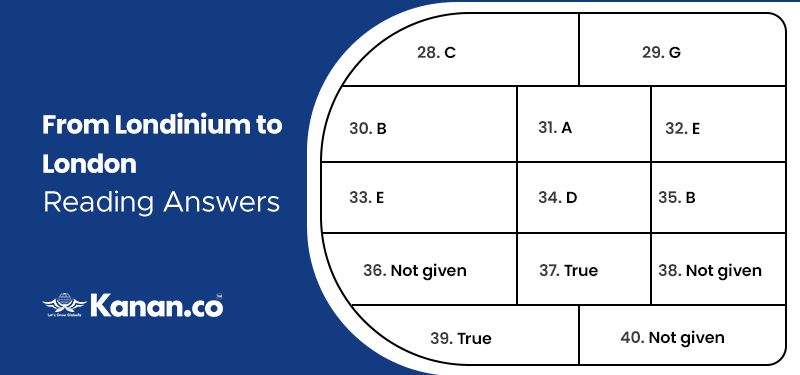
Here you can find From Londinium to London reading answers as a practice test along with answers and explanation. This article contains 13 questions in 2 different types namely- questions 8 questions as locating information and 5 questions as true, false or not given questions form. Before answering your questions, read the given passage thoroughly.
Check out our YouTube Channel to Practice Full-Length IELTS Reading Tests Daily

Table of content:
- Solution for From Londinium to London
- From Londinium to London IELTS reading practice test
- Passage
- Questions
- Answers with explanation
Solution for From Londinium to London
Answers for the From Londinium to London reading answers, are given here in the table form below.

Answer Table
| 28. C | 31. A | 34. D | 37. True | 40. Not given |
| 29. G | 32. E | 35. B | 38. Not given | |
| 30. B | 33. E | 36. Not given | 39. True |
From Londinium to London IELTS Reading Practice Test -Exam Review
We have given the From Londinium to London IELTS reading answers, as a sample article for the IELTS reading practice test. Use this article while practicing for your major exam, it will aid you to crack your exams with band scores. Go through the given passage and answer the questions.
Passage
We have given From Londinium to London reading answers with location. Be careful while reading the passage and answer the questions.
From Londinium to London reading answers
A. The history of London spans a period of approximately 2,000 years. On its way to becoming one of the present-day financial and cultural capitals of the world, momentous highs and lows have accompanied the town. By 43 AD, an early point in its history, a time when Romans had invaded Britain, it had already been a target of several external invasions. The Roman settlers there at the time named the area Londinium, which is commonly believed to be the origin of the present-day name, London.
B. Researchers believe that before the Romans, no city existed where London is today. It was just a rural area with significant richness and attractiveness in terms of natural resources and location. They base this on the fact that only very scattered evidence of farming, burial and habitation have been uncovered in the area. Early Roman London, which is also referred to as The First London, was a very small area that existed for just 17 years. Around 61 AD the Celtic-speaking Iceni tribe from Eastern Britain, who opposed the occupying forces of the Roman Empire, stormed the city and burnt it to the ground. By 100 AD it was rebuilt according to a development plan and was made the capital of the Roman province of Britannia. By the 2nd century AD, London had a population of approximately 60,000. In the 3rd century AD, however, due to internal troubles within the Roman Empire, the city was brought down again. By the 5th century AD, it had become an abandoned city.
C. During the next century, the area near London saw the settlement of a new race of people, the Anglo-Saxons. These people started to migrate about 1 kilometre upstream from the Roman London city. Their settlement was called Lundenwic, and had fishing and trading as its economic base. Disaster struck for the city in 850 AD when its defence was broken down by a major Viking raid. However, the Viking occupation which had lasted for 20 years was overturned by Alfred the Great, the new King of England, who succeeded in establishing power via a peaceful agreement. He rebuilt the defensive wall for the city to protect his people. Gradually, as a result of contributions by the then ruling kings, London once again became an international trading centre and political powerhouse. However, in the late 10th century Vikings raided again and took control of the city and forced the ruling King Ethelred to flee. His army then made a counter attack and won. Thus, English control was once more established.
D. King Canute ruled London and the adjacent countryside until his death in 1042, when his son, Edward, took control and re-founded Westminster Abbey. By this time London had already become the largest city in the whole of England. In 1066 William the Conqueror became the King of England and built a castle in the southeast part to better keep a watchful eye on its inhabitants. The later kings expanded the castle, which is now known as the Tower of London. During 1097 William II built Westminster Hall adjacent to the Westminster Abbey as a key structure in the new Palace of Westminster, which was the main royal residence all through the Middle Ages. Primarily, because of the unique administration through the Corporation of London, which was the municipal governing body that later became the City of London Corporation, London became a centre of trade and commerce and was named the capital of England in the 12th century.
E. In 1588 the Spanish Armada sailed against England and was defeated. The defeat of the Spanish led to more political stability in England allowing London to prosper even more. Good times followed until tragedy struck during the middle and late 16th century through The Great Fire of London. Starting from a small bakery, the fire burnt to the ground, the homes of 70,000 of London’s 80,000 inhabitants. Rebuilding the city would take ten long years. The middle of the 17th century was also a matter of great misfortune for London due to an outbreak of the Great Plague, which caused the deaths of almost a fifth of the population.
F. The first quarter of the 18th century saw London become and remain the world’s largest city. Major developments within this period included the building of a rail network and a city metro system; the systematic development of a workforce; a local government system and other large-scale building of infrastructure. After World War II, London became home to a large number of immigrants - especially those from other parts of the Commonwealth - making London one of the most culturally diverse cities in the whole of Europe. Despite occasional set-backs - like the Brixton Riots in the early 1980s - the integration of new migrants into London was comparatively smoother than other regions around the United Kingdom.
G. From the 1980s onward, some successful economic reforms and revival programs were implemented in London that significantly contributed to re-establish it as a pre-eminent international centre. Today London is considered by many to be the most important and influential city in Europe with around 32% of all foreign exchange around the world occurring in the city on a daily basis. The British government continues to devote more resources to the development of London with the people of the city now preparing to hosting the 2012 Summer Olympics.
Ship-borne warriors originating from Scandinavia i.e. northern Europe.
Questions
Questions 28 - 35
- The passage has seven paragraphs A-G.
- Which paragraph contains the following information?
- Write the correct letter A-G in boxes 28-35 on your answer sheet.
- NB. You may use any letter more than once.
28. an example of two groups of people making an agreement, not to war
29. a big upcoming event for London
30. London as a deserted city
31. commonly believed to be the origination of the word ‘London’
32. London and a mass disease
33. most of the city dwellers lost their dwelling place
34. the main reason why London became the capital of England
35. an example of a conclusion made by those who study history.
Questions 36-40
- Do the following information agree with the information given in the passage?
- In boxes 36-40 on your answer sheet, write:
- TRUE if the statement agrees with the information
- FALSE if the statement contradicts with the information
- NOT GIVEN if there is no information in this
36. The Romans gave London its name.
37. A sudden attack on The First London totally destroyed it.
38. The area, once known as Early Roman London, now joins with modern-day London.
39. In order to control the people of London more effectively, William the Conqueror built a castle.
40. 70,000 houses were burnt by the Great Fire of London.
Answer for From Londinium to London with Explanation
Here we have given the answers for From Londinium to London reading answers with explanations. This will aid you to rectify your mistakes while answering.
28. Answer: C
Explanation: “During the next century, the area near London saw the settlement of a new race of people, the Anglo-Saxons. These people started to migrate about 1 kilometre upstream from the Roman London city. Their settlement was called Lundenwic, and had fishing and trading as its economic base”. With this line it is clear that paragraph C states about an example of two groups of people making an agreement, not to war. Hence the given answer is located in the first 4 lines of paragraph C.
29. Answer: G
Explanation: “The British government continues to devote more resources to the development of London with the people of the city now preparing to hosting the 2012 Summer Olympics”. With this line it is clear that paragraph G states about a big upcoming event for London. Hence the given answer is located in the last 3 lines of paragraph G.
30. Answer: B
Explanation: “Researchers believe that before the Romans, no city existed where London is today. It was just a rural area with significant richness and attractiveness in terms of natural resources and location. They base this on the fact that only very scattered evidence of farming, burial and habitation have been uncovered in the area”. With this line it is clear that paragraph B states about London as a deserted city. Hence the given answer is located in the first 4 lines of paragraph B.
31. Answer: A
Explanation: “it had already been a target of several external invasions. The Roman settlers there at the time named the area Londinium, which is commonly believed to be the origin of the present-day name, London”. With this line it is clear that paragraph A states about commonly believed to be the origin of the word ‘London’. Hence the given answer is located in the last 3 lines of paragraph A.
32. Answer: E
Explanation: “The middle of the 17th century was also a matter of great misfortune for London due to an outbreak of the Great Plague, which caused the deaths of almost a fifth of the population”. With this line it is clear that paragraph E states about London and a mass disease. Hence the given answer is located in the last 3 lines of paragraph E.
33. Answer: E
Explanation: “In 1588 the Spanish Armada sailed against England and was defeated. The defeat of the Spanish led to more political stability in England allowing London to prosper even more. Good times followed until tragedy struck during the middle and late 16th century through The Great Fire of London. Starting from a small bakery, the fire burnt to the ground, the homes of 70,000 of London’s 80,000 inhabitants. Rebuilding the city would take ten long years”. With this line it is clear that paragraph E most of the city dwellers lost their dwelling place. Hence the given answer is located in the 1-6 lines of paragraph E.
34. Answer: D
Explanation: “ During 1097 William II built Westminster Hall adjacent to the Westminster Abbey as a key structure in the new Palace of Westminster, which was the main royal residence all through the Middle Ages. Primarily, because of the unique administration through the Corporation of London, which was the municipal governing body that later became the City of London Corporation, London became a centre of trade and commerce and was named the capital of England in the 12th century”. With this line it is clear that paragraph D is the main reason why London became the capital of England. Hence the given answer is located in the last 6 lines of paragraph D.
35. Answer: B
Explanation: “By 100 AD it was rebuilt according to a development plan and was made the capital of the Roman province of Britannia. By the 2nd century AD, London had a population of approximately 60,000. In the 3rd century AD, however, due to internal troubles within the Roman Empire, the city was brought down again. By the 5th century AD, it had become an abandoned city”. With this line it is clear that paragraph B is an example of a conclusion made by those who study history. Hence the given answer is located in the last 4 lines of paragraph B.
36. Answer: Not given
37. Answer: True
Explanation: “Good times followed until tragedy struck during the middle and late 16th century through The Great Fire of London. Starting from a small bakery, the fire burnt to the ground, the homes of 70,000 of London’s 80,000 inhabitants. Rebuilding the city would take ten long years. The middle of the 17th century was also a matter of great misfortune for London due to an outbreak of the Great Plague, which caused the deaths of almost a fifth of the population”. With this line it is clear that a sudden attack on The First London totally destroyed it. Hence the given answer is located in the last 6 lines of paragraph E.
38. Answer: Not given
39. Answer: True
Explanation: “In 1066 William the Conqueror became the King of England and built a castle in the southeast part to better keep a watchful eye on its inhabitants. The later kings expanded the castle, which is now known as the Tower of London”. With this line it is clear that in order to control the people of London more effectively, William the Conqueror built a castle. Hence the given answer is located in the 4-6 lines of paragraph D.
40. Answer: Not given
Other reading answers

About Author Tejaswini Kota
Tejaswini is an enthusiastic writer, reader and a passionate learner. Additionally, she was a research fellow and holds a grip in English writings and research/paper publications. She holds bachelors and masters degrees in engineering. She spent three years in the education industry and is currently working as a full-time content writer at Kanan International, writing articles for study abroad projects. She is proficient in creating good quality content that helps the students for language proficiency tests like IELTS, GRE, TOEFL etc. and can help in advising you the right choice of college for admission.
Kanan.co is a trusted study abroad consultancy offering comprehensive services, resources, and solutions for students and education institutions. We support students at every stage of their global education journey, ensuring a smooth and guided experience. Along with test preparation for IELTS, GRE, TOEFL, and SAT, we provide expert services such as SOP writing, visa guidance, accommodation support, scholarship assistance, and education loan support. Our expertise and commitment to excellence make us a reliable partner for students pursuing international education.
Free Online Mock Test 2026
Practice our mock test worth Rs. 25000 for Free and know your IELTS score!








Global Headquarters
Kanan Int EdTech Inc
320 Bay Street, Suite 321 (Spaces), Toronto ON, Canada M5B 1N9
Indian Headquarters
Kanan International Pvt. Ltd.
D-wing, 2nd Floor, Trident Complex, Ellora Park Vadiwadi Road, Vadodara, Gujarat 390007
IT/ Digital Campus
Kanan International Pvt. Ltd
Old, New No 3, 2nd Floor, 1A, Dr Sadasivam Rd, T. Nagar, Chennai, Tamil Nadu 600017
Our branches
- Bardoli
- Bharuch
- Chennai
- Dehradun
- Gurugram
- Himatnagar
- Karnal
- Nadiad
- Navsari
- Palanpur
- Rajkot
- Vadodara
- Valsad
- Vallabh Vidyanagar
- Vapi
Study Abroad
Test Prep
Top Universities
Consultants
IELTS Centers
GRE Centers
TOEFL Centers
SAT Centers
Language Courses in Vadodara
Study Abroad Calculators
Featured Blogs
Study Abroad Consultants in Chennai
Study Abroad Consultants in Surat
Study Abroad Consultants in Navsari
Study Abroad Consultants in Bardoli
Study Abroad Consultants in Ahmedabad
Study Abroad Consultants in Anand
Study Abroad Consultants in Khanna
Study Abroad Consultants in Nadiad
Study Abroad Consultants in Vadodara
Study abroad consultants in Valsad
Copyright © 2026 KANAN.CO All rights reserved.