- Study Abroad
- / ielts
- / watercraft submarine reading answers
Watercraft Submarine Reading Answers


Author
17-09-2025

In this article we have given watercraft submarine reading answers along with questions, answers and explanations. This article has 13 questions in 3 different types namely- 6 questions as short answer questions, 4 questions as matching information and 3 questions as short answer questions.
Check out our YouTube Channel to Practice Full-Length IELTS Reading Tests Daily

Table of content:
- Solution for Watercraft submarine
- Watercraft submarine IELTS Reading Practice test
- Passage
- Questions
- Answers with explanation
Solution for Watercraft submarine
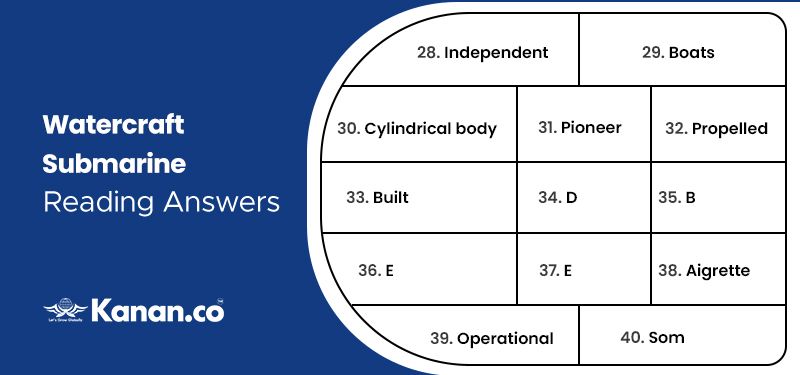
Below, we have given the answers for watercraft submarine reading answers in the table form.

Answer Table
| 28. Independent | 31. Pioneer | 34. D | 37. E | 40. Som |
| 29. Boats | 32. Propelled | 35. B | 38. Aigrette | |
| 30. Cylindrical body | 33. Built | 36. E | 39. Operational |
Watercraft submarine IELTS Reading Practice test - Exam Review
Here, we have given the Watercraft submarine IELTS reading answers as a sample article for the IELTS reading practice test. This article will help you attain a band score in your exams. Check out the given passage to answer the questions.
Passage (H3)
In this article the Watercraft submarine reading answers with location is given. Be focused on the passage while reading it and answer the given questions.
Watercraft submarine reading answers
- A submarine is a watercraft competent of independent operation underwater. It differs from a submersible, which has more limited underwater capability. The term most commonly refers to a large, crewed, autonomous vessel. It is also sometimes used historically or colloquially to refer to remotely operated vehicles and robots, as well as medium-sized or smaller vessels, such as the midget submarine and the wet sub.
- Used as an adjective in phrases such as submarine cable, “submarine” means “under the sea”. The noun submarine evolved as a shortened form of submarine boat (and is often further shortened to sub). For reasons of naval tradition, submarines are usually referred to as “boats” rather than as “ships”, regardless of their size.
- Most large submarines consist of a cylindrical body with hemispherical ( and/or conical) ends and a vertical structure, usually located amidships, which houses communications and sensing devices as well as periscopes, in modern submarines, this structure is the “sail” in American usage, and “fin” in European usage.
- A “conning tower” was an attribute of earlier designs: a separate pressure hull above the main body of the boat that allowed the use of shorter periscopes. There is a propeller (or pump jet) at the rear, and assorted hydrodynamic control fins. Smaller, deep diving and specialty submarines may deviate significantly from this customary layout. Submarines change the amount of water and air in their ballast tanks to dwindle buoyancy for submerging or amplify it for surfacing.
- The first submersible of whose construction we gave reliable information was built in 1620 by Cornellius Drebbel, a Dutchman in the service of James I of England. It was created to the standards of the design outlined by English mathematician William Bourne. It was propelled by means of oars. The precise nature of the submarine type is a matter of some controversy; some allege that it was merely a bell towed by a boat.
- By the mid 18th century, over a dozen patents for submarines/submersible boats had been granted in England. In 1747, Nathaniel Symons patented and built the first known working example of the use of a ballast tank for submersion. His blueprint used leather bags that could fill with water to submerge the craft. A mechanism was used to twist the water out of the bags and cause the boat to resurface. In 1749 the Gentleman's Magazine reported that a similar design had initially been proposed by Giovanni Borelli in 1680. By this point of development, further improvement in design necessarily stagnated for over a century, until new industrial technologies for propulsion and stability could be applied.
- The first military submarine was the Turtle (1775), a hand-powered acorn-shaped device designed by the American David Bushnell to accommodate a single person. It was the first verified submarine proficient of independent underwater operation and movement, and the first to use screws for propulsion. In 1800, France built a human-powered submarine designed by American Robert Fultion, the Nautilus. The French eventually gave upon the experiment in 1804, as did the British when they later considered Fulton’s submarine design.
- Submarines were not put into service for any widespread or routine use by navies until the early 1900s. The turn of the century marked a pivotal time in submarine development, and a number of important technologies materialized. A number of nations built and used submarines. Diesel electric propulsion became the dominant power system and equipments on effective tactics and weapons for submarines, which led to their large impact in World War 1
- The Irish inventor John Philip Holland built a model submarine in 1876 and a full scale one in 1878, followed by a number of unsuccessful ones. In 1896 he designed the Holland Type VI submarine. This vessel made use of internal combustion engine power on the surface and electric battery power for submerged operations. Launched on 17 May 1897 at Navy Lt. Lewis Nixon’s Crescent Shipyard in Elizabeth, New Jersey, the Holland VI was purchased by the United States Navy on 11 April 1900, becoming the United States Navy’s first commissioned submarine and renamed USS Holland.
- Commissioned in June 1900, the French steam and electric Marvel employed the now distinctive double -hull design, with a pressure hull inside the outer shell. The French submarine Aigrette in 1904 further improved the concept by using a diesel rather than a gasoline engine for surface power. Large numbers of these submarines were built, with seventy-six completed before 1914.
- The Royal Navy commissioned five Holland-class submarines from Vickers, Barrow-in-Furness, under license from the Holland Torpedo Boat Company during the years 1901 to 1903. Construction of the boats took longer than anticipated, with the first only ready for a diving trial at sea on 6 April 1902. These types of submarines were first used during the Russo-Japanese War of 1904-05.
- Due to the blockade at Port Arthur, the Russians sent their submarines to Vladicostok, where by 1 January 1905 there were seven boats, enough to create the world’s first “operational submarine fleet.” The new-flagged submarine fleet sent out its first patrol on 14 February, usually enduring for about 24 hours. The first confrontation with Japanese warships occurred on 29 April 1905 when the Russian submarine Som was fired upon by Japanese torpedo boats, but then withdrew.
Questions
Questions 28-33
- Choose no more than two words from the passage for each answer.
A watercraft proficient of 28__________ to function underwater is submarine. Despite the consequences of their size, submarines are frequently referred to as 29__________ as an alternative of 'ships'. Mainly big submarines consist of a 30____________ with pointed ends and a perpendicular structure. Cornellius Drebbel is believed to be the 31________ of first submersible. It was 32____________ by means of oars. Nathaniel Symons copyright and 33_____________ the former acknowledged working examples of the use of ballast tanks for submersion.
Questions 34-37
- The list of statements is given below. Match them with designers.
- NB. you may use any name more than once
- Write the correct answers, in boxes 34-37 on your answer sheet
34. Human mechanical submarine
35. Turtle an armed forces submarine
36. Holland type VI submarine
37. USS Holland
List of Designers
- Nathaniel Symons
- David Bushnell
- Giovanni Borelli
- Robert Fulton
- John Philip
Questions 38-40
- Choose no more than two words from the passage for each answer.
38__________ submarine was enhanced with diesel rather than gasoline engine
39__________ submarine fleet was world’s foremost fleet produced from seven boats.
40__________ submarine was ablaze upon by Japanese torpedo boats.
Answers for watercraft submarine with explanations
In this section we have given watercraft submarine reading answers with explanations. This portion will help you to identify your errors while answering.
28. Answer: Independent
Explanation: “A submarine is a watercraft competent of independent operation underwater”. With this line it is clear that a watercraft proficient or independent to function underwater is submarine. Hence the given answer is located in the 1st line of paragraph 1.
29. Answer: Boats
Explanation: “For reasons of naval tradition, submarines are usually referred to as “boats” rather than as “ships”, regardless of their size”. With this line it is clear that despite the consequences of their size, submarines are frequently referred to as boats as an alternative of 'ships'. Hence the given answer is located in the last 2 lines of paragraph 2.
30. Answer: Cylindrical Body
Explanation: “Most large submarines consist of a cylindrical body with hemispherical ( and/or conical) ends and a vertical structure, usually located amidships, which houses communications and sensing devices as well as periscopes”. With this line it is clear that Mainly big submarines consist of a cylindrical body with pointed ends and a perpendicular structure. Hence the given answer is located in the first 3 lines of paragraph 3.
31. Answer: Pioneer
Explanation: “The first submersible of whose construction we gave reliable information was built in 1620 by Cornellius Drebbel, a Dutchman in the service of James I of England. It was created to the standards of the design outlined by English mathematician William Bourne”. With this line it is clear that Cornellius Drebbel is believed to be the pioneer of the first submersible. Hence the given answer is located in the first 4 lines of paragraph 5.
32. Answer: Propelled
Explanation: “It was propelled by means of oars”. With this line it is clear that it was propelled by means of oars. Hence the given answer is located in the 4th line of paragraph 5.
33. Answer: Built
Explanation: “Nathaniel Symons patented and built the first known working example of the use of a ballast tank for submersion”. With this line it is clear that nathaniel Symons copyright and built the former acknowledged working examples of the use of ballast tanks for submersion. Hence the given answer is located in the 2-3 lines of paragraph 6.
34. Answer: D
Explanation: “In 1800, France built a human-powered submarine designed by American Robert Fultion, the Nautilus”. With this line it is clear that a human-powered submarine designed by American Robert Fultion. Hence the given answer is located in the 4-6 lines of paragraph 7.
35. Answer: B
Explanation: “The first military submarine was the Turtle (1775), a hand-powered acorn-shaped device designed by the American David Bushnell to accommodate a single person”. With this line it is clear that the turtle is a hand-powered acorn-shaped device designed by the American David Bushnell. Hence the given answer is located in the 1-3 lines of paragraph 7.
36. Answer: E
Explanation: “The Irish inventor John Philip Holland built a model submarine in 1876 and a full scale one in 1878, followed by a number of unsuccessful ones. In 1896 he designed the Holland Type VI submarine”. With this line it is clear that JOhn Philip designed the Holland type VI submarine. Hence the given answer is located in the first 3 lines of paragraph 9.
37. Answer: E
Explanation: “Launched on 17 May 1897 at Navy Lt. Lewis Nixon’s Crescent Shipyard in Elizabeth, New Jersey, the Holland VI was purchased by the United States Navy on 11 April 1900, becoming the United States Navy’s first commissioned submarine and renamed USS Holland”. With this line it is clear that John Philip designed USS Holland. Hence the given answer is located in the last 4 lines of paragraph 9.
38. Answer: Aigrette
Explanation: “The French submarine Aigrette in 1904 further improved the concept by using a diesel rather than a gasoline engine for surface power”. With this line it is clear that aigrette submarine was enhanced with diesel rather than gasoline engine. Hence the given answer is located in the 3-4 lines of paragraph 10.
39. Answer: Operational
Explanation: “Due to the blockade at Port Arthur, the Russians sent their submarines to Vladicostok, where by 1 January 1905 there were seven boats, enough to create the world’s first “operational submarine fleet.”. With this line it is clear that the operational submarine fleet was world’s foremost fleet produced from seven boats. Hence the given answer is located in the first 3 lines of paragraph 12.
40. Answer: Som
Explanation: “ The first confrontation with Japanese warships occurred on 29 April 1905 when the Russian submarine Som was fired upon by Japanese torpedo boats, but then withdrew”. With this line it is clear that Som submarine was ablaze upon by Japanese torpedo boats. Hence the given answer is located in the last 3 lines of paragraph 12.
Other reading answers

About Author Manimegalai Samidurai
Manimegalai is a multifaceted professional, excelling as an author, writer, and study-abroad expert. Her vast knowledge of English proficiency exams, including IELTS, GRE, SAT, and PTE, and exceptional content writing skills make her a go-to resource for students seeking guidance and support in their foreign education journey. She is a trusted authority in writing content related to these test-prep exams, making her an invaluable resource for those seeking guidance. With her well-researched and informative blogs, articles, and study materials, Manimegalai has helped countless students achieve their desired band scores and get admissions to top-notch colleges & universities in countries like Canada, USA, UK, Australia, Ireland, etc.
Kanan.co is a trusted study abroad consultancy offering comprehensive services, resources, and solutions for students and education institutions. We support students at every stage of their global education journey, ensuring a smooth and guided experience. Along with test preparation for IELTS, GRE, TOEFL, and SAT, we provide expert services such as SOP writing, visa guidance, accommodation support, scholarship assistance, and education loan support. Our expertise and commitment to excellence make us a reliable partner for students pursuing international education.
Free Online Mock Test 2026
Practice our mock test worth Rs. 25000 for Free and know your IELTS score!








Global Headquarters
Kanan Int EdTech Inc
320 Bay Street, Suite 321 (Spaces), Toronto ON, Canada M5B 1N9
Indian Headquarters
Kanan International Pvt. Ltd.
D-wing, 2nd Floor, Trident Complex, Ellora Park Vadiwadi Road, Vadodara, Gujarat 390007
IT/ Digital Campus
Kanan International Pvt. Ltd
Old, New No 3, 2nd Floor, 1A, Dr Sadasivam Rd, T. Nagar, Chennai, Tamil Nadu 600017
Our branches
- Bardoli
- Bharuch
- Chennai
- Dehradun
- Gurugram
- Himatnagar
- Karnal
- Nadiad
- Navsari
- Palanpur
- Rajkot
- Vadodara
- Valsad
- Vallabh Vidyanagar
- Vapi
Study Abroad
Test Prep
Top Universities
Consultants
IELTS Centers
GRE Centers
TOEFL Centers
SAT Centers
Language Courses in Vadodara
Study Abroad Calculators
Featured Blogs
Study Abroad Consultants in Chennai
Study Abroad Consultants in Surat
Study Abroad Consultants in Navsari
Study Abroad Consultants in Bardoli
Study Abroad Consultants in Ahmedabad
Study Abroad Consultants in Anand
Study Abroad Consultants in Khanna
Study Abroad Consultants in Nadiad
Study Abroad Consultants in Vadodara
Study abroad consultants in Valsad
Copyright © 2026 KANAN.CO All rights reserved.