- Study Abroad
- / ielts
- / the game of tennis reading answers
The Game of Tennis Reading Answers


Author
17-09-2025

In this article, we have given, The Game of Tennis reading practice test with questions and answers along with explanations. This passage has 13 questions in 2 different question forms namely- 7 questions as matching heading and 6 questions as summary completion.
Check out our YouTube Channel to Practice Full-Length IELTS Reading Tests Daily

Table of content:
- Solution for The Game of Tennis
- The Game of Tennis IELTS reading practice test
- Passage
- Questions
- Answers with explanations
Solution for The Game of Tennis
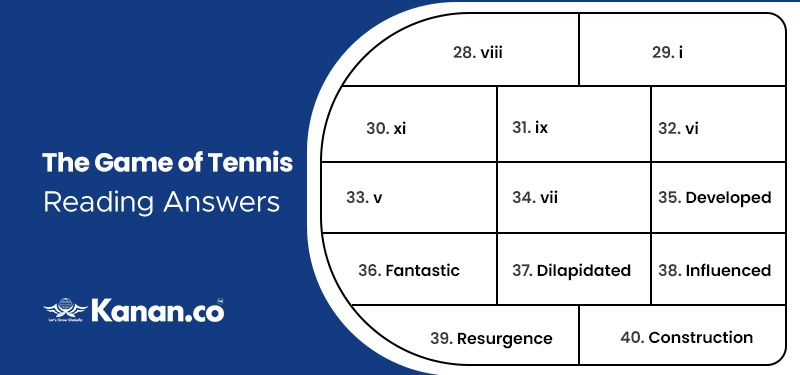
We have given The Game of Tennis reading answers, in the table given below.

Answer Table
| 28. viii | 28. viii | 31. ix | 34. vii | 37. Dilapidated | 40. Construction |
| 29. i | 29. i | 32. vi | 35. Developed | 38. Influenced | |
| 30. xi | 30. xi | 33. v | 36. Fantastic | 39. Resurgence |
The Game of Tennis IELTS reading practice test- Exam Review
In this article we have provided The Game of Tennis IELTS reading answers. This article will help to be distinguished in the IELTS reading practice to challenge your reading skill and read the given passage to answer the questions.
Passage
We have given The Game of Tennis reading answers with location. Go through the given passage carefully and answer the questions.
The Game of Tennis reading answers
A. Real Tennis as it is called in Britain, Royal Tennis as it is called in Australia, Court Tennis as it is called in the States, Jeu de Paume as it is called in France, or Tennis as it is properly known, is the oldest of all the racket games, and unlike most of the others, such as squash or lawn tennis, it is a product of evolution rather than pure invention.
B. The game started to form into something recognizable in the 11th century. It started as handball, played by monks around the cloisters of monasteries of Italy and France, much as school children do today in corners of their school playground. Gradually as monks traveled to other monasteries, more enjoyable rules were adopted, the more bizarre rules abandoned and people started to add features to their courtyards that improved the pastime, and demolish or modify others that detracted from it. The monks enjoyed the game so much that the Pope banned the playing of it, and by the 14th century the game had spread from cloister to castle and became a game of the nobility. There are other theories about the origins of the game. A tennis historian, Roger Morgan, has theorized that the game owes its origins to playing in medieval streets which is a nice idea but as the streets were also used as sewers, it couldn’t have been much fun.
C. The 16th and 17th centuries were the heyday of tennis. It was played by the nobility of France and Britain and there were reportedly 1800 courts in Paris alone at this time though a lot of these would have been quite ramshackle structures. In Britain the game flourished with royalty being famous players. King Henry VII was enthusiastic though not skilled but his son Henry VIII (more famous for his wives!) was an adept. Kings Charles I and II of England were both keen players and the game actually indirectly led to the death of King James I. One French king also died as the result of being hit by a tennis ball. Modern real tennis is virtually indistinguishable from the game played in those days.
D. Originally the game was played with the bare hand, later with a glove, then someone had the bright idea of attaching cord or tendons to the fingers. It was a short step from there to attaching these cords to a frame and adding a handle to make a racket. The ball, although similar in appearance to a lawn tennis ball, is made with a core of cork, covered with cloth, tightly bound in string and covered in felt. The balls are all hand stitched and last about 2 weeks. This method has been used throughout history, although other substances such as hair or wool were used for the center, and the balls were a good deal lighter.
E. The influence of real tennis can most clearly be seen in the Basque games known by the catchall name of pelota. There are various forms of pelota with different types of court, ball and racket, and there are forms which still use the hand or even a basket type racket. Similarities can be seen in the court layout and rules. Probably most racket sports owe something to real tennis to some extent. Squash though derives from a game known as rackets which was developed in the debtor prisons of 17th and 18th century Britain.
F. As we have seen above, tennis of one kind or another has been played in France as far back as the 12th century. It was not until the late 19th century though that lawn tennis became popular. Major Walter Wingfield, in search of a more vigorous game than croquet for the leisure classes, devised an activity that was a hybrid of badminton and real tennis. He called it Sphairistike, Greek for ball games. In 1877 the All England Club held a tournament later to be known as Wimbledon. Eventually the game was modified from the prescriptions laid out by Major Wingfield. For instance Wingfield’s rules called for the game to be played on a court the shape of an hourglass. Soon it was played on a rectangular court. There have also been changes in the quality and type of clothing and equipment used. Early last century shorts were a radical idea. During the last few decades racket materials have radically changed with graphite and other compounds being used. Wooden rackets are now an anachronism, to the lament of the purists.
G. Nowadays there is a real tennis circuit as there is for lawn tennis. The top professionals are as fit and skilled as their lawn tennis counterparts if not as famous and well paid. Every court in the world has its own professional or professionals and these players travel round the world playing the top competitions as well as looking after their home courts. In fact real tennis is now probably played at a higher standard than at any other time in its history.
H. In the mid 19th century there was a renaissance in tennis and a flurry of court construction and the first courts were built in the US and Australia. Unfortunately the coming of the First World War cut short tennis’ re-emergence. Over the last 25 years tennis has again begun to grow. The modern costs of building the courts inhibits the growth a bit but new courts have been springing up in the US, France, Australia and the UK with talk of court construction going on in Holland, Russia and South Africa. The future again looks bright for real tennis.
Questions
Questions 28 - 34
- The reading passage has 8 paragraphs (A-H).
- From the list of headings below choose the most suitable headings for paragraphs B-H
- Write the appropriate number (i - xii) in boxes 28 - 34 on your answer sheet.
- NB There are more headings than paragraphs, so you will not use them all.
i. The Golden Age of Tennis
ii. Modern Lawn Tennis
iii. Court Construction Techniques
iv. The Different Names of Tennis
v. The Real Tennis Revival
vi. Tournament Tennis
vii. Tennis During the War
viii. Early Development
ix. Other Descendants of Tennis
x. Tennis and the Pope
xi. Tennis Equipment
xii. Tennis and Prisons
28. Paragraph B
29. Paragraph C
30. Paragraph D
31. Paragraph E
32. Paragraph F
33. Paragraph G
34. Paragraph H
Questions 35 - 40
- Complete the summary using words from the box below the summary and write them in boxes 35 - 40 on your answer sheet.
- NB There are more words than spaces, so you will not use them all.
Example Answer
An ancient game, tennis has had (eg)_____names in different countries. various
An ancient game, tennis has had (eg)_________ names in different countries. The game started in Italy and France and the rules 35..................... into the game played today. The most 36………………. period of play was about four to five hundred years ago with hundreds of courts in use, albeit some rather 37...................... Royalty were enthusiastic players including several kings. Equipment is much the same today as hundreds of years ago and although some materials have changed, balls and other equipment are still made by hand. Tennis has 38..................... the development of other games including Basque pelota and the more recognisable lawn tennis. The “new” tennis has become much more well known and has revolutionised equipment. Today the “old” form of tennis is enjoying a 39..................... with a professional tournament circuit and competitions played around the world and new courts are appearing despite high 40..................... costs.
playing, popular, fantastic, construction played, insurance
Developed various, desirable, hindered, resurgence interest
dilapidated, influenced, rested.
Answers for The Game of Tennis with Explanations
Here we have given the answers for the game of tennis reading answers with explanation. This will assist you while practicing for your exams.
28. Answer: viii
Explanation: “The game started to form into something recognizable in the 11th century”. With this line it is clear that paragraph B states about the early development. Hence the given answer is located in the 1st line of paragraph B.
29. Answer: i
Explanation: “The 16th and 17th centuries were the heyday of tennis”. With this line it is clear that the golden age of tennis. Hence the given answer is located in the 1st line of paragraph C.
30. Answer: xi
Explanation: “Originally the game was played with the bare hand, later with a glove, then someone had the bright idea of attaching cord or tendons to the fingers”. With this line it is clear that tennis equipment. Hence the given answer is located in the 1-2 lines of paragraph D.
31. Answer: ix
Explanation: “The influence of real tennis can most clearly be seen in the Basque games known by the catchall name of pelota”. With this line it is clear that other descendants of tennis. Hence the given answer is located in the 1-2 lines of paragraph E.
32. Answer: vi
Explanation: “In 1877 the All England Club held a tournament later to be known as Wimbledon”. With this line it is clear that paragraph F states about the tennis tournament. Hence the given answer is located in the 5-7 lines of paragraph F.
33. Answer: v
Explanation: “Nowadays there is a real tennis circuit as there is for lawn tennis”. With this line it is clear that paragraph G states about the Real Tennis Revival. Hence the given answer is located in the 1st line of paragraph G.
34. Answer: vii
Explanation: “Unfortunately the coming of the First World War cut short tennis’ re-emergence”. With this line it is clear that paragraph H states about tennis during the war. Hence the given answer is located in the 5-6 lines of paragraph H.
35. Answer: developed
Explanation: “The game started to form into something recognizable in the 11th century. It started as handball, played by monks around the cloisters of monasteries of Italy and France, much as school children do today in corners of their school playground”. With this line it is clear that the game started in Italy and France and the rules developed into the game played today. Hence the given answer is located in the 1-3 lines of paragraph B.
36. Answer: fantastic
Explanation: “The 16th and 17th centuries were the heyday of tennis. It was played by the nobility of France and Britain and there were reportedly 1800 courts in Paris alone at this time though a lot of these would have been quite ramshackle structures”. With this line it is clear that the most fantastic period of play was about four to five hundred years ago with hundreds of courts in use. Hence the given answer is located in the 1-3 lines of paragraph C.
37. Answer: dilapidated
Explanation: “The 16th and 17th centuries were the heyday of tennis. It was played by the nobility of France and Britain and there were reportedly 1800 courts in Paris alone at this time though a lot of these would have been quite ramshackle structures”. With this line it is clear that the most fantastic period of play was about four to five hundred years ago with hundreds of courts in use, albeit some rather dilapidated. Hence the given answer is located in the 1-3 lines of paragraph C.
38. Answer: influenced
Explanation: “The influence of real tennis can most clearly be seen in the Basque games known by the catchall name of pelota”. With this line it is clear that tennis has influenced the development of other games including Basque pelota and the more recognisable lawn tennis. Hence the given answer is located in the 1-2 lines of paragraph E.
39. Answer: resurgence
Explanation: “Nowadays there is a real tennis circuit as there is for lawn tennis. The top professionals are as fit and skilled as their lawn tennis counterparts if not as famous and well paid”. With this line it is clear that today the “old” form of tennis is enjoying a resurgence with a professional tournament circuit. Hence the given answer is located in the 1-3 lines of paragraph G.
40. Answer: construction
Explanation: “The modern costs of building the courts inhibits the growth a bit but new courts have been springing up in the US, France, Australia and the UK with talk of court construction going on in Holland, Russia and South Africa”. With this line it is clear that today the “old” form of tennis is enjoying a resurgence with a professional tournament circuit and competitions played around the world and new courts are appearing despite high construction costs. Hence the given answer is located in the last 3 lines of paragraph H.
Other reading answers

About Author Gayathri Nagarajan
Gayathri, a trusted study-abroad expert, with expertise in standardized tests like IELTS, TOEFL, PTE, GRE, and GMAT. With a strong tech background from SASTRA University, she excels in software testing and has a passion for content writing and digital marketing. She aids students in finding the perfect academic fit, offering guidance on course selection, LOR and SOP writing. She remains up-to-date with the latest trends in higher education, delivering credible, accurate information on international education, including courses and test prep materials. As a trusted Study abroad expert at Kanan International, explore her latest blogs and articles for comprehensive insights into studying abroad and realizing your academic aspirations.
Kanan.co is a trusted study abroad consultancy offering comprehensive services, resources, and solutions for students and education institutions. We support students at every stage of their global education journey, ensuring a smooth and guided experience. Along with test preparation for IELTS, GRE, TOEFL, and SAT, we provide expert services such as SOP writing, visa guidance, accommodation support, scholarship assistance, and education loan support. Our expertise and commitment to excellence make us a reliable partner for students pursuing international education.
Free Online Mock Test 2026
Practice our mock test worth Rs. 25000 for Free and know your IELTS score!








Global Headquarters
Kanan Int EdTech Inc
320 Bay Street, Suite 321 (Spaces), Toronto ON, Canada M5B 1N9
Indian Headquarters
Kanan International Pvt. Ltd.
D-wing, 2nd Floor, Trident Complex, Ellora Park Vadiwadi Road, Vadodara, Gujarat 390007
IT/ Digital Campus
Kanan International Pvt. Ltd
Old, New No 3, 2nd Floor, 1A, Dr Sadasivam Rd, T. Nagar, Chennai, Tamil Nadu 600017
Our branches
- Bardoli
- Bharuch
- Chennai
- Dehradun
- Gurugram
- Himatnagar
- Karnal
- Nadiad
- Navsari
- Palanpur
- Rajkot
- Vadodara
- Valsad
- Vallabh Vidyanagar
- Vapi
Study Abroad
Test Prep
Top Universities
Consultants
IELTS Centers
GRE Centers
TOEFL Centers
SAT Centers
Language Courses in Vadodara
Study Abroad Calculators
Featured Blogs
Study Abroad Consultants in Chennai
Study Abroad Consultants in Surat
Study Abroad Consultants in Navsari
Study Abroad Consultants in Bardoli
Study Abroad Consultants in Ahmedabad
Study Abroad Consultants in Anand
Study Abroad Consultants in Khanna
Study Abroad Consultants in Nadiad
Study Abroad Consultants in Vadodara
Study abroad consultants in Valsad
Copyright © 2026 KANAN.CO All rights reserved.