- Study Abroad
- / ielts
- / academic
- / reading
- / question types
- / flow chart completion
IELTS Academic Reading Flow chart Completion


Author
21-09-2026


In IELTS Academic Reading Flow chart Completion, you will see a process or sequence of events presented as a flow chart. Your task is to identify the sequence and fill in the missing information by reading the text. The flow-chart may be descriptive or an illustration (diagram) where you have to name the different steps of a process. This task likely bewilders you with its illustrations, but it can become easier, with the help of proven tips and strategies.
In Flow chart completion, the information both in the passage and in the questions remain the same, but it is likely to be paraphrased. Your answer should be taken from the passages. Use the skimming and scanning skills to excel in this task.
IELTS trainers allocate a separate time for teaching IELTS Academic Reading Flow chart Completion to their students, compared to other IELTS academic reading question types as they believe that it is challenging to solve. From this article, You will get free tips, strategies and exercises to fill the missing information in flow chart and to perform well in the IELTS Academic Reading Test.
Check Out our YouTube Channel to Practice Full-Length IELTS Reading Tests Daily

Table of Contents
- IELTS Academic Reading Flow chart Completion
- IELTS Academic Reading Flow chart Completion - Strategies & Tips to Solve
- Challenges faced while answering Flow chart Completion
- Skills required for answering Flow chart Completion
- Flow chart Completion Practice Exercise 1
- Flow chart Completion Practice Exercise 2
- Flow chart Completion Practice Exercise 3
- Flow chart Completion Practice Exercise 4
- Flow chart Completion Practice Exercise 5
- Flow chart Completion Practice Exercise 6
- Flow chart Completion Practice Exercise 7
- Answers for Practice Exercises
- Conclusion
IELTS Academic Reading Flow chart Completion - Strategies & Tips to Solve
Following 12 IELTS Academic Reading Flow chart Completion tips and strategies can help you to solve this task with less time. We got these tips from the top IELTS experts.

- Read the instructions carefully so that you do not exceed the word limit. And, keep in mind that words must be picked up from the passage.
- Read the questions and highlight the words that you feel are important. Skim the passages with the help of those words to identify the part in the passage where the information is present.
- Notice the arrows, dates, verbs or action words, or adverbs to go to the required information in the passage.
- Skim the text with the purpose of finding a sequence of events or processes, it helps you to identify which part of the text we should focus on most.
- To make the task challenging, the statements in the flow chart may not be in passage order. So, be prepared for that.
- Assume possible answers before reading to the passage so that you can pick the required word to suit the content as well as grammatical accuracy instead of hurriedly picking synonyms or the first word you read.
- Read each statement presented, complete or incomplete, to understand the sequence.
- Try to recognize what type of word is required to fill the blank. It could be a noun, a verb, an adjective or an adverb. It will help you to trace the perfect word for the answer.
- Pick up the word/words that make the statement complete and correct according to the information in the passage.
- Take care not to write any word as your answer which is already present in the question statement in reworded form. Also, do not change the word form.
- Understanding the layout of the flow chart will be useful to know the subject and the content.
- Double check your answers to check whether the grammar and spelling are correct.
As it was already mentioned, these IELTS Academic Reading Flow chart Completion tips and strategies are recommended by the topmost IELTS experts. So, it has the potential to improve your answering ability.
Also read: IELTS academic reading tips
Challenges faced while answering Flow chart Completion

- Students, sometimes in a state of hurry exceed the word limit while answering the questions.
- Most often, Synonyms and Paraphrases will be used, so identifying the answer may be tedious.
- It normally takes more time compared to other question types.
Skills required for answering Flow chart Completion
- Skimming and scanning skills
- Time Management Skills
- Ability to paraphrase the sentence
- Ability to figure out the meaning of the sentence
Flow chart Completion Practice Exercise 1
Answer questions 1-8 which are based on the reading passage below.
Doll Restoration Reading Passage
This is a good example of how the average doll collector receives a doll. They will find a beautiful antique doll that does not look as beautiful as it should, but with proper restoration, she can be as beautiful as the day she was created. Here, there are two main problems, the eye mechanism has lost its original look, and it has a loose head. We removed the mohair wig and removed the eye system. Then we separated the head from the composition body and chemically cleaned the head, removing old dirt, and wax, but not harming the original artwork. We repaired the missing porcelain teeth by making duplicate porcelain teeth to match and reinserted them. Then we took the original eye system and reconditioned it. We then did the waxing of the eye mechanism and reset the eyebar so the eyebar would open and close as it originally did. What a wonderful difference to chemically clean and restyle the original mohair wig. Our seamstress took over point with suggestions from the owner on likes and dislikes using original period designs. She now looked, I'm sure, very much as she would have originally looked when the little child fell in love with her for the first time.
Questions 1 - 8
Complete the flow chart below
Choose NO MORE THAN THREE WORDS for each answer

Flow chart Completion Practice Exercise 2
Answer questions 1-4 which are based on the reading passage below.
A Brief (and Tasty) History of Chocolate Reading Passage
The first records that chronicle the manufacture and consumption of chocolate originate from about 200-950 A.D., during the Classic Period of Mayan culture Glyphs and ancient Vessels provide the first evidence that the Theobroma cacao a tree that grows in the tropical rainforest - was harvested for its cacao seeds. The Mayan culture was spread over vast Mesoamerican territory, covering what is now southern Mexico, Belize, Guatemala, Honduras, and part of El Salvador.
Not only were cacao trees harvested in the wild, but Mayans also grew the trees near their homes, in their own backyard gardens. After the cacao pods were picked, the seeds found inside were fermented and dried. The seeds would then be roasted over a fire, followed by grinding between two large stones. The resulting paste was mixed with water, chilli peppers, cornmeal and other ingredients. This final concoction made the cacao paste Ginto a spicy, frothy, and rather bitter drink. With sugar unknown to the Mayans, if chocolate were sweetened at all, the sweetener would have been honey or flower nectar.
The Mayan culture reached its zenith during the Classic period, followed by centuries of (decline. By 1400, the Aztec empire dominated much of the Mesoamerican landscape. The Aztecs not only adopted the cacao seeds as a dietary staple but also as a form of currency. (Cacao seeds were used to pay for items, and also given as tribute by conquered peoples. While in the Mayan culture many people could drink chocolate, at least occasionally, in Aztec culture the chocolate was reserved mostly for royalty, priests, and upper echelons of society. The priests would also present cacao seeds as offerings to the gods, serving chocolate drinks during sacred ceremonies, one reason for our calling chocolate the 'elixir of the gods'.
During the conquest of Mexico by the Spaniards in 1521, Europe became aware of chocolate for the first time. Spaniards had observed the Aztec royalty and priesthood making and drinking the dark concoction, and quickly came to like it as well. Cacao seeds were shipped back to Spain in bulk, where the paste was mixed with spices like cinnamon and sugar, thus {taking the edge off their bitterness. An expensive import, only the Spanish elite could afford to purchase chocolate, and for the next 300 years, chocolate was treated as a status symbol. Spain continued to import and manufacture its chocolate in secret for at least a hundred years before the rest of Europe caught wind of the delicious brew. Once out, chocolate became one of the greatest fads to hit the continent.
Production of both cacao beans and sugar were labour-intensive and time-consuming processes. To keep up with demand for both items, many European countries set plantations in the New World for the cultivation of these two crops. Wage labourers and slaves were used to grow the crops, then process them, for export to and sale in Europe.
It was not until the 1800s that mechanisation speeded up the process of chocolate-making making chocolate cheaper, more plentiful , and thus available to the public at large. With the advent of the steam engine, cacao beans could be ground automatically. Bakers and cheese seized the opportunity to work with this suddenly available medium, establishing shops to the exclusive manufacture of chocolate, especially in countries like Belgium, Switzerland, Germany, and France. Lindt & Sprungli, of Switzerland, showed up in 1845, and Neuhaus Master Chocolate Makers, of Belgium, in 1857.
Different chocolate manufacturing processes were also invented along the way. One of the three biggest processes to change the way in which chocolate was made and consumed was the addition of milk, instead of water, to chocolate. This idea, credited to Sir Hans Sloane, further reduced cacao bitterness and improved taste. Sir Sloane kept his discovery trade secret for some time before selling the recipe to a London apothecary (which later on became the property of the Cadbury brothers). Condensed and powdered milk eventually replaced whole milk, allowing for a smoother and far sweeter product than before; milk chocolate is by far the most popular chocolate item in America today.
Another improvement in manufacturing came with the making of liquid chocolate into semi-solid edible bars, allowing the item to become much more portable and not as perishable (solid chocolate has a shelf-life of about a year). The secret to bar-making comes from cacao butter, the fatty part of the cacao bean. When the bean is ground up, about 55% of the resulting paste is cacao butter. This fat percentage, though seemingly high, is still too low to make soft (and edible) bar chocolate, yet way too high for powdered chocolate (such as is used to make hot chocolate). Heavy-duty presses are used to remove about half of the cacao butter from the paste, after which the purified butter is added into "untouched” raw paste, making bar chocolate that is about 75% cacao butter, and semi-solid at room temperature. The stripped paste, devoid of about half of its fat content, solidifies into a hard cake that is pulverised into cacao powder.
A third, and major, improvement in chocolate manufacturing came with the discovery of the conching method - the mixing of chocolate over a period of several days in order to allow volatiles and moisture to evaporate, resulting in a more pleasing, smoother taste to the final product. Conching is credited to Rudolph Lindt (of Lindt & Sprungli fame), who found out that a batch of chocolate left mixing for several days became much smoother in texture and taste than allowed to solidify immediately.
Despite modern improvements to the processing of chocolate, the actual harvesting of the cacao bean has remained virtually unchanged since the days of the Mayans and Aztecs and is still cultivated in tropical climates, within 10 to 20 degrees of the Equator.
Questions 1 - 4
Complete the flow chart below.
Choose NO MORE THAN TWO WORDS from the passage for each answer.
Harvesting and Consumption of Cacao in Mayan Culture

Flow chart Completion Practice Exercise 3
Answer questions 1-7 which are based on the reading passage below.
Liberating The GPS Reading Passage
On May 2, 2000, by the order of President Bill Clinton, the US government discontinued the use of Selective Availability (SA) making the Global Positioning System (GPS) more responsive towards commercial and civil users worldwide. Selective Availability was an intentional limitation of GPS signals implemented for national security reasons. It limited the precision of GPS signals for non-military users. The military reserved the highest quality signal for their use, and deliberately blurred the signals for security purposes. William Perry, US Secretary of Defence, proposed to remove the restriction owing to the widespread growth of Global Positioning System services and intended to improve civilian accuracy. The government made the switch over at midnight of 1st May 2000 and 2nd May was the first day when the non-military system discovered an improved positioning precision from 330 to 66 feet. Thus, GPS became available for both military and peaceful purposes. Gradually, the GPS became more accurate and cheaper.
The GPS project was introduced in 1973 by the US Department of Defense for military purposes only. It became fully functional in 1993 with 24 satellites. It was allowed for civil use in the 1980s by the then President Ronald Regan, however, during the 1990s, the GPS quality was degraded by applying Selective Availability. In September 2007, the US government decided to obtain the future generation of GPS satellites (GPS III). These satellites are without Selective Availability and this decision was taken to ensure reliability in GPS performance which had been a concern to civil GPS users globally.
GPS has become indispensable today. It is an embedded technology in automobiles, personal computers, military munitions, weather tracking systems, electronic receivers, and other technical products. Started as a military project, it later emerged as an awareness platform for a broader range of public and its further use has given birth to other technologies which in turn benefited humanity. Activities related to commerce, scientific purposes, surveillance and tracking can be accurately done using GPS as it has turned into an extensively deployed and useful tool. The online tracking system determines the location of a person, and it also enables a person to move from one place to another with guidance. The facility of tracking is also done using the same so that one may get the accurate location of the automobile being tracked. The system created by the US defence has also made it possible to create a map of the world as well as it brought precision of timings around the globe.
Questions 1-7
Complete the flow chart below.
Write NO MORE THAN TWO WORDS AND/OR A NUMBER from the passage for each answer.

Flow chart Completion Practice Exercise 4
Answer questions 1-5 which are based on the reading passage below.
The Rufous Hare Wallaby Reading Answers
The Rufous Hare-Wallaby is a species of Australian kangaroo, usually known by its Aboriginal name, ‘mala’. At one time, there may have been as many as ten million of these little animals across the arid and semi-arid landscape of Australia, but their populations, like those of so many other small endemic species, were devastated when cats and foxes were introduced - indeed, during the 1950s it was thought that the mala was extinct. But in 1964, a small colony was found 450 miles northwest of Alice Springs in the Tanami Desert. And 12 years later, a second small colony was found nearby. Very extensive surveys were made throughout historical mala range - but no other traces were found.
Throughout the 1970s and 1980s, scientists from the Parks and Wildlife Commission of the Northern Territory monitored these two populations. At first it seemed that they were holding their own. Then in late 1987, every one of the individuals of the second and smaller of the wild colonies was killed. From examination of the tracks in the sand, it seemed that just one single fox had been responsible. And then, in October 1991, a wild-fire destroyed the entire area occupied by the remaining colony. Thus the mala was finally pronounced extinct in the wild.
Fortunately, ten years earlier, seven individuals had been captured, and had become the founders of a captive breeding programme at the Arid Zone Research Institute in Alice Springs; and that group had thrived. Part of this success is due to the fact that the female can breed when she is just five months old and can produce up to three young a year. Like other kangaroo species, the mother carries her young - known as a joey - in her pouch for about 15 weeks, and she can have more than one joey at the same time.
In the early 1980s, there were enough mala in the captive population to make it feasible to start a reintroduction programme. But first it was necessary to discuss this with the leaders of the Yapa people. Traditionally, the mala had been an important animal in their culture, with strong medicinal powers for old people. It had also been an important food source, and there were concerns that any mala returned to the wild would be killed for the pot. And so, in 1980, a group of key Yapa men was invited to visit the proposed reintroduction area. The skills and knowledge of the Yapa would play a significant and enduring role in this and all other mala projects.
With the help of the local Yapa, an electric fence was erected around 250 acres of suitable habitat, about 300 miles'northwest of Alice Springs so that the mala could adapt while protected from predators. By 1992, there were about 150 mala in their enclosure, which became known as the Mala Paddock. However, all attempts to reintroduce mala from the paddocks into the unfenced wild were unsuccessful, so in the end the reintroduction programme was abandoned. The team now faced a situation where mala could be bred, but not released into the wild again.
Thus, in 1993, a Mala Recovery Team was established to boost mala numbers, and goals for a new programme were set: the team concentrated on finding suitable predator-free or predator-controlled conservation sites within the mala’s known range. Finally, in March 1999, twelve adult females, eight adult males, and eight joeys were transferred from the Mala Paddock to Dryandra Woodland in Western Australia. Then, a few months later, a second group was transferred to Trimouille, an island off the coast of western Australia. First, it had been necessary to rid the island of rats and cats - a task that had taken two years of hard work.
Six weeks after their release into this conservation site, a team returned to the island to find out how things were going. Each of the malas had been fitted with a radio collar that transmits for about 14 months, after which it falls off. The team was able to locate 29 out of the 30 transmitters - only one came from the collar of a mala that had died of unknown causes. So far the recovery programme had gone even better than expected.
Today, there are many signs suggesting that the mala population on the island is continuing to do well.
Questions
Questions 1-5
Complete the flowchart below.
Choose NO MORE THAN THREE WORDS AND/OR A NUMBER from the passage for each answer.
The Wild Australian Mala
| Distant past: total population of up to 1____ in desert and semi-desert regions |
↓
| Populations of malas were destroyed by 2______ |
↓
| 1964/1976: two surviving colonies were discovered. |
↓
| Scientists 3_________ the colonies. |
↓
| 1987: one of the colonies was completely destroyed. |
↓
| 1991: the other colony was destroyed by 4_________ |
↓
| The wild mala was declared 5________ |
Flow chart Completion Practice Exercise 5
Answer questions 1-6 which are based on the reading passage below.
Bricks the versatile building material
- Bricks are one of the oldest known building materials dating back to 7000 BCE. The oldest found were sun-dried mud bricks in southern Turkey and these would have been standard in those days. Although sun-dried mud bricks worked reasonably well, especially in moderate climates, fired bricks were found to be more resistant to harsh weather conditions and so fired bricks are much more reliable for use in permanent buildings. Fired bricks are also useful in hotter climates, as they can absorb any heat generated throughout the day and then release it at night.
- The Romans also distinguished between the bricks they used that were dried by the sun and air and the bricks that were fired in a kiln. The Romans were real brick connoisseurs. They preferred to make their bricks in the spring and hold on to their bricks for two years, before they were used or sold. They only used clay that was whitish or red for their bricks. The Romans passed on their skills around their sphere of influence and were especially successful at using their mobile kilns to introduce kiln-fired bricks to the whole of the Roman Empire.
- During the twelfth century, bricks were introduced to northern Germany from northern Italy. This created the ‘brick Gothic period,’ which was a reduced style of Gothic architecture previously very common in northern Europe. The buildings around this time were mainly built from fired red clay bricks. The brick Gothic period can be categorised by the lack of figural architectural sculptures that had previously been carved in stone, as the Gothic figures were impossible to create out of bulky bricks at that time.
- Bricks suffered a setback during the Renaissance and Baroque periods, with exposed brick walls becoming unpopular and brickwork being generally covered by plaster. Only during the mid-eighteenth century did visible brick walls again regain some popularity.
- Bricks today are more commonly used in the construction of buildings than any other material, except wood. Brick architecture is dominant within its field and a great industry has developed and invested in the manufacture of many different types of bricks of all shapes and colours. With modern machinery, earth moving equipment, powerful electric motors and modern tunnel kilns, making bricks has become much more productive and efficient. Bricks can be made from a variety of materials, the most common being clay, but they can also be made of calcium silicate and concrete.
- Good quality bricks have major advantages over stone as they are reliable, weather resistant and can tolerate acids, pollution and fire. They are also much cheaper than cut stonework. Bricks can be made to any specification in colour, size and shape, which makes them easier to build with than stone. On the other hand, there are some bricks that are more porous and therefore more susceptible to damage from dampness when exposed to water. For best results in any construction work, the correct brick must be chosen in accordance with the job specifications.
- Today, bricks are mainly manufactured in factories, usually employing one of three principal methods – the soft mud process, the stiff mud process and the dry clay process. In the past, bricks were largely manufactured by hand, and there are still artisanal companies that specialise in this product. The process involves putting the clay, water and additives into a large pit, where it is all mixed together by a tempering wheel, often still moved by horse power. Once the mixture is of the correct consistency, the clay is removed and pressed into moulds by hand. To prevent the brick from sticking to the mould, the brick is coated in either sand or water, though coating a brick with sand gives an overall better finish to it. Once shaped, the bricks are laid outside to dry by air and sun for three to four days. If these bricks left outside for the drying process are exposed to a shower, the water can leave indentations on the brick, which, although not affecting the strength of the brick, is considered very undesirable. After drying, the bricks are then transferred to the kiln for firing and this creates the finished product. Bricks are now more generally made by manufacturing processes using machinery. This is a large-scale effort and produces bricks that have been fired in patent kilns.
- Today’s bricks are also specially designed to be efficient at insulation. If their composition is correct and their laying accurate, a good brick wall around a house can save the occupants a significant amount of money. This is primarily achieved today through cavity wall insulation. Insulating bricks are built in two separate leaves, as they are called in the trade. The gap between the inner and outer leaves of brickwork depends on the type of insulation used, but there should be enough space for a gap of twenty millimetres between the insulating material in the cavity and the two leaves on either side. The air in these gaps is an efficient insulator by itself. Cavity walls have also replaced solid walls, because they are more resistant to rain penetration. Because two leaves are necessary, a strong brick manufacturing industry is essential, so that enough good quality insulating bricks are plentifully available.
Questions 1-6
Complete the flowchart below.
Write NO MORE THAN TWO WORDS from the text for each answer.
Write your answers in boxes 6-11 on your answer sheet.
Making Hand-made Bricks
Combine the 1. _________, water and other ingredients with a 2.__________ to the desired consistency.
↓
Using the hand, fill 3.__________ with the mixture-coat with 4. __________(provides a better finish) or water to prevent stickiness.
↓
Dry in the sun; try to avoid rain, which will cause marks in the bricks – this will not affect the bricks’ 5. ___________
↓
Fire the bricks in a 6. __________; patent kilns/large-scale
Flow chart Completion Practice Exercise 6
Answer questions 1-5 which are based on the reading passage below.
The Need to Belong Reading Answers
No one likes to feel left out, ignored by colleagues at meetings or not be invited to the big party that everyone is talking about. Imagine not being part of a joke, or worse still, if the joke is on you. For most people, living the life of an outsider can have a negative effect on selfe-steem and mood. It can even lead to negative behaviour. The pull to belong is extremely strong. Scientists believe that, in part, there is an evolutionary explanation for why we have this need to belong.
In the past, people hunted and cooked together in tribes and each member of the group would be assigned a role. As each member had a purpose, it meant that in the event of the loss of one person, the group as a whole would suffer. For this reason, they had a vested interest in protecting each other. To our prehistoric ancestors, membership of a group meant the difference between survival and death.Those who were rejected and excluded from joining a group had to fend for themselves and struggled to stay alive alone in the wild. Apart from protection, being part of a group also ensured that genes could be passed on to future generations. Although it is very different now from the way our primitive ancestors lived, our brains have not had time to evolve to fit today’s lifestyles. In this day and age, it is no longer a matter of survival to be affiliated to a tribe or group, but the evolutionary instinct to find protection still lingers.
This inherent feeling of security that comes with being part of a group is powerful enough to make people employ both conscious and unconscious strategies to gain membership. One obvious way people try to be accepted into a group is self-presentation, which is the act of portraying yourself in the best possible light An individual will attempt to outwardly display the characteristics which are important to the group’s advancement At the same time, they will conceal any parts of their personality that may be seen as undesirable or not useful to a group. An example of self-presentation is the job application process. A candidate applying for a job will promote themselves as motivated, but is likely to hide the fact that they are disorganised. These conscious tactics that people use are not a surprise to anyone, but we also use other strategies unknowingly.
Psychologists Jessica Larkin, Tanya Chartrand and Robert Arkin suggested that people often resort to automatic mimicry to gain affiliation into groups, much like our primitive ancestors used to do. Before humans had the ability to speak, physical imitation was a method of begging for a place in the group. Most will be unaware they are doing it Larkin and her co-workers decided to test this hypothesis.
They took a group of student volunteers and had them play a game called Cyberball, a balltossing arcade game that resembled American football. The volunteers were led to believe they were all playing against each other, but in actual fact they were not The computer was manipulating the game by passing the ball to some volunteers and excluding others.
The ‘accepted’and ‘rejected’students were then asked if they enjoyed the game and about their opinions of the other players. Participants were then put alone in a room and their natural foot movements were filmed. Then a female entered the room under the pretence of conducting a fake photo descnption task. I he female deliberately moved her foot during the task, but not in a way that would be noticeable to the volunteer. It turned out that the rejected students mimicked the female’s foot movements the most This revealed that after exclusion, people will automatically mimic to affiliate with someone new.
However, Larkin and her colleagues wanted to go further.They believed that more often than not, in the real world, we actually know the people that reject us. How do we behave towards the group that we know has excluded us? The experiment was repeated with this question in mind. In the second experiment, only female volunteers played the Cyberball game, during which they experienced rejection by either men or women.Then each volunteer did the fake photo task, but this time with a man and then a woman. The results clearly indicated that the female students that felt rejected would unconsciously make more of an effort to mimic members of their own in-group – that is, other women – rather than men. This deep-wired instinct to mimic was not only directed towards random people, as initially thought, but targeted to specific groups, the particular group that did the rejecting in the first place.
To some, it is inconceivable why people will go to great lengths to be accepted into one of life’s social groups or clubs, enduring rejection and sometimes humiliation in order to be accepted. You only have to look at college campuses, which are notorious for strict initiations inflicted on candidates desperately seeking membership. But it happens and will continue to happen, because the desire to belong is a very powerful force and a fundamental part of human nature.
Questions 1-5
- Complete the summary.
- Choose NO MORE THAN TWO WORDS from the passage for each answer.
| Modern mans basic need to belong to clubs and groups dates back to early history. Each person within the group had a 1_______ to play and was considered integral to the entire groups dynamics and success. For an individual, belonging to a group could affect their chances of 2________ In those times, few could avoid death living alone in 3__________ . Living with other humans offered 4________ from danger. Staying in a group also meant that 5__________ could be passed down to descendants. |
Flow chart Completion Practice Exercise 7
Answer questions 1-5 which are based on the reading passage below.
Paper Recycling Reading Answers
- Paper is different from other waste produce because it comes from a sustainable resource: trees. Unlike the minerals and oil used to make plastics and metals, trees are replaceable. Paper is also biodegradable, so it does not pose as much threat to the environment when it is discarded. While 45 out of every 100 tonnes of the wood fibre used to make paper in Australia comes from waste paper, the rest comes directly from virgin fibre from forests and plantations. By world standards, this is a good performance since the worldwide average is 33 percent waste paper. Governments have encouraged waste paper collection and sorting schemes and at the same time, the paper industry has responded by developing new recycling technologies that have paved the way for even greater utilisation of used fibre. As a result, the industry’s use of recycled fibres is expected to increase at twice the rate of virgin fibre over the coming years.
- Already, waste paper constitutes 70% of paper used for packaging, and advances in the technology required to remove ink from the paper have allowed a higher recycled content in newsprint and writing paper. To achieve the benefits of recycling, the community must also contribute. We need to accept a change in the quality of paper products; for example, stationery may be less white and of a rougher texture. There also needs to support from the community for waste paper collection programs. Not only do we need to make the paper available to collectors but it also needs to be separated into different types and sorted from contaminants such as staples, paperclips, string, and other miscellaneous items.
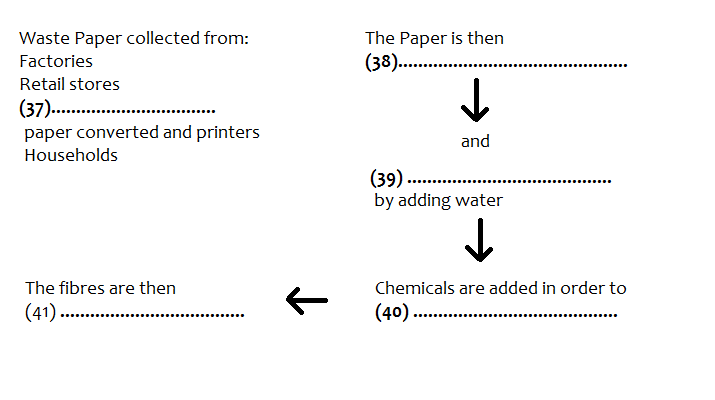
- There are technical limitations to the amount of paper which can be recycled and some paper products cannot be collected for reuse. These include paper in the form of books and permanent records, photographic paper, and paper which is badly contaminated. The four most common sources of paper for recycling are factories and retail stores which gather large amounts of packaging material in which goods are delivered, also offices which have unwanted business documents and computer output, paper converters, and printers, and lastly households which discard newspapers and packaging material. The paper manufacturer pays a price for the paper and may also incur the collection cost.
- Once collected, the paper has to be sorted by hand by people trained to recognize various types of paper. This is necessary because some types of paper can only be made from particular kinds of recycled fibre. The sorted paper then has to be repulped or mixed with water and broken down into its individual fibres. This mixture is called stock and may contain a wide variety of contaminating materials, particularly if it is made from mixed waste paper which has had little sorting. Various machineries are used to remove other materials from the stock. After passing through the repulping process, the fibres from printed waste paper are grey in colour because the printing ink has soaked into the individual fibres. This recycled material can only be used in products where the grey colour does not matter, such as cardboard boxes but if the grey colour is not acceptable, the fibres must be de-inked. This involves adding chemicals such as caustic soda or other alkalis, soaps and detergents, water-hardening agents such as calcium chloride, frothing agents, and bleaching agents. Before the recycled fibres can be made into the paper they must be refined or treated in such a way that they bond together.
- Most paper products must contain some virgin fibre as well as recycled fibres and unlike glass, paper cannot be recycled indefinitely. Most paper is down-cycled which means that a product made from recycled paper is of an inferior quality to the original paper. Recycling paper is beneficial in that it saves some of the energy, labour, and capital that go into producing virgin pulp. However, recycling requires the use of fossil fuel, a non-renewable energy source, to collect the waste paper from the community and to process it to produce new paper. And the recycling process still creates emissions which require treatment before they can be disposed of safely. Nevertheless, paper recycling is an important economic and environmental practice but one which must be carried out in a rational and viable manner for it to be useful to both industry and the community.
Questions 37 - 41
Look at paragraphs C, D, and E and, using the information in the passage, complete the flow chart below. Write your answers in boxes 37 - 41 on your answer sheet.
Use ONE OR TWO WORDS for each answer.
Answers for Practice Exercises
Here you will find the the answers for practice exercise 1,2 and 3.
Doll Restoration Reading Answers
(Note: The text in italics is from the reading passage and shows the location from where the answer is taken or inferred. The text in the regular font explains the answer in detail.)
1.(the) eye mechanism
2.(a) loose head
( 1 and 2 can be in any order)
Explanation: Here, there are two main problems, the eye mechanism has lost its original look, and it has a loose head.
3.separated
Explanation: Then we separated the head from the composition body
4.old dirt
5.wax
Explanation: … and chemically cleaned the head, removing old dirt, and wax, but not harming the original artwork.
6.original eye system
Explanation: Then we took the original eye system, and reconditioned it.
7.(original) mohair wig
Explanation: At this point, we only had to chemically clean and restyle the original mohair wig.
8.clothing designs
Explanation: Our seamstress took over, at this point with suggestions from the owner on likes and dislikes using original period clothing designs.
A Brief (and Tasty) History of Chocolate Reading Answers
(Note: The text in italics is from the reading passage and shows the location from where the answer is taken or inferred. The text in the regular font explains the answer in detail.)
1.backyard gardens
Explanation: Paragraph 2 - Not only were cacao trees harvested in the wild, but Mayans also grew the trees near their homes, in their own backyard gardens.
2.grinding
3.paste
Explanation: Paragraph 2 - The seeds would then be roasted over a fire, followed by grinding between two large stones. The resulting paste was mixed with water,...
4.bitter
Explanation: Paragraph 2 - The final concoction made the cacao paste into a spicy, frothy, and rather bitter drink.
Liberating The GPS Reading Answers
(Note: The text in italics is from the reading passage and shows the location from where the answer is taken or inferred. The text in the regular font explains the answer in detail.)
1.military/ military purposes
Explanation: Paragraph 2 - The GPS project was started in 1973 by the US Department of Defense for military purposes only.
2.24 satellites
Explanation: Paragraph 2 - It became fully functional in 1993 with 24 satellites.
3.precision
Explanation: Paragraph 1 - Selective Availability was an intentional limitation of GPS signals implemented for national security reasons. It limited the precision of GPS signals for non-military users.
4.civilian accuracy
Explanation: Paragraph 1 - William Perry, US Secretary of Defence, proposed to remove the restriction owing to the widespread growth of Global Positioning System services and intended to improve civilian accuracy.
5.discontinued
Explanation: Paragraph 1 - On May 2, 2000, by the order of President Bill Clinton, the US government discontinued the use of Selective Availability (SA) making the Global Positioning System (GPS) more responsive towards commercial and civil users worldwide.
6.positioning
Explanation: Paragraph 1 - The government made the switch over at midnight of 1st May 2000 and 2nd May was the first day when the non-military system discovered an improved positioning precision from 330 to 66 feet.
7.GPS III
Explanation: Paragraph 2 - In September 2007, the US government decided to obtain the future generation of GPS satellites (GPS III).
The Rufous Hare Wallaby Reading Answers
(Note: The text in italics is from the reading passage and shows the location from where the answer is taken or inferred. The text in the regular font explains the answer in detail.)
1.10/ten million
Explanation: The given answer is located in the second line of paragraph A.
2.cats and foxes/ foxes and cats
Explanation: The given answer is located in the 5th line of paragraph A.
3.monitored
Explanation: The given answer is located in the second line of paragraph B.
4.fire
Explanation: The given answer is located in the 6th line of paragraph B
5.extinct
Explanation: The given answer is located in the 7th line of paragraph B
Bricks the versatile building material Reading Answers
(Note: The text in italics is from the reading passage and shows the location from where the answer is taken or inferred. The text in the regular font explains the answer in detail.)
6. Answer: clay
Explanation: In Paragraph G, the writers mentioned that, ‘In the past, bricks were largely manufactured by hand, and there are still artisanal companies that specialise in this product. The process involves putting the clay, water and additives into a large pit, where it is all mixed together by a tempering wheel, often still moved by horse power.’
7. Answer: tempering wheel
Explanation: In Paragraph G, the writers mentioned that, ‘The process involves putting the clay, water and additives into a large pit, where it is all mixed together by a tempering wheel, often still moved by horse power.’
8. Answer: moulds
Explanation: In Paragraph G, the writers mentioned that, ‘Once the mixture is of the correct consistency, the clay is removed and pressed into moulds by hand.’
9. Answer: sand
Explanation: In Paragraph G, the writers mentioned that, ‘To prevent the brick from sticking to the mould, the brick is coated in either sand or water, though coating a brick with sand gives an overall better finish to it.’
10. Answer: strength
Explanation: In Paragraph G, the writers mentioned that, ‘If these bricks left outside for the drying process are exposed to a shower, the water can leave indentations on the brick, which, although not affecting the strength of the brick, is considered very undesirable.’
11. Answer: kiln
Explanation: In Paragraph G, the writers mentioned that, ‘After drying, the bricks are then transferred to the kiln for firing and this creates the finished product.’
The Need to Belong Reading Answers
(Note: The text in italics is from the reading passage and shows the location from where the answer is taken or inferred. The text in the regular font explains the answer in detail.)
1. role
Explanation: In the past, people hunted and cooked together in tribes and each member of the group would be assigned a role. The given answer is located in paragraph B in the beginning of the paragraph.
2.survival
Explanation: To our prehistoric ancestors, membership of a group meant the difference between survival and death. The given answer is located in paragraph B at 4-5 lines.
3.the wild
Explanation: Those who were rejected and excluded from joining a group had to fend for themselves and struggled to stay alive alone in the wild. The given answer is located in paragraph B in 5-7 lines.
4.protection
Explanation: It meant that in the event of the loss of one person, the group as a whole would suffer. For this reason, they had a vested interest in protecting each other. The given answer is located in paragraph B in the 2-4 lines.
5.genes
Explanation: Apart from protection, being part of a group also ensured that genes could be passed on to future generations. The given answer is located in paragraph B in the 7th line.
Liberating The GPS Reading Answers
(Note: The text in italics is from the reading passage and shows the location from where the answer is taken or inferred. The text in the regular font explains the answer in detail.)
37. Answer: offices
Explanation: Paragraph C, Line 4. The four most common sources of paper for recycling are factories and retail stores which gather large amounts of packaging material in which goods are delivered, also offices which have unwanted business documents and computer output, paper converters, and printers, and lastly households which discard newspapers and packaging material.
38. Answer: sorted
Explanation: Paragraph D, Line 1. Once collected, the paper has to be sorted by hand by people trained to recognize various types of paper.
39. Answer: repulped
Explanation: Paragraph D, Line 3. The sorted paper then has to be repulped or mixed with water and broken down into its individual fibres.
40. Answer: de-inked/remove ink
Explanation: Paragraph D, Line 10. This recycled material can only be used in products where the grey colour does not matter, such as cardboard boxes but if the grey colour is not acceptable, the fibres must be de-inked.
41. Answer: refined
Explanation: Paragraph D, Line 15. Before the recycled fibres can be made into the paper they must be refined or treated in such a way that they bond together.
Also check IELTS Academic Reading Yes No Not Given
Conclusion
To ace in the IELTS Reading section you require time and effort. The tips and strategies provided in this article will help in skill building and to answer the flow chart completion practice questions with a minimal effort and time. Familiarising yourself with this question may save your time for answering other questions along with mock test.

About Author Dinesh Pandiyan
Dinesh is a highly experienced content writer who specializes in language proficiency tests like IELTS, GRE, PTE, TOEFL, and study abroad. He provides valuable insights and tips to students on various modules of these tests, including reading, writing, speaking, and listening. His articles are well-researched, informative, and engaging, offering practical guidance to students looking to succeed in their academic pursuits. Additionally, Dinesh has coordinated with IELTS trainers to prepare test preparation materials, guides, practice tests, and mock tests, and worked closely with counsellors for study abroad consultancy, providing guidance on choosing the right institution, preparing for interviews, and writing effective statements of purpose (SOP) and letters of recommendation (LOR). Students can benefit from Dinesh's comprehensive knowledge and experience by checking out his articles.
Kanan International is a study abroad consultancy that offers reliable services, products, and solutions for students and education institutions. We support students throughout their study abroad journey, ensuring a hassle-free experience. Our expertise and commitment to excellence make us the go-to partner for expanding global horizons. The company provides coaching for IELTS, GRE, TOEFL, and SAT exams and services like visa consultation, accommodation, scholarship assistance, and education loans.
Free Online Mock Test 2026
Practice our mock test worth Rs. 25000 for Free and know your IELTS score!








Global Headquarters
Kanan Int EdTech Inc
320 Bay Street, Suite 321 (Spaces), Toronto ON, Canada M5B 1N9
Indian Headquarters
Kanan International Pvt. Ltd.
D-wing, 2nd Floor, Trident Complex, Ellora Park Vadiwadi Road, Vadodara, Gujarat 390007
IT/ Digital Campus
Kanan International Pvt. Ltd
Old, New No 3, 2nd Floor, 1A, Dr Sadasivam Rd, T. Nagar, Chennai, Tamil Nadu 600017
Our branches
- Bardoli
- Bharuch
- Chennai
- Dehradun
- Gurugram
- Himatnagar
- Karnal
- Nadiad
- Navsari
- Palanpur
- Rajkot
- Vadodara
- Valsad
- Vallabh Vidyanagar
- Vapi
Study Abroad
Test Prep
Top Universities
Consultants
IELTS Centers
GRE Centers
TOEFL Centers
SAT Centers
Language Courses in Vadodara
Study Abroad Calculators
Featured Blogs
Study Abroad Consultants in Chennai
Study Abroad Consultants in Surat
Study Abroad Consultants in Navsari
Study Abroad Consultants in Bardoli
Study Abroad Consultants in Ahmedabad
Study Abroad Consultants in Anand
Study Abroad Consultants in Khanna
Study Abroad Consultants in Nadiad
Study Abroad Consultants in Vadodara
Study abroad consultants in Valsad
Copyright © 2026 KANAN.CO All rights reserved.