- Study Abroad
- / ielts
- / americas oldest art reading answers
America’s oldest art Reading Answers


Author
16-09-2025

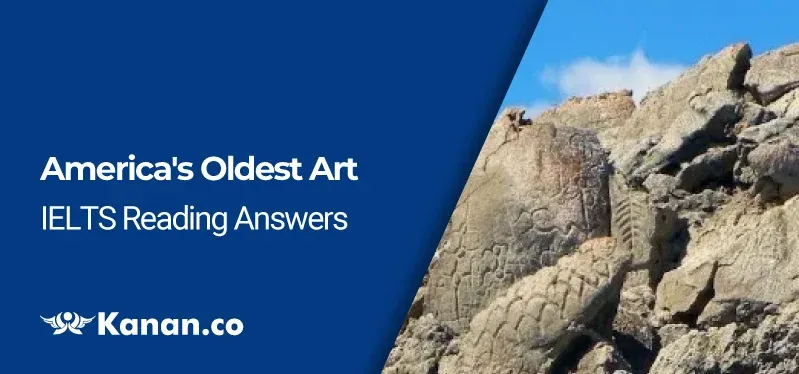
America’s oldest art answers practice tests is provided with answers and explanations. This passage comprises 14 questions divided into three question types -choose the correct letter, yes/no/not given and complete the sentence reading passage.
Check out our YouTube Channel to Practice Full-Length IELTS Reading Tests Daily

Table of contents:
- Solution for America’s oldest art
- America’s oldest art IELTS Reading Practice Test
- Passage
- Questions
- Answers with Explanations
Solution for America’s oldest art
America’s oldest art reading answers are listed in the table below. Verify your answers against our answer table, then correct any inaccuracies.
Answer Table
| 27. b | 31. yes | 35. not given | 39. a |
| 28. a | 32. not given | 36. no | 40. b |
| 29. d | 33. no | 37. c | |
| 30. no | 34. yes | 38. e |

America’s oldest art IELTS Reading Practice Test - Exam Review
America’s oldest art reading answers are given here, which will help you excel in the IELTS reading practice test to challenge your reading skills.Paraphrasing can help you to understand the ideas clearly which makes you able to efficiently answer the questions.
Passage
We’ve provided the reading passage of America’s oldest art. Read the passage and carefully complete the questions. Check the answers with our America’s oldest art reading answers with locations.
America’s oldest art
- Set within treacherously steep cliffs, and hidden away valleys of northeast Brazil,is some of Southeast America’s most significant and spectacular rock-art. Most ofthe art so far discovered from the ongoing excavations comes from thearchaeologically – important National Park of the Serra da Capivara in the state ofPiaui, and it is causing quite a controversy. The reason for the uproar? The art isbeing dated to around 25.CC0 or perhaps.
- According to some archaeologists, even36,000 years ago. If correct, this is set to challenge the wide-field view that Americawas first colonized from the north, via the Bering Straits from eastern Siberia ataround 10.000 BC. only moving down into Central and South America in the millennia thereafter.
- Prior to the designation of 130,000 hectares as a National Park, the rock-art sites were difficult to get to and often dangerous to enter. In ancient times, this inaccessibility must have heightened the importance of the sites, and indeed of the people who painted on the rocks. Wild animals and human figures dominate the art and are incorporated into often-complex scenes involving hunting, supernatural beings, fighting and dancing. The artists depicted the animals that roamed the local ancient brushwood forest.
- The large mammals are usually hunted in groups and tend to be shown a running stance, as they trying to escape from hunting parties. Processions – lines of human and animal figures – also appear of great importance to these ancient artists. Might such lines represent family units or groups of warriors? On a number of panels, rows of stylized figures, some numbering up to 30 individual figures, were painted using the natural undulating contours of the rock surface, so evoking the contours of the seconding landscape. Other interesting, but very rare, occurrences are scenes that show small human figures holding on to and dancing around a tree, possibly involved in some form of a ritual dance.
- Due to the favourable climatic conditions. the imagery on many panels is in a remarkable state of preservation. Despite this, however, there are serious conservation issues that affect their long term survival. The chemical and mineral quantities of the rock on which the imagery is panted are fragile and on several panels it is unstable. As well as the secretion of sodium carbonate on the rock surface, complete panel sections have, over the ancient and recent past, broken away from the main rock surface. These have then become buried and sealed into sometimes-ancient floor deposits.
- Perversely, this form of natural erosion and subsequent deposition has assisted archaeologists in dating several major rock-art sites. Of course, dating the art is extremely difficult oven the non-existence of plant and animal remains that might be scientifically dated. However, there am a small number of sites in the Serra da Capivara that are giving up their secrets through good systematic excavation. Thus, at Toca do Roqi.omo da Pedra Furada. rock-art researcher Nide Guidon managed to obtain a number of dates.
- At different levels ofexcavation, she located fallen painted rock fragments, which she was able to dale toat least 36,000 years ago. Along with toe painted fragments, crude stone tools werefound. Also discovered were a series of scientifically datable sites of fireplaces, orhearths, the earliest dated to 46,000 BC. arguably the oldest dates for humanhabitation in America.
- However, these conclusions are not without controversy. Critics, mainly from North America, have suggested that the hearths may, in fact, be a natural phenomenon, the result of seasonal brushwood fires. Several North American researchers have gone further and suggested that the rock art from this site dates from no earlier than about 3,730 years ago, based on the results of limited radiocarbon dating.
Adding further fool to the general debate is the fact that the artists in the area of the NationalHark tended not to draw over old motifs (as often occurs with rock-art), which makesit hard to work out the relative chronology of the images or styles. However, thediversity of imagery and the narrative the paintings created from each of the many sites within the National Park suggests different artists were probably making theirart at different times and potentially using each site over many thousands of years. - With fierce debates thus raging over to dating, where these artists originate from is also still very much open to speculation. The traditional view ignores the early dating evidence from the South American rock-art sites. In a revised scenario, some anthropologists are now suggesting that modern humans may’ have migrated from Africa using the strong currents of the Atlantic Ocean some 63.000 years or more ago, while others suggest more improbable colonization coming from the Pacific Ocean.
Yet, while the ether hypothesis is plausible, there is still no supporting archaeological evidence between the South American coastline and the interior. Rather, it seems possible that there were a number of waves of human colonization of the Americas occurring possibly over a 60,000-100,000 year period, probably using the Bering Straits as a land bridge to cross into the Americas. - Despite the compelling evidence from South America, it stands alone: the earliest secure human evidence yet found in die state of Oregon in North America only dates to 12,300 years BC. So this is a fierce debate that is likely to go on for many more years. However, the splendid rock art and its allied anthropology of northeast of Brazil, described here, is playing a huge and significant role in the discussion.
QUESTIONS
QUESTIONS 27-29
Choose the correct letter, A, B, C or D.
27. According to the first paragraph, the rock-art in Serra da Capivara may revolutionize accepted ideas about …………………….
A. the way primitive people lived in North America.
B. the date when the earliest people arrived in South America.
C. the origin of the people who crossed the Bering Straits.
D. the variety of cultures which developed in South America.
28. How did the ancient artists use the form of the rock where they painted?
A. to mimic the shape of the countryside nearby
B. to emphasize the shape of different animals
C. to give added light and shade to their paintings
D. to give the impression of distance in complex works
29. In the fourth paragraph, what does the winter say that is unusual about the rock-artists of Serra da Capivara?
A. They had a very wide range of subject-matter.
B. Their work often appears to be illustrating a story.
C. They tended to use a variety of styles in one painting.
D. They rarely made new paintings on top of old ones.
QUESTIONS 30-36
In boxes 30-36 on your answer sheet, write
YES if the statement agrees with the claims of the writer
NO if the statement contradicts the claims of the writer
NOT GIVEN if it is impossible to say what the writer thinks about this
30. Archaeologists have completed their survey of the rock-art in Piaui.
31. The location of the rock-art suggests that the artists had a significant role in their society.
32. The paintings of animals show they were regarded as sacred by the ancient humans.
33. Some damage to paintings is most likely due to changes in the weather of the region.
34. The fact that some paintings were buried is useful to archaeologists.
35. The tools found near some paintings were probably used for hunting animals.
36. The North American researchers have confirmed Niede Guidon’s dating of the paintings.
QUESTIONS 37-40
Complete each sentence with the correct ending, A-F below.
A. are giving rise to a great deal of debate among palaeo-anthropologists.
B. do not support the earliest dates suggested for the arrival of people in America.
C. are absent from rock-art sites In the Serra da Capivara.
D. have not been accepted by academics outside America.
E. centre on whether or not they are actually man-made.
F. reflect the advances in scientific dating methods.
37. Materials derived from plants or animals …………………
38. The discussions about the ancient hearths ……………….
39. Theories about where the first South Americans originated from ………………..
40. The finds of archaeologists in Oregon …………………….
Answers for America’s oldest art With Explanations
America’s oldest art reading answers with explanations is given below. Refer to the following answers with an explanation section to correct your errors.
(Note: The text in italics mentions the location and referring lines written in the reading passage.)
27.Answer : B
Explanation: located in the 5th line of paragraph A. The rock-art in Serra da Capivara is mentioned in paragraph A, where the 5th line states, "If correct, this is set to challenge the wide-field view that America was first colonized from the north, via the Bering Straits from eastern Siberia around 10.000 BC, only moving down into Central and South America millennia later." We might extrapolate from these lines that the prevailing conceptions of America being colonized from the north in 10,000 BC and the south in subsequent millennia demonstrated that the earliest people came considerably earlier in South America. As a result, the correct answer is B.
28.Answer: A
Explanation: located in the 5th line of paragraph B. The artists painted the animals that roamed the area ancient brushwood forest, according to the fifth line of paragraph B. Large mammals are typically hunted in groups and are often depicted in a running stance as they attempt to elude hunting parties. We can conclude that the artist depicted animals roaming in the nearby ancient brushwood forest in his paintings. Even enormous beasts were hunted in groups as they attempted to flee from hunting parties. As a result, the artists depicted anything they saw in their surroundings, which were then rural. As a result, the answer is A.
29.Answer: D
Explanation: located in the 5th line of paragraph D. Paragraph D's fifth line states Adding to the confusion is the fact that the painters in the National Hark tended not to draw over existing motifs (as is common with rock art), making it difficult to determine the relative timing of the pictures or styles. We believe that the artists of Serra da Capivara did not draw over ancient paintings in the same way as rockartists did, making it difficult to determine the relative dating of the pictures or styles. This was uncommon in the case of rock arts since painters rarely painted over previous motifs, that is, they rarely made new paintings on top of old ones. As a result, the answer is D.
30.Answer: No
Explanation: located in the 2nd line of paragraph A. The majority of the art unearthed so far from current digs comes from the archaeologically significant National Park of the Serra da Capivara in the state of Piaui, which is making quite a stir. These lines indicate that the excavations are still ongoing and that new artworks are being unearthed in Serra da Capivara, which resulted in the incomplete survey. The term "ongoing" alludes to the survey's continuation. As a result of the statement contradicting the information, the answer is No.
31.Answer: Yes
Explanation: located in paragraph B. The rock-art sites were difficult to access and often dangerous to enter prior to the establishment of 130,000 hectares as a National Park, according to the introductory paragraph of Paragraph B. This inaccessibility must have increased the value of the places, as well as the people who painted on the rocks, un ancient times. We can appreciate how difficult it was to gain access to the rock art sites before they were designated as a national park. The inaccessibility of these areas in ancient times boosted their value, where people painted rock paintings. These sentences show that the artists had an important part in their society. As a result of the statement matching the information, the response is Yes.
32.Answer: Not given
Explanation: Not Available
33.Answer: No
Explanation: located in the first line of paragraph C. The first words of paragraph C suggest that the imagery on several panels is in a remarkable state of preservation due to ideal environmental circumstances. Despite this, there are significant conservation challenges that threaten their long-term survival. We believe the paintings are in excellent condition because the weather has preserved the majority of the imagery on the panels. Conservation concerns are those that influence the preservation of the arts. Because the statement contradicts the data, the answer is No.
34.Answer: Yes
Explanation: located in the 5th line of paragraph C. According to the fifth sentence of paragraph C, these have then become buried and sealed into sometimes-ancient floor deposits. Contrary to popular belief, this type of natural erosion and subsequent deposition has aided archaeologists in dating some significant rock-art sites. We believe the paintings were covered in floor deposits, and the deposition caused by soil erosion has aided archaeologists in studying these rock art sites and determining their approximate dates. As a result, the answer is yes.
35.Answer: Not given
Explanation: Not Available
36.Answer: No
Explanation: located in second line of paragraph D. According to the second line of paragraph D, numerous North American researchers have gone farther and proposed that the rock art from this site dates no earlier than 3,730 years ago, based on the results of restricted radiocarbon dating. We can deduce from these lines that North American researchers have gone above and beyond, claiming that the rock art at the site dates back earlier than 3,730 years, based on the results of restricted radiocarbon dating. As a result of the statement contradicting the information, the answer is No.
37.Answer: C
Explanation: located in the 7th line of paragraph C. According to the seventh line of paragraph C, dating the art is extremely challenging due to the lack of plant and animal remnants that may be properly dated. We can deduce from these lines that dating the art is difficult due to the lack of plant and animal remains that could be scientifically dated. As a result, materials produced from plants or animals are missing from Serra da Capivara rock art locations. As a result, the solution is C.
38.Answer: E
Explanation: located in first line of paragraph D. According to the first sentence of paragraph D, opponents, primarily from North America, have maintained that the hearths are a natural phenomenon caused by seasonal brushwood fires. These lines show that North American critics believe the hearths are a natural phenomena caused by seasonal brushwood fires. As a result, it is clear that the debate over the ancient hearths is centered on whether or not they are man-made. As a result, the answer is E.
39.Answer: A
Explanation: located in first line paragraph E. With fierce debates thus raging over to dating, where these artists originate from is also still very much open to speculation. The traditional view ignores the early dating evidence from the South American rock-art sites.
40.Answer: B
Explanation: located in paragraph F. Thus, despite convincing evidence from South America, it stands alone: the earliest secure human evidence unearthed in North America was only 12,300 years ago in the state of Oregon. Although evidence from excavations suggests earlier colonization of South America, we recognize that the Oregon findings in North America do not support the earliest dates, as the existing dates of human evidence date to 12,300 years.
Other Reading Tests

About Author Gayathri Nagarajan
Gayathri, a trusted study-abroad expert, with expertise in standardized tests like IELTS, TOEFL, PTE, GRE, and GMAT. With a strong tech background from SASTRA University, she excels in software testing and has a passion for content writing and digital marketing. She aids students in finding the perfect academic fit, offering guidance on course selection, LOR and SOP writing. She remains up-to-date with the latest trends in higher education, delivering credible, accurate information on international education, including courses and test prep materials. As a trusted Study abroad expert at Kanan International, explore her latest blogs and articles for comprehensive insights into studying abroad and realizing your academic aspirations.
Kanan.co is a trusted study abroad consultancy offering comprehensive services, resources, and solutions for students and education institutions. We support students at every stage of their global education journey, ensuring a smooth and guided experience. Along with test preparation for IELTS, GRE, TOEFL, and SAT, we provide expert services such as SOP writing, visa guidance, accommodation support, scholarship assistance, and education loan support. Our expertise and commitment to excellence make us a reliable partner for students pursuing international education.
Free Online Mock Test 2026
Practice our mock test worth Rs. 25000 for Free and know your IELTS score!








Global Headquarters
Kanan Int EdTech Inc
320 Bay Street, Suite 321 (Spaces), Toronto ON, Canada M5B 1N9
Indian Headquarters
Kanan International Pvt. Ltd.
D-wing, 2nd Floor, Trident Complex, Ellora Park Vadiwadi Road, Vadodara, Gujarat 390007
IT/ Digital Campus
Kanan International Pvt. Ltd
Old, New No 3, 2nd Floor, 1A, Dr Sadasivam Rd, T. Nagar, Chennai, Tamil Nadu 600017
Our branches
- Bardoli
- Bharuch
- Chennai
- Dehradun
- Gurugram
- Himatnagar
- Karnal
- Nadiad
- Navsari
- Palanpur
- Rajkot
- Vadodara
- Valsad
- Vallabh Vidyanagar
- Vapi
Study Abroad
Test Prep
Top Universities
Consultants
IELTS Centers
GRE Centers
TOEFL Centers
SAT Centers
Language Courses in Vadodara
Study Abroad Calculators
Featured Blogs
Study Abroad Consultants in Chennai
Study Abroad Consultants in Surat
Study Abroad Consultants in Navsari
Study Abroad Consultants in Bardoli
Study Abroad Consultants in Ahmedabad
Study Abroad Consultants in Anand
Study Abroad Consultants in Khanna
Study Abroad Consultants in Nadiad
Study Abroad Consultants in Vadodara
Study abroad consultants in Valsad
Copyright © 2026 KANAN.CO All rights reserved.