- Study Abroad
- / ielts
- / answer key for academic reading passage
Answer Key for IELTS Academic Reading Passage 2


Author
19-09-2025

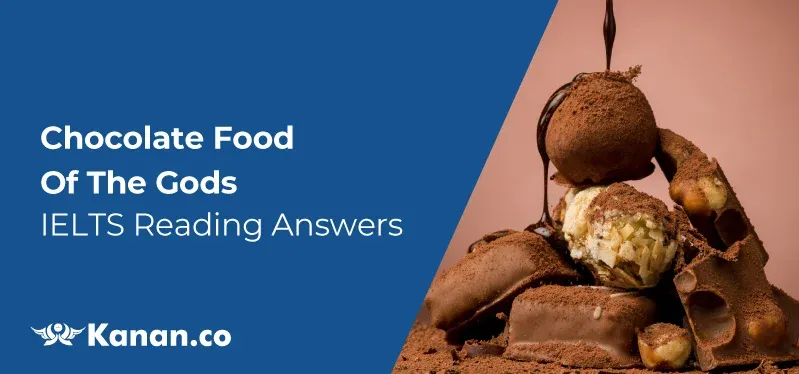
Here is the answer key for the Chocolate food of the gods reading passage.
| 1. v | 5. viii | 9. Yes | 13. Conching |
| 2. x | 6. iii | 10. Not given | |
| 3. i | 7. Yes | 11. Roasting | |
| 4. xi | 8. No | 12. Cocoa butter |

Check out our YouTube Channel to Practice Full-Length IELTS Reading Tests Daily

To learn the reasons behind each correct answer, read the following passage and questions. It helps you ace the reading section (both Academic and General).
Chocolate Food of the Gods
A. The story of chocolate begins with the discovery of America in 1492. Columbus was the first European to come into contact with cacao. On August 5th, 1502, on his fourth and last voyage to the Americas, Columbus and his crew met some natives in a canoe that contained beans from the cacao tree. Columbus was struck by how much value the Indians placed on them as he did not know the beans were used for currency. It is unlikely that Columbus brought any of these beans back to Spain and it was not until about twenty years later that Cortez grasped the commercial possibilities when he found the Aztecs using the beans to make the royal drink “chocolate”.
B. The Spanish, in general, were not fond of the bitter drink so Cortez and his followers made it more palatable by adding cane sugar and later cinnamon and vanilla were added. Spanish monks let the secret out back home and, although the Spanish hid it from their neighbors for a hundred years, finally chocolate’s popularity grew until it was the fashionable drink at the French court and the discerning choice of customers at London meeting houses.
C. The cacao beans are harvested from pods grown on the cacao tree. The pods come in a range of types since cacao trees cross-pollinate freely. These types can be reduced to three classifications. The most common is Forastero, which accounts for nearly 90% of the world’s production of cacao beans. This is the easiest to cultivate and has a thick-walled pod and a pungent aroma. Rarest and most prized are the beans of the Criollo. These beans from the soft, thin-skinned pod have an aroma and delicacy that make them sought after by the world’s best chocolate makers. Finally, there is the Trinitario, which is believed to be a natural cross from strains of the other two types. It has a great variety of characteristics but generally possesses a good, aromatic flavor and the trees are particularly suitable for cultivation.
D. The cacao tree is strictly a tropical plant thriving only in hot, rainy climates. Thus, its cultivation is confined to countries not more than 20 degrees north or south of the equator. The cacao tree is very delicate and sensitive. It needs protection from the wind and requires a fair amount of shade under most conditions. This is true, especially in its first two or three years of growth. A newly planted cacao seedling is often sheltered by a different type of tree. It is normal to plant food crops for shade such as bananas, plantain, coconuts or cocoyam. Rubber trees and forest trees are also used for shade. Once established, however, cacao trees can grow in full sunlight, provided there are fertile soil conditions and intensive husbandry. With pruning and careful cultivation, the trees of most strains will begin bearing fruit in the fifth year. With extreme care, some strains can be induced to yield good crops in the third and fourth years.
E. The process of turning cocoa into chocolate hasn’t changed much since the Swiss made the major breakthroughs in the process in the late 1800s. First, the beans (up to twelve varieties harvested from all over the world) go through a process of fermentation and drying. They are then sorted by hand before cleaning and then roasting. Winnowing follows which removes the hard outer hulls and leaves what is known as the “nibs”. A crushing and heating process known as Hunter’sProcess is then used to remove nearly half of the cocoa butter from the nibs. This makes unsweetened chocolate (also known as cooking chocolate). Basic eating chocolate is made from a blending of the unsweetened chocolate with some of the cocoa butter along with other ingredients such as sugar and vanilla. The resulting product is then “conched” and this conching gives chocolate the velvet texture that we know so well. The finished result is then molded, cooled, packaged by machine, distributed, sold and, of course, eaten!
F. Where methods of manufacturing are concerned, manufacturers have a completely free hand and have developed individual variations from the pattern. Each manufacturer seeks to protect his own methods by conducting certain operations under an atmosphere of security. No chef guards his favorite recipes more zealously than the chocolate manufacturer guards his formulas for blending the beans. Time intervals, temperatures and proportions are three critical factors that no company wants to divulge.
G. Apart from the taste, one of the most pleasant effects of eating chocolate is the “good feeling” that many people experience after indulging. Chocolate contains more than three known chemicals including caffeine, theobromine and phenylethylamine which are stimulants. Some researchers believe that chocolate contains pharmacologically active substances that have the same effect on the brain as marijuana and that these chemicals may be responsible for problems such as the psychoses associated with chocolate craving. However, eating too much of anything can obviously cause health problems and as long as moderation is exercised, chocolate should not cause the average person any harm.
Questions
Questions 1-6
- The reading passage on The Story of Chocolate has 7 paragraphs A –G.
- From the list of headings below choose the most suitable headings for paragraphs B –G. Write the appropriate number (i –xi) in boxes 1-6 on your answer sheet.
- There are more headings than paragraphs, so you will not use them all.
List of Headings
List of Headings
i) Growing The Tree
ii) Problems With Manufacture
iii) Why We Like It
iv) How the Aztecs Discovered Chocolate.
v) Chocolate Spreads to Europe
vi) First Contact
vii) The Countries that Grow Cacao Trees
viii) Secrecy Issues
ix) Recipes for Using Chocolate
x) Varieties of Cacao
xi) From Bean to Bar
Example Answer
Paragraph A iv
1. Paragraph B
2. Paragraph C
3. Paragraph D
4. Paragraph E
5. Paragraph F
6. Paragraph G
Questions 7-10
- Do the following statements agree with the information given in The Story of Chocolate?In boxes 7-10 on your answer sheet write:
- YES if the statement agrees with the information
- NO if the statement contradicts the statement
- NOT GIVEN if there is no information on this in the passage
7. Most early Spaniards did not particularly like the chocolate that the Aztecs originally drank.
8. The Forastero bean is generally regarded as making the best chocolate.
9. Cacao trees need a lot of looking after to be used commercially.
10. Some chocolate companies have been known to steal chocolate recipes from other companies.
Questions 11-13
- Using the information in the passage, complete the flowchart below. Write your answers in boxes 11-13 on your answer sheet.
- Use NO MORE THAN THREE WORDS from the passage for each answer.
The Chocolate Production Process
The beans are (eg) __________ at the farm and are then fermented, dried, sorted and cleaned. Answer – harvested
The beans are winnowed after 11.__________ and these two processes produce the nibs.
Some of the 12.__________ is then extracted using Hunte’s Process to make cooking chocolate.
The cooking chocolate is then blended with other ingredients to make the various types of eating chocolate available today. 13.__________produces the smoothness in the chocolate.The chocolate is re-heated to melt it, put into molds and then cooled to make its final shapes. The finished product is wrapped automatically, sent to the shops and then sold. Finally, the customer eats his or her bar of chocolate.
Answers with Explanations
Chocolate food of the gods reading answers with explanations are as follows.
(Note: The text in italics mentions the location and referring lines written in the reading passage)
1. Answer: v
Explanation: The Spanish, in general, were not fond of the bitter drink so Cortez and his followers made it more palatable by adding cane sugar and later cinnamon and vanilla were added. The given answer is located in the 1-3 lines of paragraph B.
2. Answer: x
Explanation: The pods come in a range of types since cacao trees cross-pollinate freely. The given answer is located in the 1-2 lines of paragraph C.
3. Answer: i
Explanation: The cocoa tree is strictly a tropical plant thriving only in hot, rainy climates. The given answer is located in the 1st line of paragraph D.
4. Answer: xi
Explanation: The process of turning cocoa into chocolate hasn’t changed much since the Swiss made the major breakthroughs in the process in the late 1800s. The given answer is located in the 1-2 lines of paragraph E.
5. Answer: viii
Explanation: Each manufacturer seeks to protect his own methods by conducting certain operations under an atmosphere of security. The given answer is located in the 2-4 lines of paragraph F.
6. Answer: iii
Explanation: Apart from the taste, one of the most pleasant effects of eating chocolate is the “good feeling” that many people experience after indulging. The given answer is located in the 1-2 lines of paragraph G.
7. Answer: Yes
Explanation: The Spanish, in general, were not fond of the bitter drink so Cortez and his followers made it more palatable by adding cane sugar and later cinnamon and vanilla were added. The given answer is located in the 1-3 lines of paragraph B.
8. Answer: No
Explanation: Rarest and most prized are the beans of the Criollo. The given answer is located in the 5th line of paragraph C.
9. Answer: Yes
Explanation: It needs protection from the wind and requires a fair amount of shade under most conditions. The given answer is located in the 3-4 lines of paragraph D.
10. Answer: Not Given
11.Answer: Roasting
Explanation: Winnowing follows which removes the hard outer hulls and leaves what is known as the “nibs''. The given answer is located in the 4-5 lines of paragraph E.
12. Answer: Cocoa Butter
Explanation: A crushing and heating process known as Hunter’s Process is then used to remove nearly half of the cocoa butter from the nibs. The given answer is located in the 6-7 lines of paragraph E.
13. Answer: Conching
Explanation: The resulting product is then “conched” and this conching gives chocolate the velvet texture that we know so well. The given answer is located in the 10-11 lines of paragraph E.
Other Reading Tests

About Author Roshan Sunthar
Roshan Sunthar is a study abroad expert as well as a renowned writer and author in international education. His academic excellence and 5+ years of work experience give him in-depth knowledge of international standardised exams and test preparation in IELTS, TOEFL, GRE, PTE, SAT, etc. The study materials he prepares incorporate exam-like questions. He’s also an expert in writing Statement of Purposes (SOPs) and Letter of Recommendations (LORs) for college admissions. He usually spends his leisure time watching English classics and documentaries, travelling, etc.
Kanan.co is a trusted study abroad consultancy offering comprehensive services, resources, and solutions for students and education institutions. We support students at every stage of their global education journey, ensuring a smooth and guided experience. Along with test preparation for IELTS, GRE, TOEFL, and SAT, we provide expert services such as SOP writing, visa guidance, accommodation support, scholarship assistance, and education loan support. Our expertise and commitment to excellence make us a reliable partner for students pursuing international education.
Free Online Mock Test 2026
Practice our mock test worth Rs. 25000 for Free and know your IELTS score!








Global Headquarters
Kanan Int EdTech Inc
320 Bay Street, Suite 321 (Spaces), Toronto ON, Canada M5B 1N9
Indian Headquarters
Kanan International Pvt. Ltd.
D-wing, 2nd Floor, Trident Complex, Ellora Park Vadiwadi Road, Vadodara, Gujarat 390007
IT/ Digital Campus
Kanan International Pvt. Ltd
Old, New No 3, 2nd Floor, 1A, Dr Sadasivam Rd, T. Nagar, Chennai, Tamil Nadu 600017
Our branches
- Bardoli
- Bharuch
- Chennai
- Dehradun
- Gurugram
- Himatnagar
- Karnal
- Nadiad
- Navsari
- Palanpur
- Rajkot
- Vadodara
- Valsad
- Vallabh Vidyanagar
- Vapi
Study Abroad
Test Prep
Top Universities
Consultants
IELTS Centers
GRE Centers
TOEFL Centers
SAT Centers
Language Courses in Vadodara
Study Abroad Calculators
Featured Blogs
Study Abroad Consultants in Chennai
Study Abroad Consultants in Surat
Study Abroad Consultants in Navsari
Study Abroad Consultants in Bardoli
Study Abroad Consultants in Ahmedabad
Study Abroad Consultants in Anand
Study Abroad Consultants in Khanna
Study Abroad Consultants in Nadiad
Study Abroad Consultants in Vadodara
Study abroad consultants in Valsad
Copyright © 2026 KANAN.CO All rights reserved.