- Study Abroad
- / ielts
- / biology of bitterness ielts reading answers
Biology of bitterness IELTS reading answers


Author
16-09-2025

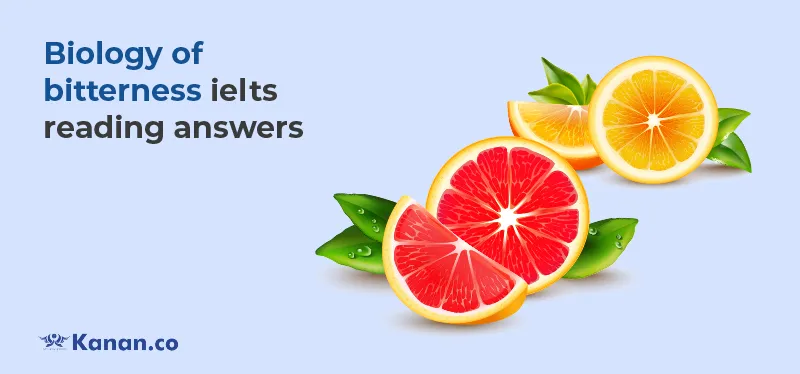
Biology of bitterness IELTS reading answer are given below in the table format. Examine your answers and correct your mistakes.
| 1.B | 5.G | 9.NARINGIN | 13.A |
| 2.I | 6.H | 10.POISONOUS | 14.D |
| 3.C | 7.A | 11.SUPERTASTERS | |
| 4.E | 8.D | 12.TASTEBUDS |
Our reading answers can help you prepare for the IELTS reading exam. Finish the practice test and go through the detailed explanations for the Biology of bitterness IELTS reading answer in order to enhance your ability to respond.
This article consists of three different IELTS reading questions types for the Biology of bitterness IELTS reading answer. Completing the provided exercise and honing the skills assessed on the IELTS reading exam will allow you to improve your IELTS reading test skills. The following question types are used in this article:
- IELTS Reading Multiple choice questions
- IELTS Reading Locating information
- IELTS Reading Summary completion
Check Out our YouTube Channel to Practice Full-Length IELTS Reading Tests Daily

Strategies to Identify Biology of bitterness IELTS reading answers with location
Note some strategies for solving the passage before writing the Biology of Bitterness reading answer.
- Biology of Bitterness passage is taken from the IELTS Academic (AC) reading practice test. Get the Biology of Bitterness reading pdf given in this article for your future reference.
- Matching headings necessitates summarising and paraphrasing abilities in order to comprehend the heading and the primary idea of each paragraph.
- To understand the answering process as well as to improve your reading skills consider the Biology of Bitterness reading answers with explanations sections in this article.
- Moreover, locate your answers with the Biology of Bitterness reading answers with locations.
- For true/false/not given you must have a good knowledge of vocabulary to recognize the statement, as it may contain synonyms, and you must identify the keywords in the statement in order to locate the information in the passage.
- To answer the sentence completion question types you must have the scanning skill as well as pay careful attention to the instructions given.
- You must have a consistent reading habit in order to excel in the IELTS test. This will help you to strengthen your reading, vocabulary, and language skills.
- To solve the reading sections in a smart way you must develop your reading skills, such as scanning, skimming, paraphrasing, and summarising, as well as manage your time efficiently.
As reading is one of the most challenging sections of the IELTS exam, you can review the other IELTS reading tips after reviewing your Biology of Bitterness reading answers.
IELTS reading passage - Biology of Bitterness
You should spend about 20 minutes on Questions 1-14 which are based on Reading Passage 2 below. After you've attempted all of the questions, review your answers using the provided Biology of Bitterness reading answers with locations.
Biology of Bitterness
For many individuals, Grapefruit is only edible when drenched in sugar. It can be changed by Bitter Blocker, namely adenosine monophosphate.
A.
Majority of individuals prefer not to drink more than a few ounces of grapefruit juice and as a result of this, it is served in small glasses. Grapefruit consists of a naturally occurring chemical compound that has a bitter taste and is named Arginin. Some are of the notion that they enjoy the bitterness in small doses as it enhances the overall flavour whereas, a few others claim that they prefer to avoid it entirely. As a result, juice packagers more often choose grapefruit with low arginine levels. Despite the fact that the compound contains antioxidants, which some nutritionists believe may aid in the prevention of cancer and atherosclerosis, the compound is not recommended for consumption.
B.
Nevertheless, grapefruit without bitter taste has possible benefits. In a test- Linguagen Corporation which I eventually decided to take part is a biotechnology firm in Cranbury, New Jersey. Sets of two miniature white paper cups labelled 304 and 305 were given to a few people seated around a conference table. We drank from one cup, then the other, wiping our palates with water and a soda cracker in between, blocks the bitterness in foods. However, comparatively, 305 was smoother; it didn't have the bitterness of arginine but a sour citrus flavor. Additives in the juice were added such as adenosine monophosphate or AMP; it is mainly used to deduce the nutritional value.
C.
Five primary flavors are delved into by scientists namely - .sweet, sour, bitter, salty, and umami, the savory taste of protein these days. Bitterness is untapped potential in food and as a result, it is appealing to the industry. Nature contains thousands of bitter-tasting compounds. Their main work is to protect the poisonous plant from animals and vice versa. However, the system is not without flaws. Despite the fact that sometimes as a result of their bitter taste, grapefruit, and cruciferous vegetables like Brussels sprouts and kale are nutritious. As time passes, the majority of individuals have learned to love them, at least in small doses.
Charles Zuker, a neuroscientist at the University of California, San Diego, asserts that only humans enjoy bitter flavors. Every other species dislikes bitter because it implies bad news, but humans have learned to enjoy it. We consume both coffee and quinine. Because bitterness can be palatable in small doses but repulsive in large doses, we believe that AMP could make a variety of foods, drinks, and medicines more appetizing — and thus more lucrative.
D.
Individuals differ in their ability to taste bitterness, and these differences appear to be genetic. 75% of individuals are sensitive to the bitter compounds phenylthiocarbamide and 6-n-propylthiouracil, compared to 25% who are not. According to University of Utah geneticist Stephen Wooding, those who are sensitive to phenylthiocarbamide appear to consume cruciferous vegetables less frequently than others. Some people, known as supertasters, are particularly sensitive to 6-n-propylthiouracil due to their unusually large number of taste buds. Vegetables, coffee, and dark chocolate are examples of bitter foods that supertasters typically avoid. Consequently, they may be thin. Alcoholic beverages, which are frequently slightly bitter, also repel them. For instance, the majority of people consider Dewar's scotch to be slightly sweet. Valerie Duffy, associate professor of dietetics at the University of Connecticut at Storrs, explains, "A supertaster, on the other hand, tastes nothing but bitterness."
E.
According to a recent study, supertasters consume alcoholic beverages on average two to three times per week, whereas non-tasters consume them five or six times per week. Each onion-shaped taste bud is composed of 50 to 100 elongated cells that extend from top to bottom. Taste molecules in food and drink, known as tastants, are captured by a small cluster of receptors at the top. The receptors function similarly to those for vision and smell. When a bitter signal is received, it is transmitted via proteins known as G proteins. Robert Margolskee, the founder of Linguagen, discovered in the early 1990s at Mount Sinai School of Medicine in New York City the G protein involved in the perception of bitterness, sweetness, and umami. The protein gustducin initiates a series of chemical reactions that alter the ion concentrations within the cell. The brain finally receives a signal indicating bitterness. Margolskee describes the signalling system as "like a bucket brigade. "It traverses the G protein and reaches other proteins."
F.
In the year 2000, Zuker and his colleagues discovered 30 distinct bitter-taste receptor-coding genes. "Because the universe of bitter tastants is so vast, we knew it had to be a large number," says Zuker. Bitter tastes the same regardless of the tastant that enters the mouth or the receptor to which it binds. The only distinction is that it is stronger and can be flavoured through the sense of smell. "Taste cells are similar to light switches," explains Zuker. They are either active or inactive.
G.
Once scientists determined the location of the taste mechanism, they began to consider ways to interfere with it. They examined AMP, an organic compound found in breast milk, in addition to other substances produced by cells during digestion. Margolskee and his colleagues discovered that although amp has no bitter taste on its own, it binds to bitter-taste receptors when added to foods. Due to the fact that AMP is unlikely to bind to all 30 bitter-taste receptors, it may not be able to mask every bitter flavour. Consequently, language has increased its search for additional bitter blockers by employing high-throughput screening technology. Beginning with cultured cells, researchers stimulate bitter taste receptors. The scientists then drop candidate substances from chemical compound libraries onto the receptors and look for evidence of a reaction.
H.
According to some taste researchers, compounds such as AMP will eventually make processed foods healthier. Consider that a single cup of Campbell's chicken noodle soup contains 850 milligrammes of sodium chloride, or table salt, which is more than a third of the RDA. The salt masks the bitterness caused by the reaction between sugars and amino acids at high temperatures during the canning process. Potassium chloride, which is frequently deficient in the diets of some individuals, could be substituted for a portion of the salt. A dose of AMP can eliminate potassium chloride's bitter aftertaste. Bitter blockers could also be used to reduce the bitterness of antihistamines, antibiotics, certain HIV drugs, and other medications in children's cough syrup in place of cherry or grape flavouring.
I.
AMP is already used in a variety of food products, and rival companies such as Senomyx in La Jolla, California, are developing additional bitter blockers. Possibly, once food companies have eliminated bitterness from canned soups and TV dinners, they will be able to concentrate on something more useful: a bitter blocker in a bottle that we can sprinkle on brussels sprouts or mix into grapefruit juice.
Biology of Bitterness IELTS reading questions
Questions 1-2
Choose the correct letter, A, B, C or D.
Write your answers in boxes 1-22 on your answer sheet.
1. According to this passage, what is the main feature of AMP?
A) neutralizes bitter flavors in food
B) is only found in 304 cups
C) tastes like citrus
D) chemical reaction when biscuit meets
2. What is G protein's primary function?
A) collecting flavor molecules
B) identifying various flavor elements
C) large molecule resolution
D) sending bitter signals to the brain.
Click to know more about IELTS reading multiple choice questions
Questions 3-10
The reading Passage has seven paragraphs A-I.
Which paragraph contains the following information?
Write the correct letter A-I, in boxes 3-10 on your answer sheet.
3. Bitterness experiment carried out
4. I investigate future applications
5. Humans and animals interpret bitterness differently.
6. The spread of bitterness within the body
7. How AMP blocks bitterness
8. Some bitterness blockers may help reduce the negative impact
9. Fruity bitterness introduced
10. Sensitivity is determined by a genetic feature.
Click to know more about IELTS reading locating information
Questions 11-14
Complete the following summary of the paragraphs of Reading Passage, using no more than two words from the Reading Passage for each answer. Write your answers in boxes 11-14 on your answer sheet.
Grapefruit's bitter taste is caused by a substance called 11._____________, which is found in it. Bitterness, on the other hand, is important in plants. It indicates that a specific plant is 12._________. Different people have different genetic abilities to taste bitterness. According to a University of Utah scientist, 13. ___________have an abundance of 14._____________, which allows them to perceive bitter compounds.
Click to know more about IELTS reading summary completion
Biology of Bitterness IELTS reading answer with explanation
Biology of Bitterness IELTS reading answers with explanation can assist you in rectifying errors and identifying the required information for your answer.
(Note: The text in italics is from the reading passage and shows the location from where the answer is taken or inferred. The text in the regular font explains the answer in detail.)
1. A
Explanation: The Fifth line of paragraph B “blocks the bitterness in foods”
2. D
Explanation: The 6th line of paragraph E, “When a bitter signal is received”
3. B
Explanation: The 2nd and 3rd line in paragraph B, “In a test- Linguagen Corporation which I eventually decided to take part is a biotechnology firm in Cranbury, New Jersey”
4. I
Explanation: The 2nd and 3rd line of paragraph I, “once food companies have eliminated bitterness.”
5. C
Explanation: The 4th line of paragraph C, “ Their main work is to protect the poisonous plant from animals and vice versa”.
6. E
Explanation: Third last line of paragraph E, “ The brain finally receives a signal indicating bitterness”.
7. G
Explanation: The 2nd and 3rd line of paragraph G, “They examined AMP, an organic compound found in breast milk, in addition to other substances produced by cells during digestion”.
8.H
Explanation: The last line of paragraph H, “A dose of AMP can eliminate potassium chloride's bitter aftertaste”.
9. A
Explanation: The second and third line of paragraph A, “Grapefruit consists of a naturally occurring chemical compound that has a bitter taste and is named Arginin”.
10. D
Explanation: In the 5th and 6th lines of paragraph D, “Some people, known as supertasters, are particularly sensitive to 6-n-propylthiouracil due to their unusually large number of taste buds”.
11. Naringin
Explanation: In the second and third line of paragraph A,Grapefruit consists of a naturally occurring chemical compound that has a bitter taste and is named Arginin”.
12. Poisonous
Explanation: Fourth line of paragraph C, “ Their main work is to protect the poisonous plant from animals and vice versa”.
13. Supertasters
Explanation: Fifth and sixth line of paragraph D, “Some people, known as supertasters, are particularly sensitive to 6-n-propylthiouracil due to their unusually large number of taste buds”.
14. Tastebuds
Explanation: Fifth and sixth line of paragraph D, “Some people, known as supertasters, are particularly sensitive to 6-n-propylthiouracil due to their unusually large number of taste buds”.
Check the other reading passages
Click to check the other important reading passages listed below,
- Bridging the Digital Divide Reading Answers
- Endangered Chocolate Reading Answers
- What The Managers Really Do Reading Answers
Conclusion
“Biology of Bitterness IELTS reading answer” article will help you to enhance your reading skills and to secure good marks in the exam. You can practice more IELTS reading passages using the links given above. We hope this article will help you in your IELTS preparations.

About Author Dinesh Pandiyan
Dinesh is a highly experienced content writer who specializes in language proficiency tests like IELTS, GRE, PTE, TOEFL, and study abroad. He provides valuable insights and tips to students on various modules of these tests, including reading, writing, speaking, and listening. His articles are well-researched, informative, and engaging, offering practical guidance to students looking to succeed in their academic pursuits. Additionally, Dinesh has coordinated with IELTS trainers to prepare test preparation materials, guides, practice tests, and mock tests, and worked closely with counsellors for study abroad consultancy, providing guidance on choosing the right institution, preparing for interviews, and writing effective statements of purpose (SOP) and letters of recommendation (LOR). Students can benefit from Dinesh's comprehensive knowledge and experience by checking out his articles.
Kanan International is a study abroad consultancy that offers reliable services, products, and solutions for students and education institutions. We support students throughout their study abroad journey, ensuring a hassle-free experience. Our expertise and commitment to excellence make us the go-to partner for expanding global horizons. The company provides coaching for IELTS, GRE, TOEFL, and SAT exams and services like visa consultation, accommodation, scholarship assistance, and education loans.
Free Online Mock Test 2026
Practice our mock test worth Rs. 25000 for Free and know your IELTS score!








Global Headquarters
Kanan Int EdTech Inc
320 Bay Street, Suite 321 (Spaces), Toronto ON, Canada M5B 1N9
Indian Headquarters
Kanan International Pvt. Ltd.
D-wing, 2nd Floor, Trident Complex, Ellora Park Vadiwadi Road, Vadodara, Gujarat 390007
IT/ Digital Campus
Kanan International Pvt. Ltd
Old, New No 3, 2nd Floor, 1A, Dr Sadasivam Rd, T. Nagar, Chennai, Tamil Nadu 600017
Our branches
- Bardoli
- Bharuch
- Chennai
- Dehradun
- Gurugram
- Himatnagar
- Karnal
- Nadiad
- Navsari
- Palanpur
- Rajkot
- Vadodara
- Valsad
- Vallabh Vidyanagar
- Vapi
Study Abroad
Test Prep
Top Universities
Consultants
IELTS Centers
GRE Centers
TOEFL Centers
SAT Centers
Language Courses in Vadodara
Study Abroad Calculators
Featured Blogs
Study Abroad Consultants in Chennai
Study Abroad Consultants in Surat
Study Abroad Consultants in Navsari
Study Abroad Consultants in Bardoli
Study Abroad Consultants in Ahmedabad
Study Abroad Consultants in Anand
Study Abroad Consultants in Khanna
Study Abroad Consultants in Nadiad
Study Abroad Consultants in Vadodara
Study abroad consultants in Valsad
Copyright © 2026 KANAN.CO All rights reserved.