- Study Abroad
- / ielts
- / canals on mars reading answers
Canals on Mars Reading Answers


Author
17-09-2025

Here we have given Canals on Mars reading practice and answers with explanations. It has 14 questions in 3 different questions types - 2 questions as multiple choice questions, 6 questions as matching features, and 6 questions as yes, no or not given questions form.
Check out our YouTube Channel to Practice Full-Length IELTS Reading Tests Daily

Table of content:
- Solution for Canals on Mars
- Canals on Mars IELTS reading practice test
- Passage
- Questions
- Answers with explanation
Solution for Canals on Mars
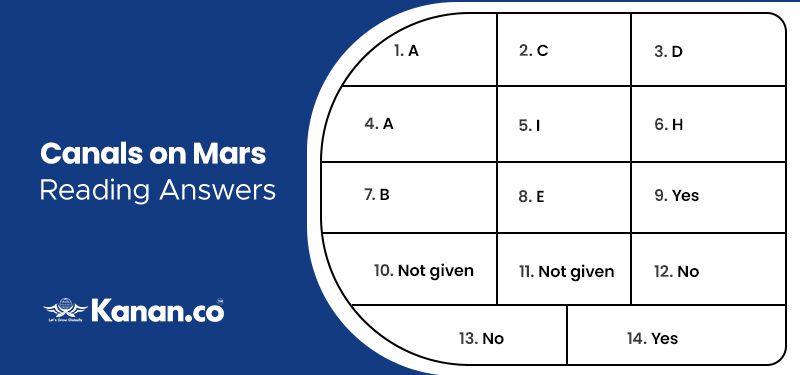
We have given Canals on Mars reading answers, in the table given below.

Answer Table
| 1. A | 4. A | 7. B | 10. Not given | 13. No |
| 2. C | 5. I | 8. E | 11. Not given | 14. Yes |
| 3. D | 6. H | 9. Yes | 12. No |
Canals on Mars IELTS reading practice test - Exam Review
In this article we have provided Canals on Mars IELTS reading answers. This article will help to be distinguished in the IELTS reading practice to challenge your reading skill and read the given passage to answer the questions.
Passage
We have given Canals on Mars reading answers with location. Go through the given passage carefully and answer the questions.
Canals on Mars reading answers
A. Popular interest in Mars, the ‘Red Planet’, is long-established, but has enjoyed two dramatic flowerings, one in the 1890s and the other a century later.
B. Any speculation about life on Mars, then or now, is part of a long discussion on ‘the plurality of worlds’. Pluralists believe that there are other worlds apart from ours which contain life — an idea that had its origins in classical Greece. In the 19th century, the new science of astrophysics suggested that large numbers of stars in the sky were similar to the sun in their composition — perhaps they too were circled by planetary systems. Nearer to home Mars, our neighbour in the solar system seemed to offer the evidence the pluralists had lacked until then.
C. The characteristics of Mars’ orbit are such that its distance from Earth varies considerably — from 34.5 to 234.5 million miles. From an astronomer’s standpoint, it was particularly well-placed for observation in 1877, 1892 and 1909. Observations in each of these years intensified discussion about possible life on Mars.
D. If life, intelligent or otherwise, were to be found on Mars, then life on Earth would not be unique. The scientific, theological and cultural outcomes of such a discovery could be stupendous. In 1859, Fr. Angelo Secchi, director of the Vatican observatory and a confirmed pluralist, observed markings on the surface of Mars, which he described as canals, ‘channels’. The fateful word had been launched on its career, although there was little immediate development from Secchi’s work.
E. In 1877 another Italian, Giovanni Schiaparelli, one of Europe’s most distinguished astronomers, also observed the canals, but he added the refinement that they appeared to be constituents of a system. Other astronomers observed features that might be continents or seas; Schiaparelli confirmed these findings and gave them finely sonorous classical names such as Hellas, Mare Etythraeum, Promethei Sinus.
F. Although Schiaparelli was cautious in his public statements, recent research suggests that he was a pluralist. Certainly his choice of familiar place names for the planet, and his publicising of the calla network, encouraged pluralist speculation. Inevitably, cumuli was soon being translated into English as ‘canals’ rather than ‘channels’. In 1882, Schiaparelli further fuelled speculation by discovering twin canals; a configuration which he named ‘gemination’; he described no fewer than sixty canals and twenty geminations.
G. Some of Schiaparelli's findings were confirmed by the astronomers Perrotin and Thollon at Nice Observatory in 1886. In 1888, however, Perrotin confused matters by announcing that the Martian continent of ‘Libya’ observed by Schiaparelli in 1886 ‘no longer exists today’. The confusion grew; two prestigious observatories in the US found in one case no canals, in another a few of them but no geminations, and no changes to Libya.
H. While the observers exchanged reports and papers, the popularisers got to work. They were generally restrained at first. The British commentator Richard Proctor thought that the canals might be rivers; he was among the first to suggest that a Martian canal would have to be ‘fifteen or twenty miles broad’ to be seen from Earth.
The leading French pluralist, Camille Flammarion, published his definitive La Planete Mars in 1892: ‘the canals may be due … to the rectification of old rivers by the inhabitants for the purpose of the general distribution of water…! Other commentators supposed the ‘canals’ might be an optical illusion, a line first advanced by the English artist Nathaniel Green, teacher of painting to Queen Victoria and an amateur astronomer.
I. The canals debate might have levelled off at this point had it not been for the incursion of its most prominent controversialist — and convinced pluralist — Percival Lowell. Lowell, an eminent Bostonian, entered the astronomical argument after a career in business and diplomacy, mainly in the Orient. He may not have brought an entirely objective mind to the task. Even before he started observing he had announced that the canals were probably ‘the work of some sort of intelligent beings’.
J. The newly-arrived popular press was very willing to report Lowell’s findings and views; canal mania grew apace. By 1910 Lowell had reported over 400 canals with.an average length of 1,500 miles. He wrote plausibly about the Martian atmosphere and the means by which the canals distributed water from Mars polar caps to irrigate the planet before evaporation returned moisture to the poles. This water cycle appealed to popular evolutionism which perceived Mars as an old, dying world trying to avert its fate by rational and large-scale engineering — this was, after all, an age of great canals: Panama, Dortmund-Ems, Manchester, Corinth.
Questions
Questions 1-2
- Choose the correct letter A, B, C or D.
1. What do pluralists believe?
A There is life in other parts of the universe.
B Other stars have planets.
C There is life on Mars.
D There are many other stars like the sun.
2. What circumstance helped astronomers to study Mars in the late 19th century?
A A new science had developed.
B People believed that there was life on other planets.
C Mars was close to Earth on several occasions.
D There was popular interest in Mars at the time.
Questions 3-8
- Look at the following lists of astronomers and thinkers (Questions 3-8) and ideas about Mars (A-I).
- Match each astronomer with the idea or ideas he expressed.
- NB There are more ideas than astronomers and thinkers, so you will not need to use them all.
A. A particular geographical feature of Mars has disappeared.
B. People think they can see canals, but they do not really exist.
C. Life on Mars has become extinct.
D. Some canals are organised in pairs.
E. The canals are used to carry water from colder areas to warmer areas.
F. The canals must be extremely deep to carry so much water.
G. The inhabitants of Mars are still building canals.
H. The Martians have adapted natural features to meet their needs.
I. The canals might be very wide and not artificial.
3. Schiaparelli………
4. Perrotin ……….
5. Proctor……..
6. Flammarion ………
7. Green……….
8. Lowell ……….
Questions 9-14
- Do the following statements agree with the information given in the Reading Passage?
- In boxes 9-14 on your answer sheet, write
- YES if the statement agrees with the writer’s claims
- NO if the statement contradicts the writer’s claims
- NOT GIVEN if there is impossible to say what the writer thinks about this
9. Discussion about whether there is life on Mars forms part of a long tradition.
10. The belief that life existed on Mars was encouraged by a translation error.
11. The limitations of 19th century technology encouraged the idea that there were canals on Mars.
12. All Lowell’s statements about Mars were based on what he was able to see.
13. Lowell’s investigations of Mars aroused little interest outside the scientific community.
14. Lowell’s theory about how canals on Mars were used may have been inspired by fashionable ideas of the time.
Answers for Canals on Mars with Explanation
We have given Canals on Mars reading answers with explanation, this will help you to identify your mistakes in the answering process.
1. Answer: A
Explanation: “Pluralists believe that there are other worlds apart from ours which contain life — an idea that had its origins in classical Greece”. With this line it is clear that pluralists believe there is life in other parts of the universe. Hence the given answer is located in the 2-3 lines of paragraph B.
2. Answer: C
Explanation: “From an astronomer’s standpoint, it was particularly well-placed for observation in 1877, 1892 and 1909.” With these lines it is clear that mars was close to Earth on several occasions. Hence the given answer is located in the 2-3 lines of paragraph C.
3. Answer: D
Explanation: “Schiaparelli further fuelled speculation by discovering twin canals; a configuration which he named ‘gemination’; he described no fewer than sixty canals and twenty geminations”. With this line it is clear that schaiparelli’s idea about twin canals. Hence the given answer is located in the last 2 lines of paragraph F.
4. Answer: A
Explanation: “Perrotin confused matters by announcing that the Martian continent of ‘Libya’ observed by Schiaparelli in 1886 ‘no longer exists today’. With this line it is clear that Perrotin states that a particular geographical feature of Mars (the Martian continent of ‘Libya’) has disappeared. Hence the given answer is located in the 2-4 lines of paragraph G.
5. Answer: I
Explanation: “The British commentator dthat the canals might be rivers; he was among the first to suggest that a Martian canal would have to be ‘fifteen or twenty miles broad’ to be seen from Earth”. With this line it is clear that the British commentator Richard Proctor thought that the canals might be rivers. Hence the given answer is located in 2-4 lines of paragraph H.
6. Answer: H
Explanation: “The leading French pluralist, Camille Flammarion, published his definitive La Planete Mars in 1892: ‘the canals may be due … to the rectification of old rivers by the inhabitants for the purpose of the general distribution of water…”.with this line it is clear that the Martians have adapted natural features to meet their needs. Hence the given answer is located in the 5-7 lines of paragraph H.
7. Answer: B
Explanation: “Other commentators supposed the ‘canals’ might be an optical illusion, a line first advanced by the English artist Nathaniel Green, teacher of painting to Queen Victoria and an amateur astronomer”. With this line it is clear that Nathaniel Green states that people think they can see canals, but they do not really exist. Hence the given answer is located in the last 3 lines of paragraph H.
8. Answer: E
Explanation: “By 1910 Lowell had reported over 400 canals with.an average length of 1,500 miles. He wrote plausibly about the Martian atmosphere and the means by which the canals distributed water from Mars polar caps to irrigate the planet before evaporation returned moisture to the poles”. With this line it is clear that Lowell’s states that the canals are used to carry water from colder areas to warmer areas. Hence the given answer is located in the 2-5 lines of paragraph J.
9. Answer: Yes
Explanation: “Any speculation about life on Mars, then or now, is part of a long discussion on ‘the plurality of worlds”. With this line it is clear that life on Mars forms part of a long tradition. Hence the given answer is located in the first 2 lines of paragraph B.
10. Answer: Not given
11. Answer: Not given
12. Answer: No
Explanation: “Lowell, an eminent Bostonian, entered the astronomical argument after a career in business and diplomacy, mainly in the Orient. He may not have brought an entirely objective mind to the task. Even before he started observing he had announced that the canals were probably ‘the work of some sort of intelligent beings’”. With this line it is clear the Lowell’s statements about Mars were not based on what he was able to see. Hence the given answer is located in the last 4 lines of paragraph I.
13. Answer: No
Explanation: “The newly-arrived popular press was very willing to report Lowell’s findings and views; canal mania grew apace”. With this line it is clear that the given statement contradicts with the given information. Hence the given answer is located in the first 2 lines of paragraph J.
14. Answer: Yes
Explanation: “This water cycle appealed to popular evolutionism which perceived Mars as an old, dying world trying to avert its fate by rational and large-scale engineering — this was, after all, an age of great canals: Panama, Dortmund-Ems, Manchester, Corinth”. With this line it is clear that Lowell’s theory about how canals on Mars were used may have been inspired by fashionable ideas of the time. Hence the given answer is located in the last 4 lines of paragraph J.
Other reading answers

About Author Manimegalai Samidurai
Manimegalai is a multifaceted professional, excelling as an author, writer, and study-abroad expert. Her vast knowledge of English proficiency exams, including IELTS, GRE, SAT, and PTE, and exceptional content writing skills make her a go-to resource for students seeking guidance and support in their foreign education journey. She is a trusted authority in writing content related to these test-prep exams, making her an invaluable resource for those seeking guidance. With her well-researched and informative blogs, articles, and study materials, Manimegalai has helped countless students achieve their desired band scores and get admissions to top-notch colleges & universities in countries like Canada, USA, UK, Australia, Ireland, etc.
Kanan.co is a trusted study abroad consultancy offering comprehensive services, resources, and solutions for students and education institutions. We support students at every stage of their global education journey, ensuring a smooth and guided experience. Along with test preparation for IELTS, GRE, TOEFL, and SAT, we provide expert services such as SOP writing, visa guidance, accommodation support, scholarship assistance, and education loan support. Our expertise and commitment to excellence make us a reliable partner for students pursuing international education.
Free Online Mock Test 2026
Practice our mock test worth Rs. 25000 for Free and know your IELTS score!








Global Headquarters
Kanan Int EdTech Inc
320 Bay Street, Suite 321 (Spaces), Toronto ON, Canada M5B 1N9
Indian Headquarters
Kanan International Pvt. Ltd.
D-wing, 2nd Floor, Trident Complex, Ellora Park Vadiwadi Road, Vadodara, Gujarat 390007
IT/ Digital Campus
Kanan International Pvt. Ltd
Old, New No 3, 2nd Floor, 1A, Dr Sadasivam Rd, T. Nagar, Chennai, Tamil Nadu 600017
Our branches
- Bardoli
- Bharuch
- Chennai
- Dehradun
- Gurugram
- Himatnagar
- Karnal
- Nadiad
- Navsari
- Palanpur
- Rajkot
- Vadodara
- Valsad
- Vallabh Vidyanagar
- Vapi
Study Abroad
Test Prep
Top Universities
Consultants
IELTS Centers
GRE Centers
TOEFL Centers
SAT Centers
Language Courses in Vadodara
SOP Blogs
Featured Blogs
Study Abroad Consultants in Chennai
Study Abroad Consultants in Surat
Study Abroad Consultants in Navsari
Study Abroad Consultants in Bardoli
Study Abroad Consultants in Ahmedabad
Study Abroad Consultants in Anand
Study Abroad Consultants in Khanna
Study Abroad Consultants in Nadiad
Study Abroad Consultants in Vadodara
Study abroad consultants in Valsad
Copyright © 2026 KANAN.CO All rights reserved.