- Study Abroad
- / ielts
- / carbon capture and storage reading answers
Carbon Capture and Storage Reading Answers


Author
17-09-2025

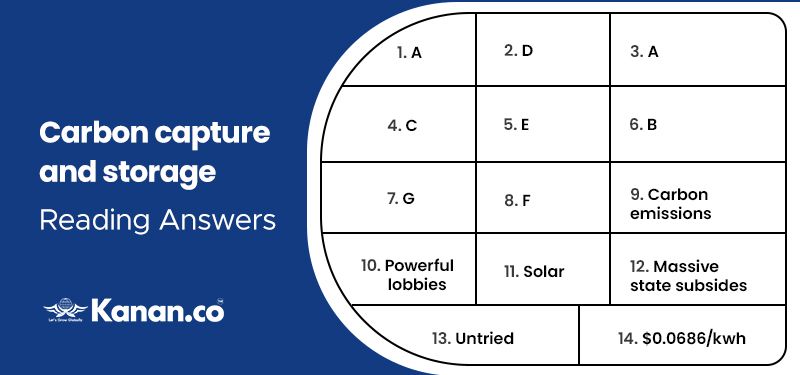
In this article the Carbon capture and storage reading answers are given as IELTS practice test, along with answers and explanations. It consists of 14 questions in 3 different types namely- 2 questions as multiple choice, 6 questions as diagram labeling, and 6 questions as short answer questions. Read the passage and questions carefully and try to answer them. You can verify your answers against our answer table.
Check out our YouTube Channel to Practice Full-Length IELTS Reading Tests Daily

Table of content
- Solutions for Carbon capture and storage
- Carbon capture and storage IELTS reading practice test
- Passage
- Questions
- Answers with explanation
Solution for carbon capture and storage
We have given Carbon capture and storage reading answers, in the table given below

Answer Table
| 1. A | 4. C | 7. G | 10. Powerful lobbies | 13. Untried |
| 2. D | 5. E | 8. F | 11. Solar | 14. $0.0686/kwh |
| 3. A | 6. B | 9. Carbon emissions | 12. Massive state subsides |
Carbon capture and storage IELTS reading practice test-Exam Review
Here, we have given Carbon capture and storage IELTS reading answers as a sample article for the IELTS reading practice test. This article will help you attain a band score in your exams. Check out the given passage to answer the questions.
Passage
In this article the Carbon capture and storage reading answers with location is given. Be focused on the passage while reading it and answer the given questions.
Carbon capture and storage reading answers
High coal dependence
Renewable energy is much discussed, but coal still plays the greatest role in the generation of electricity, with recent figures from the International Energy Agency showing that China relies on it for 79% of its power, Australia for 78%, and the US for 45%. Germany has less reliance at 41%, which is also the global average. Furthermore, many countries have large, easily accessible deposits of coal, and numerous highly skilled miners, chemists, and engineers. Meanwhile, 70% of the world’s steel production requires coal, and plastic and rayon are usually coal derivatives.
Currently, coal-fired power plants fed voracious appetites, but they produce carbon dioxide (CO2) in staggering amounts. Urbanites may grumble about an average monthly electricity bill of $113, yet they steadfastly ignore the fact that they are not billed for the 6-7 million metric tons of CO2 their local plant belches out, which contribute to the 44% of global CO2 levels from fossil-fuel emissions. Yet, as skies fill with smog and temperatures soar, people crave clean air and cheap power.
The Intergovernmental Panel on Climate Change that advises the United Nations has testified that the threshold of serious harm to the Earth’s temperature is a mere 2° Celsius above current levels, so it is essential to reduce carbon emissions by 80% over the next 30 years, even as demand for energy will rise by 50%, and one proposal for this is the adoption of carbon capture and storage (CCS).
Underground carbon storage
Currently, CO2 storage, or sequestration as it is known, is practiced by the oil and gas industry, where CO2 is pumped into oil fields to maintain pressure and ease extraction – one metric ton dissolves out about three barrels, or separated from natural gas and pumped out of exhausted coal fields or other deep seams. The CO2 remains underground or is channeled into disused sandstone reservoirs. However, the sale of oil and natural gas is profitable, so the $17-per-ton sequestration cost is easily borne. There is also a plan for the injection of CO2 into saline aquifers, 1,000 meters beneath the seabed, to prevent its release into the atmosphere.
Carbon capture
While CO2 storage has been accomplished, its capture from power plants remains largely hypothetical, although CCS plants throughout Western Europe and North America are on the drawing board.
There are three main forms of CCS: pre-combustion, post-combustion, and oxy-firing. In a 2012 paper from the US Congressional Budget Office (CBO), post-combustion capture was viewed most favorably since existing power plants can be retrofitted with it, whereas pre-combustion and oxy-firing mean the construction of entirely new plants. However, pre-combustion and oxy-firing remove more CO2 than post-combustion and generate more electricity.
Post-combustion capture means CO2 is separated from gas after coal is burnt but before electricity is generated, while in oxy-firing, coal is combusted in pure oxygen. In pre-combustion, as in an Integrated Gasification Combined Cycle system (IGCC), oxygen, coal, and water are burnt together to produce a synthetic gas called Syngas – mainly hydrogen – which drives two sets of turbines, firstly gas-driven ones, then, as the cooling Syngas travel through water, steam-driven ones. Emissions from this process contain around ten percent of the CO2 that burning coal produces.
The pros and cons of CCS
Several countries are keen to scale up CCS as it may reduce carbon emissions quickly, and powerful lobby groups for CCS exist among professionals in mining and engineering. Foundries and refineries that produce steel and emit carbon may also benefit, and the oil and gas industry is interested because power-plant equipment consumes their products. In addition, recent clean energy acts in many countries mandate that a percentage of electricity be generated by renewables or by more energy-efficient systems, like CCS.
As with desalination, where powerful lobbies wield influence, states sometimes find it easier to engage in large projects involving a few players rather than change behaviors on a more scattered household scale. Furthermore, replacing coal with zero-emission photovoltaic (PV) cells to produce solar energy would require covering an area of nearly 20,720 square kilometers, roughly twice the size of Lebanon or half of Denmark.
Still, there are many reservations about CCS. Principally, it is enormously expensive: conservative estimates put the electricity it generates at more than five times the current retail price. As consumers are unlikely to want to bear this price hike, massive state subsidies would be necessary for CCS to work.
The capital outlay of purchasing equipment for retrofitting existing power plants is high enough, but the energy needed to capture CO2 means one-third more coal must be burnt, and building new CCS plants is at least 75% more expensive than retrofitting.
Some CCS technology is untried, for example, the Syngas-driven turbines in an IGCC system have not been used on an industrial scale. Post capture, CO2 must be compressed into a supercritical liquid for transport and storage, which is also costly. The Qatar Carbonates and Carbon Storage Research Centre predicts that 700 million barrels per day of this liquid would be produced if CCS were adopted modestly. It is worth noting that current oil production is around 85 million barrels per day, so CCS would produce eleven times more waste for burial than oil that was simultaneously being extracted.
Sequestration has been used successfully, but there are limited coal and oil fields where optimal conditions exist. In rock that is too brittle, earthquakes could release the CO2. Moreover, proposals to store CO2 in saline aquifers are just that – proposals: sequestration has never been attempted in aquifers.
Most problematic of all, CCS reduces carbon emissions but does not end them, rendering it a medium-term solution.
Alternatives
There are at least four reasonably priced alternatives to CCS. Firstly, conventional pulverized coal power plants are undergoing redesign so more electricity can be produced from less coal. Before coal is phased out – as ultimately it will have to be – these plants could be more cost-effective. Secondly, hybrid plants using natural gas and coal could be built. Thirdly, natural gas could be used on its own. Lastly, solar power is fast gaining credibility.
In all this, an agreed measure of cost for electricity generation must be used. This is called a levelized cost of energy (LCOE) – an average cost of producing electricity over the lifetime of a power plant, including construction, financing, and operation, although pollution is not counted. In 2012, the CBO demonstrated that a new CCS plant had an LCOE of about $0.09-0.15 per kilowatt-hour (kWh), but according to the US Energy Information Administration, the LCOE from a conventional natural gas power plant without CCS is $0.0686/kWh, making it the cheapest way to produce clean energy.
Solar power costs are falling rapidly. In 2013, the Los Angeles Department of Water and Power reported that energy via a purchase agreement from a large solar plant was $0.095/kWh, and Greentech Media, a company that reviews environmental projects, found a 2014 New Mexico solar project that generates power for $0.0849/kWh.
Still, while so much coal and so many coal-fired plants exist, decommissioning them all may not be realistic. Whatever happens, the conundrum of cheap power and clean air may remain unsolved for some time.
Questions
Questions 1-2
- Choose the correct letter A,B C, or D.
1. What is the global average for electricity generated from coal?
- 41%
- 44%
- 49%
- 70%
2. What does the average American pay each month for CO2 produced by a local power plant?
- $17
- $80
- $113
- Nothing
Questions 3-8
- Label the diagrams on the following page
- Write the correct letter, A-H, in boxes 3-8 on your answer sheet.
- CO2
- Coal
- Natural gas
- Oil
- Saline aquifer
- Steam-driven turbines
- Syngas
- syngas -driven turbines
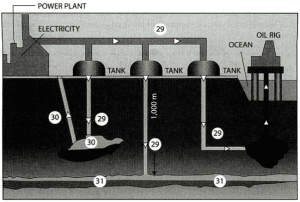
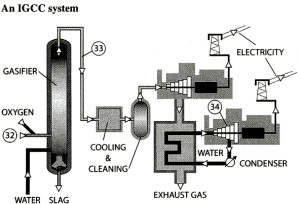
Note: The labeled numbers (29-34) actually stand for questions (3-8).
3 ……………………………
4 ……………………………
5 ……………………………
6 ……………………………
7 ……………………………
8 ……………………………
Questions 9-14
- Choose no more than three words/and or a number from the passage for each answer.
Advantages of CCS
Sequestration is already used in the oil and gas sector.
CCS may cut 9……………….. in a short time.
10……………….. in labour, industry, and states already support CCS.
Alternatives, like 11……………….energy, take up vast amounts of space.
Disadvantages of CCS
The construction of new and the conversion of existing power plants and the liquefaction and transport of CO2 are very costly. While sequestration is possible, the scale would be enormous. Therefore, CCS would need 12………………..
Some CCS technology is 13.……………….. Gas-driven turbines for IGCC have not been used on an industrial scale.
Shallow underground storage may be limited; deep ocean storage is currently impossible. Geologists fear leaks in quake-prone regions.
Natural gas and solar PVs are cheaper. LCOE estimates for CCS = $0.09-15/kWh; for natural gas= 14………………..; and, for solar PV = $0.0849/kWh.
Answers for Carbon capture and storage with explanation
We have given Carbon capture and storage reading answers with explanations, this will help you to identify your mistakes in the answering process.
1. Answer: A
Explanation: “Renewable energy is much discussed, but coal still plays the greatest role in the generation of electricity, with recent figures from the International Energy Agency showing that China relies on it for 79% of its power, Australia for 78%, and the US for 45%. Germany has less reliance at 41%, which is also the global average”. From these lines it is proven that 41% is the global average for electricity generated from coal. Hence the given answer is located in the first 4 lines of paragraph 1 under high coal dependence.
2. Answer: D
Explanation: “In all this, an agreed measure of cost for electricity generation must be used. This is called a levelized cost of energy (LCOE) – an average cost of producing electricity over the lifetime of a power plant, including construction, financing, and operation, although pollution is not counted”. From this line it is clear that an average cost of producing electricity over the lifetime of a power plant, including construction, financing, and operation, although pollution is not counted. Hence the given answer is located in the 1-4 lines of paragraph 2 under alternatives.
3. Answer: A
Explanation: “While CO2 storage has been accomplished, its capture from power plants remains largely hypothetical”. This line explains that even the carbon capture has been accomplished in terms of co2 storage, but it's capture from power plants is still hypothetical. Hence the given answer is located in the 1-2 lines of paragraph 1 under carbon capture.
4. Answer: C
Explanation: “Post-combustion capture means CO2 is separated from gas after coal is burnt but before electricity is generated, while in oxy-firing, coal is combusted in pure oxygen”. This line explains that CO2 is separated from natural gas after coal is burnt. Hence the given answer is located in the first 2 lines of paragraph 3 under carbon capture.
5. Answer: E
Explanation: “There is also a plan for the injection of CO2 into saline aquifers, 1,000 meters beneath the seabed, to prevent its release into the atmosphere”. This line explains the injection of co2 into saline aquifers, 1000 meters below the seabed. Hence the given answer is located in the last 2 lines of paragraph of underground carbon storage.
6. Answer: B
Explanation: “Post-combustion capture means CO2 is separated from gas after coal is burnt but before electricity is generated, while in oxy-firing, coal is combusted in pure oxygen”. This line explains that CO2 is separated from natural gas after coal is burnt. Hence the given answer is located in the first 2 lines of paragraph 3 under carbon capture.
7. Answer: G
Explanation: “In pre-combustion, as in an Integrated Gasification Combined Cycle system (IGCC), oxygen, coal, and water are burnt together to produce a synthetic gas called Syngas – mainly hydrogen – which drives two sets of turbines, firstly gas-driven ones”. In these lines it is clear in pre-combustion, as in an Integrated Gasification Combined Cycle system (IGCC), oxygen, coal, and water are burnt together to produce a synthetic gas called Syngas. Hence the given answer is located in the 2-5 lines of paragraph 3 under carbon capture.
8. Answer: F
Explanation: “Some CCS technology is untried, for example, the Syngas-driven turbines in an IGCC system have not been used on an industrial scale”. This line explains the untire of ccs technology. Hence the given answer is located in the 4-5 lines of paragraph 3 under the pros and cons of CCS.
9. Answer: Carbon emissions
Explanation: “Most problematic of all, CCS reduces carbon emissions but does not end them, rendering it a medium-term solution”. This line explains that CCS reduces carbon emissions but does not end them. Hence the given answer is located in the last 2 lines under the pros and cons of CCS.
10. Answer: Powerful lobbies
Explanation: “Several countries are keen to scale up CCS as it may reduce carbon emissions quickly, and powerful lobby groups for CCS exist among professionals in mining and engineering”. From this line it is proved that some countries that are keen to scale up CCS may reduce carbon emissions quickly and powerful lobbies for CCS exist among professionals in mining and engineering. Hence the given answer is located in the first 3 lines 1st paragraph under the pros and cons of CCS.
11. Answer: Solar
Explanation: “Furthermore, replacing coal with zero-emission photovoltaic (PV) cells to produce solar energy would require covering an area of nearly 20,720 square kilometers, roughly twice the size of Lebanon or half of Denmark”. This line proved that alternatives like solar energy take up vast amounts of space. Hence the given answer is located in the 3-5 lines 2nd paragraph under the pros and cons of CCS.
12. Answer: Massive state subsidies
Explanation: “As consumers are unlikely to want to bear this price hike, massive state subsidies would be necessary for CCS to work”. This line explains that The construction of new and the conversion of existing power plants and the liquefaction and transport of CO2 are very costly. While sequestration is possible, the scale would be enormous. Therefore, CCS would need massive state subsidies. Hence the given answer is located in the last 2 lines 2nd paragraph under the pros and cons of CCS
13. Answer: untried
Explanation: “Some CCS technology is untried, for example, the Syngas-driven turbines in an IGCC system have not been used on an industrial scale”. From this line it is clear that some CCS technology is untried. Gas-driven turbines for IGCC have not been used on an industrial scale. Hence the given answer is located in the 4-5 lines of paragraph 3 under the pros and cons of CCS.
14. Answer: $0.0686/kWh
Explanation: “In 2012, the CBO demonstrated that a new CCS plant had an LCOE of about $0.09-0.15 per kilowatt-hour (kWh), but according to the US Energy Information Administration, the LCOE from a conventional natural gas power plant without CCS is $0.0686/kWh, making it the cheapest way to produce clean energy”. From these lines it is clear that natural gas and solar PVs are cheaper. LCOE estimates for CCS = $0.09-15/kWh; for natural gas= $0.0686/kWh and, for solar PV = $0.0849/kWh. Hence the given answer is located in the last 4 lines of paragraph 2 under alternatives.
Other reading answers

About Author Roshan Sunthar
Roshan Sunthar is a study abroad expert as well as a renowned writer and author in international education. His academic excellence and 5+ years of work experience give him in-depth knowledge of international standardised exams and test preparation in IELTS, TOEFL, GRE, PTE, SAT, etc. The study materials he prepares incorporate exam-like questions. He’s also an expert in writing Statement of Purposes (SOPs) and Letter of Recommendations (LORs) for college admissions. He usually spends his leisure time watching English classics and documentaries, travelling, etc.
Kanan.co is a trusted study abroad consultancy offering comprehensive services, resources, and solutions for students and education institutions. We support students at every stage of their global education journey, ensuring a smooth and guided experience. Along with test preparation for IELTS, GRE, TOEFL, and SAT, we provide expert services such as SOP writing, visa guidance, accommodation support, scholarship assistance, and education loan support. Our expertise and commitment to excellence make us a reliable partner for students pursuing international education.
Free Online Mock Test 2026
Practice our mock test worth Rs. 25000 for Free and know your IELTS score!








Global Headquarters
Kanan Int EdTech Inc
320 Bay Street, Suite 321 (Spaces), Toronto ON, Canada M5B 1N9
Indian Headquarters
Kanan International Pvt. Ltd.
D-wing, 2nd Floor, Trident Complex, Ellora Park Vadiwadi Road, Vadodara, Gujarat 390007
IT/ Digital Campus
Kanan International Pvt. Ltd
Old, New No 3, 2nd Floor, 1A, Dr Sadasivam Rd, T. Nagar, Chennai, Tamil Nadu 600017
Our branches
- Bardoli
- Bharuch
- Chennai
- Dehradun
- Gurugram
- Himatnagar
- Karnal
- Nadiad
- Navsari
- Palanpur
- Rajkot
- Vadodara
- Valsad
- Vallabh Vidyanagar
- Vapi
Study Abroad
Test Prep
Top Universities
Consultants
IELTS Centers
GRE Centers
TOEFL Centers
SAT Centers
Language Courses in Vadodara
Study Abroad Calculators
Featured Blogs
Study Abroad Consultants in Chennai
Study Abroad Consultants in Surat
Study Abroad Consultants in Navsari
Study Abroad Consultants in Bardoli
Study Abroad Consultants in Ahmedabad
Study Abroad Consultants in Anand
Study Abroad Consultants in Khanna
Study Abroad Consultants in Nadiad
Study Abroad Consultants in Vadodara
Study abroad consultants in Valsad
Copyright © 2026 KANAN.CO All rights reserved.