- Study Abroad
- / ielts
- / cognitive dissonance reading answers
Cognitive Dissonance Reading Answers


Author
17-09-2025

We have given Cognitive Dissonance reading answers as a practice test in this article. We have also given the answers along with explanations. This topic has 14 questions in 2 different types namely - 8 questions as matching headings, and 6 questions as multiple choice questions.
Check out our YouTube Channel to Practice Full-Length IELTS Reading Tests Daily

Table of contents:
- Solution for Cognitive Dissonance
- Cognitive Dissonance IELTS reading practice test
- Passage
- Questions
- Answers with explanations
Solution for Cognitive Dissonance
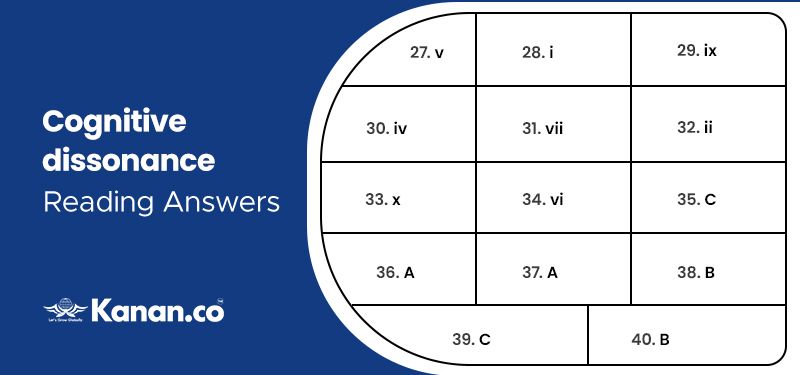
Here we have given Cognitive Dissonance reading answers, in the table given below.

Answer Table
| 27. v | 30. iv | 33. x | 36. A | 39. C |
| 28. i | 31. vii | 34. vi | 37. A | 40. B |
| 29. ix | 32. ii | 35. C | 38. B |
Cognitive Dissonance IELTS Reading Practice Test- Exam Review
Here we have given Cognitive Dissonance IELTS reading answers, as a sample article for the IELTS reading practice test. This article will help you to crack your exam with band scores. Scrutinize the given passage to answer the questions.
Passage
We have given Cognitive Dissonance reading answers with location. Be careful while reading the passage and answer the questions.
Cognitive Dissonance reading answers
A. Charles Darwin said, “This is not the strongest of the species that survive, nor the most intelligent, but the one most responsive to change.” So you’ve sold your home, quit your job, shunned your colleagues, abandoned your friends and family. The end of the world is nigh, and you ‘know for a fact’ that you are one of the chosen few who will be swept up from the ‘great flood’ approaching on 21st December at midnight to be flown to safety on a far off planet. And then midnight on 21st December comes around and there is no flood. No end of the world. No flying saucer to the rescue. What do you do? Admit you were wrong? Acknowledge that you gave up position, money, friends – for nothing? Tell yourself and others you have been a schmuck? Not on your life.
B. Social psychologist Leon Festinger infiltrated a flying saucer doomsday cult in the late 1950s. The members of this cult had given up everything on the premise that the world was about to self-destruct and that they, because of their faith, would be the sole survivors. In the lead up to the fateful day, the cult shunned publicity and shied away from journalists. Festinger posed as a cultist and was present when the spaceship failed to show up. He was curious about what would happen. How would the disappointed cultists react to the failure of their prophecy? Would they be embarrassed and humiliated? What actually happened amazed him.
C. Now, after the non-event, the cultists suddenly wanted publicity. They wanted media attention and coverage. Why? So they could explain how their faith and obedience had helped save the planet from the flood. The aliens had spared planet earth for their sake – and now their new role was to spread the word and make us all listen. This fascinated Festinger. He observed that the real driving force behind the cultists’ apparently inexplicable response was the need, not to face the awkward and uncomfortable truth and ‘change their minds’, but rather to ‘make minds comfortable’ – to smooth over the unacceptable inconsistencies.
D. Festinger coined the term ‘cognitive dissonance’ to describe the uncomfortable tension we feel when we experience conflicting thoughts or beliefs (cognitions), or engage in behavior that is apparently opposed to our stated beliefs. What is particularly interesting is the lengths to which people will go to reduce the inner tension without accepting that they might, in fact, be wrong. They will accept almost any form of relief, other than admitting being at fault, or mistaken. Festinger quickly realized that our intolerance for ‘cognitive dissonance’ could explain many mysteries of human behavior.
E. In a fascinating experiment Festinger and his colleagues paid some subjects twenty dollars to tell a specific lie, while they paid another group of subjects only one dollar to do the same. Those who were paid just one dollar were far more likely to claim, after the event, that they had actually believed in the lie they were told to tell. Why? Well, because it’s just so much harder to justify having done something that conflicts with your own sense of being ‘an honest person’ for a mere pittance. If you get more money, you can tell yourself: ‘Yeah, I lied, but I got well paid! It was justified.’ But for one dollar? That’s not a good enough reason to lie, so what you were saying must have been true in the first place, right?
F. Emotional factors influence how we vote for our politicians much more than our careful and logical appraisal of their policies, according to Drew Westen, a professor of psychiatry and psychology. This may come as little surprise to you, but what about when we learn that our favored politician may be dishonest? Do we take the trouble to really find out what they are supposed to have done, and so possibly have to change our opinions (and our vote), or do we experience that nasty cognitive dissonance and so seek to keep our minds comfortable at the possible cost of truth?
G. Cognitive dissonance is essentially a matter of commitment to the choices one has made, and the ongoing need to satisfactorily justify that commitment, even in the face of convincing but conflicting evidence. This is why it can take a long time to leave a cult or an abusive relationship – or even to stop smoking. Life’s commitments, whether to a job, a social cause, or a romantic partner, require heavy emotional investment, and so carry significant emotional risks. If people didn’t keep to their commitments, they would experience uncomfortable emotional tension. In a way, it makes sense that our brains should be hard-wired for monitoring and justifying our choices and actions – so as to avoid too much truth breaking in at once and overwhelming us.
H. I guess we can’t really develop unless we start to get a grip and have some personal honesty about what really motivates us. This is part of genuine maturity. If I know I am being lazy, and can admit it to myself, that at least is a first step to correcting it. If, however, I tell myself it’s more sensible to wait before vacuuming, then I can go around with a comfortable self-concept of ‘being sensible’ while my filthy carpets and laziness remain unchanged. Cognitive dissonance can actually help me mature, if I can bring myself, first, to notice it (making it conscious) and second, to be more open to the message it brings me, in spite of the discomfort. As dissonance increases, providing I do not run away into self-justification, I can get a clearer and clearer sense of what has changed, and what I need to do about it.
And then I can remember what Darwin had to say about who will survive…
Questions
Questions 1-8
- The reading passage has eight paragraphs A-H
- Choose the most suitable headings for these paragraphs from the list of ten headings below.
- Write the appropriate number i-x in the text boxes 1-8
- There are more paragraph headings than paragraphs, so you will not use them all.
List of headings:
i. Leon Festinger: On being stood up by the aliens
ii. Dishonest politicians? Never!
iii. Mind manipulation: the true reason of strange behavior
iv. You can’t handle the truth!
v. The catastrophe of 21st December
vi. Grow up – make cognitive dissonance work for you
vii. How many dollars would you take to tell a lie?
Viii. Revealing mysteries: Darwin was right.
ix. Cognitive dissonance: who are you kidding?
x. The high cost of commitment exposes us to cognitive dissonance
1. Passage A
2. Passage B
3. Passage C
4. Passage D
5. Passage E
6. Passage F
7. Passage G
8. Passage H
Questions 9-14
- Choose the correct letter A,B, C or D
- Write the correct letter in boxes 9-14 on your answer sheet
9. After the spaceship didn’t show up on a fateful day, the members of flying saucer doomsday cult
- Didn’t want to admit the uncomfortable truth and still believed that the world would self-destruct.
- Were embarrassed and humiliated because of their failure.
- Wanted media attention to say that they saved the planet.
10. The main reason why people fight cognitive dissonance is
- A desire to reduce the inner tension.
- People’s unwillingness to accept their mistakes.
- Wish to avoid the awkward feeling of lying for no good reason.
11. During the experiment, people who were telling lies were more likely to claim that they believed in the lie if
- They were paid less.
- They were paid more.
- They felt uncomfortable because of lying
12. Commitment to the choices someone has made, and the ongoing need to justify that commitment, despite the conflicting evidence can be explained by the fact that
- It causes uncomfortable emotional tension.
- Commitments require heavy emotional investment.
- Our brain always justifies our choices.
13. The big part of genuine maturity is the ability of
- Sensible reasoning.
- Disregarding cognitive dissonance.
- Being honest with yourself.
14. According to the text, which of the situations below is NOT an example of cognitive dissonance?
- A man learns that his favored politician is dishonest, but continues to vote for him.
- A woman doesn’t want to do vacuuming, but convinces herself that otherwise her carpet will remain filthy and finally does it.
- A woman has been dating with her boyfriend for five years. Everyone tells her that it’s an abusive relationship because he often beats and humiliates her, but she doesn’t want to leave her romantic partner.
Answers for Cognitive Dissonance with explanation
We have given Cognitive Dissonance reading answers with explanations, this will help you to identify your mistakes in the answering process.
1. Answer: V
Explanation: “And then midnight on 21st December comes around and there is no flood. No end of the world”. With this line it is clear that paragraph A discusses the catastrophe of 21st December. Hence the given answer is located in the 6-7 lines of paragraph A.
2. Answer: i
Explanation: “Social psychologist Leon Festinger infiltrated a flying saucer doomsday cult in the late 1950s. The members of this cult had given up everything on the premise that the world was about to self-destruct and that they, because of their faith, would be the sole survivors. In the lead up to the fateful day, the cult shunned publicity and shied away from journalists”. With this line it is clear that paragraph B discusses the social psychologist Leon Festinger. Hence the given answer is located in the first 5 lines of paragraph B.
3. Answer: ix
Explanation:
4. Answer: iv
Explanation: “Festinger coined the term ‘cognitive dissonance’ to describe the uncomfortable tension we feel when we experience conflicting thoughts or beliefs (cognitions), or engage in behavior that is apparently opposed to our stated beliefs”. With this line it is clear that paragraph D introduces the concept of cognitive dissonance and its connection to conflicting thoughts or beliefs. Hence the given answer is located in the first 3 lines of paragraph D.
5. Answer: vii
Explanation: If you get more money, you can tell yourself: ‘Yeah, I lied, but I got well paid! It was justified.’ But for one dollar? That’s not a good enough reason to lie, so what you were saying must have been true in the first place, right?. This line is taken from paragraph E and it describes an experiment Conducted by Festinger on lying and cognitive dissonance. Hence the given answer is located in the last 3 lines of paragraph E.
6. Answer: ii
Explanation: “Emotional factors influence how we vote for our politicians much more than our careful and logical appraisal of their policies, according to Drew Westen, a professor of psychiatry and psychology”. This line is taken from paragraph F and it describes the emotional factors on voting for politicians. Hence the given answer is located in the first 3 lines of paragraph F.
7. Answer: x
Explanation: “Cognitive dissonance is essentially a matter of commitment to the choices one has made, and the ongoing need to satisfactorily justify that commitment, even in the face of convincing but conflicting evidence”. These lines are taken from paragraph G and it talks about the cognitive dissonance in relation to commitment. Hence the given answer is located in the first 3 lines of paragraph G.
8. Answer: vi
Explanation: “I guess we can’t really develop unless we start to get a grip and have some personal honesty about what really motivates us”. This line is taken from paragraph H and this paragraph concludes by mentioning the need for personal honesty and maturity. Hence the given answer is located in the first 2 lines of paragraph H.
9. Answer: C
Explanation: “Now, after the non-event, the cultists suddenly wanted publicity. They wanted media attention and coverage. Why? So they could explain how their faith and obedience had helped save the planet from the flood”. With this line it is clear that after the spaceship didn’t show up on a fateful day, the members of flying saucer doomsday cult wanted media attention to say that they saved the planet. Hence the given answer is located in the first 3 lines of paragraph C.
10. Answer: A
Explanation: “Festinger coined the term ‘cognitive dissonance’ to describe the uncomfortable tension we feel when we experience conflicting thoughts or beliefs (cognitions), or engage in behavior that is apparently opposed to our stated beliefs”. With this line it is clear that the main reason why people fight cognitive dissonance is desire to reduce the inner tension. Hence the given answer is located in paragraph D.
11. Answer: A
Explanation: “Those who were paid just one dollar were far more likely to claim, after the event, that they had actually believed in the lie they were told to tell”. With this line it is clear that during the experiment, people who were telling lies were more likely to claim that they believed in the lie if they were paid less. Hence the given answer is located in the 3-4 lines of paragraph E.
12. Answer: B
Explanation: “Life’s commitments, whether to a job, a social cause, or a romantic partner, require heavy emotional investment, and so carry significant emotional risks”. With this line it is clear that commitment to the choices someone has made, and the ongoing need to justify that commitment, despite the conflicting evidence can be explained by the fact that commitments require heavy emotional investment. Hence the given answer is located in the 4-6 lines of paragraph G.
13. Answer: C
Explanation: “I guess we can’t really develop unless we start to get a grip and have some personal honesty about what really motivates us. This is part of genuine maturity”. With this line it is clear that the big part of genuine maturity is the ability of being honest with yourself. Hence the given answer is located in the first 2 lines of paragraph H.
14. Answer: B
Explanation: “If I know I am being lazy, and can admit it to myself, that at least is a first step to correcting it. If, however, I tell myself it’s more sensible to wait before vacuuming, then I can go around with a comfortable self-concept of ‘being sensible’ while my filthy carpets and laziness remain unchanged”. Hence the given answer is located in paragraph H with that we can conclude the situation is not an example of cognitive dissonance as a woman doesn’t want to do vacuuming, but convinces herself that otherwise her carpet will remain filthy and finally does it.
Other reading answers

About Author Roshan Sunthar
Roshan Sunthar is a study abroad expert as well as a renowned writer and author in international education. His academic excellence and 5+ years of work experience give him in-depth knowledge of international standardised exams and test preparation in IELTS, TOEFL, GRE, PTE, SAT, etc. The study materials he prepares incorporate exam-like questions. He’s also an expert in writing Statement of Purposes (SOPs) and Letter of Recommendations (LORs) for college admissions. He usually spends his leisure time watching English classics and documentaries, travelling, etc.
Kanan.co is a trusted study abroad consultancy offering comprehensive services, resources, and solutions for students and education institutions. We support students at every stage of their global education journey, ensuring a smooth and guided experience. Along with test preparation for IELTS, GRE, TOEFL, and SAT, we provide expert services such as SOP writing, visa guidance, accommodation support, scholarship assistance, and education loan support. Our expertise and commitment to excellence make us a reliable partner for students pursuing international education.
Free Online Mock Test 2026
Practice our mock test worth Rs. 25000 for Free and know your IELTS score!








Global Headquarters
Kanan Int EdTech Inc
320 Bay Street, Suite 321 (Spaces), Toronto ON, Canada M5B 1N9
Indian Headquarters
Kanan International Pvt. Ltd.
D-wing, 2nd Floor, Trident Complex, Ellora Park Vadiwadi Road, Vadodara, Gujarat 390007
IT/ Digital Campus
Kanan International Pvt. Ltd
Old, New No 3, 2nd Floor, 1A, Dr Sadasivam Rd, T. Nagar, Chennai, Tamil Nadu 600017
Our branches
- Bardoli
- Bharuch
- Chennai
- Dehradun
- Gurugram
- Himatnagar
- Karnal
- Nadiad
- Navsari
- Palanpur
- Rajkot
- Vadodara
- Valsad
- Vallabh Vidyanagar
- Vapi
Study Abroad
Test Prep
Top Universities
Consultants
IELTS Centers
GRE Centers
TOEFL Centers
SAT Centers
Language Courses in Vadodara
Study Abroad Calculators
Featured Blogs
Study Abroad Consultants in Chennai
Study Abroad Consultants in Surat
Study Abroad Consultants in Navsari
Study Abroad Consultants in Bardoli
Study Abroad Consultants in Ahmedabad
Study Abroad Consultants in Anand
Study Abroad Consultants in Khanna
Study Abroad Consultants in Nadiad
Study Abroad Consultants in Vadodara
Study abroad consultants in Valsad
Copyright © 2026 KANAN.CO All rights reserved.