- Study Abroad
- / ielts
- / structure and function of cell membrane reading answers
Structure and Function of Cell Membrane Reading Answers


Author
17-09-2025

In this article the Structure and function of cell membrane reading answers are given as IELTS practice test, along with answers and explanations. It consists of 13 questions in 3 different types namely- 3 questions as diagram labeling, 5 questions as matching information, and 5 questions as summary completion. Read the passage and questions carefully and try to answer them.
Check out our YouTube Channel to Practice Full-Length IELTS Reading Tests Daily

Table of content:
- Solutions for structure and function of cell membrane
- Structure and function of cell membrane IELTS reading practice test
- Passage
- Questions
- Answers with explanation
Solutions for Structure and Function of Cell Membrane
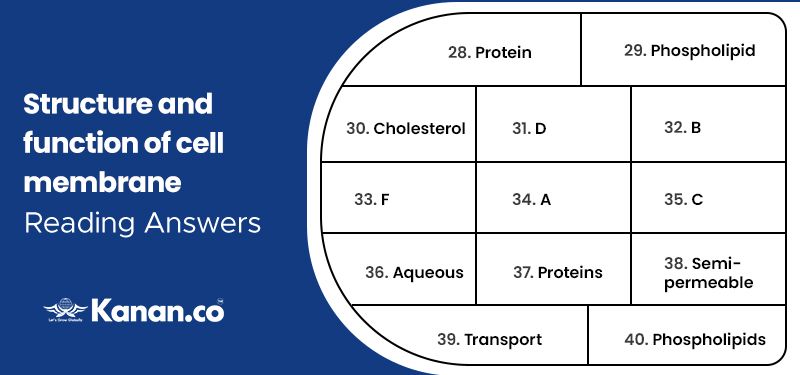
We have given the Structure and function of cell membrane reading answers, in the table given below.

Answer Table
| 28. Protein | 31. D | 34. A | 37. Proteins | 40. Phospholipids |
| 29. Phospholipid | 32. B | 35. C | 38. Semi-permeable | |
| 30. Cholesterol | 33. F | 36. Aqueous | 39. Transport |
Structure and function of cell Membrane IELTS reading practice test -Exam Review
Here, we have given the structure and function of cell membrane IELTS reading answers as a sample article for the IELTS reading practice test. This article will help you attain a band score in your exams. Check out the given passage to answer the questions.
Passage
In this article, the Structure and function of cell membrane reading answers with location is given. Be focused on the passage while reading it and answer the given questions.
Structure and function of cell membrane reading answers
A. Human body is made up of millions of cells - little building blocks of life. Each cell contains many functional subunits (organelles) that enable its proper functioning and is protected from the external environment by a cell membrane. While structure and function of organelles are extensively covered in various biology courses, the importance of study of cell membranes is often underrated. This article is dedicated to provide a short introduction into the basic functions and anatomy of a cell membrane.
B. Cell membranes protect and organize cells. Most importantly they serve as barriers, discriminating the cell’s interior from the outer milieu. Because cells always exist in aqueous environments their membranes should be structured in such a way so they do not solve in water. This function is ideally carried by special chemical molecules - phospholipids. These molecules are constructed from two parts: tails made up of 2 molecules of fat that ‘avoid’ water and heads that have an affinity for water. For this specific behavior the phospholipid’s tails are called hydrophobic (‘hydro’ means water and ‘phobia’ means fear) and heads are called hydrophilic (‘philos’ means love). When phospholipids are added to water, they self-assemble into double-layered structures, shielding their hydrophobic portions from water and exposing their hydrophilic portions to the environment. This phospholipid bilayer may resemble a sandwich, where phospholipid heads are bread rolls and tails are the sandwich filling.
C. In addition to lipids, membranes are loaded with proteins. They usually go through the lipid bilayer and are exposed to both aqueous environment and cell's interior. In fact, proteins account for roughly half the mass of most cellular membranes. They make the membrane semi-permeable, which means that some molecules can diffuse across the lipid bilayer but others cannot. Small hydrophobic molecules and gases like oxygen and carbon dioxide cross membranes rapidly. Small molecules, such as water and ethanol, can also pass through membranes, but they do so more slowly. On the other hand, cell membranes restrict diffusion of highly charged molecules, such as ions, and large molecules, such as sugars and amino acids. The passage of these molecules relies on specific transport proteins embedded in the membrane.
D. Membrane transport proteins are specific and selective for the molecules they move, and they often use energy to enhance passage. Also, these proteins transport some nutrients against the concentration gradient, which requires additional energy. The ability to maintain concentration gradients and sometimes move materials against them is vital to cell health and maintenance. Thanks to membrane barriers and transport proteins, the cell can accumulate nutrients in higher concentrations than exist in the environment and, conversely, dispose of waste products.
E. Other membrane-embedded proteins have communication-related jobs. Large molecules from the extracellular environment, such as hormones or immune mediators, bind to the receptor proteins on the cell membrane. Such binding causes a conformational change in the protein that transmits a signal to intracellular messenger molecules. Like transport proteins, receptor proteins are specific and selective for the molecules they bind.
F. Another important type of membrane’s components are cholesterol molecules, which account for about 20 percent of the lipids in animal cell plasma membranes. However, cholesterol is not present in bacterial membranes or mitochondrial membranes. The cholesterol molecules are embedded in place of phospholipid molecules and help to regulate the stiffness of membranes. To function properly, the cell membrane should be in fluid state. Cholesterol reduces membrane fluidity at moderate temperatures by reducing the moving of phospholipids. But at low temperatures, it hinders solidification by disrupting the regular packing of phospholipids.
Questions
Questions 28-30
- Label the diagram below.
- Write NO MORE THAN ONE WORD from the passage for each answer. Do not write the articles.
Which elements of cell membrane correspond to the numbers in the diagram?
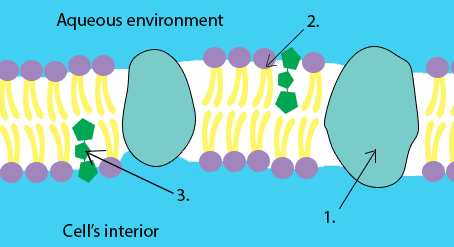
28. ____________
29. ____________
30. ____________
Questions 31-35
- Reading Passage 3 has six paragraphs, A-F.
- Which paragraph contains the following information?
- Write the correct letter, A–F, in boxes 31–35 on your answer sheet.
31. Specific proteins transport nutrients from the external environment against the concentration gradient.
32. The barrier function of cell membranes is supported by a bilayer of phospholipids.
33. The level of membrane fluidity is regulated by cholesterol molecules.
34. The importance of cell membranes are often underestimated.
35. Proteins make the membrane semi-permeable.
Questions 36–40
- Complete the summary below.
- Choose ONLY ONE WORD from the passage for each answer.
- Write your answers in boxes 36–40 on your answer sheet.
Cell membranes protect cells and organize their activities. The first main function of cell membrane - barrier function - is carried by phospholipids. These molecules don’t solve in water and, thus, are ideal for cells that always exist in 36.______ environment.
In addition to lipids, membranes are loaded with 37._________ that makes the membrane 38.________ , which means that some molecules can diffuse across the lipid bilayer but others cannot. One of the most important types of membrane proteins is 39.________ proteins and receptor proteins.
The last type of membrane elements are cholesterol molecules, which are embedded in place of 40._________ molecules and help to regulate the stiffness of membranes.
Answers for Structure and function of cell membrane with explanation
We have given the Structure and function of cell membrane reading answers with an explanation, this section will help you to identify your errors in the answering process.
28. Answer: Protein
Explanation: “In addition to lipids, membranes are loaded with proteins. They usually go through the lipid bilayer and are exposed to both aqueous environment and cell's interior. In fact, proteins account for roughly half the mass of most cellular membranes”. With this line it is clear that cell membranes are loaded with proteins and they seem like roughly half the mass of most cellular membranes. Hence the given answer is located in the 1-3 lines of paragraph C.
29. Answer: Phospholipid
Explanation: “These molecules are constructed from two parts: tails made up of 2 molecules of fat that ‘avoid’ water and heads that have an affinity for water. For this specific behavior the phospholipid’s tails are called hydrophobic (‘hydro’ means water and ‘phobia’ means fear) and heads are called hydrophilic (‘philos’ means love). When phospholipids are added to water, they self-assemble into double-layered structures, shielding their hydrophobic portions from water and exposing their hydrophilic portions to the environment. This phospholipid bilayer may resemble a sandwich, where phospholipid heads are bread rolls and tails are the sandwich filling”. With these lines it is clear that the phospholipid resembles a sandwich. Hence the given answer is located in the 5-12 lines of paragraph B.
30. Answer: Cholesterol
Explanation: “The cholesterol molecules are embedded in place of phospholipid molecules and help to regulate the stiffness of membranes”. With this line it is clear that cholesterol molecules are embedded in place of phospholipid molecules. Hence the given answer is located in the 3-5 lines of paragraph F.
31. Answer: D
Explanation: “Membrane transport proteins are specific and selective for the molecules they move, and they often use energy to enhance passage. Also, these proteins transport some nutrients against the concentration gradient, which requires additional energy”. With this line it is clear that some specific proteins transport nutrients from the external environment against the concentration gradient. Hence the given answer is located in the first 3 lines of paragraph D.
32. Answer: B
Explanation: “This function is ideally carried by special chemical molecules - phospholipids. These molecules are constructed from two parts: tails made up of 2 molecules of fat that ‘avoid’ water and heads that have an affinity for water. For this specific behavior the phospholipid’s tails are called hydrophobic (‘hydro’ means water and ‘phobia’ means fear) and heads are called hydrophilic (‘philos’ means love). When phospholipids are added to water, they self-assemble into double-layered structures, shielding their hydrophobic portions from water and exposing their hydrophilic portions to the environment. This phospholipid bilayer may resemble a sandwich, where phospholipid heads are bread rolls and tails are the sandwich filling”. With these lines it is clear that the barrier function of cell membranes is supported by a bilayer of phospholipids. Hence the given answer is located in paragraph B.
33. Answer: F
Explanation: “Cholesterol reduces membrane fluidity at moderate temperatures by reducing the moving of phospholipids”. With this line it is clear that the level of membrane fluidity is regulated by cholesterol molecules. Hence the given answer is located in the 6-7 lines of paragraph F.
34. Answer: A
Explanation: “While structure and function of organelles are extensively covered in various biology courses, the importance of study of cell membranes is often underrated”. With this line it is clear that the importance of cell membranes are often underestimated. Hence the given answer is located in the 3-5 lines of paragraph A.
35. Answer: C
Explanation: “In addition to lipids, membranes are loaded with proteins. They usually go through the lipid bilayer and are exposed to both aqueous environment and cell's interior. In fact, proteins account for roughly half the mass of most cellular membranes. They make the membrane semi-permeable, which means that some molecules can diffuse across the lipid bilayer but others cannot”. With this line it is clear that protein makes the membrane semi-permeable. Hence the given answer is located in the 1-5 lines of paragraph C.
36. Answer: Aqueous
Explanation: “Cell membranes protect and organize cells. Most importantly they serve as barriers, discriminating the cell’s interior from the outer milieu. Because cells always exist in aqueous environments their membranes should be structured in such a way so they do not solve in water”. With this line it is clear that cell membranes protect cells and organize their activities. The barrier function is carried by phospholipids. These molecules don’t solve in water and, thus, are ideal for cells that always exist in an aqueous environment. Hence the given answer is located in the 1-4 lines of paragraph B.
37. Answer: Proteins
Explanation: “In addition to lipids, membranes are loaded with proteins. They usually go through the lipid bilayer and are exposed to both aqueous environment and cell's interior. In fact, proteins account for roughly half the mass of most cellular membranes. They make the membrane semi-permeable, which means that some molecules can diffuse across the lipid bilayer but others cannot”. With this line it is clear that lipids, membranes are loaded with proteins. Hence the given answer is located in the 1-5 lines of paragraph C.
38. Answer: Semi-permeable
Explanation: “In addition to lipids, membranes are loaded with proteins. They usually go through the lipid bilayer and are exposed to both aqueous environment and cell's interior. In fact, proteins account for roughly half the mass of most cellular membranes. They make the membrane semi-permeable, which means that some molecules can diffuse across the lipid bilayer but others cannot”. With this line it is clear that the protein makes the membrane semi-permeable. Hence the given answer is located in the 1-5 lines of paragraph C.
39. Answer: Transport
Explanation: “On the other hand, cell membranes restrict diffusion of highly charged molecules, such as ions, and large molecules, such as sugars and amino acids. The passage of these molecules relies on specific transport proteins embedded in the membrane”. With this line it is clear one of the most important types of membrane proteins is transport proteins and receptor proteins. Hence the given answer is located in the last 3 lines of paragraph C.
40. Answer: Phospholipids
Explanation: “Another important type of membrane’s components are cholesterol molecules, which account for about 20 percent of the lipids in animal cell plasma membranes. However, cholesterol is not present in bacterial membranes or mitochondrial membranes. The cholesterol molecules are embedded in place of phospholipid molecules and help to regulate the stiffness of membranes”. With this line it is clear that the last type of membrane elements are cholesterol molecules, which are embedded in place of Phospholipids molecules and help to regulate the stiffness of membranes. Hence the given answer is located in the first 5 lines of paragraph F.
Other reading answers

About Author Roshan Sunthar
Roshan Sunthar is a study abroad expert as well as a renowned writer and author in international education. His academic excellence and 5+ years of work experience give him in-depth knowledge of international standardised exams and test preparation in IELTS, TOEFL, GRE, PTE, SAT, etc. The study materials he prepares incorporate exam-like questions. He’s also an expert in writing Statement of Purposes (SOPs) and Letter of Recommendations (LORs) for college admissions. He usually spends his leisure time watching English classics and documentaries, travelling, etc.
Kanan.co is a trusted study abroad consultancy offering comprehensive services, resources, and solutions for students and education institutions. We support students at every stage of their global education journey, ensuring a smooth and guided experience. Along with test preparation for IELTS, GRE, TOEFL, and SAT, we provide expert services such as SOP writing, visa guidance, accommodation support, scholarship assistance, and education loan support. Our expertise and commitment to excellence make us a reliable partner for students pursuing international education.
Free Online Mock Test 2026
Practice our mock test worth Rs. 25000 for Free and know your IELTS score!








Global Headquarters
Kanan Int EdTech Inc
320 Bay Street, Suite 321 (Spaces), Toronto ON, Canada M5B 1N9
Indian Headquarters
Kanan International Pvt. Ltd.
D-wing, 2nd Floor, Trident Complex, Ellora Park Vadiwadi Road, Vadodara, Gujarat 390007
IT/ Digital Campus
Kanan International Pvt. Ltd
Old, New No 3, 2nd Floor, 1A, Dr Sadasivam Rd, T. Nagar, Chennai, Tamil Nadu 600017
Our branches
- Bardoli
- Bharuch
- Chennai
- Dehradun
- Gurugram
- Himatnagar
- Karnal
- Nadiad
- Navsari
- Palanpur
- Rajkot
- Vadodara
- Valsad
- Vallabh Vidyanagar
- Vapi
Study Abroad
Test Prep
Top Universities
Consultants
IELTS Centers
GRE Centers
TOEFL Centers
SAT Centers
Language Courses in Vadodara
Study Abroad Calculators
Featured Blogs
Study Abroad Consultants in Chennai
Study Abroad Consultants in Surat
Study Abroad Consultants in Navsari
Study Abroad Consultants in Bardoli
Study Abroad Consultants in Ahmedabad
Study Abroad Consultants in Anand
Study Abroad Consultants in Khanna
Study Abroad Consultants in Nadiad
Study Abroad Consultants in Vadodara
Study abroad consultants in Valsad
Copyright © 2026 KANAN.CO All rights reserved.