- Study Abroad
- / ielts
- / rag pickers the bottom rung in the waste trade ladder reading answers
Rag-Pickers: The Bottom Rung in the Waste Trade Ladder Reading Answers


Author
17-09-2025

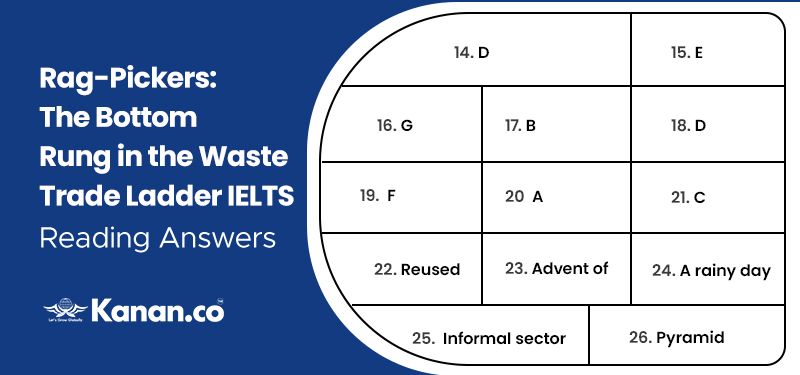
Here you can find Rag-Pickers: The Bottom Rung in the Waste Trade Ladder reading answers as a practice test along with answers and explanations. This article contains 13 questions in 2 different types- 8 questions as locating information and 5 questions as summary completion. Before answering your questions, read the given passage thoroughly.
Check out our YouTube Channel to Practice Full-Length IELTS Reading Tests Daily

Table of contents:
- Solution for Rag-Pickers: The Bottom Rung in the Waste Trade Ladder
- Rag-Pickers: The Bottom Rung in the Waste Trade Ladder IELTS reading practice test
- Passage
- Questions
- Answers with explanation
Solution for Rag-Pickers: The Bottom Rung in the Waste Trade Ladder
Answers for the Rag-Pickers: The Bottom Rung in the Waste Trade Ladder reading answers, are given here in the table form below.

Answer Table
| 14. D | 17. B | 20. A | 23. Advent of | 26. Pyramid |
| 15. E | 18. D | 21. C | 24. A rainy day | |
| 16. G | 19. F | 22. Reused | 25. Informal sector |
Rag-Pickers: The Bottom Rung in the Waste Trade Ladder IELTS reading practice test - Exam Review
We have given the Rag-Pickers: The Bottom Rung in the Waste Trade Ladder IELTS reading answers, as a sample article for the IELTS reading practice test. Use this article while practicing for your major exam, it will aid you to crack your exams with band scores. Go through the given passage and answer the questions.
Passage
We have given Rag-Pickers: The Bottom Rung in the Waste Trade Ladder reading answers with location. Be careful while reading the passage and answer the questions.
Rag-Pickers: The Bottom Rung in the Waste Trade Ladder reading answers
- Recycling has existed in one form or another for many years in India and is complicated. Long before the term itself seeped into everyday vocabulary, women separated newspapers and sold them to weekend buyers, who cycled by with a weighing scale and loose change to pay with. Bottles were reused until they broke, and tins were simply never thrown away. As a 13- year-old, I was surrounded by baby food tins from my infancy, storing rice, dais, and chutneys. These habits are sadly dying out, superseded by the advent of the non-recyclable, non-reusable sachet and plastic packaging. Now, instead of being stored away for a rainy day, unwanted products are tossed carelessly into the dustbin. And this is where modern-day recycling begins. In Delhi, for every hundred residents, one person is engaged in recycling.
- All recycling in India is undertaken by and via the informal sector. This sector includes ragpickers, middlemen, transporters, and finally, reprocessors. In terms of human resources, this sector is arranged in a table-top pyramid with rag pickers at the base, forming the backbone of waste collection. At the thinner end of the wedge are the small middlemen, who buy the waste and sell it to larger middlemen, who usually specialize in particular items and materials. Above them are factory owners, who procure supplies from those beneath through a ubiquitous network of agents.
- Delhi is particularly interesting because it has one of the largest and most vibrant recycling bases in the country. The 1,00,000 waste-pickers are the base of a huge recycling pyramid, handling something like 15% of the solid waste generated in the city. Since over 7,000 metric tonnes of waste is generated daily, this is a substantial business. A range of materials is processed within the sector, including plastics, metals, paper, and glass. Studies estimate that this informal labor force saves the three Delhi Municipalities a minimum of Rs. 6 lakhs (approx. 12,000 USD) every day. It has been calculated that a single scrap of material can increase 700% in value before it is even reprocessed, as it moves along the recycling chain.
- So recycling in Delhi is big business but is it a green business, and who does it benefit? Consider first the rag-picker, usually a young person though not a child, with a large woven sack hanging from his or her shoulder. He or she will begin work as early as 4 am, or miss the most profitable finds. As locations and routes are territorial, residents may begin to recognize their own rag-picker. By later afternoon, or when the bag is full, the rag-picker hunts down a middleman to sell to. The waste should be separated according to almost 30 different categories, and it must be clean and dry. IN secret segregation patches around the city; thousands of the poorest inhabitants sort through waste and wash it from makeshift water sources. Hunched over for hours, the poor undertake what the privileged preach: segregation of waste. If the privileged had done this themselves, the poor would suffer less from backache, allergies, and respiratory disorders, and have fewer cuts, burns, and dog bites. The transaction at the selling point is complex and frequently unjust. A rag-picker may be paid less if waste is substandard or wet, or if the buyer is temporarily cash-strapped. Rag-pickers often take loans from buyers, and soon find themselves working simply to pay back debt.
- Rag-pickers generally live either in slums, often the shop or warehouse of a middleman, or outside in alleyways and on footpaths. Some sleep in dustbins. Their access to basic amenities and essential services is virtually non-existent. The police regularly beat them or burn their bags of waste, leaving them with nothing to show for a day’s work. Municipal workers charge rag-pickers to be allowed to forage in a bin, and if it is a lucrative bin, the rates gradually increase. Once ensconced, the municipal worker makes them do additional work, sweeping or loading trucks. It is not unknown for the police to pick up rag-pickers and force them to clean the police station.
- Sadly and shockingly, this whole process subsidies the consumption of various materials by the city’s wealthier citizens. The example of plastics is a good example. According to a report by the Ministry of Environment, the plastics industry is growing at 10% per annum, and almost 52% of this is expected to be used in the packaging sector. Packaging is a short life use and it will be collected and processed as waste by the informal sector. It will be undertaken in a manner that ensures that ecologically, economically, and socially, the costs will be internalized by this recycling chain.
- In India, the informal sector has an essential role because it is able to undertake to recycle, which the municipality cannot. However, although it is critical, especially for the handling of solid waste, the sector is unable to optimize its work. There is a stark lack of awareness and specific skills, as well as very poor working conditions. The services provided by this sector are poorly understood and ultimately free to consumers, so are currently unappealing to the private sector. Recycling, at least for now, must be seen as the flip side of urban middle- class consumption.
- The state’s attitude towards informal recycling is schizophrenic. On the one hand, in conferences and seminars, the sector is praised and rag-pickers complimented for their contribution. On the other hand, the sector is ignored by planners and policymakers, who look to reform municipal systems. The current Third Master Plan for Delhi, though still being drafted in secrecy, has been largely criticized for having ‘left out the informal sectors&rsquo. This lack of planning perpetuates the image of the sector as an illegal and illegitimate one, which is projected as encroaching upon the city, rather than serving it.
Questions
Question 14 – 21
- Reading passage 2 has seven sections, A-G. Which section contains the following information?
- Write the correct letter A-G in boxes 14-21 on your answer sheet NB you may use any letter more than once.
14. An account of a typical day’s labor
15. Examples of cruelty and specific exploitation
16. An accusation that double standards are operating
17. A description of a hierarchical system
18. An allegation that wealthier people are not doing what they could
19. An assertion that the rich benefit from the hard work of the poor
20. A summary of how a business has changed over time
21. A claim that recycling is economically beneficial to the authorities
Questions 22-26
- Complete the summary below
- Write no more than three words com the passage (or each answer. Write your answers in boxes 22-26 on your answer sheet.
The notion of recycling in India has changed hugely. At one time, people 22_____________ everything from newspapers to household containers. Now, with the 23 __________________ disposable products and plastic packaging, people simply throw things away instead of putting them aside for 24____________. The 25____________ takes care of the whole recycling process nowadays. Rag-pickers are at the bottom of a 26 _______________________ with everyone from the various middlemen to the factory owners and their agents looking down.
Answers for with Rag-Pickers: The Bottom Rung in the Waste Trade Ladder explanation
Here we have given Rag-Pickers: The Bottom Rung in the Waste Trade Ladder reading answers with explanations, this section will assist you to identify your errors in the answering process.
14. Answer: D
Explanation: “A rag-picker may be paid less if waste is substandard or wet, or if the buyer is temporarily cash strapped. Rag-pickers often take loans from buyers, and soon find themselves working simply to pay back debt”. Hence the given answer is located in the last 3 lines of paragraph D and the entire passage states an account of typical day’s labor of a rag-picker.
15. Answer: E
Explanation: “Rag-pickers generally live either in slums, often the shop or warehouse of a middleman, or outside in alleyways and on footpaths. Some sleep in dustbins”. Hence the given answer is located in the first 2 lines of paragraph E and the entire passages illustrate the cruelty and specific exploration of Rag pickers.
16. Answer: G
Explanation: “In India, the informal sector has an essential role because it is able to undertake to recycle, which the municipality cannot. However, although it is critical, especially for the handling of solid waste, the sector is unable to optimize its work”. Hence the given answer is located in the first 4 lines of paragraph G. and this paragraph states an accusation that double standards are operating.
17. Answer: B
Explanation: “This sector is arranged in a table-top pyramid with rag pickers at the base, forming the backbone of waste collection. At the thinner end of the wedge are the small middlemen, who buy the waste and sell it to larger middlemen, who usually specialize in particular items and materials. Above them are factory owners, who procure supplies from those beneath through a ubiquitous network of agents”. With this line it is clear that this paragraph clearly states the description of a hierarchical system. Hence the given answer is located in the 3-8 lines of paragraph B.
18. Answer: D
Explanation: “The poor undertake what the privileged preach: segregation of waste. If the privileged had done this themselves, the poor would suffer less from backache, allergies, and respiratory disorders, and have fewer cuts, burns, and dog bites. The transaction at the selling point is complex and frequently unjust”. With this line it is clear that paragraph B states an allegation that wealthier people are not doing what they could. Hence the given answer is located in the 10-14 lines of paragraph B.
19. Answer: F
Explanation: “Sadly and shockingly, this whole process subsidies the consumption of various materials by the city’s wealthier citizens. The example of plastics is a good example. According to a report by the Ministry of Environment, the plastics industry is growing at 10% per annum, and almost 52% of this is expected to be used in the packaging sector”. With this line it is clear that paragraph F indicates an assertion that the rich benefit from the hard work of the poor. Hence the given answer is located in the first 5 lines of paragraph F.
20. Answer: A
Explanation: “Recycling has existed in one form or another for many years in India and is complicated. Long before the term itself seeped into everyday vocabulary, women separated newspapers and sold them to weekend buyers, who cycled by with a weighing scale and loose change to pay with, and These habits are sadly dying out, superseded by the advent of the non-recyclable, non-reusable sachet and plastic packaging. Now, instead of being stored away for a rainy day, unwanted products are tossed carelessly into the dustbin. And this is where modern-day recycling begins. In Delhi, for every hundred residents, one person is engaged in recycling”. With these lines it is clear that paragraph A explains about how a business has changed over time. Hence the given answer is located in the first 4 lines and last 5 lines of paragraph A.
21. Answer: C
Explanation: “The 1,00,000 waste-pickers are the base of a huge recycling pyramid, handling something like 15% of the solid waste generated in the city. Since over 7,000 metric tonnes of waste is generated daily, this is a substantial business. A range of materials is processed within the sector, including plastics, metals, paper, and glass. Studies estimate that this informal labor force saves the three Delhi Municipalities a minimum of Rs. 6 lakhs (approx. 12,000 USD) every day. It has been calculated that a single scrap of material can increase 700% in value before it is even reprocessed, as it moves along the recycling chain”. Hence the given answer is located in paragraph C and this paragraph explains that recycling is economically beneficial to the authorities.
22. Answer: Reused
Explanation: “Recycling has existed in one form or another for many years in India and is complicated. Long before the term itself seeped into everyday vocabulary, women separated newspapers and sold them to weekend buyers, who cycled by with a weighing scale and loose change to pay with. Bottles were reused until they broke, and tins were simply never thrown away”.This line explains the nation of recycling in India has changed hugely. At one time, people reuse everything from newspapers to household containers. Hence the given answer is located in the first 5 lines of paragraph A.
23. Answer: Advent of
Explanation: “These habits are sadly dying out, superseded by the advent of the non-recyclable, non-reusable sachet and plastic packaging”. This line explains that Now, with the advent of disposable products and plastic packaging. Hence the given answer is located in the 7-8 lines of paragraph A.
24. Answer: A rainy day
Explanation: “Now, instead of being stored away for a rainy day, unwanted products are tossed carelessly into the dustbin. And this is where modern-day recycling begins”. With this line it is clear that people simply throw things away instead of putting them aside on rainy days. Hence the given answer is located in the 9-11 lines of paragraph A.
25. Answer: Informal sector
Explanation: “All recycling in India is undertaken by and via the informal sector. This sector includes ragpickers, middlemen, transporters, and finally, reprocessors”. With this line it is clear that the informal sector takes care of the whole recycling process nowadays. Hence the given answer is located in the first 2 lines of paragraph B.
26. Answer: Pyramid
Explanation: “In terms of human resources, this sector is arranged in a table-top pyramid with rag pickers at the base, forming the backbone of waste collection”. With this line it is clear that Rag-pickers are at the bottom of a pyramid with everyone from the various middlemen to the factory owners and their agents looking down. Hence the given answer is located in the 2-4 lines of paragraph B.
Other reading answers

About Author Arivarasi
Arivarasi is an experienced author with expertise in the study abroad industry and preparing test materials for exams like IELTS, TOEFL, GRE, SAT, PTE, etc. She stays up-to-date with university and college requirements for international students which allows her to provide guidance on course selection, documents like SOP, LOR, and scholarship opportunities. She has written numerous articles on study abroad exams, destinations, universities & colleges requirements, admission procedures, and the entire process of studying abroad. Collaborating with industry experts and counselors, she crafts informative articles that make students take the right decisions.
Kanan.co is a trusted study abroad consultancy offering comprehensive services, resources, and solutions for students and education institutions. We support students at every stage of their global education journey, ensuring a smooth and guided experience. Along with test preparation for IELTS, GRE, TOEFL, and SAT, we provide expert services such as SOP writing, visa guidance, accommodation support, scholarship assistance, and education loan support. Our expertise and commitment to excellence make us a reliable partner for students pursuing international education.
Free Online Mock Test 2026
Practice our mock test worth Rs. 25000 for Free and know your IELTS score!








Global Headquarters
Kanan Int EdTech Inc
320 Bay Street, Suite 321 (Spaces), Toronto ON, Canada M5B 1N9
Indian Headquarters
Kanan International Pvt. Ltd.
D-wing, 2nd Floor, Trident Complex, Ellora Park Vadiwadi Road, Vadodara, Gujarat 390007
IT/ Digital Campus
Kanan International Pvt. Ltd
Old, New No 3, 2nd Floor, 1A, Dr Sadasivam Rd, T. Nagar, Chennai, Tamil Nadu 600017
Our branches
- Bardoli
- Bharuch
- Chennai
- Dehradun
- Gurugram
- Himatnagar
- Karnal
- Nadiad
- Navsari
- Palanpur
- Rajkot
- Vadodara
- Valsad
- Vallabh Vidyanagar
- Vapi
Study Abroad
Test Prep
Top Universities
Consultants
IELTS Centers
GRE Centers
TOEFL Centers
SAT Centers
Language Courses in Vadodara
Study Abroad Calculators
Featured Blogs
Study Abroad Consultants in Chennai
Study Abroad Consultants in Surat
Study Abroad Consultants in Navsari
Study Abroad Consultants in Bardoli
Study Abroad Consultants in Ahmedabad
Study Abroad Consultants in Anand
Study Abroad Consultants in Khanna
Study Abroad Consultants in Nadiad
Study Abroad Consultants in Vadodara
Study abroad consultants in Valsad
Copyright © 2026 KANAN.CO All rights reserved.