- Study Abroad
- / ielts
- / could you pass me my glasses please reading answers
Could you pass me my glasses please? Reading Answers


Author
16-09-2025

Could you pass me my glasses please? reading answers practice tests is provided with answers and explanations. This passage comprises 13 questions divided into three question types - true/false/not given, multiple choice questions and summary completion reading passage.
Check out our YouTube Channel to Practice Full-Length IELTS Reading Tests Daily

Table of contents:
- Solution for could you pass me my glasses please?
- could you pass me my glasses please? IELTS Reading Practice Test
- Passage
- Questions
- Answers with Explanations
Solution for could you pass me my glasses please?
could you pass me my glasses please? reading answers are listed in the table below. Verify your answers against our answer table, then correct any inaccuracies.
Answer Table
| 1. true | 5. Focal length | 9. Temperature change | 13.a |
| 2. false | 6. Convex lenses | 10. peripheral | |
| 3. Not given | 7.(Johannes) Kepler | 11.a | |
| 4. Focal point | 8. Conscious effort | 12.c |

could you pass me my glasses please? IELTS Reading Practice Test - Exam Review
could you pass me my glasses please? reading answers are given here, which will challenge your IELTS reading practice test reading skills. Paraphrasing can help you to understand the ideas clearly which makes you able to efficiently answer the questions.
Passage
We’ve provided the reading passage of could you pass me my glasses please?. Read the passage and carefully complete the questions. Check the answers with our could you pass me my glasses please? reading answers with locations.
could you pass me my glasses please?
1. The human eye was not designed for the years of intensive book learning that are now common in modern society. The result is eye strain and deterioration, often at an early age, but this same society has provided the obvious answer: corrective lensed eyeglasses. Ubiquitous and ever present, coming in all styles, colours, and designs, the optical correction of faulty vision with these devices is a phase which probably everyone will have to face at some stage in their lives.
2.It is not surprising that the first eyeglasses were made by the Catholic monks dedicated to the writing, translation, and reproduction of finely written religious texts. In contrast to the general undereducation and illiteracy of the times, these monks were versed in many languages, and worked for years in badly-illuminated candle-lit ‘scriptoriums’ – an effort which took its toll on their eyesight. Thus, the earliest pictorial evidence for the use of eyeglasses is a 1352 portrait of the Catholic cardinal, Hugh de Provence. However, the usefulness of glasses had already long been realised by the population at large, and by 1300 the trade of lens-grinding was widespread enough to require formal guilds and regulations.
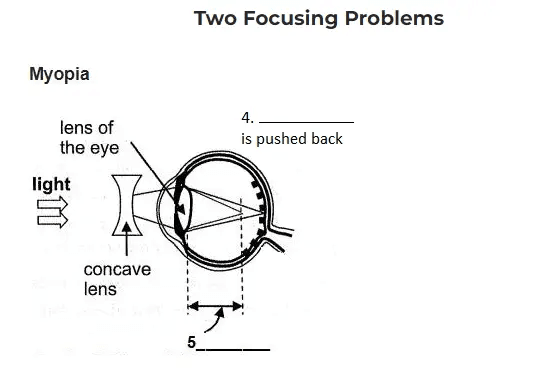
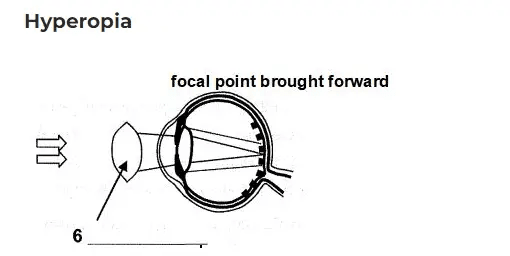
3.Although popular and effective, no one was quite sure of the mechanics of it all. The first detailed mathematical explanation would not come until Johannes Kepler published his work on optics in 1604. Basically, glasses modify the focal length of the eye’s lens. There are two main focusing disorders: myopia and hyperopia. In the case of the first (near-sightedness, in which it is difficult to see objects at a distance), concave lenses are used, compensating for the eye’s refractive error by pushing the focal point back, to the retina. Hyperopia (far-sightedness) uses convex lenses to do the opposite, bringing the focal point forward, to the retina.
4.Yet, to accommodate the range of situations in which clear vision is needed, from reading books and computer monitors, to television watching and driving cars, some glasses are equipped with more than one lens type. The most common are bi-focal lenses, with two distinct horizontal viewing areas. A conscious effort is thus necessary to focus through the band of the lens necessary to solve the visual challenge faced. A variation which helps with this are lenses which allow progressive transitions, rather than distinct changes between viewing angles. The simplest system of all is to merely have several pairs of glasses, reserving them for specific tasks.
5.These days, lenses are most commonly a plastic polycarbonate material, offering lower weight and higher scratch resistance, as well as the ability to screen out harmful ultraviolet and infrared rays from the sun. Similarly, the frames are flexible and lightweight, offering less friction and irritation for the skin. Nevertheless, glasses cannot be said to be convenient devices. Grease, dirt, sweat, and vapour can streak them when eating or cooking, or from natural condensation due to temperature changes (such as when exiting a heated building into the colder outdoors). Glasses are also awkward during fast-motion sports or labouring jobs, are rather easily broken, and not cheap to repair.
6.Obviously then, contact lenses have considerable advantages. These are inserted directly over the pupil, and have the additional benefit of a perceived aesthetic appeal. Traditional glasses are sometimes seen as unfashionable, carrying associations of age or infirmity. The almost invisible contacts avoid this, which is perhaps one reason why most wearers are female. Having said that, by completely covering the pupil, contacts also offer better peripheral vision, and are more appropriate for certain less common vision impairments. Their disadvantage is the difficulty and discomfort involved in putting them on and taking them off. They can also result in dryness and irritation.
7.Interestingly though, the modern era has seen eyeglasses become somewhat of a fashion accessory. The musicians Buddy Holly and John Lennon were so characterised by their glasses that their names have been given to the style they wore. Glasses can now even be bought ‘off the shelf’, without an eye examination, cashing in on the need for quick solutions that people want in a busy society. Although they are a source of much revenue, opticians advise people to first have proper eye examinations, not only to ensure the best results, but also for early detection of potential eye diseases, such as glaucoma, which might actually be the root cause of focusing problems.
8.The lace of the future may well be ‘laser eye surgery’. In this process, laser beams are used, usually to alter the curvature of the cornea and thus provide long-term corrective benefits. Although straightforward enough and increasingly safe and affordable, given the delicacy of the eye, there remains a small risk of failure and resultant vision problems, such as ghosting or halos. It is an interesting fact, that, despite the growth of such surgery, and the use of contacts, traditional lenses remain as popular as ever. Nothing, it seems, can match the simple convenience of putting on a pair of glasses.
Questions
Questions 1-3
Do the following statements agree with the information given in Reading Passage One?
TRUE if the statement agrees with the information
FALSE if the statement contradicts the information
NOT GIVEN If there is no information on this
1. Most people study hard today.
2. When glasses were invented, most people could read.
3. Most monks suffered eye problems.
Questions 4-6
Complete the diagram. Choose NO MORE THAN TWO WORDS from the passage for each answer.
Questions 7-10
Answer the questions. Choose NO MORE THAN TWO WORDS from the passage for each answer.
7. Who first explained how glasses function?
8. What is needed when viewing through bi-focal glasses?
9. What can cause condensation on glasses?
10. What aspect of sight do contact lenses improve better than glasses?
Questions 11-13
Choose the correct letter, A, B, C, or D.
11. Modern lenses are
A safer.
B heavier.
C softer.
D more flexible.
12. ‘Off-the-shelf’ glasses
A are not popular.
B can cause glaucoma.
C earn shops good money.
D are recommended.
13. Laser eye surgery is
A of limited benefit.
B more convenient than glasses.
C becoming more popular.
D complex.
Answers for could you pass me my glasses please? With Explanations
could you pass me my glasses please? reading answers with explanations is given below. Refer to the following answers with an explanation section in order to correct your errors.
(Note: The text in italics mentions the location and referring lines written in the reading passage.)
1.Answer: true
Explanation: it is located in first two lines of first paragraph were it is stated that intensive book learning is now done by the modern society. The lines are “The human eye was not designed for the years of intensive book learning that are now common in modern society”.
2.Answer: false
Explanation: it is located in first two lines of second paragraph where it stated that glasses where invented for writing, reproduction and translation of text in contrast of illiteracy of that time. It is not surprising that the first eyeglasses were made by the Catholic monks dedicated to the writing, translation, and reproduction of finely written religious texts. In contrast to the general undereducation and illiteracy of the times
3.Answer: not given
Explanation: the information related most monks faced eye problem was not located anywhere thus the answer will be not given.
4. Answer: focal point
Explanation: it is located in last third line of 3 paragraph where the disorder of myopia is stated. “ concave lenses are used, compensating for the eye’s refractive error by pushing the focal point back, to the retina”.
5. Answer: focal lenght
Explanation: it is located in third line of 3 paragraph, the distance from lens of the eye and the last part of the eye is know as focal length. Basically, glasses modify the focal length of the eye’s lens
6. Answer: convex lenses
Explanation: Hyperopia (far-sightedness) uses convex lenses to do the opposite, bringing the focal point forward, to the retina. It is located in last lines of 3 paragraph and it is clearly stated that convex lenses are used in hyperopia.
7. Answer: Johannes Kepler
Explanation: The first detailed mathematical explanation would not come until Johannes Kepler published his work on optics in 1604. It is located in first two lines of 3rd paragraph where it is clearly stated that mathematical explanation was discovered by kepler.
8. Answer: conscious effort
Explanation: A conscious effort is thus necessary to focus through the band of the lens necessary to solve the visual challenge faced, it is located in 4-5 lines of 4th paragraph. That a conscious effort is very much important while using bi-focal lenses.
9. Answer: temperature changes
Explanation: Grease, dirt, sweat, and vapour can streak them when eating or cooking, or from natural condensation due to temperature changes (such as when exiting a heated building into the colder outdoors), it is located in 5-7 lines of 5th paragraph where many causes are sated but the condensation of glasses is done because of temperature change in the environment.
10. Answer: peripheral
Explanation: it is located in last lines of 6 paragraph, that peripheral vision can be improved. Having said that, by completely covering the pupil, contacts also offer better peripheral vision, and are more appropriate for certain less common vision impairments.
11. Answer: a
Explanation: it is located in 5 paragraph in first three lines and modern era can be decoded by “these days”, These days, lenses are most commonly a plastic polycarbonate material, offering lower weight and higher scratch resistance, as well as the ability to screen out harmful ultraviolet and infrared rays from the sun. with all the features it also protects our eyes from uv rays therefore it is safer. Answer is a
12. Answer: c
Explanation: answer is c earn shoop good money because it is source more generating revenue for all the shoopkeepres. Glasses can now even be bought ‘off the shelf’, without an eye examination, cashing in on the need for quick solutions that people want in a busy society. Although they are a source of much revenue, opticians advise people to first have proper eye examinations, it is located in 7 paragraph in 4-7 lines.
13. Answer: c
Explanation: It is an interesting fact, that, despite the growth of such surgery, and the use of contacts, traditional lenses remain as popular as ever. Nothing, it seems, can match the simple convenience of putting on a pair of glasses. Since it involves littel risk and people stiil prefer to wear a pair of glasses over having this surgery therefore the answer will be option a. It is located in 8 paragraph last 4 lines.
Other Reading Tests

About Author Roshan Sunthar
Roshan Sunthar is a study abroad expert as well as a renowned writer and author in international education. His academic excellence and 5+ years of work experience give him in-depth knowledge of international standardised exams and test preparation in IELTS, TOEFL, GRE, PTE, SAT, etc. The study materials he prepares incorporate exam-like questions. He’s also an expert in writing Statement of Purposes (SOPs) and Letter of Recommendations (LORs) for college admissions. He usually spends his leisure time watching English classics and documentaries, travelling, etc.
Kanan.co is a trusted study abroad consultancy offering comprehensive services, resources, and solutions for students and education institutions. We support students at every stage of their global education journey, ensuring a smooth and guided experience. Along with test preparation for IELTS, GRE, TOEFL, and SAT, we provide expert services such as SOP writing, visa guidance, accommodation support, scholarship assistance, and education loan support. Our expertise and commitment to excellence make us a reliable partner for students pursuing international education.
Free Online Mock Test 2026
Practice our mock test worth Rs. 25000 for Free and know your IELTS score!








Global Headquarters
Kanan Int EdTech Inc
320 Bay Street, Suite 321 (Spaces), Toronto ON, Canada M5B 1N9
Indian Headquarters
Kanan International Pvt. Ltd.
D-wing, 2nd Floor, Trident Complex, Ellora Park Vadiwadi Road, Vadodara, Gujarat 390007
IT/ Digital Campus
Kanan International Pvt. Ltd
Old, New No 3, 2nd Floor, 1A, Dr Sadasivam Rd, T. Nagar, Chennai, Tamil Nadu 600017
Our branches
- Bardoli
- Bharuch
- Chennai
- Dehradun
- Gurugram
- Himatnagar
- Karnal
- Nadiad
- Navsari
- Palanpur
- Rajkot
- Vadodara
- Valsad
- Vallabh Vidyanagar
- Vapi
Study Abroad
Test Prep
Top Universities
Consultants
IELTS Centers
GRE Centers
TOEFL Centers
SAT Centers
Language Courses in Vadodara
Study Abroad Calculators
Featured Blogs
Study Abroad Consultants in Chennai
Study Abroad Consultants in Surat
Study Abroad Consultants in Navsari
Study Abroad Consultants in Bardoli
Study Abroad Consultants in Ahmedabad
Study Abroad Consultants in Anand
Study Abroad Consultants in Khanna
Study Abroad Consultants in Nadiad
Study Abroad Consultants in Vadodara
Study abroad consultants in Valsad
Copyright © 2026 KANAN.CO All rights reserved.