- Study Abroad
- / ielts
- / detection of a meteorite lake reading answers
Detection of a Meteorite Lake Reading Answers


Author
16-09-2025

We have offered detection of a Meteorite Lake reading practice test and answers with explanations. It consists of 14 questions in 3 different types -14 questions, 5 questions are true, false or not given questions, 4 questions are flow chart completion, 5 questions are summary completion questions.
Check out our YouTube Channel to Practice Full-Length IELTS Reading Tests Daily

Table of contents:
- Solution for detection of a Meteorite Lake
- Detection of a Meteorite Lake IELTS reading practice test
- Passage
- Questions
- Answers with explanations
Solution for detection of a Meteorite Lake
We have provided detection of a Meteorite Lake reading answers, in the table given below.
Answer Table
| 14. True | 18. False | 22. Hydrophones | 26. Three-dimensional |
| 15. Not given | 19. (high-pressure) air gun | 23. Shipping container | 27. Fishing nets |
| 16. False | 20. Sound energy | 24. Seismic reflection profiling | |
| 17. True | 21. Cable | 25. Laboratory |

Detection of a Meteorite Lake IELTS reading practice test - Exam Review
We have provided this detection of a Meteorite Lake IELTS reading answers , which will help you to shine in the IELTS reading practice test to challenge your reading skills and go through the passage to find some keywords to use while answering.
Passage
We have given detection of a Meteorite Lake reading answers with location. Read carefully and answer the questions.
Detection of a Meteorite Lake
A. As the sun rose over picturesque Lake Bosumtwi, a team of Syracuse University researchers prepared for another day of using state-of- the-art equipment to help unlock the mysteries hidden below the lake bottom. Nestled in the heart of Ghana, the lake holds an untapped reservoir of information that could help scientists predict future climate changes by looking at evidence from the past. This information will also improve the scientists’ understanding of the changes that occur in a region struck by a massive meteorite
B. The project, led by earth sciences professor Christopher Scholz of the College of Arts and Sciences and funded by the National Science Foundation (NSF), is the first large-scale effort to study Lake Bosumtwi, which formed 1.1 million years ago when a giant meteor crashed into the Earth’s surface. The resulting crater is one of the largest and most well- preserved geologically young craters in the world, says Scholz, who is collaborating on the project with researchers from the University of Arizona, the University of South Carolina, the University of Rhode Island, and several Ghanaian institutions. “Our data should provide information about what happens when an impact hits hard, pre-Cambrian, crystalline rocks that are a billion years old,” he says.
C. Equally important is the fact that the lake, which is about 8 kilometers in diameter, has no natural outlet. The rim of the crater rises about 250 meters above the water’s surface. Streams flow into the lake, Scholz says, but the water leaves only by evaporation, or by seeping through the lake sediments. For the past million years, the lake has acted as a tropical rain, filling and drying with changes in precipitation and the tropical climate. The record of those changes is hidden in sediment below the lake bottom. “The lake is one of the best sites in the world for the study of tropical climate changes,” Scholz says. “The tropics are the heat engine for the Earth’s climate. To understand global climate, we need to have records of climate changes from many sites around the world, including the tropics.”
D. Before the researchers could explore the lake’s subsurface, they needed a boat with a large, working deck area that could carry eight tons of scientific equipment. The boat dubbed R/V Kilindi was built in Florida last year. It was constructed in modules that were dismantled, packed inside a shipping container, and reassembled over a 10-day period in late November and early December 1999 in the rural village of Abono, Ghana. The research team then spent the next two weeks testing the boat and equipment before returning to the United States for the holidays.
E. In mid-January, five members of the team—Keely Brooks, an earth sciences graduate student; Peter Cattaneo, a research analyst; and Kiram Lezzar, a postdoctoral scholar, all from SU; James McGill, a geophysical field engineer; and Nick Peters, a Ph.D. student in geophysics from the University of Miami—returned to Abono to begin collecting data about the lake’s subsurface using a technique called seismic reflection profiling. In this process, a high-pressure air gun is used to create small, pneumatic explosions in the water. The sound energy penetrates about 1,000 to 2,000 meters into the lake’s subsurface before bouncing back to the surface of the water.
F. The reflected sound energy is detected by underwater microphones-called hydrophones—embedded in a 50-meter-long cable that is towed behind the boat as it crosses the lake in a carefully designed grid pattern. On-board computers record the signals, and the resulting data are then processed and analysed in the laboratory. “The results will give us a good idea of the shape of the basin, how thick the layers of sediment are, and when and where there were major changes in sediment accumulation,” Scholz says. “We are now developing a three-dimensional perspective of the lake’s subsurface and the layers of sediment that have been laid down.”
G. Team members spent about four weeks in Ghana collecting the data. They worked seven days a week/ arriving at the lake just after sunrise. On a good day, when everything went as planned, the team could collect data and be back at the dock by early afternoon. Except for a few relatively minor adjustments, the equipment and the boat worked well. Problems that arose were primarily non-scientific—tree stumps, fishing nets, cultural barriers, and occasional misunderstandings with local villagers.
H. Lake Bosumtwi, the largest natural freshwater lake in the country, is sacred to the Ashanti people, who believe their souls come to the lake to bid farewell to their god. The lake is also the primary source of fish for the 26 surrounding villages. Conventional canoes and boats are forbidden. Fishermen travel on the lake by floating on traditional planks they propel with small paddles. Before the research project could begin, Scholz and his Ghanaian counterparts had to secure special permission from tribal chiefs to put the R/V Kilindi on the lake.
I. When the team began gathering data, rumors flew around the lake as to why the researchers were there. “Some thought we were dredging the lake for gold, others thought we were going to drain the lake or that we had bought the lake,” Cattaneo says, “But once the local people understood why we were there, they were very helpful.”
Questions
Questions 14-18
- Do the following statements agree with the information given in the reading passage? In boxes 14-18 on your answer sheet, write:
- TRUE, if the statement is true
- FALSE, if the statement is false
- NOT GIVEN, if the statement is not given in the passage.
14. With the investigation of the lake, scientists may predict the climate changes in the future.
15. The crater resulting from a meteorite impact is the largest and most preserved one in the world.
16. The water stored in Lake Bosumtwi was gone only by seeping through the lake sediments.
17. Historical climate changes can be detected by the analysis of the sediment in the lake
18. The greatest obstacle to research of scientists had been the interference by the locals due to the indigenous beliefs.
Questions 19 – 22
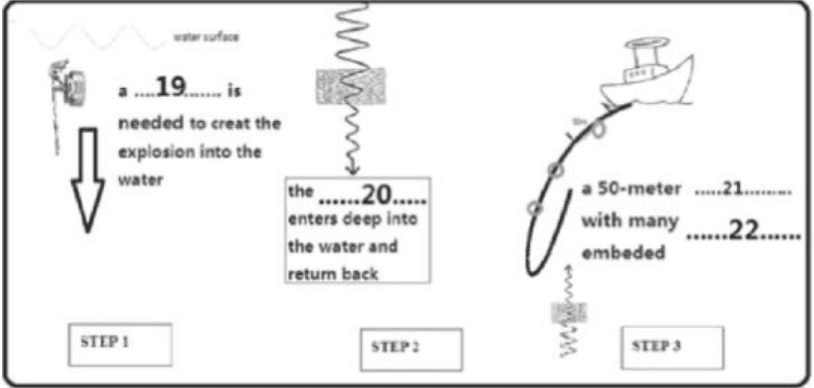
- There are three steps of collecting data from the lake as followings, please fill in the blanks in the Flowchart below.
Questions 23- 27
- Complete the following summary of the paragraphs of Reading passage 2, using No more than three words from the Reading passage 2 for each answer.
- Write your answers in boxes 23-27 on your answer sheet.
The boat-double R/V Kilindi crossed the lake was dismantled and stored in a 23___________ The technology they used called 24___________ .They created sound energy into 1000-2000 meters in to the bottom of the lake, and used separate equipment to collect the returned waves. Then the data had been analyzed and processed in the 25___________. Scholz also added that they were now building 26___________ view of the sediment or sub-image in the bottom of the lake. Whole set of equipment works well yet the ship should avoid physical barriers including tree stumps or 27___________ floating on the surface of the lake.
Answers for detection of a Meteorite Lake with explanation
We have provided this detection of a Meteorite Lake reading answers with explanations, It will help you to find your errors in the answering process.
(Note: The text in italics mentions the location and referring lines written in the reading passage)
14. Answer: True
Explanation: The lake holds an untapped reservoir of information that could help scientists predict future climate changes by looking at evidence from the past. The given answer is located in the 3-5 lines of paragraph A.
15. Answer: Not given
Explanation : Not Avaliable
16. Answer: False
Explanation: Streams flow into the lake, Scholz says, but the water leaves only by evaporation, or by seeping through the lake sediments. The given answer is located in the 3-4 lines of paragraph C.
17. Answer: True
Explanation: past million years, the lake has acted as a tropical rain, filling and drying with changes in precipitation and the tropical climate. The record of those changes is hidden in sediment below the lake bottom. The given answer is located in the 4-7 lines of paragraph C.
18. Answer: False
Explanation: “But once the local people understood why we were there, they were very helpful.” The given answer is located in the last line of paragraph I.
19. Answer: (high-pressure) air gun
Explanation: a high-pressure air gun is used to create small, pneumatic explosions in the water. The given answer is located in the 6-7 lines of paragraph E.
20. Answer: Sound energy
Explanation: The sound energy penetrates about 1,000 to 2,000 meters into the lake’s subsurface before bouncing back to the surface of the water. The given answer is located in the last 2 lines of paragraph E.
21. Answer: Cable
Explanation: The reflected sound energy is detected by underwater microphones-called hydrophones—embedded in a 50-meter-long cable. The given answer is located in the first 2 lines of paragraph F.
22. Answer: Hydrophones
Explanation: The reflected sound energy is detected by underwater microphones-called hydrophones—embedded in a 50-meter-long cable. The given answer is located in the first 2 lines of paragraph F.
23. Answer: Shipping container
Explanation: The boat dubbed R/V Kilindi was built in Florida last year. It was constructed in modules that were dismantled, packed inside a shipping container. The given answer is located in the 2-4 lines of paragraph D.
24. Answer: Seismic reflection profiling
Explanation: Begin collecting data about the lake’s subsurface using a technique called seismic reflection profiling. The given answer is located in the 4-6 lines of paragraph E.
25. Answer: Laboratory
Explanation: On-board computers record the signals, and the resulting data are then processed and analyzed in the laboratory. The given answer is located in the 3-4 lines of paragraph F.
26. Answer: Three-dimensional
Explanation: “We are now developing a three-dimensional perspective of the lake’s subsurface and the layers of sediment that have been laid down.” The given answer is located in the last 2 lines of paragraph F.
27. Answer: Fishing nets
Explanation: Except for a few relatively minor adjustments, the equipment and the boat worked well. Problems that arose were primarily non-scientific—tree stumps, fishing nets, cultural barriers, and occasional misunderstandings with local villagers. The given answer is located in the last 3 lines of paragraph G.
Other reading answers

About Author Manimegalai Samidurai
Manimegalai is a multifaceted professional, excelling as an author, writer, and study-abroad expert. Her vast knowledge of English proficiency exams, including IELTS, GRE, SAT, and PTE, and exceptional content writing skills make her a go-to resource for students seeking guidance and support in their foreign education journey. She is a trusted authority in writing content related to these test-prep exams, making her an invaluable resource for those seeking guidance. With her well-researched and informative blogs, articles, and study materials, Manimegalai has helped countless students achieve their desired band scores and get admissions to top-notch colleges & universities in countries like Canada, USA, UK, Australia, Ireland, etc.
Kanan.co is a trusted study abroad consultancy offering comprehensive services, resources, and solutions for students and education institutions. We support students at every stage of their global education journey, ensuring a smooth and guided experience. Along with test preparation for IELTS, GRE, TOEFL, and SAT, we provide expert services such as SOP writing, visa guidance, accommodation support, scholarship assistance, and education loan support. Our expertise and commitment to excellence make us a reliable partner for students pursuing international education.
Free Online Mock Test 2026
Practice our mock test worth Rs. 25000 for Free and know your IELTS score!








Global Headquarters
Kanan Int EdTech Inc
320 Bay Street, Suite 321 (Spaces), Toronto ON, Canada M5B 1N9
Indian Headquarters
Kanan International Pvt. Ltd.
D-wing, 2nd Floor, Trident Complex, Ellora Park Vadiwadi Road, Vadodara, Gujarat 390007
IT/ Digital Campus
Kanan International Pvt. Ltd
Old, New No 3, 2nd Floor, 1A, Dr Sadasivam Rd, T. Nagar, Chennai, Tamil Nadu 600017
Our branches
- Bardoli
- Bharuch
- Chennai
- Dehradun
- Gurugram
- Himatnagar
- Karnal
- Nadiad
- Navsari
- Palanpur
- Rajkot
- Vadodara
- Valsad
- Vallabh Vidyanagar
- Vapi
Study Abroad
Test Prep
Top Universities
Consultants
IELTS Centers
GRE Centers
TOEFL Centers
SAT Centers
Language Courses in Vadodara
Study Abroad Calculators
Featured Blogs
Study Abroad Consultants in Chennai
Study Abroad Consultants in Surat
Study Abroad Consultants in Navsari
Study Abroad Consultants in Bardoli
Study Abroad Consultants in Ahmedabad
Study Abroad Consultants in Anand
Study Abroad Consultants in Khanna
Study Abroad Consultants in Nadiad
Study Abroad Consultants in Vadodara
Study abroad consultants in Valsad
Copyright © 2026 KANAN.CO All rights reserved.