- Study Abroad
- / ielts
- / robots at work reading answers
Robots at work Reading Answers


Author
16-09-2025


We have given the Robots at work reading practice test and answers with explanations. These will help you evaluate your performance. It has 14 questions of three different question types. Go through this entire post to check Robots at work Reading Answers and rectify your mistakes.
Check out our YouTube Channel to Practice Full-Length IELTS Reading Tests Daily

Table of Contents:
- Solution for Robots at work
- Robots at work IELTS Reading Practice Test
- Passage
- Questions
- Answers with Explanations
Solution for Robots at work
In the table given below, you have the Robots at work reading answers. Use them to evaluate your band score and performance.
Answer Table
| 27. v | 31. viii | 35. (aluminium) printing plates | 39. pastor robot (s) |
| 28. vii | 32. iii | 36. programmed | 40. storage area |
| 29. iv | 33. transmitted (electronically) | 37. (tough) wrapping / damaged paper | |
| 30. i | 34. (photographic) film/negative (s) | 38. weighed |

Robots at work IELTS Reading Practice Test - Exam Review
The Robots at work IELTS reading answers are given. It will help you to take the IELTS reading practice test to challenge your reading skills. Diagrams are described in sentences, therefore, read the passage carefully to understand what is asked in the question. Do not exceed the word limit, or the answer will be considered wrong. Highlight or underline the keywords, which will help you in finding the answers quickly.
Passage
You have been given the Robots at work reading passage below. Spend around 20 minutes solving this passage which consists of 12 questions. Read the passage carefully and swiftly before answering. We have also provided Robots at work reading answers with locations.
Robots at work
- The newspaper production process has come a long way from the old days when the paper was written, edited, typeset and ultimately printed in one building with the journalists working on the upper floors and the printing presses going on the ground floor. These days the editor, subeditors and journalists who put the paper together are likely to find themselves in a totally different building or maybe even in a different city. This is the situation which now prevails in Sydney. The daily paper is compiled at the editorial headquarters, known as the prepress centre, in the heart of the city, but printed far away in the suburbs at the printing centre. Here human beings are in the minority as much of the work is done by automated machines controlled by computers.
- Once the finished newspaper has been created for the next morning’s edition, all the pages are transmitted electronically from the prepress centre to the printing centre. The system of transmission is an update on the sophisticated page facsimile system already in use in many other newspapers. An imagesetter at the printing centre delivers the pages as films. Each page takes less than a minute to produce, although for colour pages four versions, once each for black, cyan, magenta and yellow are sent. The pages are then processed into photographic negatives and the film is used to produce aluminium printing plates ready for the presses.
- A procession of automated vehicles is busy at the new printing centre where the Sydney Morning Herald is printed each day. With lights flashing and warning horns honking, the robots (to give them their correct name, the LGVs or laser guided vehicles) look for all the world like enthusiastic machines from a science fiction movie, as they follow their own random paths around the plant busily getting on with their jobs. Automation of this kind is now standard in all modern newspaper plants. The robots can detect unauthorised personnel and alert security staff immediately if they find an “intruder”; not surprisingly, tall tales are already being told about the machines starting to take on personalities of their own.
- The robots’ principal job, however, is to shift the newsprint (the printing paper) that arrives at the plant in huge reels and emerges at the other end sometime later as newspapers. Once the size of the day’s paper and the publishing order are determined at head office, the information is punched into the computer and the LGVs are programmed to go about their work. The LGVs collect the appropriate size paper reels and take them where they have to go. When the press needs another reel its computer alerts the LGV system. The Sydney LGVs move busily around the press room fulfilling their two key functions to collect reels of newsprint either from the reel stripping stations or from the racked supplies in the newsprint storage area. At the stripping station, the tough wrapping that helps to protect a reel of paper from rough handling is removed. Any damaged paper is peeled off and the reel is then weighed.
- Then one of the four paster-robots moves in. Specifically designed for the job, it trims the paper neatly and prepares the reel for the press. If required the reel can be loaded directly onto the press; if not needed immediately, an LGV takes it to the storage area. When the press computer calls for a reel, an LGV takes it to the reel loading area of the presses. It lifts the reel into the loading position and places it in the correct spot with complete accuracy. As each reel is used up, the press drops the heavy cardboard core into a waste bin. When the bin is full, another LGV collects it and deposits the cores into a shredder for recycling.
- The LGVs move at walking speed. Should anyone step in front of one or get too close, sensors stop the vehicle until the path is clear. The company has chosen a laser guide function system for the vehicles because, as the project development manager says “The beauty of it is that if you want to change the routes, you can work out a new route on your computer and lay it down for them to follow”. When an LGV’s batteries run low, it will take itself offline and go to the nearest battery maintenance point for replacement batteries. And all this is achieved with absolute minimum human input and a much reduced risk of injury to people working in the printing centres.
- The question newspaper workers must now ask, however, is, “how long will it be before the robots are writing the newspapers as well as running the printing centre, churning out the latest edition every morning?”
Questions
Questions 27 - 32
You are advised to spend about 5 minutes on Questions 27 - 32.
The following Reading Passage has seven paragraphs (A-G). Choose the most suitable headings for paragraphs A-B and D-G from the list of headings below.
Write the appropriate numbers (i-ix) in boxes 27-32 on your answer sheet.
Note There are more headings than paragraphs, so you will not use all of them.
List of Headings
i Robots working together
ii Preparing LGVs for take-over
iii Looking ahead
iv The LGVs' main functions
v Split location for newspaper production
vi Newspapers superseded by technology
vii Getting the newspaper to the printing centre
viii Controlling the robots
ix Beware of robots!
Example Answer
Paragraph C ix
27. Paragraph A
28. Paragraph B
29. Paragraph D
30. Paragraph E
31. Paragraph F
32. Paragraph G
Questions 33 - 40
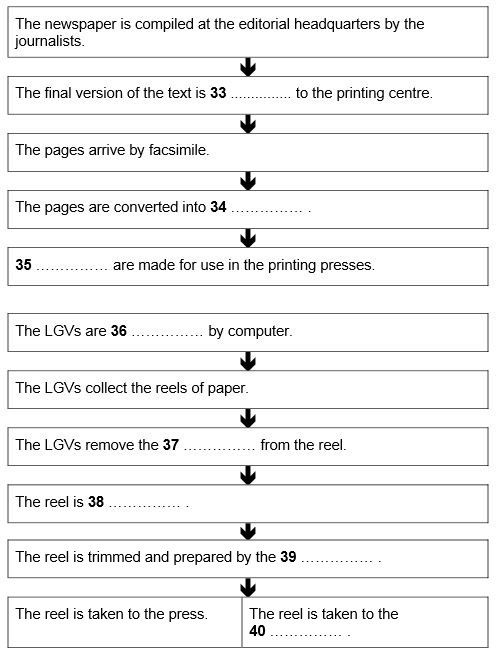
Using the information in the passage, complete the flow-chart below.
Write your answers in boxes 33-40 on your answer sheet.
Choose NO MORE THAN THREE WORDS from the passage for each answer.
The Production Process
Answers for Robots at work with Explanations
The Robots at work reading answers with explanations is provided below. They will help you in assessing your reading skills and band score.
27. Answer: v
Explanation: Located in paragraph A, 3rd line. These days the editor, subeditors and journalists who put the paper together are likely to find themselves in a totally different building or maybe even in a different city.
28. Answer: vii
Explanation: Located in paragraph B, 1st line. Once the finished newspaper has been created for the next morning’s edition, all the pages are transmitted electronically from the prepress centre to the printing centre.
29. Answer: iv
Explanation: Located in paragraph D, 6th line. The Sydney LGVs move busily around the press room fulfilling their two key functions to collect reels of newsprint either from the reel stripping stations or from the racked supplies in the newsprint storage area. At the stripping station, the tough wrapping that helps to protect a reel of paper from rough handling is removed. Any damaged paper is peeled off and the reel is then weighed.
30. Answer: i
Explanation: Located in paragraph E, 4th line. When the press computer calls for a reel, an LGV takes it to the reel loading area of the presses. It lifts the reel into the loading position and places it in the correct spot with complete accuracy. As each reel is used up, the press drops the heavy cardboard core into a waste bin. When the bin is full, another LGV collects it and deposits the cores into a shredder for recycling.
31. Answer: viii
Explanation: Located in paragraph F, 2nd line. The company has chosen a laser guide function system for the vehicles because, as the project development manager says “The beauty of it is that if you want to change the routes, you can work out a new route on your computer and lay it down for them to follow”. When an LGV’s batteries run low, it will take itself offline and go to the nearest battery maintenance point for replacement batteries.
32. Answer: ii
Explanation: Located in paragraph G, whole text. The question newspaper workers must now ask, however, is, “how long will it be before the robots are writing the newspapers as well as running the printing centre, churning out the latest edition every morning?”
33. Answer: transmitted (electronically)
Explanation: Located in paragraph B, 1st line. Once the finished newspaper has been created for the next morning’s edition, all the pages are transmitted electronically from the prepress centre to the printing centre.
34. Answer: (photographic) film/negative(s)
Explanation: Located in paragraph B, 5th line. The pages are then processed into photographic negatives and the film is used to produce aluminium printing plates ready for the presses.
35. Answer: (aluminium) printing plates
Explanation: Located in paragraph B, 6th line. the film is used to produce aluminium printing plates ready for the presses.
36. Answer: programmed
Explanation: Located in paragraph D, 3rd line. the information is punched into the computer and the LGVs are programmed to go about their work.
37. Answer: (tough) wrapping // damaged paper
Explanation: Located in paragraph D, 7th line. At the stripping station, the tough wrapping that helps to protect a reel of paper from rough handling is removed. Any damaged paper is peeled off and the reel is then weighed.
38. Answer: weighed
Explanation: Located in paragraph D, 8th line. Any damaged paper is peeled off and the reel is then weighed.
39. Answer: paster robot(s)
Explanation: Located in paragraph E,1st line. Then one of the four paster-robots moves in.
40. Answer: storage area
Explanation: Located in paragraph E, 3rd line. an LGV takes it to the storage area.
Other Reading Tests

About Author Arivarasi
Arivarasi is an experienced author with expertise in the study abroad industry and preparing test materials for exams like IELTS, TOEFL, GRE, SAT, PTE, etc. She stays up-to-date with university and college requirements for international students which allows her to provide guidance on course selection, documents like SOP, LOR, and scholarship opportunities. She has written numerous articles on study abroad exams, destinations, universities & colleges requirements, admission procedures, and the entire process of studying abroad. Collaborating with industry experts and counselors, she crafts informative articles that make students take the right decisions.
Kanan.co is a trusted study abroad consultancy offering comprehensive services, resources, and solutions for students and education institutions. We support students at every stage of their global education journey, ensuring a smooth and guided experience. Along with test preparation for IELTS, GRE, TOEFL, and SAT, we provide expert services such as SOP writing, visa guidance, accommodation support, scholarship assistance, and education loan support. Our expertise and commitment to excellence make us a reliable partner for students pursuing international education.
Free Online Mock Test 2026
Practice our mock test worth Rs. 25000 for Free and know your IELTS score!








Global Headquarters
Kanan Int EdTech Inc
320 Bay Street, Suite 321 (Spaces), Toronto ON, Canada M5B 1N9
Indian Headquarters
Kanan International Pvt. Ltd.
D-wing, 2nd Floor, Trident Complex, Ellora Park Vadiwadi Road, Vadodara, Gujarat 390007
IT/ Digital Campus
Kanan International Pvt. Ltd
Old, New No 3, 2nd Floor, 1A, Dr Sadasivam Rd, T. Nagar, Chennai, Tamil Nadu 600017
Our branches
- Bardoli
- Bharuch
- Chennai
- Dehradun
- Gurugram
- Himatnagar
- Karnal
- Nadiad
- Navsari
- Palanpur
- Rajkot
- Vadodara
- Valsad
- Vallabh Vidyanagar
- Vapi
Study Abroad
Test Prep
Top Universities
Consultants
IELTS Centers
GRE Centers
TOEFL Centers
SAT Centers
Language Courses in Vadodara
SOP Blogs
Featured Blogs
Study Abroad Consultants in Chennai
Study Abroad Consultants in Surat
Study Abroad Consultants in Navsari
Study Abroad Consultants in Bardoli
Study Abroad Consultants in Ahmedabad
Study Abroad Consultants in Anand
Study Abroad Consultants in Khanna
Study Abroad Consultants in Nadiad
Study Abroad Consultants in Vadodara
Study abroad consultants in Valsad
Copyright © 2026 KANAN.CO All rights reserved.