- Study Abroad
- / ielts
- / florence nightingale reading answers
Florence Nightingale Reading Answers


Author
17-09-2025

Here you can find Florence Nightingale Reading Answers as a practice test with answers and explanations. This topic consists of 13 questions in 3 different types namely- 7 questions as true, false or not given, 3 questions as sentence completion and 3 questions as multiple choice question form.
Check out our YouTube Channel to Practice Full-Length IELTS Reading Tests Daily

Table of content
- Solution for Florence Nightingale
- Florence Nightingale IELTS reading practice test
- Passage
- Question
- Answers with explanation
Solution for Florence Nightingale
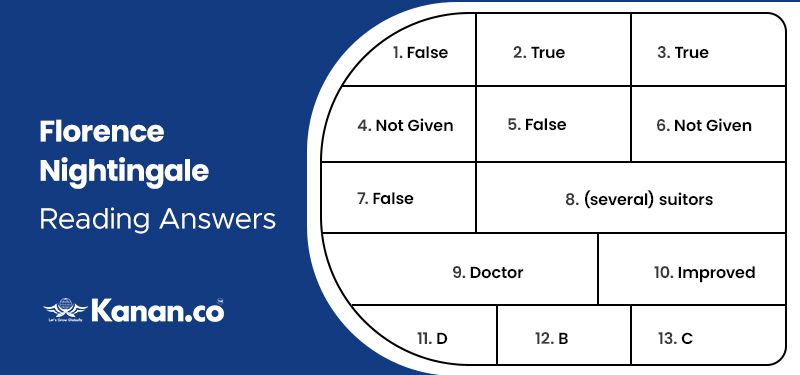
Below, we have given the answers for Florence Nightingale reading answers in table form.

Answer Table
| 1. False | 4. Not given | 7. False | 10. Improved | 13. C |
| 2. True | 5. False | 8. (several) suitors | 11. D | |
| 3. True | 6. Not given | 9. Doctor | 12. B |
Florence Nightingale IELTS Reading Practice Test- Exam Review
We have provided the Florence Nightingale IELTS reading answers as an illustration article for the IELTS reading practice test. Use this article while practicing for your exams, we ensure that this article will guide you to attain a band score in major exams. Before answering the questions, read the entire passage carefully.
Passage
We have given Florence Nightingale reading answers with location. Go through the given passage completely and start answering your questions.
Florence Nightingale reading answers
- Florence Nightingale, the daughter of the wealthy landowner, William Nightingale of Embly Park, Hampshire, was born in Florence, Italy, on 12th May, 1820. Her father was a Unitarian and a Whig who was involved in the anti-slavery movement. As a child, Florence was very close to her father, who, without a son, treated her as his friend and companion. He took responsibility for her education and taught her Greek, Latin, French, German, Italian, history, philosophy, and mathematics.
- Florence refused to marry several suitors, and at the age of twenty-five told her parents she wanted to become a nurse. Her parents were totally opposed to the idea as nursing was associated with working class women.
- Florence’s desire to have a career in medicine was reinforced when she met Elizabeth Blackwell at St. Bartholomew’s Hospital in London, Blackwell was the first woman to qualify as a doctor in the United States. Blackwell, who had to overcome considerable prejudice to achieve her ambition, encouraged her to keep trying and in 1851 Florence’s father gave her permission to train as a nurse.
- Florence, now thirty-one, went to Kaiserwerth, Germany where she studied to become a nurse at the Institute of Protestant Deaconesses. Two years later she was appointed resident lady superintendent of a hospital for invalid women in Harley Street, London.
- In March, 1853, Russia invaded Turkey. Britain and France, concerned about the growing power of Russia, went to Turkey’s aid. This conflict became known as the Crimean War. Soon after British soldiers arrived in Turkey, they began going down with cholera and malaria. Within a few weeks an estimated 8,000 men were suffering from these two diseases.
- When The Times published the fact that a large number of British soldiers were dying of cholera there was a public outcry, and the government was forced to change its mind about the situation. Nightingale volunteered her services and was eventually given permission to take a group of thirty-eight nurses to Turkey.
- Nightingale found the conditions in the army hospital in Scutari appalling. The men were kept in rooms without blankets or decent food. Unwashed, they were still wearing their army uniforms that were “stiff with dirt and gore”. In these conditions, it was not surprising that, in army hospitals, war wounds accounted for one death in six. However, diseases such as typhus, cholera and dysentery were the main reasons why the death-rate was so high amongst wounded soldiers.
- Military officers and doctors objected to Nightingale’s views on reforming military hospitals. They interpreted her comments as an attack on their professionalism and she was made to feel unwelcome. Nightingale received very little help from the military until she used her contacts at The Times to report details of the way that the British Army treated its wounded soldiers. John Delane, the editor of the newspaper, took up her cause, and after a great deal of publicity, Nightingale was subsequently given the task of organizing the barracks hospital after the battle of Inkerman, By improving the quality of the sanitation she was able to dramatically reduce the death-rate of her patients.
- In 1856 Florence Nightingale returned to England as a national heroine. She had been deeply shocked by the lack of hygiene and elementary care that the men received in the British Army. Nightingale therefore decided to begin a campaign to improve the quality of nursing in military hospitals. In October, 1856, she had a long interview with Queen Victoria and Prince Albert and the following year gave evidence to the 1857 Sanitary Commission. This eventually resulted in the formation of the Army Medical College.
- To spread her opinions on reform, Nightingale published two books, Notes on Hospital (1859) and Notes on Nursing (1859). With the support of wealthy friends and John Delane at The Times, Nightingale was able to raise £59,000 to improve the quality of nursing. In 1860, she used this money to found the Nightingale School and Home for Nurses at St. Thomas’s Hospital. She also became involved in the training of nurses for employment in the workhouses that had been established as a result of the 1834 Poor Law Amendment Act.
- In later life, Florence Nightingale suffered from poor health and in 1895 went blind. Soon afterwards, the loss of other faculties meant she had to receive full-time nursing. Although a complete invalid, she lived another fifteen years before her death in London on 13th August, 1910.
Questions
Questions 1-7
- Do the following statements agree with the information given in the reading passage?
- In boxes 1-7 on your answer sheet, write
- True if the statement agrees with the information
- False if the statement contradicts the information
- Not given if there is no information on this
1. Florence’s father would rather have had a son.
2. Florence was determined to study medicine.
3. She helped disabled women after training in Germany.
4. Florence was not able to wash when working in a hospital in Turkey.
5. No food was given to the soldiers in the hospital.
6. John Delane was a wealthy man.
7. In 1856, Florence had an interview for a job.
Questions 8-10
- Complete the sentences below.
- Choose no more than three words from the passage for each answers
- Write your answers in boxes 8-10 on your answer sheet.
8. Florence rejected the advances of ……………… because she wanted to become a nurse.
9. Florence was encouraged to study medicine by America’s first female ………………
10. After returning to England from Turkey, she realised that the quality of nursing had to be …………………...
Questions 11-13
- Choose the correct letter A, B, C or D.
- Write the correct letter in boxes 11-13 on your answer sheet.
11. What disease did many soldiers die from?
- Typhus
- Cholera
- Dysentery
- All of the above
12. What reaction best describes doctors’ feelings towards Florence’s views on military hospitals?
- They supported her
- They disagreed with her
- They welcomed her
- They physically attacked her
13. What did she do in 1857?
- Have an interview with Queen Victoria.
- Start the Army Medical College
- Talk to the Sanitary Commission
- Publish two books
Answers for Florence Nightingale with Explanation
We have given Florce Nenightingale reading answers with explanation, this will help you to correct your mistakes in the answering process.
1. Answer: False
Explanation: “As a child, Florence was very close to her father, who, without a son, treated her as his friend and companion”. With this line it is clear that Florence was the only daughter for her father and he had no son. Florence was very close to her father and he treated her as his friend and companion. Hence the given answer is located in the 4-5 lines of paragraph 1.
2. Answer: True
Explanation: “Florence refused to marry several suitors, and at the age of twenty-five told her parents she wanted to become a nurse” and “Florence’s desire to have a career in medicine”. With this line it is clear that Florence desired to have a career in medicine. Hence the given answer is located in the 1-2 lines of paragraph 2 and 1st line of paragraph 3.
3. Answer: True
Explanation: “Florence, now thirty-one, went to Kaiserwerth, Germany where she studied to become a nurse at the Institute of Protestant Deaconesses. Two years later she was appointed resident lady superintendent of a hospital for invalid women in Harley Street, London”. With these lines it is clear that Florence was appointed resident lady superintendent of a hospital for invalid women in Harley street, London. Hence the given answer is located in paragraph 4.
4. Answer: Not given
5. Answer: False
Explanation: “The men were kept in rooms without blankets or decent food”. With this line it is clear that men were kept in rooms without blankets or decent food so the given statement contradicts with the given answers. Hence the given answer is located in the 2nd line of paragraph 7.
6. Answer: Not given
7. Answer: False
Explanation: “In October, 1856, she had a long interview with Queen Victoria and Prince Albert and the following year gave evidence to the 1857 Sanitary Commission”. With this line it is clear that she had a long interview with Queen Victoria in October 1856. Hence the given answer is located in the last 3 lines of paragraph 9.
8. Answer: (several) suitors
Explanation: “Florence refused to marry several suitors, and at the age of twenty-five told her parents she wanted to become a nurse”. With this line it is clear that Florence rejected the advances of several suitors because she wanted to become a nurse. Hence the given answer is located in the first 2 lines of paragraph 2.
9. Answer: Doctor
Explanation: “Florence’s desire to have a career in medicine was reinforced when she met Elizabeth Blackwell at St. Bartholomew’s Hospital in London, Blackwell was the first woman to qualify as a doctor in the United States”. With this line it is clear that Florence was encouraged to study medicine by America’s first female doctor. Hence the given answer is located in the first 3 lines of paragraph 3.
10. Answer: Improved
Explanation: “In 1856 Florence Nightingale returned to England as a national heroine. She had been deeply shocked by the lack of hygiene and elementary care that the men received in the British Army. Nightingale therefore decided to begin a campaign to improve the quality of nursing in military hospitals”. With these lines it is clear that after returning to England from Turkey, she realised that the quality of nursing had to be improved. Hence the given answer is located in the first 4 lines of paragraph 9.
11. Answer: D
Explanation: “However, diseases such as typhus, cholera and dysentery were the main reasons why the death-rate was so high amongst wounded soldiers”. With this line it is clear that all these three diseases were the main reasons for the increase in death-rate amongst wounded soldiers. Hence the given answer is located in the last 3 lines of paragraph 7.
12. Answer: B
Explanation: “Military officers and doctors objected to Nightingale’s views on reforming military hospitals”. With this line it is clear that military officers and doctors disagree with Nightingale's views. Hence the given answer is located in the first 2 lines of paragraph 8.
13. Answer: C
Explanation: “In October, 1856, she had a long interview with Queen Victoria and Prince Albert and the following year gave evidence to the 1857 Sanitary Commission”. With this line it is clear that she had a long interview with Queen Victoria and Prince Alber and the following year gave evidence to 1857. Hence the given answer is located in the last 3 lines of paragraph 9.
Other reading answers

About Author Roshan Sunthar
Roshan Sunthar is a study abroad expert as well as a renowned writer and author in international education. His academic excellence and 5+ years of work experience give him in-depth knowledge of international standardised exams and test preparation in IELTS, TOEFL, GRE, PTE, SAT, etc. The study materials he prepares incorporate exam-like questions. He’s also an expert in writing Statement of Purposes (SOPs) and Letter of Recommendations (LORs) for college admissions. He usually spends his leisure time watching English classics and documentaries, travelling, etc.
Kanan.co is a trusted study abroad consultancy offering comprehensive services, resources, and solutions for students and education institutions. We support students at every stage of their global education journey, ensuring a smooth and guided experience. Along with test preparation for IELTS, GRE, TOEFL, and SAT, we provide expert services such as SOP writing, visa guidance, accommodation support, scholarship assistance, and education loan support. Our expertise and commitment to excellence make us a reliable partner for students pursuing international education.
Free Online Mock Test 2026
Practice our mock test worth Rs. 25000 for Free and know your IELTS score!








Global Headquarters
Kanan Int EdTech Inc
320 Bay Street, Suite 321 (Spaces), Toronto ON, Canada M5B 1N9
Indian Headquarters
Kanan International Pvt. Ltd.
D-wing, 2nd Floor, Trident Complex, Ellora Park Vadiwadi Road, Vadodara, Gujarat 390007
IT/ Digital Campus
Kanan International Pvt. Ltd
Old, New No 3, 2nd Floor, 1A, Dr Sadasivam Rd, T. Nagar, Chennai, Tamil Nadu 600017
Our branches
- Bardoli
- Bharuch
- Chennai
- Dehradun
- Gurugram
- Himatnagar
- Karnal
- Nadiad
- Navsari
- Palanpur
- Rajkot
- Vadodara
- Valsad
- Vallabh Vidyanagar
- Vapi
Study Abroad
Test Prep
Top Universities
Consultants
IELTS Centers
GRE Centers
TOEFL Centers
SAT Centers
Language Courses in Vadodara
Study Abroad Calculators
Featured Blogs
Study Abroad Consultants in Chennai
Study Abroad Consultants in Surat
Study Abroad Consultants in Navsari
Study Abroad Consultants in Bardoli
Study Abroad Consultants in Ahmedabad
Study Abroad Consultants in Anand
Study Abroad Consultants in Khanna
Study Abroad Consultants in Nadiad
Study Abroad Consultants in Vadodara
Study abroad consultants in Valsad
Copyright © 2026 KANAN.CO All rights reserved.