- Study Abroad
- / ielts
- / fordlandia reading answers
Fordlandia reading Answers


Author
16-09-2025

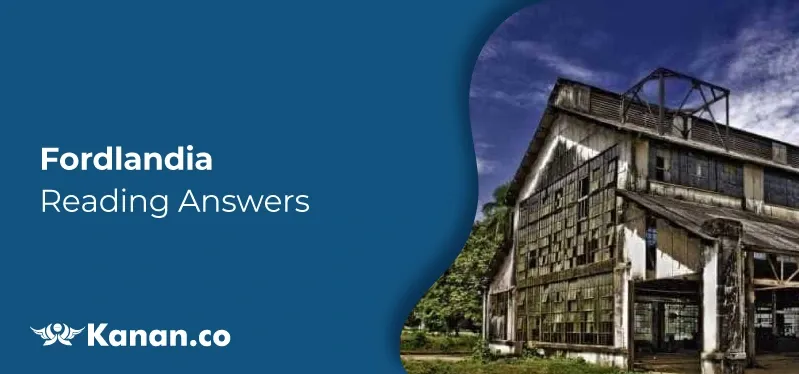
Fordlandia reading answers practice test is provided with answers and explanations. This passage comprises 13 questions divided into three question types that answer the questions and classify the following.
Table of contents:
- Solution for Fordlandia
- Fordlandia IELTS Reading Practice Test
- Passage
- Questions
- Answers with Explanations
Solution for Fordlandia
Fordlandia reading answers are listed in the table below. Verify your answers against our answer table, then correct any inaccuracies.
Answer Table
| 1. True | 5. Appropriate | 9. Local Customs | 13. Synthetic rubber reading answers |
| 2. True | 6. Significant Quantity | 10. Riot (followed) | |
| 3. Not Given | 7. Company Engineers | 11. Leaf Blight | |
| 4. False | 8. Monoculture | 12. Trained horticulture |

Fordlandia IELTS Reading Practice Test - Exam Review
Check out our YouTube Channel to Practice Full-Length IELTS Reading Tests Daily

Fordlandia reading answers are given here, which will help you practise your reading module. This IELTS reading practice test is to make you ready for the actual IELTS examination. Finding the answers will be simple with the right vocabulary. Additionally, using the skimming and scanning approach will give you enough time to proofread the responses at the end.
Passage
We’ve provided the reading passage of Fordlandia. Read the passage and carefully complete the questions. Check the answers with our Fordlandia reading answers with locations.
Fordlandia
Natural latex, or rubber, comes from the sap of rubber trees. Native to the Amazon region of South America, they had long been a Brazilian monopoly, and the boom in wild rubber had made many remote jungle towns rich, until thousands of seeds of the tree were smuggled out by an entrepreneurial Brit, Henry Wickham. These were used to start plantations throughout British East-Asia, where the trees, facing none of their natural insect or fund=gal enemies, thrived. Thus, the Brazilian rubber boom crashed, leaving control of the world's supplies with the plantation owners in Malaysia (where to this day, most of the world’s natural rubber is still produced).
But in the late 1920s, the automobile tycoon, Henry Ford, had a vision. He believed in vertical integration— that is, a supply chain of car parts and products unites through his ownership. With his factories producing hundreds of thousands of cars, each of them needing rubber tyres, Ford wanted his own source of rubber and resented dealing with the British plantation interests. He therefore, decided to buy a huge tract of Amazonian workers and lifestyle, in order to make the largest rubber plantation on the planet. It would be called Fordlandia — ambitious, grandiose, and doomed from the beginning.
The first mistake was to hire a rather untrustworthy Brazilian to scout for the best location in the Amazon, This man recommended a damp, rocky, and infertile series of hillsides near the Tapajos river, a tributary of the wide and mighty Amazon. In 1928, Ford blindly acquired a 10,000-square-kilometres concession and immediately ordered an immense amount of infrastructure to be built-at huge cost. To this end, earth-moving equipment arrived, tractors, stump-pullers, trains, prefabricated living quarters, and food-making equipment. The surface jungle was cleared, scores of Ford's employees were relocated, and out of this wilderness sprang an instant slice of America, complete with a modern hospital, library, hotels, ice cream makers, and now upon row of prefabricated houses positioned along nicely paved streets.
The second big mistake was that, incredibly, Ford never thought to consult trained horticulturists. He naively assumed that his own company engineers. Who had proven their worth in the production of cars, would prove equally adept at this agricultural endeavour. Thus, they planted the rubber trees thickly together, believing that they would nourish in their home environment. However, in the Amazonian jungle, wild rubber trees are actually few and far between — a defence against the prodigious insect life which chews, drills, sucks, and bites. In such environments, monocultural farming approaches are dubious at best. Ford’s young rubber trees had no sooner appeared from the ground than they were attacked by caterpillars, ants, red spiders, and most significantly, South American leaf blight, which, to this day, limits the number of rubber plantations in this, the tree’s native land.
The next problem was based on cultural differences. The newly planted fields needed hundreds of local workers, who, although well paid, were expected to follow Ford’s patronising vision of a healthy lifestyle. Instead of the local custom of working before and after the roastingly hot middle of the way, Ford’s workers were forced to do the standard company 9-to-5 shift. Similarly, they had to eat American food and take part in weekend activities considered sufficiently wholesome, such as poetry reading and square-dancing. Alcohol was strictly forbidden at work, in the housing estates, or within Fordlandia’s sphere of influence. After a year denied their local customs, the disgruntled workers had enough, and a riot followed, leaving the hapless American staff scurrying into the jungle to escape injury. It was all finally quelled with the arrival of the Brazilian army.
After threes years, and no significant quantity of rubber to show for it all, Ford did what he should have done from the beginning — hired a trained horticulturist, who ultimately concluded that, in whatever manner the rubber trees were planted, the land was not appropriate for their cultivation. With such humiliating news, anyone less stubborn would have given up, yet Ford purchased another tract of land some fifty miles downstream of the Tapajos river— flatter, dried, better drained, and more suitable for machinery — and started all over again. This time, Ford imported blight-resistant Malaysian rubber trees, and much more horticulture expertise. Still, 10 years later, in 1942, the operation could only produce a paltry 750 tons of latex rubber. Ford’s factories were hoping for almost 40,000.
The final nail in the coffin was the development of synthetic rubber, and in 1945, it was time to admit defeat, although it was not Ford who did so. By that time he was old and ill and had relinquished control of his company to his grandson, Henry Ford II, who closed down the entire rubber operation. The holdings were sold back to the Brazilian government for a patience, leaving a loss of over $20 million (which would be over 10 times that much in today’s terms) — a complete and utter financial disaster.
Questions
Questions 1-4
Do the following statements agree with the information given in Reading Passage One?
Write
- TRUE if the statement agrees with the information
- FALSE if the statement contradicts the information
- NOT GIVEN If there is no information on this
1. Henry Wickham destroyed the Brazilian rubber boom.
2. Rubber trees are well suited to Malaysia.
3. The Tapajos river is very wide.
4. Fordlandia may have succeeded.
Questions 5-10
Complete the table.
Choose NO MORE THAN TWO WORDS from the passage for each answer.
| Fordlandia's Problems | Result of these | |
| One | first piece of land not 5._______ for rubber trees | no 6._______ of rubber produced |
|
7.________ were unfamiliar with farming |
an unwise 8._________ approach | |
| Three | not following 9.________ | a 10.________ |
Questions 11-13
Complete the sentences.
Choose NO MORE THAN TWO WORDS from the passage for each answer.
The natural enemy of rubber trees is 11._______
Plantations definitely need the skills of 12.______.
Fordlandia closed down upon the invention of 13.________.
Answers for Fordlandia With Explanations
Fordlandia reading answers with explanations is given below. Refer to the following answers with an explanation section in order to correct your errors.
(Note: The text in italics mentions the location and referring lines written in the reading passage.)
1. Answer: True
Explanation: In the second last line of paragraph A, “the Brazilian rubber boom crashed, leaving control of the world's supplies”.
2. Answer: True
Explanation: In the last line of paragraph A, “Malaysia (where to this day, most of the world’s natural rubber is still produced)”.
3. Answer: Not given
Explanation: —
4. Answer: False
Explanation: In the last line of paragraph B, “It would be called Fordlandia — ambitious, grandiose, and doomed from the beginning”.
5. Answer: Appropriate
Explanation: In the fourth line of paragraph F, “land was not appropriate for their cultivation”.
6. Answer: Significant Quantity
Explanation: In the first line of paragraph F, “no significant quantity of rubber to show for it all”.
7. Answer: Company Engineers
Explanation: In the second line of paragraph D, “He naively assumed that his own company engineers”.
8. Answer: Monoculture (farming)
Explanation: In the eighth line of paragraph D, “monocultural farming approaches are dubious at best”.
9. Answer: Local Customs
Explanation: In the last third line of paragraph E, “After a year denied their local customs”.
10. Answer: Riot (followed)
Explanation: In the second last line of paragraph E, “and a riot followed”.
11. Answer: Leaf Blight
Explanation: In the last line of paragraph D, “South American leaf blight, which, to this day, limits the number of rubber plantations in this, the tree’s native land”.
12. Answer: Trained Horticulture
Explanation: In the first line of paragraph D, “hired a trained horticulturist”.
13. Answer: Synthetic Rubber
Explanation: In the first line of paragraph G, “The final nail in the coffin was the development of synthetic rubber”.
Other Reading Tests

About Author Abishek Babu M
Abishek is a seasoned expert in the study abroad processes and IELTS, GRE, TOEFL, and SAT subjects. With over 2.5 years of experience in helping students achieve their foreign education goals, he has become a trusted individual in the industry. His extensive knowledge and authority in the IELTS test have earned him a reputation as a go-to resource for students seeking to excel in their exams. Abishek's exceptional track record has earned him the trust of countless students who rely on his resources to achieve their study abroad dreams.
Kanan International is a study abroad consultancy that offers reliable services, products, and solutions for students and education institutions. We support students throughout their study abroad journey, ensuring a hassle-free experience. Our expertise and commitment to excellence make us the go-to partner for expanding global horizons. The company provides coaching for IELTS, GRE, TOEFL, and SAT exams and services like visa consultation, accommodation, scholarship assistance, and education loans.
Free Online Mock Test 2026
Practice our mock test worth Rs. 25000 for Free and know your IELTS score!








Global Headquarters
Kanan Int EdTech Inc
320 Bay Street, Suite 321 (Spaces), Toronto ON, Canada M5B 1N9
Indian Headquarters
Kanan International Pvt. Ltd.
D-wing, 2nd Floor, Trident Complex, Ellora Park Vadiwadi Road, Vadodara, Gujarat 390007
IT/ Digital Campus
Kanan International Pvt. Ltd
Old, New No 3, 2nd Floor, 1A, Dr Sadasivam Rd, T. Nagar, Chennai, Tamil Nadu 600017
Our branches
- Bardoli
- Bharuch
- Chennai
- Dehradun
- Gurugram
- Himatnagar
- Karnal
- Nadiad
- Navsari
- Palanpur
- Rajkot
- Vadodara
- Valsad
- Vallabh Vidyanagar
- Vapi
Study Abroad
Test Prep
Top Universities
Consultants
IELTS Centers
GRE Centers
TOEFL Centers
SAT Centers
Language Courses in Vadodara
SOP Blogs
Featured Blogs
Study Abroad Consultants in Chennai
Study Abroad Consultants in Surat
Study Abroad Consultants in Navsari
Study Abroad Consultants in Bardoli
Study Abroad Consultants in Ahmedabad
Study Abroad Consultants in Anand
Study Abroad Consultants in Khanna
Study Abroad Consultants in Nadiad
Study Abroad Consultants in Vadodara
Study abroad consultants in Valsad
Copyright © 2026 KANAN.CO All rights reserved.