- Study Abroad
- / ielts
- / the bridge that swayed reading answers
The Bridge that Swayed Reading Answers


Author
18-09-2025

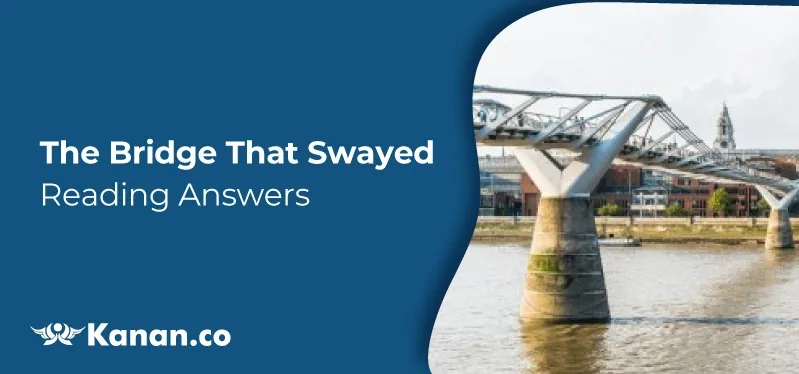
Here, the given The bridge that swayed reading practice test consists of a total of 13 questions, and it contains 3 different question types with appropriate answers with their location and explanation.
Given question types are, Multiple Choice Questions, Summary Completion Questions, and Table Completion Questions.
Table of contents:
- Solution for The bridge that swayed
- The bridge that swayed IELTS reading practice Test
- Passage
- Questions
- Answers with Explanations
Solution for The bridge that swayed
You can refer to The bridge that swayed reading Answers, and use them to check your answers or understand any mistakes you made.
Answer Table
| 1. B | 5. wind(s) | 9. Horizontal forces | 13. University of Southampton |
| 2. D | 6. swaying | 10. upright | |
| 3. E | 7. Further apart | 11. (engineer designer) Arup | |
| 4. H | 8. Footsteps | 12. Imperial College |

The bridge that swayed IELTS Reading Practice Test - Exam Review
Check out our YouTube Channel to Practice Full-Length IELTS Reading Tests Daily

Engaging in this practice test will contribute to improving your ability to respond and solve questions effectively. The answers provided for The bridge that swayed IELTS reading answers in the IELTS reading section will serve as a helpful resource for your IELTS examination. Practise more to achieve your desired score.
Passage
The reading passage of The bridge that swayed is provided here. Read the whole passage and respond to the questions carefully, and check your responses with our The bridge that swayed reading answers with location.
The bridge that swayed
1. When the London Millennium footbridge was opened in June 2000, it swayed alarmingly. This generated huge public interest and the bridge became known as London's "wobbly bridge".
2. The Millennium Bridge is the first new bridge to access the river Thames in London since Tower Bridge opened in 1894, and it is the first ever designed for pedestrians only. The bridge links the City of London near St Paul's Cathedral with the Tate Modern art gallery on Bankside.
3. The bridge opened initially on Saturday 10th June 2000. For the opening ceremony, a crowd of over 1,000 people had assembled on the south half of the bridge with a band in front. When they started to walk across with the band playing, there was immediately an unexpectedly pronounced lateral movement of the bridge deck. "It was a fine day and the bridge was on the route of a major organised walk for a noble cause," one of the pedestrians recounted what he saw that day. “At first, it was still. Then it began to sway sideways, just slightly. Then, almost from one moment to the next, when large groups of people were crossing, the wobble intensified. Everyone had to stop walking to retain balance and sometimes to hold on to the handrails for support”. Immediately, it was decided to limit the number of people on the bridge, and the bridge was dubbed the ‘wobbly’ bridge by the media who declared it another high-profile British Millennium Project failure. In order to fully investigate and resolve the issue the decision was taken to close the bridge on 12th June 2000.
4. Arup, the leading member of the committee in charge of the construction of the bridge, decided to tackle the issue head on. They immediately undertook a fast-track research project to seek the cause and the cure. The embarrassed engineers found the videotape that day which showed the centre span swaying about 3 inches sideways every second and the south span 2 inches every 1.25 seconds. Because there was a significant wind blowing on the opening days (force 3-4) and the bridge had been decorated with large flags, the engineers first thought that winds might the exerting excessive force on the many large flags and banners, but it was rapidly concluded that wind buffering had not contributed significantly to vibration of the bridge. But after measurements were made in university laboratories of the effects of people walking on swaying platforms and after large-scale experiments with crowds of pedestrians were conducted on the bridge itself, a new understanding and a new theory were developed.
5. The unexpected motion was the result of a natural human reaction to small lateral movements. It is well known that a suspension bridge has a tendency to sway when troops march over it in lockstep, which is why troops are required to break step when crossing such a bridge. “If we walk on a swaying surface we tend to compensate and stabilise ourselves by spreading our legs further apart but this increases the lateral push”. Pat Dallard, the engineer at Arup, says that you change the way you walk to match what the bridge is doing. It is an unconscious tendency for pedestrians to match their footsteps to the sway, thereby exacerbating it even more. “It's rather like walking on a rolling ship deck, you move one way and then the other to compensate for the roll.” The way people walk doesn't have to match exactly the natural frequency of the bridge as in resonance the interaction is more subtle. As the bridge moves, people adjust the way they walk in their own manner. The problem is that when there are enough people on the bridge the total sideways push can overcome the bridge's ability to absorb it. The movement becomes excessive and continues to increase until people begin to have difficulty in walking they may even have to hold on to the rails.
6. Professor Funjino Yozo of Tokyo University, who studied the earth-resistant Toda Bridge in Japan, believes the horizontal forces caused by walking, running or jumping could also in turn cause excessive dynamic vibration in the lateral direction in the bridge. He explains that as the structure began moving, pedestrians adjusted their gait to the same lateral rhythm as the bridge; the adjusted footsteps magnified the motion just like when four people all stand up in a small boat at the same time. As more pedestrian: locked into the same rhythm, the increasing oscillation led to the dramatic swaying captured on film until people stopped walking altogether, because they could not even keep upright.
7. In order to design a method of reducing the movements, an immediate research program was launched by the bridge's engineering designer Arup. It was decided that the force exerted by the pedestrians had to be quantified and related to the motion of the bridge. Although there are some descriptions of this phenomenon in existing literature, none of these actually quantifies the force. So there was no quantitative analytical way to design the bridge against this effect. The efforts to solve the problem quickly got supported by a number of universities and research organisations.
8. The tests at the University of Southampton involved a person walking on the spot on a small shake table. The tests at Imperial College involved persons walking along a specially built, 7.2m- long platform, which could be driven laterally at different frequencies and amplitudes. These tests have their own limitations. While the Imperial College test platform was too short that only seven or eight steps could be measured at one time, the "walking on the spot" test did not accurately replicate forward walking, although many footsteps could be observed using this method. Neither test could investigate any influence of other people in a crowd on the behaviour of the individual tested.
9. The results of the laboratory tests provided information which enabled the initial design of a retrofit to be progressed. However, unless the usage of the bridge was to be greatly restricted, only two generic options to improve its performance were considered feasible. The first was to increase the stiffness of the bridge to move all its lateral natural frequencies out of the range that could be excited by the lateral footfall forces, and the second was to increase the damping of the bridge to reduce the resonant response.
Questions
Questions 1-4
Choose FOUR letters, A-I. Write the correct letters in boxes 1-4 on your answer
sheet.
Which FOUR of the following could be seen on the day when the bridge opened to the public?
A. the bridge moved vertically
B. the bridge swayed from side to side
C. the bridge swayed violently throughout the opening ceremony
D. it was hard to keep balance on the bridge
E. pedestrians walked in synchronised steps
F. pedestrians lengthened their footsteps
G. a music band marched across the bridge
H. the swaying rhythm varied to the portions of the bridge
I. Flags and banners kept still on the bridge
Questions 5-10
Complete the summary below.
Choose NO MORE THAN TWO WORDS from the passage for each answer.
To understand why the Millennium Bridge swayed, engineers of Arup studied the
videotape taken on the day of the opening ceremony. In the beginning they thought of the forces of 5. _________ might have caused the movement because there were many flags and banners on the bridge that day. But quickly new understandings arose after a series of tests were conducted on how people walk on 6. _________ floors. The tests showed people would place their legs 7. ________ to keep balance when the floor is shaking. Pat Dallard even believes pedestrians may unknowingly adjust their 8. _________ to match the sway of the bridge. Professor Fujino Yozo's study found that the vibration of a bridge could be caused by the 9. _________ of people walking, running and jumping on it because the lateral rhythm of the sway could make pedestrians adjust their walk and reach the same step until it is impossible to stand 10. __________
Questions 11-13
Complete the table below.
Choose NO MORE THAN THREE WORDS from the passage for each answer.
| Test Conducted by | Problems of the test |
| 11. ___________ | Not enough data collection |
| 12. __________ | Not long enough |
| 13. ___________ | Not like the real walking experience |
Answers For The bridge that swayed With Explanations
The bridge that swayed reading answers with explanations provided here. Refer to this to check your responses and know your mistakes as the answers are given with the proper explanation.
(Note: The text in the italics mentions the location and referring lines written in the reading passage.)
1. Answer: B
Explanation: In Paragraph 3, the writers mentioned that, ‘At first, it was still. Then it began to sway sideways, just slightly. Then, almost from one moment to the next, when large groups of people were crossing, the wobble intensified.’ Thus, upon its public opening, the bridge exhibited a lateral swaying motion, moving from one side to the other. Hence, the answer is B.
2. Answer: D
Explanation: In Paragraph 3, the writers mentioned that, ‘Then, almost from one moment to the next, when large groups of people were crossing, the wobble intensified. Everyone had to stop walking to retain balance and sometimes to hold on to the handrails for support.’ The phrase "wobble intensified" indicates that maintaining balance on the bridge was challenging. Hence, the answer is D.
3. Answer: E
Explanation: In Paragraph 5, the writers mentioned that, ‘It is an unconscious tendency for pedestrians to match their footsteps to the sway, thereby exacerbating it even more.’ The fact that pedestrians matched their footsteps suggests that they walked in coordinated steps. Hence, the answer is E.
4. Answer: H
Explanation: In Paragraph 4, the writers mentioned that, ‘The embarrassed engineers found the videotape that day which showed the centre span swaying about 3 inches sideways every second and the south span 2 inches every 1.25 seconds.’ This indicates that the swaying motion of the bridge varied in different sections. Hence, the answer is H.
5. Answer: wind(s)
Explanation: In Paragraph 4, the writers mentioned that, ‘Because there was a significant wind blowing on the opening days (force 3-4) and the bridge had been decorated with large flags, the engineers first thought that winds might the exerting excessive force on the many large flags and banners, but it was rapidly concluded that wind buffering had not contributed significantly to vibration of the bridge.’
6. Answer: swaying
Explanation: In Paragraph 4, the writers mentioned that, ‘But after measurements were made in university laboratories of the effects of people walking on swaying platforms and after large-scale experiments with crowds of pedestrians were conducted on the bridge itself, a new understanding and a new theory were developed.’
7. Answer: Further apart
Explanation: In Paragraph 5, the writers mentioned that, ‘If we walk on a swaying surface we tend to compensate and stabilise ourselves by spreading our legs further apart but this increases the lateral push.’
8. Answer: footsteps
Explanation: In Paragraph 5, the writers mentioned that, ‘It is an unconscious tendency for pedestrians to match their footsteps to the sway, thereby exacerbating it even more.’
9. Answer: Horizontal forces
Explanation: In Paragraph 6, the writers mentioned that, ‘Toda Bridge in Japan, believes the horizontal forces caused by walking, running or jumping could also in turn cause excessive dynamic vibration in the lateral direction in the bridge.’
10. Answer: upright
Explanation: In Paragraph 6, the writers mentioned that, ‘As more pedestrians: locked into the same rhythm, the increasing oscillation led to the dramatic swaying captured on film until people stopped walking altogether, because they could not even keep upright.’
11. Answer: (engineer designer) Arup
Explanation: In Paragraph 7, the writers mentioned that, ‘In order to design a method of reducing the movements, an immediate research program was launched by the bridge's engineering designer Arup. It was decided that the force exerted by the pedestrians had to be quantified and related to the motion of the bridge. Although there are some descriptions of this phenomenon in existing literature, none of these actually quantifies the force. So there was no quantitative analytical way to design the bridge against this effect.’
12. Answer: Imperial College
Explanation: In Paragraph 8, the writers mentioned that, ‘While the Imperial College test platform was too short that only seven or eight steps could be measured at one time, the "walking on the spot" test did not accurately replicate forward walking, although many footsteps could be observed using this method.’
13. Answer: University of Southampton
Explanation: In Paragraph 8, the writers mentioned that, ‘The tests at the University of Southampton involved a person walking on the spot on a small shake table.’
Other reading tests

About Author Manimegalai Samidurai
Manimegalai is a multifaceted professional, excelling as an author, writer, and study-abroad expert. Her vast knowledge of English proficiency exams, including IELTS, GRE, SAT, and PTE, and exceptional content writing skills make her a go-to resource for students seeking guidance and support in their foreign education journey. She is a trusted authority in writing content related to these test-prep exams, making her an invaluable resource for those seeking guidance. With her well-researched and informative blogs, articles, and study materials, Manimegalai has helped countless students achieve their desired band scores and get admissions to top-notch colleges & universities in countries like Canada, USA, UK, Australia, Ireland, etc.
Kanan.co is a trusted study abroad consultancy offering comprehensive services, resources, and solutions for students and education institutions. We support students at every stage of their global education journey, ensuring a smooth and guided experience. Along with test preparation for IELTS, GRE, TOEFL, and SAT, we provide expert services such as SOP writing, visa guidance, accommodation support, scholarship assistance, and education loan support. Our expertise and commitment to excellence make us a reliable partner for students pursuing international education.
Free Online Mock Test 2026
Practice our mock test worth Rs. 25000 for Free and know your IELTS score!








Global Headquarters
Kanan Int EdTech Inc
320 Bay Street, Suite 321 (Spaces), Toronto ON, Canada M5B 1N9
Indian Headquarters
Kanan International Pvt. Ltd.
D-wing, 2nd Floor, Trident Complex, Ellora Park Vadiwadi Road, Vadodara, Gujarat 390007
IT/ Digital Campus
Kanan International Pvt. Ltd
Old, New No 3, 2nd Floor, 1A, Dr Sadasivam Rd, T. Nagar, Chennai, Tamil Nadu 600017
Our branches
- Bardoli
- Bharuch
- Chennai
- Dehradun
- Gurugram
- Himatnagar
- Karnal
- Nadiad
- Navsari
- Palanpur
- Rajkot
- Vadodara
- Valsad
- Vallabh Vidyanagar
- Vapi
Study Abroad
Test Prep
Top Universities
Consultants
IELTS Centers
GRE Centers
TOEFL Centers
SAT Centers
Language Courses in Vadodara
Study Abroad Calculators
Featured Blogs
Study Abroad Consultants in Chennai
Study Abroad Consultants in Surat
Study Abroad Consultants in Navsari
Study Abroad Consultants in Bardoli
Study Abroad Consultants in Ahmedabad
Study Abroad Consultants in Anand
Study Abroad Consultants in Khanna
Study Abroad Consultants in Nadiad
Study Abroad Consultants in Vadodara
Study abroad consultants in Valsad
Copyright © 2026 KANAN.CO All rights reserved.