- Study Abroad
- / ielts
- / grimms fairy tales reading answers
Grimm’s Fairy Tales Reading Answers


Author
17-09-2025

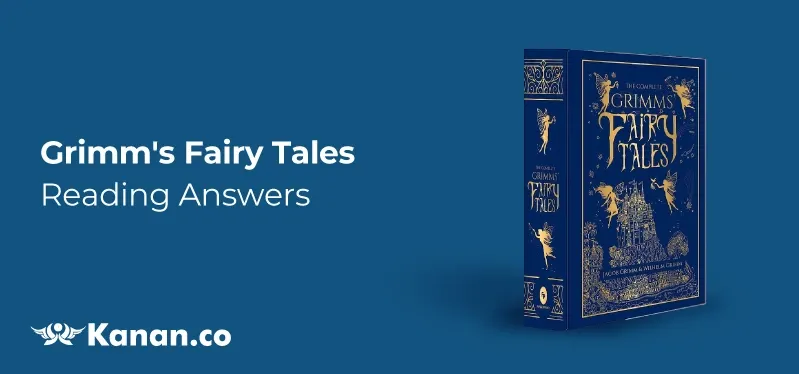
Check the below table for the Grimm’s Fairytales Reading Answers.
| 1. No | 5. Yes | 9. D | 13. E |
| 2. Not given | 6. No | 10. D | 14. B |
| 3. Yes | 7. A | 11. A | |
| 4. Not given | 8. C | 12. H |
Read the entire passage and then respond to the three different question types provided in this article. Check out Grimm’s Fairytales Reading Answers for thorough justifications of the right answers.
- IELTS reading yes no not given
- IELTS reading multiple choice questions
- IELTS reading matching sentence endings
Check out our YouTube Channel to Practice Full-Length IELTS Reading Tests Daily
Grimm’s Fairy Tales Reading Passage
In the given time, you must read the given passage and then answer the following questions.
Grimm’s Fairy Tales
- Jacob and Wilhelm Grimm gave their story collection the title Children's and Household Tales, and the very initial of its seven editions were released in Germany in 1812. Cinderella, Sleeping Beauty, Snow White, Little Red Riding Hood, Rapunzel, Rumpelstiltskin, Hansel and Gretel, and the Frog King are all listed in the table of contents like A-list fairy-tale stars. The 210 tales in the Grimm's collection, which were primarily derived from oral narratives, comprise an unparalleled collection of fairy tales, animal fables, country farces, and religious allegories.
- The modest Grimms would have been shocked by such enduring fame. The collection only sold a handful of hundred copies a year at first during their lifetimes in Germany.
Early versions didn't even have a child audience in mind. Scholarly citations took up almost as much space as the talcs themselves, and the brothers originally rejected to consider illustrations. Jacob and Wilhelm saw themselves as patriotic folklorists rather than kid-friendly entertainers. When they started their work, Napoleon's French had just taken over Germany and were determined to repress local culture. The Brothers Grimm undertook the collection of fairy tales as young, workaholic scholars who were single and shared a small apartment with the intention of preserving Germany's imperiled oral tradition. - Teachers, parents, and religious leaders, especially in the United States, condemned the Grimms' collection for much of the 19th century because of its undeveloped, barbaric content. Adults who were offended protested the horrific punishments meted out to the stories' villains. The evil stepmother in the original "Snow White" is made to dance in hot iron shoes until she passes out. The Grimms' talcs are still avoided by some protective parents because of their reputation for violence.
- Children's and Household Tales gradually gained traction with the general public despite its occasionally rocky reception. The brothers had no idea that the publication of their work would take place at the same time as Europe's children's literature was experiencing great flowering. In order to appeal to a newly literate audience looking for moral nursery literature, English publishers took the lead and produced beautiful folktale collections and high-quality picture books like Jack and the Beanstalk. The Brothers Grimm began modifying and relaxing their tales, which had originally been earthy peasant fare, once they became aware of this new audience. The Grimms turned unmarried lovers into married couples, cruel mothers into evil stepmothers, and the intimate father into the devil.
- The Grimms' fairy tales have taken over children's bedroom bookcases in the 20th century. The tales seem to come true: handsome lads and beautiful damsels defeat giants, witches, and wild animals with the aid of magic. They outsmart cruel, egotistical adults. The boy and girl will undoubtedly fall in love and marry. Parents continue to read because they agree with the finger-wagging morals drilled into the stories: keep your word, don't approach strangers, put in the effort, and obey your parents. The Grimms claimed that the compilation served as "a manual of manners".
- About 40 people in total brought stories to the Grimms. A large number of storytellers visited the Grimms' home in Kassel. Dorothea Viehmann, a widow who walked into town to sell produce from her garden, was especially welcomed by the brothers. Viehmann, the daughter of an innkeeper, had grown up hearing tales from travelers heading to Frankfurt.
She had "Aschenputtel"—Cinderella—among her treasure. Their sister Charlotte's friend, Marie Hassenpflug, was a well-educated, French-speaking woman in her 20s. Perrault's influential 1697 book, Tales of My Mother Goose, which included elaborate versions of "Little Red Riding Hood," "Snow White," and "Sleeping Beauty," among other stories, and Marie's wonderful tales combined themes from the oral tradition. Numerous of these were adaptations of earlier Italian stories. - The question of how German Grimm tales are necessary in light of the fact that many of their sources can be found throughout Europe, the Middle East, and the Orient. Heinz Rolleke, a scholar, says it's very. Teutonic characteristics include a love of the underdog, simplicity in the countryside, and creativity. The stories were also influenced by the rough texture of life in Germany during the Middle Ages when many of the tales entered the oral tradition. Similar to Hansel and Gretel, young children were frequently abandoned and neglected throughout Europe. As with the evil mother-in-law in "The Six Swans," suspected witches were burned at the stake. Rolleke notes that "the cruelty in the stories was not the Grimm's fantasy" but rather "it reflected the law-and-order system of the old times".
- The Grimms' editorial imprint betrays the particular values of German bourgeois, Christian society in the 19th century. But that hasn't stopped almost every culture and nation in the world from embracing the tales. What explains this widespread and enduring appeal? There are no specific descriptions of the clothes, the land, the forest, the castles, or the "universal style" of writing, as noted by Bernhard Lauer. According to Jack Zipes of the University of Minnesota, whose 1987 translation of the entire canon of fairy tales captures the rustic vigor of the original text, it makes the stories timeless and placeless. "The tales allow us to express 'our utopian longings'," he says. They demonstrate a desire for happiness that none of us fully understands but that we feel is attainable. We can empathize with the protagonists of the stories and imagine ourselves to be the masters and mistresses of our own fates.
- The unconscious is exercised by fairy tales, according to psychoanalysts. The therapeutic value of the Grimms' tales was famously emphasized by Bruno Bettelheim, who referred to fairy tales as "great comforters." Children discover they can control their anxieties by facing their fears and phobias, which are represented by witches, heartless stepmothers, and ravenous wolves. The validity of Bettelheim's theory is still hotly contested. However, the majority of young readers aren't keen on using their unconsciousness. In fact, there are countless ways to enjoy the Grimm tales; something about them seems to reflect our own attitudes and interests as we read them. They are suitable for almost any time and any culture thanks to their flexibility of interpretation.
Grimm’s Fairytales IELTS Reading Questions
Questions 1-6
Do the following statements agree with the information given in Reading Passage?
In boxes 1-6 on your answer sheet, write
YES if the statement is true
NO if the statement is false
NOT GIVEN if the information is not given in the passage
- In England rather than Germany, the first edition of Grimm's fairy tales sold more copies.
- The life of Dorothea Viehmann served as the inspiration for the Grimm brothers' "Cinderella" story.
- For reasons that are different from those that children have, adults enjoy reading Grimm's fairy tales.
- The Grimm brothers thought they would become well-known around the world.
- Grimm fairy tales are still viewed as inappropriate for children by some parents today.
- The Grimm brothers were compelled to operate covertly.
Click to know more about the IELTS Reading Yes No Not Given
Questions 7-9
Choose the correct letter, A, B, C, or D.
Write your answers in boxes 7-9 on your answer sheet.
7. What exactly did Marie Hassenpflug add to the Grimm Brothers' stories?
A. She used her talent for languages to translate a well-known book for the brothers
B. She recited oral tales, which were based on classic Italian tales
C. She published stories
D. She talked with them about the stories
8. What modifications did the Grimm Brothers make in subsequent printings?
A. Less violence was featured in the stories' plots
B. They discovered additional tales' sources
C. The stories were condensed
D. They spoke more verbally
9. What changes in Europe are mentioned in paragraph D?
A. Children had access to schools
B. Excellent picture books were collected by many people
C. The population's level of literacy increased
D. It became simpler to publish as printing technology advanced
Click to know more about the IELTS Reading Multiple Choice Questions
Questions 10-14
Complete the following summary of the paragraphs of Reading Passage, using NO MORE THAN TWO WORDS from the Reading Passage for each answer.
Write your answers in boxes 10-14 on your answer sheet.
10. According to Jack Zipes, the pursuit of happiness in the stories indicates that
11. According to Bruno Bettelheim, the therapeutic benefits of the stories make the fairy tales
12. Bernhard Lauer claimed that the Grimm Brothers' writing style is universal since they
13. According to Heinz Rolleke, The Grimm's Tales are "German" because
14. Heinz Rolleke claimed that the orphans in fairy tales
- Identify the real-life heroes
- narrate how straightforward life was in the German countryside
- help people believe in the power of nature
- assist kids in resolving their issues
- omit information about the social context of the characters
- reflect on the way of life at the time
- Show the inefficient system
- encourage people to think of themselves as capable of anything
Click to know more about the IELTS Reading Matching Sentence Endings
Grimm’s Fairytales Reading Answers with Explanations
The Grimm’s Fairy Tales reading answers with explanations where you can find the solutions with their location in the passage and clarification.
(Note: The text in Bold mentions the location and answer given in the passage itself. The lines in italics show the referring lines written in the reading passages.)
1. Not given
Explanation: There is no information available regarding this question.
2. No
Explanation: 3rd, 4th, and 5th line of paragraph F explains that Dorothea Viehmann, a widow who walked into town to sell produce from her garden, was especially welcomed by the brothers. Viehmann, the daughter of an innkeeper, had grown up hearing tales from travelers heading to Frankfurt. She had "Aschenputtel"—Cinderella—among her treasure.
3. Yes
Explanation: 5th and 6th line of paragraph E narrates that Parents continue to read because they agree with the finger-wagging morals drilled into the stories: keep your word, don't approach strangers, put in the effort, and obey your parents. The Grimms claimed that the compilation served as "a manual of manners".
4. No
Explanation: 1st line in paragraph B proves that The modest Grimms would have been shocked by such enduring fame.
5. Yes
Explanation: 1st and 4th line of paragraph C reveals that Teachers, parents, and religious leaders, especially in the United States, condemned the Grimms' collection for much of the 19th century because of its undeveloped, barbaric content. The Grimms' talcs are still avoided by some protective parents because of their reputation for violence.
6. Not given
Explanation: There is no information available regarding this question.
7. B
Explanation: 7th line of paragraph F justifies that Perrault's influential 1697 book, Tales of My Mother Goose, which included elaborate versions of "Little Red Riding Hood," "Snow White," and "Sleeping Beauty," among other stories, and Marie's wonderful tales combined themes from the oral tradition.
8. A
Explanation: The second last line of paragraph D suggests that The Brothers Grimm began modifying and relaxing their tales, which had originally been earthy peasant fare, once they became aware of this new audience.
9. C
Explanation: 3rd line of paragraph D describes that In order to appeal to a newly literate audience looking for moral nursery literature, English publishers took the lead and produced beautiful folktale collections and high-quality picture books like Jack and the Beanstalk.
10. H
Explanation: The second last and last line of paragraph H represents that They demonstrate a desire for happiness that none of us fully understands but that we feel is attainable. We can empathize with the protagonists of the stories and imagine ourselves to be the masters and mistresses of our own fates.
11. D
Explanation: 2nd and 3rd line of paragraph I depicts that The therapeutic value of the Grimms' tales was famously emphasized by Bruno Bettelheim, who referred to fairy tales as "great comforters." Children discover they can control their anxieties by facing their fears and phobias, which are represented by witches, heartless stepmothers, and ravenous wolves.
12. E
Explanation: 4th and 5th line of paragraph H illustrates that There are no specific descriptions of the clothes, the land, the forest, the castles, or the "universal style" of writing, as noted by Bernhard Lauer. According to Jack Zipes of the University of Minnesota, whose 1987 translation of the entire canon of fairy tales captures the rustic vigor of the original text, it makes the stories timeless and placeless.
13. B
Explanation: 2nd and 3rd line of paragraph G expresses that Teutonic characteristics include a love of the underdog, simplicity in the countryside, and creativity. The stories were also influenced by the rough texture of life in Germany during the Middle Ages when many of the tales entered the oral tradition.
14. F
Explanation: 4th line of paragraph G says that Similar to Hansel and Gretel, young children were frequently abandoned and neglected throughout Europe.
Check the other reading passages
- The final frontier for tourism reading answers
- Motivating employees under adverse condition reading answers
- Learning lessons from the past reading answers
Conclusion
The article “Grimm’s Fairytales Reading Answers'' will help you better understand the structure, length, and types of questions on the reading exam. By practicing the mock test provided in this article, you will also increase your vocabulary and comprehension abilities.

About Author Roshan Sunthar
Roshan Sunthar is a study abroad expert as well as a renowned writer and author in international education. His academic excellence and 5+ years of work experience give him in-depth knowledge of international standardised exams and test preparation in IELTS, TOEFL, GRE, PTE, SAT, etc. The study materials he prepares incorporate exam-like questions. He’s also an expert in writing Statement of Purposes (SOPs) and Letter of Recommendations (LORs) for college admissions. He usually spends his leisure time watching English classics and documentaries, travelling, etc.
Kanan.co is a trusted study abroad consultancy offering comprehensive services, resources, and solutions for students and education institutions. We support students at every stage of their global education journey, ensuring a smooth and guided experience. Along with test preparation for IELTS, GRE, TOEFL, and SAT, we provide expert services such as SOP writing, visa guidance, accommodation support, scholarship assistance, and education loan support. Our expertise and commitment to excellence make us a reliable partner for students pursuing international education.
Free Online Mock Test 2026
Practice our mock test worth Rs. 25000 for Free and know your IELTS score!








Global Headquarters
Kanan Int EdTech Inc
320 Bay Street, Suite 321 (Spaces), Toronto ON, Canada M5B 1N9
Indian Headquarters
Kanan International Pvt. Ltd.
D-wing, 2nd Floor, Trident Complex, Ellora Park Vadiwadi Road, Vadodara, Gujarat 390007
IT/ Digital Campus
Kanan International Pvt. Ltd
Old, New No 3, 2nd Floor, 1A, Dr Sadasivam Rd, T. Nagar, Chennai, Tamil Nadu 600017
Our branches
- Bardoli
- Bharuch
- Chennai
- Dehradun
- Gurugram
- Himatnagar
- Karnal
- Nadiad
- Navsari
- Palanpur
- Rajkot
- Vadodara
- Valsad
- Vallabh Vidyanagar
- Vapi
Study Abroad
Test Prep
Top Universities
Consultants
IELTS Centers
GRE Centers
TOEFL Centers
SAT Centers
Language Courses in Vadodara
Study Abroad Calculators
Featured Blogs
Study Abroad Consultants in Chennai
Study Abroad Consultants in Surat
Study Abroad Consultants in Navsari
Study Abroad Consultants in Bardoli
Study Abroad Consultants in Ahmedabad
Study Abroad Consultants in Anand
Study Abroad Consultants in Khanna
Study Abroad Consultants in Nadiad
Study Abroad Consultants in Vadodara
Study abroad consultants in Valsad
Copyright © 2026 KANAN.CO All rights reserved.