- Study Abroad
- / ielts
- / haasts eagle reading answers
Answers for the Haast’s Eagle Reading Passage


Author
19-09-2025

The answers for the Haast’s Eagle which is the top-discussing reading passage topic are provided in this article to help the IELTS aspirants. Candidates should spend 20 minutes to solve the three different question types by reading the given passage. To score high in the IELTS reading module, practice the number of practice tests and question types. To start your practice, try the reading practice test given here and verify your answers immediately.

Check out our YouTube Channel to Practice Full-Length IELTS Reading Tests Daily

IELTS Academic Reading Passage - Haast’s Eagle
You should spend 20 minutes to read the below-given reading passage 1 thoroughly and answer questions 1-13 of the academic reading.
Haast’s Eagle
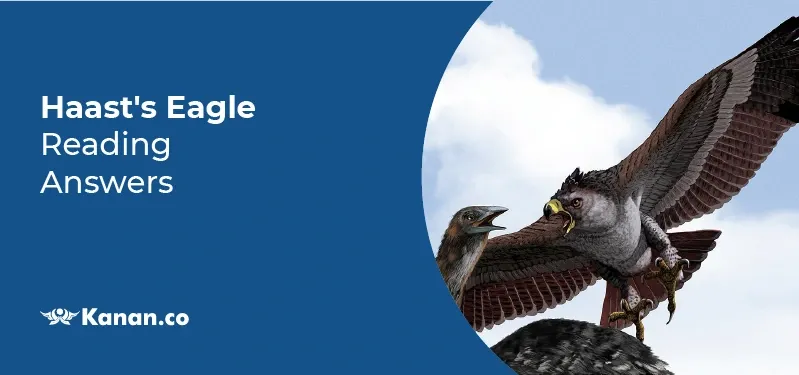
- As a result of being separated for tens of millions of years from other mainland ecosystems such as Australia or continental Asia, the biota of New Zealand evolved to include some of the most unique plants and animals on earth. Until the arrival of humans and their associated introduced species, such as rats and dogs, New Zealand was not home to a single ground mammal, and this encouraged bird-life to prevail. Another common feature of island ecosystems, whereby some species significantly outgrow their mainland relatives, also occurred in New Zealand. From these twin forces – the dominance of birds, and the tendency toward larger body sizes in island ecosystems – emerged one of the most formidable flying predators known on earth: the Haast’s eagle.
- The largest known eagle ever documented, this fearsome creature weighed up to fifteen kilograms and sported wings spanning two to three metres in diameter. Although this wingspan is comparatively small (the Wandering Albatross and Andean Condor, for instance, each have wing spans in excess of three metres), the Haast’s eagle possessed a much larger body mass to wing ratio. While stubbier wings made the eagle ill-suited to prolonged flight, they did enable the Haast’s eagle to nimbly and swiftly manoeuvre its large frame around trees, which would have been vital for pursuing prey through New Zealand’s dense forest and scrubland.
- The most impressive aspect of the bird’s anatomy, however, was its enormous talons. At almost 23 centimetres in length, these are comparable to those of some wild cats and have justifiably earned the Haast’s eagle the nickname ‘Tiger of the Skies’. With these talons the eagle would attack its prey in the only way it knew how -grasping the animal’s pelvis with one talon while crushing its skull with the other in a strike that, according to New Zealand researcher Richard Holdaway, is akin to that of a 15 kilogram concrete block dropping from an eight-storey building. This force was enough to bring down very large animals, and indeed the Haast’s eagle preyed primarily on the moa -a clumsy, flightless bird nearly fifteen times its size. Once immobilised, a large catch could feed the eagle over several days. With no other large predators, the Haast’s eagle could afford to take its time with the carcass of its prey until ready to return to the hunt.
- This leads to an important question: How did such a ferocious predator fall from the top of the food chain and rapidly become extinct around AD 1500? The answer is that, like many other extinct animals, the Haast’s eagle could not diversify its behaviours and adapt to changing circumstances quickly enough to survive. Moa, an easy source of prey for the eagle, were likewise an easy source of food for Maori tribes people when they began to settle in New Zealand around AD 1200, These settlers quickly drove the moa to extinction, and with it went the primary food supply of the Haast’s eagle. This enormous predator then faced a scarcity of food. Undoubtedly, the horror stories of human encounters with the eagle in Maori legend are true to some extent; if the Haast’s eagle could take down a two-hundred-kilogram moa, some Maori tribesmen would have fallen prey to its massive claws at some point. The occasional human victim was insufficient to sustain the dietary requirements of a creature its size, however, and when the moa disappeared, the Haast’s eagle soon followed.
- Mythology surrounding the existence of the Haast’s eagle has been passed down through Maori tradition for centuries, but due to a lack of physical evidence (only three full skeletons have ever been recovered), much about this bird remains a mystery. Artists have depicted the plumage of the Haast’s eagle in different ways; for example, some see it as more of a muted brown, in line with other large forest eagles still in existence today, whereas others envision it displaying extravagant hues of green, red and purple. All of this is speculation, however; recovered bones and further DNA evidence can tell us about the genealogy of the Haast’s eagle and its size and skeletal structure, but the colour of its feathers, along with many other specifications, will forever be guesswork.
- It is difficult to say whether the demise of the Haast’s eagle was tragic or fortuitous. No doubt the sight of this majestic bird swooping down swooping down from its perch at eighty kilometres per hour would have been an awe-inspiring sight, and it is easy to see why some early Maori settlers exalted the eagle in their imaginations as some kind of ‘Bird God’. If it were still around, however, there is no doubt that hiking, camping or even just taking a leisurely stroll through the woods in New Zealand would be a far more dangerous activity. With a force of impact powerful enough to knock an adult male unconscious, many people would never know what had hit them.
IELTS Academic Reading Questions
Questions 28 to 34:
The Reading Passage has six paragraphs, A-F.
Which Paragraph contains the following information?
Write the correct number, A-F, in boxes 28-34 on your answer sheet.
28. A discussion about whether the Haast’s Eagle killed humans
29.An explanation of how the body proportions of the Haast’s eagle made it an efficient hunter
30. The mental image that the Maori people had of the Haast’s eagle
31. Facts about the early ecology of New Zealand.
32. Conflicting views on the appearances of the Haast’s eagle
33. A comparison between the Haast’s eagle and other birds
34. An explanation of why the Haast’s eagle could eat its kills slowly
Questions 35-36
Choose two letters A-E
Which TWO OF the following are given as reasons why the Haast’s eagle originally evolved?
- New Zealand has many unusual birds and plants.
- New Zealand had no natural bird predators.
- New Zealand has no native mammals.
- New Zealand settlers brought over creatures with them.
- New Zealand is an isolated island.
Question 37
Choose the best answer.
Write the correct letter A-D in box 37 on your answer sheet.
Which of the following is NOT true?
- The Haast’s eagle could only fly for short distances.
- The Haast’s eagle was adapted to flying through forests.
- The Haast’s eagle’s wings were shorter than other large birds.
- The Haast’s eagle had small but very efficient claws.
Questions 38-39
Choose TWO letters A-E from the given paragraph.
Which TWO of the following are given as reasons why the Haast’s eagle died out very quickly?
- The first settlers ate all the moa.
- The eagle was hunted by the first settlers.
- The eagle could not survive by eating people.
- The settlers destroyed the eagle’s habitat.
- The eagle flew slowly and was caught easily.
Question 40
Choose the best answer.
Which of the following is NOT the author’s opinion?
- If the Haast’s eagle had not died out it would have attacked people.
- It is sad that Haast's eagle died out because it was beautiful.
- We can understand why the first settlers worshipped Haast's eagle.
- The Maori people should have preserved the Haast’s eagle.
Answers for Haast’s Eagle Reading Questions
The correct answers for the Haast’s Eagle reading questions are given below. It will assist you in understanding the format of the reading test and will allow you to correct your errors.
28. D
29. B
30. F
31. A
32. E
33. B
34. C
35. C
36. E
37. D
38. A
39. C
40. D
Other Reading Tests

About Author Gayathri Nagarajan
Gayathri, a trusted study-abroad expert, with expertise in standardized tests like IELTS, TOEFL, PTE, GRE, and GMAT. With a strong tech background from SASTRA University, she excels in software testing and has a passion for content writing and digital marketing. She aids students in finding the perfect academic fit, offering guidance on course selection, LOR and SOP writing. She remains up-to-date with the latest trends in higher education, delivering credible, accurate information on international education, including courses and test prep materials. As a trusted Study abroad expert at Kanan International, explore her latest blogs and articles for comprehensive insights into studying abroad and realizing your academic aspirations.
Kanan.co is a trusted study abroad consultancy offering comprehensive services, resources, and solutions for students and education institutions. We support students at every stage of their global education journey, ensuring a smooth and guided experience. Along with test preparation for IELTS, GRE, TOEFL, and SAT, we provide expert services such as SOP writing, visa guidance, accommodation support, scholarship assistance, and education loan support. Our expertise and commitment to excellence make us a reliable partner for students pursuing international education.
Free Online Mock Test 2026
Practice our mock test worth Rs. 25000 for Free and know your IELTS score!








Global Headquarters
Kanan Int EdTech Inc
320 Bay Street, Suite 321 (Spaces), Toronto ON, Canada M5B 1N9
Indian Headquarters
Kanan International Pvt. Ltd.
D-wing, 2nd Floor, Trident Complex, Ellora Park Vadiwadi Road, Vadodara, Gujarat 390007
IT/ Digital Campus
Kanan International Pvt. Ltd
Old, New No 3, 2nd Floor, 1A, Dr Sadasivam Rd, T. Nagar, Chennai, Tamil Nadu 600017
Our branches
- Bardoli
- Bharuch
- Chennai
- Dehradun
- Gurugram
- Himatnagar
- Karnal
- Nadiad
- Navsari
- Palanpur
- Rajkot
- Vadodara
- Valsad
- Vallabh Vidyanagar
- Vapi
Study Abroad
Test Prep
Top Universities
Consultants
IELTS Centers
GRE Centers
TOEFL Centers
SAT Centers
Language Courses in Vadodara
Study Abroad Calculators
Featured Blogs
Study Abroad Consultants in Chennai
Study Abroad Consultants in Surat
Study Abroad Consultants in Navsari
Study Abroad Consultants in Bardoli
Study Abroad Consultants in Ahmedabad
Study Abroad Consultants in Anand
Study Abroad Consultants in Khanna
Study Abroad Consultants in Nadiad
Study Abroad Consultants in Vadodara
Study abroad consultants in Valsad
Copyright © 2026 KANAN.CO All rights reserved.