- Study Abroad
- / ielts
- / hard disk drive technology reading answers
Hard Disk Drive Technology Reading Answers


Author
19-09-2025

Hard Disk Drive Technology Reading Answers are provided below. These will help you evaluate your performance. It has 12 questions of three different question types.
Table of Contents:
- Solution for Hard Disk Drive Technology
- Hard Disk Drive Technology IELTS Reading Practice Test
- Passage
- Questions
- Answers with Explanations
Solution for Hard Disk Drive Technology
In the table given below, you have the Hard Disk Drive Technology reading answers. Use them to evaluate your band score and performance.
Answer Table
| 29. second head | 30. platter | 31. special protective coating | 32. B |
| 33. D | 34. D | 35. A | 36. D |
| 37. B | 38. E | 39. A | 40. G |

Hard Disk Drive Technology IELTS Reading Practice Test - Exam Review
Check out our YouTube Channel to Practice Full-Length IELTS Reading Tests Daily

The Hard Disk Drive Technology IELTS reading practice test is given here. It will help you measure your performance and skills. Diagrams are described in sentences, therefore, read the passage carefully to understand what is asked in the question. Do not exceed the word limit, or the answer will be considered wrong. Highlight or underline the keywords, which will help you in finding the answers quickly.
Passage
You have been given the Hard Disk Drive Technology reading passage below. Spend around 20 minutes solving this passage which consists of 12 questions. Read the passage carefully and swiftly before answering. We have also provided Hard Disk Drive Technology reading answers with locations.
Hard Disk Drive Technology
- A few years ago, a query about the health of a person's hard disk drive would have been met with a blank stare. Nowadays, almost everyone is aware of this remarkable electronic storage medium that is part of every modern computer, even though most users remain ignorant of the complexity of hard drive technology.
- In the early days of computing, an information record of a computer' s memory content was kept on punched cards similar to the way in which an automated piano stores the keynote sequences on a piano roll. Later, magnetic tape was used to store electronic signals, and is still the favoured means of economically backing up the contents of hard drives. However, accessing information sequentially stored on tape is slow since the electronic data must be input through a fixed head in a single pass.
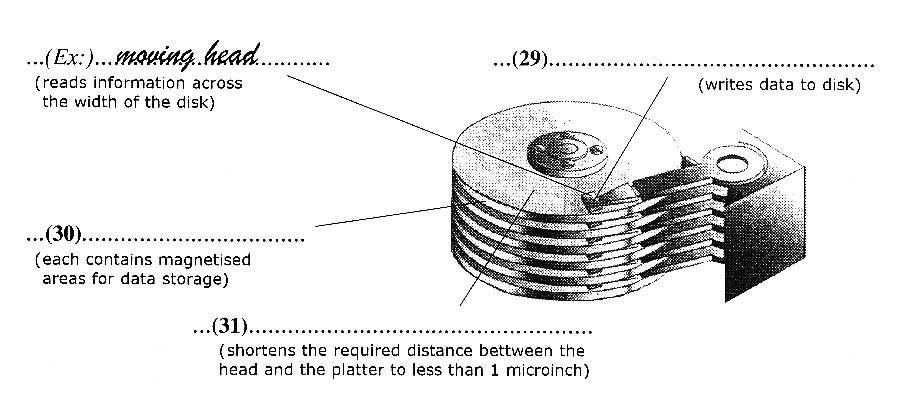
- Hard disk drives solve this problem by incorporating a spinning platter on which magnetic data can be made accessible via a moving head that reads and writes information across the width of the disk. It is analogous to the way in which a person can choose to play a particular track on a CD player by causing the arm to move the head across the disk. The CD player is, in fact, necessarily similar in design to a hard drive, although there are significant differences in speed of data access.
- Most modern hard drives incorporate several platters to further reduce the time spent seeking the required information. Also, some newer drives have two heads; one for reading, and a second head for writing data to disk. This separation of tasks enables much higher densities of magnetic information to be written on the platter, which increases the capacity of the hard drive.
- There are three important ways in which the capacity of hard disks has been increased. First, the data code itself has been tightened with express coding techniques. Second, as previously noted, the head technology has been improved; and third, the distance between the heads and the platters has been greatly reduced. It is hard to believe, but the head can be made to pass over the magnetised platter at distances of less than 1 microinch (the width of a typical human hair is 5000 microinches). This is achieved by means of a special protective coating applied to the platter. Each of these three improvements enables speedier access to the data.
- Hard drives are more commonplace than tape recorders these days, but it must be remembered that they are much more fragile. Treated with respect they may last a number of years, but they are quite easily damaged, often with disastrous consequences for the user, whose precious data can become lost forever. Dropping a drive is almost always fatal, as is passing an incorrect electrical current through one (by faulty connection). Dust and even extremes of temperature can cause failure. Yet, no physical damage can ever result from the input of data via the keyboard or mouse. Of course, over time the magnetised coating on the platters will erode, yet this is almost entirely independent of the amount of use.
- There are serious questions being raised about the direction of the future of electronic storage media. Some researchers claim that it would be wiser to invest more time and money in setting up systems for streaming data across networks of computers from centralised banks of information storage. This would avoid the need for each personal computer user to have his or her own copy of a software program resident on a local hard drive. Personal data files could be kept at a central storage unit, and be suitably protected from disaster by a failsafe backup system.
- As the Internet becomes ever more pervasive, and the speed of access to other machines increases across our telephone lines, it might be possible to do away with local storage systems altogether.
Glossary:
- backing up -- duplicating
- sequential(ly) -- in sequence (or one after the other)
- platter -- circular disk or plate
- Streaming data -- sending or broadcasting information as data
Questions
Questions 29 - 31
You are advised to spend about 5 minutes on Questions 29 - 31.
Choose from the words and phrases in the given list, and label the diagram with the correct name of each part of the hard drive.
Write your answers in boxes 29 - 31 on your Answer Sheet. The first one has been done for you as an example.
Note that you will not need to use every word or phrase in the list.
|
List of Parts: |
Questions 32 - 36
Choose the correct letter A, B, C, or D.
Write your answers in the boxes 32 - 36 on your answer sheet.
32. Magnetically-coated disks are one of many types of:
- sequential access information systems
- information storage solutions
- tape storage solutions
- CD players
33. Connecting a hard drive incorrectly usually:
- results in excess temperature
- erodes the magnetised material on the platters
- damages the keyboard or mouse
- destroys the drive
34. Keyboard or mouse use can easily cause:
- incorrect electrical currents
- the magnetised coating on the platter to wear out
- physical damage to the hard disk drive
- none of the above
35. In the future, a computer user might be able to access personal data files from:
- a central storage unit
- a local hard drive
- a software program
- the local bank
36. Centralised banks of storage information could:
- offer better protection of a user's data files
- stream data across telephone lines
- mean the end of local storage systems
- all of the above
Questions 37 - 40
Complete each gap in the text by choosing the best phrase from the box below the summary.
Write your answers in boxes 37 - 40 on your Answer Sheet.
Note that there are more phrases to choose from than are required.
The cheapest way to store computer information is 37. __________. However, it is slow to read back stored information in this way. 38. __________ , on the other hand, consists of one or more spinning platters coated with magnetised material holding data made accessible by two moving heads. Modern advances in disk technology have increased the 39. ____________ of hard disks. This has been accomplished 40. ______________.
|
Answers for Hard Disk Drive Technology with Explanations
The Hard Disk Drive Technology reading answers with explanations is provided below. They will help you in assessing your reading skills and band score.
29. Answer: second head
Explanation: Paragraph D, Line 1. Most modern hard drives incorporate several platters to further reduce the time spent seeking the required information. Also, some newer drives have two heads; one for reading, and a second head for writing data to disk.
30. Answer: platter
Explanation: Paragraph C, Line 1. Hard disk drives solve this problem by incorporating a spinning platter on which magnetic data can be made accessible via a moving head that reads and writes information across the width of the disk.
31. Answer: special protective coating
Explanation: Paragraph E, Line 5. It is hard to believe, but the head can be made to pass over the magnetised platter at distances of less than 1 microinch (the width of a typical human hair is 5000 microinches). This is achieved by means of a special protective coating applied to the platter.
32. Answer: B
Explanation: Paragraph D, Line 3. This separation of tasks enables much higher densities of magnetic information to be written on the platter, which increases the capacity of the hard drive. Paragraph E, Line 5. It is hard to believe, but the head can be made to pass over the magnetised platter at distances of less than 1 microinch (the width of a typical human hair is 5000 microinches). This is achieved by means of a special protective coating applied to the platter. The line above explains that these disks are coated with magnetised coating, and can be used to store a lot of information. Hence, the answer is option B.
33. Answer: D
Explanation: Paragraph F, Line 2. Treated with respect they may last a number of years, but they are quite easily damaged, often with disastrous consequences for the user, whose precious data can become lost forever. Dropping a drive is almost always fatal, as is passing an incorrect electrical current through one (by faulty connection).
34. Answer: D
Explanation: Paragraph F, Line 7. Yet, no physical damage can ever result from the input of data via the keyboard or mouse. As the line suggests no damage is cause by the keyboard or mouse, the correct answer is option D “none of the above”.
35. Answer: A
Explanation: Paragraph G, Line 6. Personal data files could be kept at a central storage unit, and be suitably protected from disaster by a failsafe backup system.
36. Answer: D
Explanation: Paragraph G, Line 1. Some researchers claim that it would be wiser to invest more time and money in setting up systems for streaming data across networks of computers from centralised banks of information storage. This would avoid the need for each personal computer user to have his or her own copy of a software program resident on a local hard drive. Personal data files could be kept at a central storage unit, and be suitably protected from disaster by a failsafe backup system. As all the options are included in this list of functions, the correct answer is option D “all of the above”.
37. Answer: B
Explanation: Paragraph B, Line 3. Later, magnetic tape was used to store electronic signals, and is still the favoured means of economically backing up the contents of hard drives.
38. Answer: E
Explanation: Paragraph C, Line 1. Hard disk drives solve this problem by incorporating a spinning platter on which magnetic data can be made accessible via a moving head that reads and writes information across the width of the disk.
39. Answer: A
Explanation: Paragraph D, Line 1. Most modern hard drives incorporate several platters to further reduce the time spent seeking the required information. Also, some newer drives have two heads; one for reading, and a second head for writing data to disk. This separation of tasks enables much higher densities of magnetic information to be written on the platter, which increases the capacity of the hard drive. All the line above are indicating the use of two heads which help in increasing storage capacity of the hard drive. Thus, the answer is option A.
40. Answer: G
Explanation: Paragraph E, Line 1. There are three important ways in which the capacity of hard disks has been increased. First, the data code itself has been tightened with express coding techniques. Second, as previously noted, the head technology has been improved; and third, the distance between the heads and the platters has been greatly reduced.
Other Reading Tests

About Author Roshan Sunthar
Roshan Sunthar is a study abroad expert as well as a renowned writer and author in international education. His academic excellence and 5+ years of work experience give him in-depth knowledge of international standardised exams and test preparation in IELTS, TOEFL, GRE, PTE, SAT, etc. The study materials he prepares incorporate exam-like questions. He’s also an expert in writing Statement of Purposes (SOPs) and Letter of Recommendations (LORs) for college admissions. He usually spends his leisure time watching English classics and documentaries, travelling, etc.
Kanan.co is a trusted study abroad consultancy offering comprehensive services, resources, and solutions for students and education institutions. We support students at every stage of their global education journey, ensuring a smooth and guided experience. Along with test preparation for IELTS, GRE, TOEFL, and SAT, we provide expert services such as SOP writing, visa guidance, accommodation support, scholarship assistance, and education loan support. Our expertise and commitment to excellence make us a reliable partner for students pursuing international education.
Free Online Mock Test 2026
Practice our mock test worth Rs. 25000 for Free and know your IELTS score!








Global Headquarters
Kanan Int EdTech Inc
320 Bay Street, Suite 321 (Spaces), Toronto ON, Canada M5B 1N9
Indian Headquarters
Kanan International Pvt. Ltd.
D-wing, 2nd Floor, Trident Complex, Ellora Park Vadiwadi Road, Vadodara, Gujarat 390007
IT/ Digital Campus
Kanan International Pvt. Ltd
Old, New No 3, 2nd Floor, 1A, Dr Sadasivam Rd, T. Nagar, Chennai, Tamil Nadu 600017
Our branches
- Bardoli
- Bharuch
- Chennai
- Dehradun
- Gurugram
- Himatnagar
- Karnal
- Nadiad
- Navsari
- Palanpur
- Rajkot
- Vadodara
- Valsad
- Vallabh Vidyanagar
- Vapi
Study Abroad
Test Prep
Top Universities
Consultants
IELTS Centers
GRE Centers
TOEFL Centers
SAT Centers
Language Courses in Vadodara
Study Abroad Calculators
Featured Blogs
Study Abroad Consultants in Chennai
Study Abroad Consultants in Surat
Study Abroad Consultants in Navsari
Study Abroad Consultants in Bardoli
Study Abroad Consultants in Ahmedabad
Study Abroad Consultants in Anand
Study Abroad Consultants in Khanna
Study Abroad Consultants in Nadiad
Study Abroad Consultants in Vadodara
Study abroad consultants in Valsad
Copyright © 2026 KANAN.CO All rights reserved.