- Study Abroad
- / ielts
- / human interference and finches reading answers
Human interference and finches Reading Answers


Author
16-09-2025

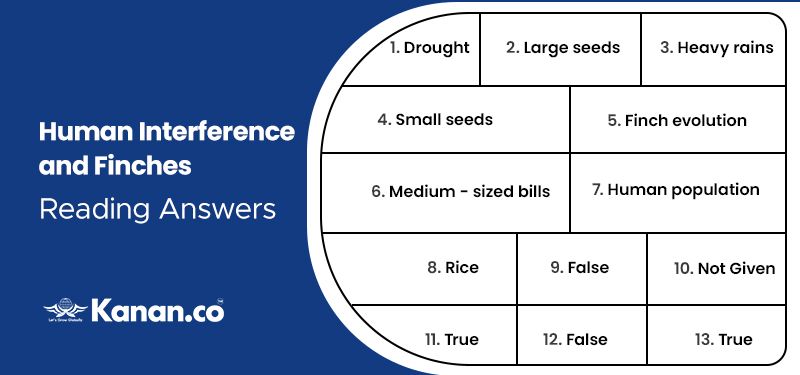
Here we have given Human interference and finches reading practice and answers with explanations. It has 13 questions in 3 different questions types- 4 questions as table completion, 4 questions as summary completion, and 5 questions as true, false or not given questions form.
Check out our YouTube Channel to Practice Full-Length IELTS Reading Tests Daily

Table of contents:
- Solution for Human interference and finches
- Human interference and finches IELTS reading practice test
- Passage
- Questions
- Answers with explanations
Solution for Human interference and finches
We have given Human interference and finches reading answers, in the table given below.

Answer Table
| 1. Drought | 4. Small seeds | 7. Human population | 10. Not given | 13. True |
| 2. Large seeds | 5. Finch evolution | 8. Rice | 11. True | |
| 3. Heavy rains | 6. Medium-sized bills | 9. False | 12. False |
Human interference and finches IELTS reading practice test- Exam Review
In this article we have provided Human interference and finches IELTS reading answers. This article will help to be distinguished in the IELTS reading practice to challenge your reading skill and read the given passage to answer the questions.
Passage
We have given Human interference and finches reading answers with location. Go through the given passage carefully and answer the questions.
Human interference and finches
A Today, the quest continues. On Daphne Major-one of the most desolate of the Galápagos Islands, an uninhabited volcanic cone where cacti and shrubs seldom grow higher than a researcher’s knee-Peter and Rosemary Grant have spent more than three decades watching Darwin’s finch respond to the challenges of storms, drought and competition for food. Biologists at Princeton University, the Grants know and recognize many of the individual birds on the island and can trace the birds’ lineages hack through time. They have witnessed Darwin’s principle in action again and again, over many generations of finches.
B The Grants’ most dramatic insights have come from watching the evolving bill of the medium ground finch. The plumage of this sparrow-sized bird ranges from dull brown to jet black. At first glance, it may not seem particularly striking, but among scientists who study evolutionary biology, the medium ground finch is a superstar. Its bill is a middling example in the array of shapes and sizes found among Galápagos finches: heftier than that of the small ground finch, which specializes in eating small, soft seeds, but petite compared to that of the large ground finch, an expert at cracking and devouring big, hard seeds.
C When the Grants began their study in the 1970s, only two species of finch lived on Daphne Major, the medium ground finch and the cactus finch. The island is so small that the researchers were able to count and catalogue every bird. When a severe drought hit in 1977, the birds soon devoured the last of the small, easily eaten seeds. Smaller members of the medium ground finch population, lacking the bill strength to crack large seeds, died out.
D Bill and body size are inherited traits, and the next generation had a high proportion of big-billed individuals. The Grants had documented natural selection at work-the same process that, over many millennia, directed the evolution of the Galápagos’ 14 unique finch species, all descended from a common ancestor that reached the islands a few million years ago.
E Eight years later, heavy rains brought by an El Nino transformed the normally meager vegetation on Daphne Major. Vines and other plants that in most years struggle for survival suddenly flourished, choking out the plants that provide large seeds to the finches. Small seeds came to dominate the food supply, and big birds with big bills died out at a higher rate than smaller ones. ‘Natural selection is observable,’ Rosemary Grant says. ‘It happens when the environment changes. When local conditions reverse themselves, so does the direction of adaptation.
F Recently, the Grants witnessed another form of natural selection acting on the medium ground finch: competition from bigger, stronger cousins. In 1982, a third finch, the large ground finch, came to live on Daphne Major. The stout bills of these birds resemble the business end of a crescent wrench. Their arrival was the first such colonization recorded on the Galápagos in nearly a century of scientific observation. ‘We realized,’ Peter Grant says, ‘we had a very unusual and potentially important event to follow.’ For 20 years, the large ground finch coexisted with the medium ground finch, which shared the supply of large seeds with its bigger-billed relative. Then, in 2002 and 2003, another drought struck. None of the birds nested that year, and many died out. Medium ground finches with large bills, crowded out of feeding areas by the more powerful large ground finches, were hit particularly hard.
G When wetter weather returned in 2004, and the finches nested again, the new generation of the medium ground finch was dominated by smaller birds with smaller bills, able to survive on smaller seeds. This situation, says Peter Grant, marked the first time that biologists have been able to follow the complete process of an evolutionary change due to competition between species and the strongest response to natural selection that he had seen in 33 years of tracking Galápagos finches.
H On the inhabited island of Santa Cruz, just south of Daphne Major, Andrew Hendry of McGill University and Jeffrey Podos of the University of Massachusetts at Amherst have discovered a new, man-made twist in finch evolution. Their study focused on birds living near the Academy Bay research station, on the fringe of the town of Puerto Ayora. The human population of the area has been growing fast-from 900 people in 1974 to 9,582 in 2001. Today Puerto Ayora is full of hotels and mai tai bars,’ Hendry says. ‘People have taken this extremely arid place and tried to turn it into a Caribbean resort.’
I Academy Bay records dating back to the early 1960s show that medium ground finches captured there had either small or large bills. Very few of the birds had mid-size bills. The finches appeared to be in the early stages of a new adaptive radiation. If the trend continued, the medium ground finch on Santa Cruz could split into two distinct subspecies, specializing in different types of seeds. But in the late 1960s and early 70s, medium ground finches with medium-sized bills began to thrive at Academy Bay along with small and large-billed birds. The booming human population had introduced new food sources, including exotic plants and bird feeding stations stocked with rice. Billsize, once critical to the finches’ survival, no longer made any difference. ‘Now an intermediate bill can do fine,’ Hendry says.
J At a control site distant from Puerto Ayora, and relatively untouched by humans, the medium ground finch population remains split between large- and small-billed birds. On undisturbed parts of Santa Cruz, there is no ecological niche for a middling medium ground finch, and the birds continue to diversify. In town, though there are still many finches, once-distinct populations are merging.
K The finches of Santa Cruz demonstrate a subtle process in which human meddling can stop evolution in its tracks, ending the formation of new species. In a time when global biodiversity continues its downhill slide, Darwin’s finches have yet another unexpected lesson to teach. ‘If we hope to regain some of the diversity that’s already been lost/ Hendry says, ‘we need to protect not just existing creatures, but also the processes that drive the origin of new species.
Questions
Questions 1-4
- Complete the table now.
- Choose no more than two words from reading passage 1 for each answer.
- Write your answers in boxes 1-4 on your answer sheet.
| Year | Climate | Finch’s Condition |
| 1977 | 1________ | Small-beak birds failing to survive, without the power to open 2__________ |
| 1985 | 3_________ | Big-beak birds dying out, with 4________ as the main food resource. |
Questions 5-8
- Complete the following summary of the paragraphs of the reading passage.
- Using no more than two words from the reading passage for each answer.
- Write your answers in boxes 5-8 on your answer sheet.
On the remote island of Santa Cruz, Andrew Hendry and Jeffrey Podos conducted a study on reversal 5 …………………… due to human activity. In the early 1960s medium ground finches were found to have a larger or smaller beak. But in the late 1960s and early 70s, finches with 6 …………………… flourished. The study speculates that it is due to the growing 7 …………………… who brought in alien plants with intermediate-size seeds into the area and the birds ate 8…………………… sometimes
Questions 9-13
- Do the following statements agree with the claims of the writer in reading passage 1?
- In boxes 9-13 on your answer sheet, write.
- True if the statement is true
- False if the statement is false
- Not given if the information is not given in the passage
9. Grants’ discovery has questioned Darwin’s theory.
10. The cactus finches are less affected by food than the medium ground finch.
11. In 2002 and 2003, all the birds were affected by the drought.
12. The discovery of Andrew Hendry and Jeffrey Podos was the same as that of the previous studies.
13. It is shown that the revolution in finches on Santa Cruz is likely a response to human intervention.
Answers for human interference and finches with explanation
We have given human interference and finches reading answers with explanation, this will help you to identify your mistakes in the answering process.
1. Answer: Drought
Explanation: When a severe drought hit in 1977, the birds soon devoured the last of the small, easily eaten seeds. In this line it is clearly mentioned that drought hit in 1977 and it is a climate. Hence the given answer is located in the 3-4 lines of paragraph C.
2. Answer: Large seeds
Explanation: Smaller members of the medium ground finch population, lacking the bill strength to crack large seeds, died out. In this line it is clearly mentioned that small-beaked birds could not open the large seed and smaller seeds are eaten up. Hence the given answer is located in the last 2 lines of paragraph C.
3. Answer: Heavy rains
Explanation: Eight years later, heavy rains brought by an El Nino transformed the normally meager vegetation on Daphne Major. This line explains that in 1985, EI Nino brought heavy rain. Hence the given answer is located in the first two lines of paragraph E.
4. Answer: Small seeds
Explanation: Small seeds came to dominate the food supply, and big birds with big bills died out at a higher rate than smaller ones. Here it is clearly mentioned that small seeds are the only source of food and the large birds are died faster than small ones. Hence the given answer is located in the 4-5 lines of paragraph E.
5. Answer: Finch evolution
Explanation: On the inhabited island of Santa Cruz, just south of Daphne Major, Andrew Hendry of McGill University and Jeffrey Podos of the University of Massachusetts at Amherst have discovered a new, man-made twist in finch evolution. In this line it is explained that Santa Cruz, Andrew Hendrey and jeffrey podos have conducted a study about a new finch evolution caused by human activity. Hence the given answer is located in the first 3 lines of paragraph H.
6. Answer: Medium-sized bills
Explanation: But in the late 1960s and early 70s, medium ground finches with medium-sized bills began to thrive at Academy Bay along with small and large-billed birds. In this line it is clear that in the late 1960 and early 70 finches with medium-sized bills were grown. Hence the given answer is located in the 4-7 lines of paragraph I.
7. Answer: Human population
Explanation: The human population of the area has been growing fast-from 900 people in 1974 to 9,582 in 2001. In this line it is mentioned that increased population can bring a new source of food for birds. Hence the given answer is located in the 4-6 lines of paragraph H.
8. Answer: Rice
Explanation: The booming human population had introduced new food sources, including exotic plants and bird feeding stations stocked with rice. Billsize, once critical to the finches’ survival, no longer made any difference. In this line it is mentioned that because of humans, finches eat rice. Hence the given answer is located in the last 3 lines of paragraph I.
9. Answer: False
Explanation: Grant have spent more than three decades watching Darwin’s finch respond to the challenges of storms, drought and competition for food. Here it is clearly mentioned that Darwin’s finch theory is seen repeatedly as Grant studies in finches. Hence the given answer is located in the 3-5 lines of paragraph A.
10. Answer: Not given
11. Answer: True
Explanation: Then, in 2002 and 2003, another drought struck. None of the birds nested that year, and many died out. Here it is mentioned that during 2002 and 2003 birds were affected by a drought. Hence the given answer is located in the 8-9 lines of paragraph F.
12. Answer: False
Explanation: On the inhabited island of Santa Cruz, just south of Daphne Major, Andrew Hendry of McGill University and Jeffrey Podos of the University of Massachusetts at Amherst have discovered a new, man-made twist in finch evolution. These lines explain that the discovery of Andrew Hendry and Jeffrey Podos are not the same as that of the previous studies. Hence the given answer is located in the 1-3 lines of paragraph H.
13. Answer: True
Explanation: The finches of Santa Cruz demonstrate a subtle process in which human meddling can stop evolution in its tracks, ending the formation of new species. This line explains that revolution on finches of Santa Cruz is a response to Human intervention. Hence the given answer is located in the first 2 lines of paragraph K.
Other reading answers

About Author Gayathri Nagarajan
Gayathri, a trusted study-abroad expert, with expertise in standardized tests like IELTS, TOEFL, PTE, GRE, and GMAT. With a strong tech background from SASTRA University, she excels in software testing and has a passion for content writing and digital marketing. She aids students in finding the perfect academic fit, offering guidance on course selection, LOR and SOP writing. She remains up-to-date with the latest trends in higher education, delivering credible, accurate information on international education, including courses and test prep materials. As a trusted Study abroad expert at Kanan International, explore her latest blogs and articles for comprehensive insights into studying abroad and realizing your academic aspirations.
Kanan.co is a trusted study abroad consultancy offering comprehensive services, resources, and solutions for students and education institutions. We support students at every stage of their global education journey, ensuring a smooth and guided experience. Along with test preparation for IELTS, GRE, TOEFL, and SAT, we provide expert services such as SOP writing, visa guidance, accommodation support, scholarship assistance, and education loan support. Our expertise and commitment to excellence make us a reliable partner for students pursuing international education.
Free Online Mock Test 2026
Practice our mock test worth Rs. 25000 for Free and know your IELTS score!








Global Headquarters
Kanan Int EdTech Inc
320 Bay Street, Suite 321 (Spaces), Toronto ON, Canada M5B 1N9
Indian Headquarters
Kanan International Pvt. Ltd.
D-wing, 2nd Floor, Trident Complex, Ellora Park Vadiwadi Road, Vadodara, Gujarat 390007
IT/ Digital Campus
Kanan International Pvt. Ltd
Old, New No 3, 2nd Floor, 1A, Dr Sadasivam Rd, T. Nagar, Chennai, Tamil Nadu 600017
Our branches
- Bardoli
- Bharuch
- Chennai
- Dehradun
- Gurugram
- Himatnagar
- Karnal
- Nadiad
- Navsari
- Palanpur
- Rajkot
- Vadodara
- Valsad
- Vallabh Vidyanagar
- Vapi
Study Abroad
Test Prep
Top Universities
Consultants
IELTS Centers
GRE Centers
TOEFL Centers
SAT Centers
Language Courses in Vadodara
Study Abroad Calculators
Featured Blogs
Study Abroad Consultants in Chennai
Study Abroad Consultants in Surat
Study Abroad Consultants in Navsari
Study Abroad Consultants in Bardoli
Study Abroad Consultants in Ahmedabad
Study Abroad Consultants in Anand
Study Abroad Consultants in Khanna
Study Abroad Consultants in Nadiad
Study Abroad Consultants in Vadodara
Study abroad consultants in Valsad
Copyright © 2026 KANAN.CO All rights reserved.