- Study Abroad
- / ielts
- / lighting up the lies reading answers
Lighting Up The Lies Reading Answers


Author
17-09-2025

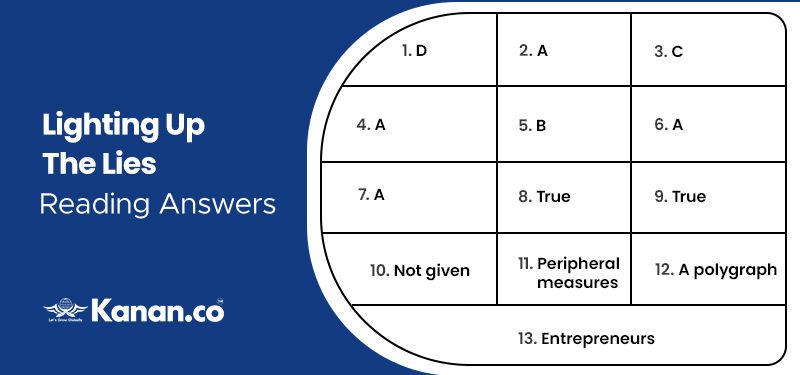
Here you can find Lighting Up The Lies reading answers as a practice test along with answers and explanations. This article contains 13 questions in 3 different types namely - 7 questions as matching features, 3 different questions as true, false or not given, and 3 questions as summary completion. Before answering your questions, read the given passage thoroughly.
Check out our YouTube Channel to Practice Full-Length IELTS Reading Tests Daily

Table of contents:
- Solution for Lighting Up The Lies
- Lighting Up The Lies IELTS reading practice test
- Passage
- Questions
- Answers with explanation
Solution for Lighting Up The Lies
Answers for the Lighting Up The Lies reading answers, are given here in the table form below.

Answer Table
| 1. D | 4. A | 7. A | 10. Not given | 13. Entrepreneurs |
| 2. A | 5. B | 8. True | 11. Peripheral measures | |
| 3. C | 6. A | 9. True | 12. A polygraph |
Lighting Up The Lies IELTS Reading Practice Test- Exam Review
We have given the Lighting Up The Lies IELTS reading answers, as a sample article for the IELTS reading practice test. Use this article while practicing for your major exam, it will aid you to crack your exams with band scores. Go through the given passage and answer the questions.
Passage
We have given Lighting Up The Lies reading answers with location. Be careful while reading the passage and answer the questions.
Lighting Up The Lies
- Last year Sean A. Spence, a professor at the school of medicine at the University of Sheffield in England, performed brain scans that showed that a woman convicted of poisoning a child in her care appeared to be telling the truth when she denied committing the crime. This deception study, along with two others performed by the Sheffield group, was funded by Quickfire Media, a television production company working for the U.K. 's Channel 4, which broadcast videos of the researchers at work as part of a three-part series called “Lie Lab.” The brain study of the woman later appeared in the journal European Psychiatry.
- Functional magnetic resonance imaging (fMRI) purports to detect mendacity by seeing inside the brain instead of tracking peripheral measures of anxiety—such as changes in pulse, blood pressure or respiration —measured by a polygraph. Besides drawing hundreds of thousands of viewers, fMRI has pulled in entrepreneurs. Two companies—Cephos in Pepperell, Mass., and No Lie MRI in Tarzana, Calif.—claim to predict with 90 percent or greater certainty whether you are telling the truth. No Lie MRI, whose name evokes the casual familiarity of a walk-in dental clinic in a strip mall, suggests that the technique may even be used for “risk reduction in dating” .
- Many neuroscientists and legal scholars doubt such claims—and some even question whether brain scans for lie detection will ever be ready for anything but more research on the nature of deception and the brain. An fMRI machine tracks blood flow to activated brain areas. The assumption in lie detection is that the
the brain must exert extra effort when telling a lie and that the regions that do more work get more blood. Such areas light up in scans; during the lie studies, the illuminated regions are primarily involved in decision making. - To assess how fMRI and other neuroscience findings affect the law, the Mac- Arthur Foundation put up $10 million last year to pilot for three years the Law and Neuroscience Project. Part of the funding will attempt to set criteria for accurate and reliable lie detection using fMRI and other brain-scanning technology. “I think it’s not possible, given the current technology, to trust the results,” says Marcus Raichle, a neuroscientist at the Washington University School of Medicine in St. Louis who heads the project’s study group on lie detection. “But it’s not impossible to set up a research program to determine whether that’s possible.” A major review article last year in the American Journal of Law and Medicine by Henry T. Greely of Stanford University and Judy Illes, now at the University of British Columbia, explores the deficiencies of existing research and what may be needed to move the technology forward. The two scholars found that lie detection studies conducted so far (still less than 20 in all) failed to prove that fMRI is “effective as a lie detector in the real world at any accuracy level.”
- Most studies examined groups, not individuals.Subjects in these studies were healthy young adults—making it unclear how the results would apply to someone who takes a drug that affects blood pressure or has a blockage in an artery. The two researchers questioned the specificity of the lit-up areas; they noted that the regions also correlate with a wide range of cognitive behaviors, including memory, self- monitoring and conscious self-awareness.
- The biggest challenge for which the Law and Neuroscience Project is already funding new research—is how to diminish the artificiality of the test protocol. Lying about whether a playing card is the seven of spades may not activate the same areas of the cortex as answering a question about whether you robbed the comer store. In fact, the most realistic studies to date may have come from the Lie Lab television programs. The two companies marketing the technology are not waiting for more data. Cephos is offering scans without charge to people who claim they were falsely accused if they meet certain criteria in an effort to get scans accepted by the courts. Allowing scans as legal evidence could open a potentially huge and lucrative market. “We may have to take many shots on goal before we actually see a courtroom,” says Cephos chief executive Steven Laken. He asserts that the technology has achieved 97 percent accuracy and that the more than 100 people scanned using the Cephos protocol have provided data that have resolved many of the issues that Greely and Illes cited.
- But until formal clinical trials prove that the machines meet safety and effectiveness criteria, Greely and Illes have called for a ban on non-research uses. Trials envisaged for regulatory approval hint at the technical challenges. Actors, professional poker players and sociopaths would be compared against average Joes. The devout would go in the scanner after nonbelievers. Testing would take into account social settings. White lies—“no, dinner really was fantastic”—would have to be compared against untruths about sexual peccadilloes to ensure that the brain reacts identically.
- There potential for abuse prompts caution. “The danger is that people’s lives can be changed in bad ways because of mistakes in the technology,” Greely says.
“The danger for science is that it gets a black eye because of this very high profile use of neuroimaging that goes wrong.” Considering the long and controversial history of the polygraph, gradualism may be the wisest course to follow for a new diagnostic that probes an essential quality governing social interaction.
Questions
Questions 1-7
- Use the information in the passage to match the people (listed A-D) with opinions or deeds below.
- Write the appropriate letters A-D in boxes 1-7 on your answer sheet.
- NB you may use any letter more than once
A Henry T. Greely &Judy Illes
B Steven Laken
C Henry T. Greely
D Marcus Raichle
1. The possibility hidden in a mission impossible
2. The uncertain effectiveness of functional magnetic resonance imaging for detecting lies
3. The hazard lying behind the technology as a lie detector
4. The limited fields for the use of lie detection technology
5. Several successful cases of applying the results from the lie detection technology
6. Cons of the current research related to lie-detector tests
7. There should be some requested work to improve the techniques regarding lie detection
Questions 8-10
- Do the following statements agree with the information given in Reading Passage?
- In boxes 8-10 on your answer sheet, write
- TRUE if the statement is true
- FALSE if the statement is false
- NOT GIVEN if the information is not given in the passage
8. The lie detection for a convicted woman was first conducted by researchers in Europe.
9. The legitimization of using scans in the court might mean a promising and profitable business.
10. There is always something wrong with neuroimaging.
Questions 11-13
- Complete the following summary of the paragraphs of Reading Passage, using No More than Three words from the Reading Passage for each answer.
- Write your answers in boxes 11-13 on your answer sheet.
It is claimed that functional magnetic resonance imaging can check lies by observing the internal part of the brain rather than following up 11__________ to evaluate the anxiety as 12________ does. Audiences as well as 13__________ are fascinated by this amazing lie-detection technology.
Answer for Lighting Up The Lies with Explanation
Here we have given the answers for Lighting Up The Lies reading answers with explanations, make use of it to rectify your errors.
1. Answer: D
Explanation: “I think it’s not possible, given the current technology, to trust the results,” says Marcus Raichle, a neuroscientist at the Washington University School of Medicine in St. Louis who heads the project’s study group on lie detection. “But it’s not impossible to set up a research program to determine whether that’s possible.” With this line it is clear that this opinion is given by Marcus Riachle. Hence the given answer is located in the 4-8 lines of paragraph D.
2. Answer: A
Explanation: “A major review article last year in the American Journal of Law and Medicine by Henry T. Greely of Stanford University and Judy Illes, now at the University of British Columbia, explores the deficiencies of existing research and what may be needed to move the technology forward. The two scholars found that lie detection studies conducted so far (still less than 20 in all) failed to prove that fMRI is “effective as a lie detector in the real world at any accuracy level.” . With this line it is clear that Henry T. Greely and Judy Illes had stated this opinion. Hence the given answer is located in the last 6 lines of paragraph D.
3. Answer: C
Explanation: “There potential for abuse prompts caution. “The danger is that people’s lives can be changed in bad ways because of mistakes in the technology,” Greely says. “The danger for science is that it gets a black eye because of this very high profile use of neuroimaging that goes wrong.” with this line it is clear that Henry T. Greely had stated this opinion. Hence the given answer is located in the first 4 lines of paragraph H.
4. Answer: A
Explanation: “But until formal clinical trials prove that the machines meet safety and effectiveness criteria, Greely and Illes have called for a ban on non-research uses. Trials envisaged for regulatory approval hint at the technical challenges”. With this line it is clear that Greely and Illes stated this opinion. Hence the given answer is located in the first 3 lines of paragraph G.
5. Answer: B
Explanation: “Allowing scans as legal evidence could open a potentially huge and lucrative market. “We may have to take many shots on goal before we actually see a courtroom,” says Cephos chief executive Steven Laken. He asserts that the technology has achieved 97 percent accuracy and that the more than 100 people scanned using the Cephos protocol have provided data that have resolved many of the issues that Greely and Illes cited”. With this line it is clear that these lines are stated by Steven Laken. Hence the given answer is located in the last 6 lines of paragraph F.
6. Answer: A
Explanation: “The danger for science is that it gets a black eye because of this very high profile use of neuroimaging that goes wrong.” Considering the long and controversial history of the polygraph, gradualism may be the wisest course to follow for a new diagnostic that probes an essential quality governing social interaction”. With this line it is clear that these lines are stated by Henry T. Greely &Judy Illes. Hence the given answer is located in the last 4 lines of paragraph H.
7. Answer: A
Explanation: “Considering the long and controversial history of the polygraph, gradualism may be the wisest course to follow for a new diagnostic that probes an essential quality governing social interaction”. With this line it is clear that these lines are stated by Henry T. Greely &Judy Illes. Hence the given answer is located in the last 3 lines of paragraph H.
8. Answer: True
Explanation: “Last year Sean A. Spence, a professor at the school of medicine at the University of Sheffield in England, performed brain scans that showed that a woman convicted of poisoning a child in her care appeared to be telling the truth when she denied committing the crime” and “broadcast videos of the researchers at work as part of a three-part series called “Lie Lab.” The brain study of the woman later appeared in the journal European Psychiatry”. With this line it is clear that the lie detection for a convicted woman was first conducted by researchers in Europe. Hence the given answer is located in the first 4 lines and last 3 lines of paragraph A.
9. Answer: True
Explanation: “The two companies marketing the technology are not waiting for more data. Cephos is offering scans without charge to people who claim they were falsely accused if they meet certain criteria in an effort to get scans accepted by the courts. Allowing scans as legal evidence could open a potentially huge and lucrative market”. With this line it is clear that the legitimization of using scans in the court might mean a promising and profitable business. Hence the given answer is located in the 6-10 lines of paragraph F.
10. Answer: Not given
11. Answer: Peripheral measures
Explanation: “Functional magnetic resonance imaging (fMRI) purports to detect mendacity by seeing inside the brain instead of tracking peripheral measures of anxiety—such as changes in pulse, blood pressure or respiration —measured by a polygraph. Besides drawing hundreds of thousands of viewers, fMRI has pulled in entrepreneurs”. With this line it is clear that functional magnetic resonance imaging can check lies by observing the internal part of the brain rather than following up Peripheral measures. Hence the given answer is located in the first 5 lines of paragraph B.
12. Answer: A polygraph
Explanation: “Functional magnetic resonance imaging (fMRI) purports to detect mendacity by seeing inside the brain instead of tracking peripheral measures of anxiety—such as changes in pulse, blood pressure or respiration —measured by a polygraph. Besides drawing hundreds of thousands of viewers, fMRI has pulled in entrepreneurs”. With this line it is clear that functional magnetic resonance imaging can check lies by observing the internal part of the brain rather than following up Peripheral measures functional magnetic resonance imaging can check lies by observing the internal part of the brain rather than following up Peripheral measures to evaluate the anxiety as a polygraph does. Hence the given answer is located in the first 5 lines of paragraph B.
13. Answer: Entrepreneurs
Explanation: “Besides drawing hundreds of thousands of viewers, fMRI has pulled in entrepreneurs. Two companies—Cephos in Pepperell, Mass., and No Lie MRI in Tarzana, Calif.—claim to predict with 90 percent or greater certainty whether you are telling the truth. No Lie MRI, whose name evokes the casual familiarity of a walk-in dental clinic in a strip mall, suggests that the technique may even be used for “risk reduction in dating”. With this line it is clear that audiences as well as entrepreneurs are fascinated by this amazing lie-detection technology. Hence the given answer is located in the last 6 lines of paragraph B.
Other reading answers

About Author Tejaswini Kota
Tejaswini is an enthusiastic writer, reader and a passionate learner. Additionally, she was a research fellow and holds a grip in English writings and research/paper publications. She holds bachelors and masters degrees in engineering. She spent three years in the education industry and is currently working as a full-time content writer at Kanan International, writing articles for study abroad projects. She is proficient in creating good quality content that helps the students for language proficiency tests like IELTS, GRE, TOEFL etc. and can help in advising you the right choice of college for admission.
Kanan.co is a trusted study abroad consultancy offering comprehensive services, resources, and solutions for students and education institutions. We support students at every stage of their global education journey, ensuring a smooth and guided experience. Along with test preparation for IELTS, GRE, TOEFL, and SAT, we provide expert services such as SOP writing, visa guidance, accommodation support, scholarship assistance, and education loan support. Our expertise and commitment to excellence make us a reliable partner for students pursuing international education.
Free Online Mock Test 2026
Practice our mock test worth Rs. 25000 for Free and know your IELTS score!








Global Headquarters
Kanan Int EdTech Inc
320 Bay Street, Suite 321 (Spaces), Toronto ON, Canada M5B 1N9
Indian Headquarters
Kanan International Pvt. Ltd.
D-wing, 2nd Floor, Trident Complex, Ellora Park Vadiwadi Road, Vadodara, Gujarat 390007
IT/ Digital Campus
Kanan International Pvt. Ltd
Old, New No 3, 2nd Floor, 1A, Dr Sadasivam Rd, T. Nagar, Chennai, Tamil Nadu 600017
Our branches
- Bardoli
- Bharuch
- Chennai
- Dehradun
- Gurugram
- Himatnagar
- Karnal
- Nadiad
- Navsari
- Palanpur
- Rajkot
- Vadodara
- Valsad
- Vallabh Vidyanagar
- Vapi
Study Abroad
Test Prep
Top Universities
Consultants
IELTS Centers
GRE Centers
TOEFL Centers
SAT Centers
Language Courses in Vadodara
Study Abroad Calculators
Featured Blogs
Study Abroad Consultants in Chennai
Study Abroad Consultants in Surat
Study Abroad Consultants in Navsari
Study Abroad Consultants in Bardoli
Study Abroad Consultants in Ahmedabad
Study Abroad Consultants in Anand
Study Abroad Consultants in Khanna
Study Abroad Consultants in Nadiad
Study Abroad Consultants in Vadodara
Study abroad consultants in Valsad
Copyright © 2026 KANAN.CO All rights reserved.