- Study Abroad
- / ielts
- / malaria reading answers
Malaria Reading Answers


Author
19-09-2025

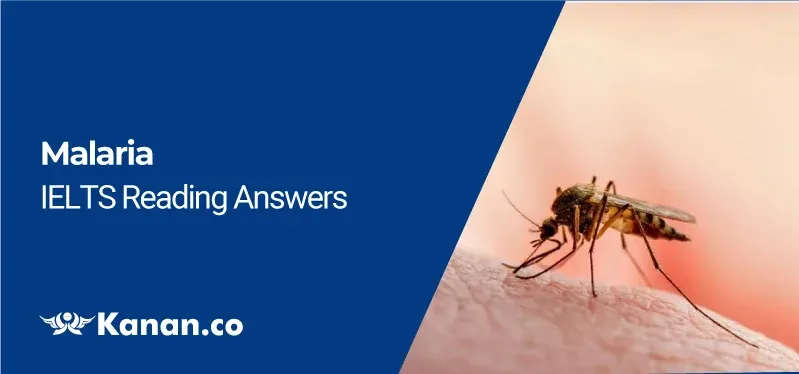
Malaria reading answers practice tests are provided with answers and explanations. This passage comprises 14 questions divided into three question types - list of headings, yes/no/not given and statement completion.
Table of contents:
- Solution for Malaria Reading Answers
- Malaria Reading Answers IELTS Reading Practice Test
- Passage
- Questions
- Answers with Explanations
Solution for Malaria Reading Answers
Malaria Reading Answers are listed in the table below. Verify your answers against our answer table, then correct any inaccuracies.
Answer Table
| 27. v | 31. x | 35. No | 39. E |
| 28. viii | 32. iii | 36. Yes | 40. G |
| 29. vii | 33. xi | 37. B | |
| 30. i | 34. No | 38. H |

Malaria Reading Answers IELTS Reading Practice Test - Exam Review
Check out our YouTube Channel to Practice Full-Length IELTS Reading Tests Daily

Malaria Reading Answers are given here, which will help you excel in the IELTS reading test to challenge your reading skills. Paraphrasing can help you to understand the ideas clearly which makes you able to efficiently answer the questions.
Passage
We’ve provided the reading passage of Malaria Reading Answers. Read the passage and carefully complete the questions. Check the answers with our Malaria Reading Answers with locations.
Malaria Reading Answers
A. Approximately 300 million people worldwide are affected by malaria and between 1 and 1.5 million people die from it every year. Previously extremely widespread, malaria is now mainly confined to Africa, Asia and Latin America. The problem of controlling malaria in these countries is aggravated by inadequate health structures and poor socio-economic conditions. The situation has become even more complex over the last few years with the increase in resistance to the drugs normally used to combat the parasite that causes the disease.
B. Malaria is caused by protozoan parasites of the genus Plasmodium. Four species of Plasmodium can produce the disease in its various forms: plasmodium falciparum, plasmodium vivax, plasmodium ovale and plasmodium malaria. Plasmodium falciparum is the most widespread and dangerous of the four: untreated it can lead to fatal cerebral malaria. Malaria parasites are transmitted from one person to another by the female anopheline mosquito. The males do not transmit the disease as they feed only on plant juices. There are about 380 species of anopheline mosquito, but only 60 or so are able to transmit the parasite. Their sensitivity to insecticides is also highly variable.
C. Plasmodium develops in the gut of the mosquito and is passed on in the saliva of an infected insect each time it takes a new blood meal. The parasites are then carried by the blood into the victim’s liver where they invade the cells and multiply. After nine to sixteen days they return to the blood and penetrate the red cells where they multiply again, progressively breaking down the red cells. This induces bouts of fever and anemia in the infected individual. In the case of cerebral malaria the infected red cells obstruct the blood vessels in the brain. Other vital organs can also be damaged often leading to the death of the patient.
D. Malaria is diagnosed by the clinical symptoms and microscopic examination of the blood. It can normally be cured by anti-malarial drugs. The symptoms – fever, shivering, pain in the joints and headache – quickly disappear once the parasite is killed. In certain regions, however, the parasites have developed resistance to certain antimalarial drugs, particularly chloroquine. Patients in these areas require treatment with other more expensive drugs. In endemic regions where transmission rates are high, people are continually infected so that they gradually develop immunity to the disease. Until they have acquired such immunity, children remain highly vulnerable. Pregnant women are also highly susceptible since the natural defense mechanisms are reduced during pregnancy.
E. Malaria has been known since time immemorial but it was centuries before the true causes were understood. Surprisingly in view of this some ancient treatments were remarkably effective. An infusion of qinghao containing artemisinin has been used for at least the last 2000 years in China and the antifebrile properties of the bitter bark of Cinchona Ledgeriana were known in Peru before the 15th century. Quinine, the active ingredient of this potion, was first isolated in 1820 by the pharmacists. Although people were unaware of the origin of malaria and the mode of transmission, protective measures against the mosquito have been used for many hundreds of years. The inhabitants of swampy regions in Egypt were recorded as sleeping in tower-like structures out of the reach of mosquitoes, whereas others slept under nets as early as 450 B.C.
F. Malaria has social consequences and is a heavy burden on economic development. It is estimated that a single bout of malaria costs a sum equivalent to over 10 working days in Africa. The cost of treatment is between $US0.08 and $US5.30 according to the type of drugs prescribed as determined by local drug resistance. In 1987 the total cost of malaria – health care, treatment, lost production, etc. – was estimated to be $US800 million for tropical Africa and this figure is currently estimated to be more than $US1800 million.
G. The significance of malaria as a health problem is increasing in many parts of the world. Epidemics are even occurring around traditionally endemic zones in areas where transmission has been eliminated. These outbreaks are generally associated with deteriorating social and economic conditions and the main victims are underprivileged rural populations. Economic and political pressures compel entire populations to leave malaria free areas and move into endemic zones. People who are non-immune are at high risk of severe disease. Unfortunately, these population movements and the intensive urbanisation are not always accompanied by adequate development of sanitation and health care. In many areas conflict, economic crises and administrative disorganisation can result in the disruption of health services. The absence of adequate health services frequently results in recourse to self-administration of drugs often with incomplete treatment. This is a major factor in the increase in resistance of the parasites to previously effective drugs.
H. The hope of global eradication of malaria was finally abandoned in 1969 when it was recognised that this was unlikely ever to be achieved. Ongoing control programs remain essential in endemic areas. In all situations control programs should be based on half a dozen objectives: provision of early diagnosis, prompt treatment to all people at risk, selective application of sustainable preventive measures, vector control adapted to the local situations, the development of reliable information on infection risk and assessment of living conditions of concerned populations.Malaria is a complex disease but it is a curable and preventable one.
Questions
Questions 27-33
The reading passage on Malaria has eight paragraphs (A–H)
From the list of headings below choose the most suitable headings for paragraphs B – H.
Write the appropriate number (i – xi) in boxes 27 – 33 on your answer sheet.
NB: There are more headings than paragraphs, so you will not use them all.
i. Old Remedies
ii. Fatality Rates
iii. Shifting Demographics Causes Further Problems
iv. The Current Situation
v. The Bug and Its Carrier
vi. Total Elimination of Malaria
vii. Tackling Malaria Today
viii. Transmission to Humans and Effects
ix. Local African Medicine
x. Malaria Effects on the Community
xi. Identification
27. Paragraph B
28. Paragraph C
29. Paragraph D
30. Paragraph E
31. Paragraph F
32. Paragraph G
33. Paragraph H
Questions 34-36
Do the following statements agree with the views of the writer of Reading Passage 3 Malaria?
In Boxes 34 – 36 write:
YES if the statement agrees with the writer
NO if the statement doesn’t agree with the writer
NOT GIVEN if it is impossible to say what the writer thinks about this
34. Ancient Peruvian doctors were famous for their malarial treatment.
35. Children are always under great threat from malaria.
36. Poorer people are usually more at risk from malaria.
Questions 37-40
Complete the following statements (Questions 37 – 40) with the best ending from the box below (A – H) according to the information in the reading passage Malaria.
Write the appropriate letter (A – H) in boxes 37 – 40 on your answer sheet.
There are more sentence endings (A – H) than questions so you will not need to use them all.
A. ….. have finally been eradicated.
B. …. are not always affected by insecticides.
C. …..are the results of incompetent doctors.
D. ….. are always female.
E. ….. have been taken for hundreds of years.
F. ….. should be based on several clear goals.
G. ….. have resulted in parasitic resistance to treatment.
H. ….. are later found again in the bloodstream.
Answers for Malaria Reading Answers With Explanations
Malaria Reading Answers with explanations is given below. Refer to the following answers with an explanation section in order to correct your errors.
(Note: The text in italics mentions the location and referring lines written in the reading passage.)
27. Answer: v
Explanation: Located in the second and third line of paragraph B, “Plasmodium can produce the disease in its various forms: plasmodium falciparum, plasmodium vivax, plasmodium ovale and plasmodium malaria”.
28. Answer: viii
Explanation: Located in the second to fourth lines of paragraph C, “The parasites are then carried by the blood into the victim’s liver where they invade the cells and multiply. After nine to sixteen days they return to the blood and penetrate the red cells where they multiply again, progressively breaking down the red cells”.
29. Answer: vii
Explanation: Located in the first two lines of paragraph D, “Malaria is diagnosed by the clinical symptoms and microscopic examination of the blood. It can normally be cured by anti-malarial drugs”.
30. Answer: i
Explanation: Located in the first three lines of paragraph E, “Malaria has been known since time immemorial but it was centuries before the true causes were understood. Surprisingly in view of this some ancient treatments were remarkably effective”.
31. Answer: x
Explanation: Located in the first three lines of paragraph F, “ Malaria has social consequences and is a heavy burden on economic development. It is estimated that a single bout of malaria costs a sum equivalent to over 10 working days in Africa”.
32. Answer: iii
Explanation: Located in the last few lines of paragraph G, “In many areas conflict, economic crises and administrative disorganisation can result in the disruption of health services. The absence of adequate health services frequently results in recourse to self-administration of drugs often with incomplete treatment. This is a major factor in the increase in resistance of the parasites to previously effective drugs”.
33. Answer: xi
Explanation: Located in the first two lines of paragraph H, “The hope of global eradication of malaria was finally abandoned in 1969 when it was recognised that this was unlikely ever to be achieved”.
34. Answer: Not Given
Explanation: — Not Available
35. Answer: No
Explanation: Located in the last few lines of paragraph D, “Patients in these areas require treatment with other more expensive drugs. In endemic regions where transmission rates are high, people are continually infected so that they gradually develop immunity to the disease. Until they have acquired such immunity, children remain highly vulnerable. Pregnant women are also highly susceptible since the natural defense mechanisms are reduced during pregnancy”.
36. Answer: Yes
Explanation: Located in the third and fourth lines of paragraph G, “These outbreaks are generally associated with deteriorating social and economic conditions and the main victims are underprivileged rural populations”.
37. Answer: B
Explanation: Located in the last few lines of paragraph B, “Malaria parasites are transmitted from one person to another by the female anopheline mosquito. The males do not transmit the disease as they feed only on plant juices. There are about 380 species of anopheline mosquito, but only 60 or so are able to transmit the parasite. Their sensitivity to insecticides is also highly variable”.
38. Answer: H
Explanation: Located in the last two second and third lines of paragraph C, “The parasites are then carried by the blood into the victim’s liver where they invade the cells and multiply ”.
39. Answer: E
Explanation: Located in the second line of paragraph D, “It can normally be cured by anti-malarial drugs”.
40. Answer: G
Explanation: Located in the fourth and fifth lines of paragraph D, “ In certain regions, however, the parasites have developed resistance to certain antimalarial drugs, particularly chloroquine”.
Other Reading Tests

About Author Roshan Sunthar
Roshan Sunthar is a study abroad expert as well as a renowned writer and author in international education. His academic excellence and 5+ years of work experience give him in-depth knowledge of international standardised exams and test preparation in IELTS, TOEFL, GRE, PTE, SAT, etc. The study materials he prepares incorporate exam-like questions. He’s also an expert in writing Statement of Purposes (SOPs) and Letter of Recommendations (LORs) for college admissions. He usually spends his leisure time watching English classics and documentaries, travelling, etc.
Kanan.co is a trusted study abroad consultancy offering comprehensive services, resources, and solutions for students and education institutions. We support students at every stage of their global education journey, ensuring a smooth and guided experience. Along with test preparation for IELTS, GRE, TOEFL, and SAT, we provide expert services such as SOP writing, visa guidance, accommodation support, scholarship assistance, and education loan support. Our expertise and commitment to excellence make us a reliable partner for students pursuing international education.
Free Online Mock Test 2026
Practice our mock test worth Rs. 25000 for Free and know your IELTS score!








Global Headquarters
Kanan Int EdTech Inc
320 Bay Street, Suite 321 (Spaces), Toronto ON, Canada M5B 1N9
Indian Headquarters
Kanan International Pvt. Ltd.
D-wing, 2nd Floor, Trident Complex, Ellora Park Vadiwadi Road, Vadodara, Gujarat 390007
IT/ Digital Campus
Kanan International Pvt. Ltd
Old, New No 3, 2nd Floor, 1A, Dr Sadasivam Rd, T. Nagar, Chennai, Tamil Nadu 600017
Our branches
- Bardoli
- Bharuch
- Chennai
- Dehradun
- Gurugram
- Himatnagar
- Karnal
- Nadiad
- Navsari
- Palanpur
- Rajkot
- Vadodara
- Valsad
- Vallabh Vidyanagar
- Vapi
Study Abroad
Test Prep
Top Universities
Consultants
IELTS Centers
GRE Centers
TOEFL Centers
SAT Centers
Language Courses in Vadodara
Study Abroad Calculators
Featured Blogs
Study Abroad Consultants in Chennai
Study Abroad Consultants in Surat
Study Abroad Consultants in Navsari
Study Abroad Consultants in Bardoli
Study Abroad Consultants in Ahmedabad
Study Abroad Consultants in Anand
Study Abroad Consultants in Khanna
Study Abroad Consultants in Nadiad
Study Abroad Consultants in Vadodara
Study abroad consultants in Valsad
Copyright © 2026 KANAN.CO All rights reserved.