- Study Abroad
- / ielts
- / the growth of liquorice reading answers
The Growth Of Liquorice Reading Answers


Author
19-09-2025

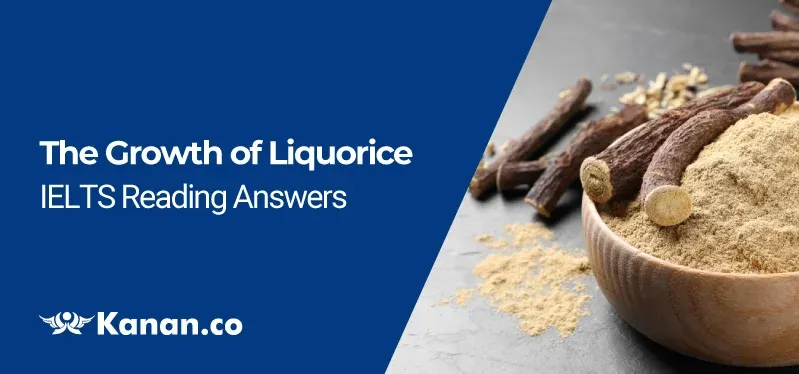
The Growth Of Liquorice Reading Answers practice tests are provided with answers and explanations. This passage comprises 13 questions divided into three question types - multiple choice questions, true/false/not given and matching sentence headings. The Growth Of Liquorice Reading Answers reading answers with explanation.
Table of contents:
- Solution for The Growth Of Liquorice Reading Answers
- The Growth Of Liquorice Reading Answers IELTS Reading Practice Test
- Passage
- Questions
- Answers with Explanations
Solution for The Growth Of Liquorice Reading Answers
The Growth Of Liquorice Reading Answers reading answers are listed in the table below. Verify your answers against our answer table, then correct any inaccuracies.
Answer Table
| 1. B | 5. J | 9. Not given | 13. E |
| 2. D | 6. False | 10. Not given | |
| 3. F | 7. True | 11. C | |
| 4. I | 8. False | 12. A |

The Growth Of Liquorice Reading Answers IELTS Reading Practice Test - Exam Review
Check out our YouTube Channel to Practice Full-Length IELTS Reading Tests Daily

The Growth Of Liquorice Reading Answers reading answers are given here, which will help you excel in the IELTS reading test to challenge your reading skills. Paraphrasing can help you to understand the ideas clearly which makes you able to efficiently answer the questions.
Passage
We’ve provided the reading passage of The Growth Of Liquorice Reading Answers. Read the passage and carefully complete the questions. Check the answers with our The Growth Of Liquorice Reading Answers with locations.
The Growth Of Liquorice Reading Answers
A LIQUORICE has a long, honourable history in the service of mankind. Alexander The Great, the Scythian armies and the Roman Emperor Caesar,are all on record for endorsing the beneficial properties contained in liquorice. Warriors used it as a substitute for water on a march, while others recognized liquorice’s valuable healing properties.
B Native to Asia and the Mediterranean region, liquorice (Glycyrrhiza glabra) in the family Leguminosae is a tall shrub (1.5 m) with blue or violet flowers. The most common variety, Spanish liquorice, is characterized by blue flowers, while Russian liquorice has violet blossoms. The name glycyrrhiza comes from Greek words meaning ‘sweet root’. The roots contain the medicinally active constituents, and the plant requires rich soils and grows in subtropical climates. It is indigenous to Turkey, Iraq, Spain, Greece and northern China.
C The plants are graceful and their leaves have an almost feathery appearance from a distance. The leaves hang down during the night on each side of the stem, though they do not meet beneath it. From the leaves, spring spikes of small pale-blue, violet or purplish flowers, followed by small pods somewhat resembling a partly grown pea pod in form.
D The underground system, as in so many Leguminosae, is double: one part consisting of a vertical or tap root, often with several branches; the other of a horizontal runner, coming off the root below the surface of the ground. These runners have leaf buds and throw up stems in their second year. The perennial downward-running roots, as well as the long horizontal runners, are equally preserved for use.
E English·grown liquorice is dug up in late autumn and sold mostly in its fresh state for making extract, with only a small amount being dried. When washed, fresh English liquorice is a bright yellowish brown. It is very flexible, with a light yellow, juicy internal substance, which consists of a thick bark surrounding a woody column. The root has a peculiar earthy odour and a strong, characteristic, sweet taste. The English extract of liquorice, made from the fresh home-grown root, is said to have a more delicate flavour than that of imported varieties.
F In southern Italy, large quantities of liquorice root are grown, but it is chiefly converted into extract, though some of the root is exported. Spain and the south of France provide quantities of carefully dried liquorice root. Up to the year 1890, the cultivation of Spanish liquorice was small or moderate in comparison with the wild collection. Owing, however, to the depletion of the natural supplies of good quality root, this cultivation has grown rapidly in southern and southern-central Europe, where the climate is favourable.
G Nearly all the Russian liquorice that has been exported has already been peeled. It reaches a much larger size than the Spanish variety, and the taste, although sweet, is accompanied by a subtle bitterness or acridity. It consists chiefly of roots, not runners, in long and often crooked pieces, about 5 cm in thickness. These are pale yellow externally,and are a lighter yellow and softer internally than the Spanish variety.
H Spain was formerly the main supplier, which explains why the extract is still referred to as ‘Spanish Juice’, but the best grade has almost disappeared. The sticks vary in size, but are commonly about 2 cm in diameter and 15 or 18 cm in length. When imported, they are usually wrapped in bay leaves.
I Liquorice grows best on sandy soil near streams and is usually not found in the wild more than 50 metres from water. It will not flourish on clay and prefers the rich, fine soil of lowlands in river valleys, where there is an abundance of moisture during the growing period. Liquorice also flourishes where the ground hardens during the hot, dry summer months.
J The plant grows most successfully in a warm climate. Not only can it not endure severe freezing, but cool weather interferes with the formation of the sweet liquorice juice and makes the plant woody. It appears that climates which are particularly favourable for the production of oranges are also favourable for liquorice.
K Owing to the depth to which the root penetrates and its propagation, the plant is a persistent weed in cultivated grounds, where it is indigenous and exceedingly difficult to remove by its roots. It is very healthy and robust and rarely subject to disease. It can successfully occupy the ground to the exclusion of other planes. For this reason, the continuation of a natural supply may be considered as assured, although it is liable to suffer from severe depletion due to being overpicked.
Questions
Questions 1-5
Choose FIVE letters, A-E
Which FIVE of the following statements about the liquorice plant are true according to the passage?
A The health properties of liquorice are not well known.
B Liquorice used to be valued as a means to quench thirst.
C Liquorice plants only grow in tropical climates.
D Liquorice blossoms are blue or violet.
E Liquorice flowers last for a long time.
F The leaves of the liquorice plant look like feathers.
G Pods develop on the plant after the flowering stage.
H Medicine is derived from the flowers of the liquorice plant.
I The liquorice root system has two roots.
J Horizontal runners develop stems immediately.
1 ……………………….
2 ……………………….
3 ……………………….
4 ……………………….
5 ……………………….
Questions 6-10
Do the following statements agree with the information given in the Reading Passage?
Write
TRUE if the statement agrees with the information
FALSE if the statement contradicts the information
NOT GIVEN if the information is little information on this
6 Only some of the English liquorice is harvested in the autumn.
7 Improved varieties of liquorice have a stronger taste than English liquorice.
8 After 1890, the production of Spanish liquorice declined slowly.
9 Russian liquorice is not popular because it has a bitter taste.
10 Russian and Spanish varieties of liquorice have identical flavours.
Questions 11-13
Complete each sentence with the correct ending, A-B, below.
11 Wild liquorice is usually found near streams because it
12 To guarantee the development of juice, the liquorice plant
13 In some areas, the liquorice plant is a problem because it
A requires a warm climate.
B flourishes on clay.
C needs a lot of water.
D tolerates very low temperatures.
E spreads very easily.
Answers for The Growth Of Liquorice Reading Answers With Explanations
The Growth Of Liquorice Reading Answers reading answers with explanations is given below. Refer to the following answers with an explanation section in order to correct your errors.
(Note: The text in italics mentions the location and referring lines written in the reading passage.)
1. Answer: B
Explanation: Located in last two lines of paragraph A, “Warriors used it as a substitute for water on a march, while others recognized liquorice’s valuable healing properties”.
2. Answer: D
Explanation: Located in the first two lines of paragraph B, “Native to Asia and the Mediterranean region, liquorice (Glycyrrhiza glabra) in the family Leguminosae is a tall shrub (1.5 m) with blue or violet flowers”.
3. Answer: F
Explanation: Located in the first two lines of paragraph C, “ The plants are graceful and their leaves have an almost feathery appearance from a distance”.
4. Answer: I
Explanation: Located in the first three lines of paragraph D, “The underground system, as in so many Leguminosae, is double: one part consisting of a vertical or tap root, often with several branches; the other of a horizontal runner, coming off the root below the surface of the ground”.
5. Answer: J
Explanation: Located in the last three lines of paragraph D, “ These runners have leaf buds and throw up stems in their second year. The perennial downward-running roots, as well as the long horizontal runners, are equally preserved for use”.
6. Answer: False
Explanation: Located in the entire paragraph E, “English·grown liquorice is dug up in late autumn and sold mostly in its fresh state for making extract, with only a small amount being dried. When washed, fresh English liquorice is a bright yellowish brown. It is very flexible, with a light yellow, juicy internal substance, which consists of a thick bark surrounding a woody column. The root has a peculiar earthy odour and a strong, characteristic, sweet taste. The English extract of liquorice, made from the fresh home-grown root, is said to have a more delicate flavour than that of imported varieties”.
7. Answer: True
Explanation: Located in the last two lines of paragraph E, “The English extract of liquorice, made from the fresh home-grown root, is said to have a more delicate flavour than that of imported varieties”.
8. Answer: False
Explanation: Located in the third and fourth lines of paragraph F, “Up to the year 1890, the cultivation of Spanish liquorice was small or moderate in comparison with the wild collection”.
9. Answer: Not given
Explanation: Not Available
10. Answer: Not given
Explanation: Not Available
11. Answer: C
Explanation: Located in the entire paragraph I, “Liquorice grows best on sandy soil near streams and is usually not found in the wild more than 50 metres from water. It will not flourish on clay and prefers the rich, fine soil of lowlands in river valleys, where there is an abundance of moisture during the growing period. Liquorice also flourishes where the ground hardens during the hot, dry summer months”.
12. Answer: A
Explanation: Located in the entire paragraph J, “The plant grows most successfully in a warm climate. Not only can it not endure severe freezing, but cool weather interferes with the formation of the sweet liquorice juice and makes the plant woody. It appears that climates which are particularly favourable for the production of oranges are also favourable for liquorice”.
13. Answer: E
Explanation: Located in the entire paragraph K, “Owing to the depth to which the root penetrates and its propagation, the plant is a persistent weed in cultivated grounds, where it is indigenous and exceedingly difficult to remove by its roots. It is very healthy and robust and rarely subject to disease. It can successfully occupy the ground to the exclusion of other planes. For this reason, the continuation of a natural supply may be considered as assured, although it is liable to suffer from severe depletion due to being overpicked”.
Other Reading Tests

About Author Dinesh Pandiyan
Dinesh is a highly experienced content writer who specializes in language proficiency tests like IELTS, GRE, PTE, TOEFL, and study abroad. He provides valuable insights and tips to students on various modules of these tests, including reading, writing, speaking, and listening. His articles are well-researched, informative, and engaging, offering practical guidance to students looking to succeed in their academic pursuits. Additionally, Dinesh has coordinated with IELTS trainers to prepare test preparation materials, guides, practice tests, and mock tests, and worked closely with counsellors for study abroad consultancy, providing guidance on choosing the right institution, preparing for interviews, and writing effective statements of purpose (SOP) and letters of recommendation (LOR). Students can benefit from Dinesh's comprehensive knowledge and experience by checking out his articles.
Kanan International is a study abroad consultancy that offers reliable services, products, and solutions for students and education institutions. We support students throughout their study abroad journey, ensuring a hassle-free experience. Our expertise and commitment to excellence make us the go-to partner for expanding global horizons. The company provides coaching for IELTS, GRE, TOEFL, and SAT exams and services like visa consultation, accommodation, scholarship assistance, and education loans.
Free Online Mock Test 2026
Practice our mock test worth Rs. 25000 for Free and know your IELTS score!








Global Headquarters
Kanan Int EdTech Inc
320 Bay Street, Suite 321 (Spaces), Toronto ON, Canada M5B 1N9
Indian Headquarters
Kanan International Pvt. Ltd.
D-wing, 2nd Floor, Trident Complex, Ellora Park Vadiwadi Road, Vadodara, Gujarat 390007
IT/ Digital Campus
Kanan International Pvt. Ltd
Old, New No 3, 2nd Floor, 1A, Dr Sadasivam Rd, T. Nagar, Chennai, Tamil Nadu 600017
Our branches
- Bardoli
- Bharuch
- Chennai
- Dehradun
- Gurugram
- Himatnagar
- Karnal
- Nadiad
- Navsari
- Palanpur
- Rajkot
- Vadodara
- Valsad
- Vallabh Vidyanagar
- Vapi
Study Abroad
Test Prep
Top Universities
Consultants
IELTS Centers
GRE Centers
TOEFL Centers
SAT Centers
Language Courses in Vadodara
Study Abroad Calculators
Featured Blogs
Study Abroad Consultants in Chennai
Study Abroad Consultants in Surat
Study Abroad Consultants in Navsari
Study Abroad Consultants in Bardoli
Study Abroad Consultants in Ahmedabad
Study Abroad Consultants in Anand
Study Abroad Consultants in Khanna
Study Abroad Consultants in Nadiad
Study Abroad Consultants in Vadodara
Study abroad consultants in Valsad
Copyright © 2026 KANAN.CO All rights reserved.