- Study Abroad
- / ielts
- / martin luther king reading answers
Martin Luther King Reading Answers


Author
16-09-2025

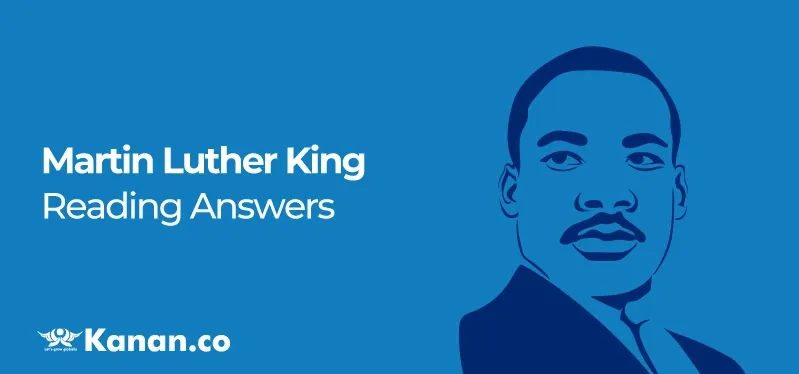
You are provided with Martin Luther King reading answers in a tabular format.
| 1. B | 5. D | 9. V | 13 VI |
| 2. A | 6. TRUE | 10. IV | 14 III |
| 3. D | 7. FALSE | 11. II | |
| 4. A | 8. NOT GIVEN | 12. I |
To get a feel for the format and the kinds of questions you will be asked, view Martin Luther King reading answers with explanation. Your overall band score may increase if you perform better on the IELTS reading portion of the exam.
Three possible IELTS reading question types are presented in this article. They are:
- IELTS Reading Matching Headings
- IELTS Reading Multiple Choice Questions
- IELTS Reading True/False/Not Given
Check out our YouTube Channel to Practice Full-Length IELTS Reading Tests Daily

IELTS Reading Passage - Martin Luther King
Questions 1-14, which are based on the Reading Passage below, should take you about 20 minutes. Review your responses using the given Martin Luther King reading answers with locations after you've answered all of the questions.
Martin Luther King
- In Atlanta, Georgia, on January 15, 1929, Martin Luther King was born. He was the son of Alberta Williams King and the Reverend Martin Luther King, Sr. Alfred Daniel Williams King was his younger brother, while Willie Christine King was his older sister. King studied at Booker T. Washington High School while he was still a child in Atlanta. He attended Morehouse College at the age of fifteen without having officially completed high school after skipping the ninth and twelfth grades. Martin was aware that white people and black people in some regions of America had differing rights from the day he was born.
- A black family had to sit in a different area of the restaurant if they wanted to eat there. They had to use separate restrooms and sit in the back of the theatre. A black guy would have to undergo the humiliation of giving up his personal seat to a white man in several southern states if all the seats on the bus were taken, which is arguably even worse. King was unable to comprehend the heinous injustice of this. He earned a Bachelor of Arts in Sociology in 1948. Afterwards, King started his systematic theology PhD studies at Boston University, where he graduated on June 5, 1955, with a doctorate of Philosophy. On June 18, 1953, King wed Coretta Scott; they had four kids together.
- King initially gained national attention when he assisted in organising the black boycott of Montgomery bus system in 1955. He later moved back to the South and took a position as preacher of a Baptist church in Montgomery, Alabama. In the segregated south, where black people could only sit at the back of the bus, this was organised when Rosa Parks, a black woman, refused to hand over her seat to a white man. The bus company changed its policies as a result of the 382-day boycott, as well as the Supreme Court ruled that such discrimination was unconstitutional.
- King was involved in the Southern Leadership Christian Conference (SCLC), which was established in 1957 to organise rallies against segregation. He promoted nonviolent direct action based on Gandhi's strategies, who organised demonstrations opposing British rule in India that resulted in the country's independence in 1947. At Birmingham, Alabama, in which the white populace was fiercely opposing desegregation, King spearheaded widespread demonstrations against discriminatory practices. When attacks on civil rights protestors mounted, the city came to be known as "Bombingham," and King was detained and imprisoned for his involvement in the demonstrations.
- Upon his release, King took part in the massive civil rights march in Washington in August 1963, when he gave his well-known "I have a dream" speech, which foresaw the day when the American dream of equality and liberty for all people would come true. After receiving the Nobel Peace Prize in 1964, he oversaw a voter registration drive for blacks in 1965. The Voting Rights Act, which outlawed the discriminatory practices that had kept blacks from voting in the south, was passed by the US Congress the same year.
- King discovered that the younger generation did not generally agree with his philosophy of nonviolent protest because as civil rights movement grew more radical. King started to demonstrate it against Vietnam War and the US's high poverty rate. King travelled to Memphis, Tennessee, on March 29, 1968, in support of the black sanitary public works workers who had been on strike since March 12 in demand of better pay and treatment. When black street repairmen were sent home due to inclement weather in one instance, they only received payment for the first two hours, whereas white personnel received payment for the entire day. King could not endure to be silent about such blatant acts of prejudice. He made an effort to bring together his people and all the American people who had experienced discrimination in order to calmly but resolutely demonstrate for their rights.
- King had reserved room 306 at Walter Bailey's Lorraine Motel for his journey to Memphis. King was shot on the second-floor balcony of the motel at 6:01 p.m. on April 4, 1968. King was taken by ambulance to St. Joseph's Hospital, where medical professionals opened his chest and massaged his heart manually. At 7:05 p.m., he was pronounced dead. In spite of being only 39 years old, King's autopsy indicated that he possessed the heart of a 60-year-old man.
Martin Luther King Reading Questions
Questions 1-6
Reading Passage has 6 sections A—F.
Choose the most suitable heading for each section from the list of headings below. Write the appropriate numbers (i-viii) in boxes 1-6 on your answer sheet.
Note: There are more headings than sections so you will not use all of them. You may use any of the headings more than once.
- Paragraph A
- Paragraph B
- Paragraph C
- Paragraph D
- Paragraph E
- Paragraph F
i the memorable speech
ii unhappy about violence
iii A tragic incident
iv Protests and action
v the background of an iconic man
vi Making his mark internationally
vii Difficult childhood
viii Black Street repairmen
Click to know more about IELTS Reading Matching Headings
Questions 7-11
Choose the correct option from A-D
7. What thoughts did Martin Luther King, Jr. have towards the civil rights movement?
- It was beneficial to the Vietnam War.
- The younger generation came together as a result.
- Politicians who sought to win more votes had taken advantage of it.
- Sometimes the protesters' behaviour was too violent.
8. In 1965, what did Martin Luther King struggle for?
- the right for black people to vote
- the activities of the U.S. Congress
- the right of winning the Nobel peace price
- the right of blacks to travel internationally
9. What factors impacted Martin Luther King in his nonviolent activism?
- India's independence in 1947
- Christianity
- Gandhi's techniques
- the Southern Leadership Christian Conference
10. What made Martin Luther King renowned in the beginning?
- the boycott of the Montgomery bus system by blacks
- obtaining a position as a pastor in a Baptist church
- When Rosa Parks refused to give up her seat on a bus
- When he convinced Rosa Parks out of giving up her seat on the bus to a white man
11. Martin Luther King, from a young age
- wanted to show support for black people's rights.
- could not comprehend the unequal treatment with black people.
- was prohibited from visiting restaurants or cinemas.
- was aware that several northern states were subjecting black people to humiliation.
Know more about IELTS Reading Multiple Choice Questions
Questions 12-14
Do the following statements agree with the information given in the reading passage?
In boxes 12-14 on your answer sheet, write
TRUE if the statement is true
FALSE if the statement is false
NOT GIVEN if the information is not given in the passage.
12. The black bus boycott in Montgomery was successful.
13. Alabama's white population demanded desegregation in 1963.
14. In his protest against the Vietnam War, Martin Luther King accomplished a lot.
Click to know more about IELTS Reading True/False/Not Given
Martin Luther King Reading answers with explanation
Martin Luther King reading answers with explanations will help you in correcting your mistakes and provide you with all the relevant information.
(Note: The text in italics is from the reading passage and gives the location from where the answer is taken or inferred. The text in regular font gives an explanation of the answer in brief.)
1. V
Answer Location: Paragraph A
Explanation: The paragraph includes information about King's parents, siblings, and brothers as well as his birthdate, birthplace, and family. It also makes reference to his school and gives us background information about the leader. This indicates that the king's background is given.
2. VII
Answer Location: Paragraph B
Explanation: We can see the challenges a black person faced from paragraph B. All of these injustices affected Martin Luther King, as well. He said it was quite embarrassing. He consequently had a challenging upbringing.
3. IV
Answer Location: Paragraph C
Explanation: The black bus boycott in Montgomery is mentioned by the author in paragraph B. This made it possible for the bus business to alter its rules. They began to raise awareness of the injustice and resist it. The term protests and action is apt because the segment discusses King's protests.
4. II
Answer Location: Paragraph D
Explanation: According to the passage, it is clear that King supported Gandhi's nonviolent philosophy. This demonstrates that he disapproved of the notion of using violence.
5. I
Answer Location: Paragraph E
Explanation: According to the passage, Martin Luther King gave his well-known "I have a dream" speech in August 1963. This demonstrates how memorable the speech was, supporting the accuracy of the header.
6. VI
Answer Location: Paragraph F
Explanation: Martin Luther King, who was originally from the USA, created history while serving in Vietnam. The term is fitting because the fighter is establishing his mark while competing in a foreign nation.
7. D
Answer Location: Paragraph F 1st line
Explanation: According to the paragraph, Martin Luther King believed that the civil rights movement did not adhere to his vision of non-violent protests. Younger generations in particular did not adhere to this. The evidence for this is in paragraph F. As a result, the demonstration was violent.
8. A
Answer Location: Paragraph E 4th line
Explanation: According to paragraph E of the passage, in 1965, King lead an effort to ensure that blacks could register and cast votes.
9. C
Answer Location: Paragraph D 3rd line
Explanation: Gandhi is referenced in the passage as an example of someone who brought nonviolence to India. Martin Luther King was impacted by this.
10. A
Answer Location: Paragraph C 1st line
Explanation: The author began detailing King's rise to fame and recognition in paragraph C by stating that he became famous and known due to his ability to rally people and boycott the Montgomery bus system.
11. B
Answer Location: Paragraph B 5th line
Explanation: According to the author, King witnessed numerous injustices involving Black people. They were instructed to take seats in different parts of the eateries. For the blacks, there were separate theatres and restrooms. If all the seats on a bus were occupied by white individuals, they were also required to surrender their seats. According to the passage, King was unable to comprehend these grave abuses committed on members of their society.
12. TRUE
Answer Location: Paragraph C last line
Explanation: The statement in paragraph C indicates that the bus business was obliged to alter its policies as a result of the boycott because the Supreme Court ruled that such segregation was unconstitutional, demonstrating the boycott's effectiveness.
13. FALSE
Answer Location: Paragraph D 4th line
Explanation: The white population of Alabama was strongly opposed to desegregation, as paragraph D makes very obvious.
14. NOT GIVEN
Answer Location: Not available
Explanation: There is no bonding in the passage which states that ‘In his protest against the Vietnam War, Martin Luther King accomplished a lot’.
Check the other reading passages
Check the other reading passages listed below.
- Alternative transportation reading answers
- Highs and lows reading answers
- The Gulf Stream and Global Warming reading answers
Conclusion
In this blog, we have provided you with “Martin Luther King reading answers”. Also, the keyword locations and explanations of the solutions have been provided. So, this will help you to easily find the answers in the passage. It will also give you a perfect clarification for the selected answer. We hope that this article has provided you help in your IELTS reading test preparation.

About Author Arivarasi
Arivarasi is an experienced author with expertise in the study abroad industry and preparing test materials for exams like IELTS, TOEFL, GRE, SAT, PTE, etc. She stays up-to-date with university and college requirements for international students which allows her to provide guidance on course selection, documents like SOP, LOR, and scholarship opportunities. She has written numerous articles on study abroad exams, destinations, universities & colleges requirements, admission procedures, and the entire process of studying abroad. Collaborating with industry experts and counselors, she crafts informative articles that make students take the right decisions.
Kanan.co is a trusted study abroad consultancy offering comprehensive services, resources, and solutions for students and education institutions. We support students at every stage of their global education journey, ensuring a smooth and guided experience. Along with test preparation for IELTS, GRE, TOEFL, and SAT, we provide expert services such as SOP writing, visa guidance, accommodation support, scholarship assistance, and education loan support. Our expertise and commitment to excellence make us a reliable partner for students pursuing international education.
Free Online Mock Test 2026
Practice our mock test worth Rs. 25000 for Free and know your IELTS score!








Global Headquarters
Kanan Int EdTech Inc
320 Bay Street, Suite 321 (Spaces), Toronto ON, Canada M5B 1N9
Indian Headquarters
Kanan International Pvt. Ltd.
D-wing, 2nd Floor, Trident Complex, Ellora Park Vadiwadi Road, Vadodara, Gujarat 390007
IT/ Digital Campus
Kanan International Pvt. Ltd
Old, New No 3, 2nd Floor, 1A, Dr Sadasivam Rd, T. Nagar, Chennai, Tamil Nadu 600017
Our branches
- Bardoli
- Bharuch
- Chennai
- Dehradun
- Gurugram
- Himatnagar
- Karnal
- Nadiad
- Navsari
- Palanpur
- Rajkot
- Vadodara
- Valsad
- Vallabh Vidyanagar
- Vapi
Study Abroad
Test Prep
Top Universities
Consultants
IELTS Centers
GRE Centers
TOEFL Centers
SAT Centers
Language Courses in Vadodara
Study Abroad Calculators
Featured Blogs
Study Abroad Consultants in Chennai
Study Abroad Consultants in Surat
Study Abroad Consultants in Navsari
Study Abroad Consultants in Bardoli
Study Abroad Consultants in Ahmedabad
Study Abroad Consultants in Anand
Study Abroad Consultants in Khanna
Study Abroad Consultants in Nadiad
Study Abroad Consultants in Vadodara
Study abroad consultants in Valsad
Copyright © 2026 KANAN.CO All rights reserved.