- Study Abroad
- / ielts
- / paul nash reading answers
Paul Nash Reading Answers


Author
16-09-2025

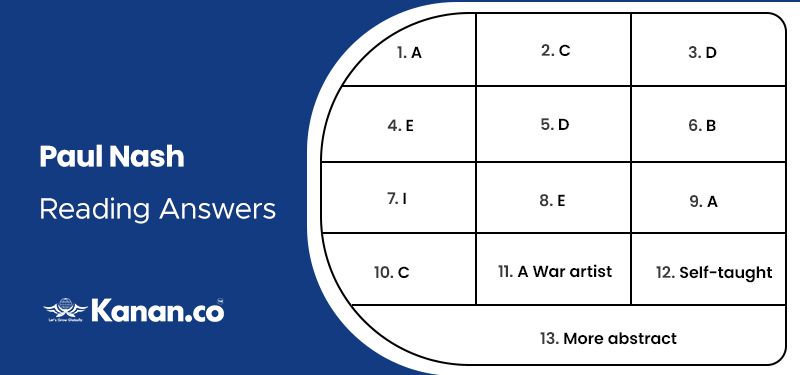
Here we have given “Paul Nash” reading passage along with answers and explanations. It is given as a practice test where 13 questions are asked based on the paragraph. There are 3 different questions types where - 4 questions as multiple choice, 5 questions as locating information, and 3 questions short answer questions. Read the passage carefully and answer the questions.
Check out our YouTube Channel to Practice Full-Length IELTS Reading Tests Daily

Table of contents:
- Solution for Paul Nash
- Paul Nash IELTS reading practice test
- Passage
- Questions
- Answers with explanations
Solution for Paul Nash
We have given Paul Nash reading answers, in the table given below.

Answer Table
| 1. A | 4. E | 7. I | 10. C | 13. More abstract |
| 2. C | 5. D | 8. E | 11. A war artist | |
| 3. D | 6. B | 9. A | 12. Self-taught |
Paul Nash IELTS reading practice test- Exam Review
We have given Paul Nash IELTS reading answers. This article will assist you to be excellent in the IELTS reading practice to challenge your reading skill and read the given passage to answer the questions.
Passage
We have given Paul Nash reading answers with location. Go through the given passage carefully and answer the questions.
Paul Nash Reading Answers
{A} Paul Nash, the elder son of William Nash and his first wife, Caroline Jackson, was born in London on 11th May 1889. His father was a successful lawyer who became the Recorder of Abingdon. According to Ronald Blythe: “In 1901 the family returned to its native Buckinghamshire, where the garden of Wood Lane House at Iver Heath, and the countryside of the Chiltern Hills, with its sculptural beeches and chalky contours, were early influences on the development of the three children. Their lives were overshadowed by their mother’s mental illness and Nash himself was greatly helped by his nurse who, with some elderly neighbors, introduced him to the universe of plants.”
{B} Nash was educated at St. Paul’s School and the Slade School of Art, where he met Dora Carrington. Unlike some of his contemporaries at the Slade School, Nash remained untouched by the two post-impressionist exhibitions organized by Roger Fry in 1910 and 1912. Instead, he was influenced by the work of William Blake. He also became a close friend of Gordon Bottomley, who took a keen interest in his career.
{C} Nash had his first one-man show, of ink and wash drawings, at the Carfax Gallery in 1912. The following year he shared an exhibition at the Dorian Leigh Gallery with his brother, John Nash. Myfanwy Piper has added: “Nash had a noteworthy sense of order and of the niceties of presentation; his pictures were beautifully framed, drawings mounted, his studio precisely and decoratively tidy, and oddments which he collected were worked up into compositions.”
{D} Paul Nash was strongly attracted to Dora Carrington: He later recalled: “Carrington… was the dominating personality, I got an introduction to her and eventually won her regard by lending her my braces for a fancy-dress party. We were on the top of a bus and she wanted them then and there.”
{E} On the outbreak Nash considered the possibility of joining the British Army. He told a friend: “I am not keen to rush off and be a soldier. The whole damnable war is too horrible of course and I am all against killing anybody, speaking off-hand, but besides all that I believe both Jack and I might be more useful as ambulance and red cross men, and to that end we are training. Nash enlisted in the Artists’ Rifles. He told Gordon Bottomley: “I have joined the Artists’ London Regiment of Territorials, the old Corps which started with Rossetti, Leighton, and Millais as members in 1860. Every man must do his bit in this horrible business so I have given up painting. There are many nice creatures in my company and I enjoy the burst of exercise – marching, drilling all day in the open air about the pleasant parts of Regents Park and Hampstead Heath.”
{F} In March 1917 he was sent to the Western Front Nash, who took part in the offensive at Ypres, had reached the rank of lieutenant in the Hampshire Regiment by 1916. Whenever possible, Nash made sketches of life in the trenches. In May 1917 he was invalided home after a non-military accident. While recuperating in London, Nash worked from his sketches to produce a series of war paintings. This work was well-received when exhibited later that year. As a result of this exhibition, Charles Masterman, head of the government’s War Propaganda Bureau (WPB), and the advice of Edward Marsh and William Rothenstein, it was decided to recruit Nash as a war artist. In November 1917 in the immediate aftermath of the battle of Passchendaele Nash returned to France.
{G} Nash was unhappy with his work as a member of the War Propaganda Bureau. He wrote at the time: “I am no longer an artist. I am a messenger who will bring back word from the men who are fighting to those who want the war to go on forever. Feeble, inarticulate will be my message, but it will have a bitter truth and may burn their lousy souls.” However, as Myfanwy Piper has pointed out: “The drawings he made then, of shorn trees in ruined and flooded landscapes, were the works that made Nash’s reputation. They were shown at the Leicester Galleries in 1918 together with his first efforts at oil painting, in which he was self-taught and quickly successful, though his drawings made in the field had a more immediate public impact.
{H} In 1919 Nash moved to Dymchurch in Kent, beginning his well-known series of pictures of the sea, the breakwaters, and the long wall that prevents the sea from flooding Romney Marsh. This included the Winter Sea and Dymchurch Steps. Nash also painted the landscapes of the Chiltern Hills. In 1924 and 1928 he had successful exhibitions at the Leicester Galleries. Despite this popular acclaim in 1929, his work became more abstract. In 1933 Nash founded Unit One, the group of experimental painters, sculptors, and architects.
{I} During the Second World War Nash was employed by the Ministry of Information and the Air Ministry and paintings produced by him during this period include the Battle of Britain and Totes Meer. His biographer, Myfanwy Piper, has argued: “This war disturbed Nash but did not change his art as the last one had. His style and his habits were formed, and in the new war, he treated his new subjects as he had treated those he had been thinking about for so long. His late paintings, both oils, and watercolors are alternately brilliant and somber in color with the light of setting suns and rising moons spreading over wooded and hilly landscapes. “Paul Nash died at 35 Boscombe Spa Road, Bournemouth, on 11th July 1946.
Questions
Questions 1-4
- Choose the correct letter, A-G?
- write your answers in boxes 1-4 on your answer sheet.
What four statements are correct concerning Nash’s story?
A) He did not make an effort after becoming a high-ranking official in the army.
B) He had a dream since his childhood.
C) He once temporarily ceased his painting career for some reason.
D) He was not affected by certain shows attractive to his other peers.
E) He had cooperation in art with his relative.
F) Some of his paintings were presented in a chaotic way.
G) His achievement after being enlisted in the army did not as much attention as his previous works.
Questions 5-10
- The reading Passage has eleven paragraphs A-I.
- Write the correct letter A-I, in boxes 5-10 on your answer sheet.
- Which paragraph contains the following information?
- NB You may use any letter more than once.
5) a charming lady in Nash’s eyes
6) Nash’s passion for following particularly appreciated artists
7) Nash’s works with contrast elements
8) the true cause for Nash to join the military service
9) the noticeable impact on Nash’s growth exerted from the rearing environment
10) high praise for Nash’s unique taste of presenting his works
Questions 11-13
- Answer the questions below.
- Choose NO MORE THAN THREE WORDS AND/OR A NUMBER from the passage for each answer.
11) Because of a popular display of Nash’s works created in the army, what did his leader designate him as?
12) How did Nash learn oil painting?
13) What change took place for Nash’s painting style in the late second decade of the twentieth century?
Answer for Paul Nash with explanation
We have given Paul Nash reading answers with explanations, this article will help you to identify where you went wrong.
1. Answer: A
Explanation: During the Second World War Nash was employed by the Ministry of Information and the Air Ministry and paintings produced by him during this period include the Battle of Britain and Totes Meer. His biographer, Myfanwy Piper, has argued: “This war disturbed Nash but did not change his art as the last one had. His style and his habits were formed, and in the new war, he treated his new subjects as he had treated those he had been thinking about for so long. From this line it is clear that even though the war disturbed, he did not change his art as the last one had. Hence the given answer is located in the first 6 lines of paragraph I.
2. Answer: C
Explanation: “He told Gordon Bottomley: “I have joined the Artists’ London Regiment of Territorials, the old Corps which started with Rossetti, Leighton, and Millais as members+ in 1860. Every man must do his bit in this horrible business so I have given up painting”. From these lines it is clear that he once temporarily ceased his painting career for some reason. Hence the given answer is located in the 5-8 lines of paragraph E.
3. Answer: D
Explanation: They were shown at the Leicester Galleries in 1918 together with his first s at oil painting, in which he was self-taught and quickly successful, though his drawings made in the field had a more immediate public impact. From this line it is clear that he was not affected by certain s attractive to his other peers. Hence the given answer is located in the last 3 lines of paragraph G.
4. Answer: E
Explanation: Nash had his first one-man show, of ink and wash drawings, at the Carfax Gallery in 1912. The following year he shared an exhibition at the Dorian Leigh Gallery with his brother, John Nash. From this line it is clear that Nash had cooperation in art with his relative. hence the given answer is located in the first 3 lines of paragraph C.
5. Answer: D
Explanation: Paul Nash was strongly attracted to Dora Carrington: He later recalled: “Carrington… was the dominating personality, I got an introduction to her and eventually won her regard by lending her my braces for a fancy-dress party. In this line it is clear that Paul Nash was attracted to Dora Carrington. Hence the given answer is located in the first 3 lines of paragraph D.
6. Answer: B
Explanation: He also became a close friend of Gordon Bottomley, who took a keen interest in his career. This line explains that Nash became a close friend to Gordon Bottomely, who is interested in his career. Hence the given answer is located in the last 2 lines of paragraph B.
7. Answer: I
Explanation: His style and his habits were formed, and in the new war, he treated his new subjects as he had treated those he had been thinking about for so long. His late paintings, both oils, and watercolors are alternately brilliant and somber in color with the light of setting suns and rising moons spreading over wooded and hilly landscapes. These lines explain how Nash works with contrast elements. Hence the given answer is located in the 4-8 lines of paragraph I.
8. Answer: E
Explanation: On the outbreak Nash considered the possibility of joining the British Army. He told a friend: “I am not keen to rush off and be a soldier. The whole damnable war is too horrible of course and I am all against killing anybody, speaking off-hand, but besides all that I believe both Jack and I might be more useful as ambulance and red cross men, and to that end we are training. These are the true causes for Nash to join the military service. Hence the given answer is located in the first 5 lines of paragraph E.
9. Answer: A
Explanation: Their lives were overshadowed by their mother’s mental illness and Nash himself was greatly helped by his nurse who, with some elderly neighbors, introduced him to the universe of plants.” From this line it is clear that his lives were overshadowed. Hence the given answer is located in the last 3 lines of paragraph A.
10. Answer: C
Explanation: Nash had his first one-man show, of ink and wash drawings, at the Carfax Gallery in 1912. The following year he shared an exhibition at the Dorian Leigh Gallery with his brother, John Nash. Myfanwy Piper has added: “Nash had a noteworthy sense of order and of the niceties of presentation. From this line it is clear that Nash had a unique taste of presenting his works. Hence the given answer is located in the first 4 lines of paragraph C.
11. Answer: A war artist
Explanation: This work was well-received when exhibited later that year. As a result of this exhibition, Charles Masterman, head of the government’s War Propaganda Bureau (WPB), and the advice of Edward Marsh and William Rothenstein, it was decided to recruit Nash as a war artist. From this line it is clear that his work was well-received and he was recruited as a war artist. Hence the given answer is located in the 5-8 lines of paragraph F.
12. Answer: Self-taught
Explanation: They were shown at the Leicester Galleries in 1918 together with his first s at oil painting, in which he was self-taught and quickly successful, though his drawings made in the field had a more immediate public impact. From this line it is clear that Nash learned oil painting as self. Hence the given answer is located in the last 3 lines of paragraph G.
13. Answer: More abstract
Explanation: During the Second World War Nash was employed by the Ministry of Information and the Air Ministry and paintings produced by him during this period include the Battle of Britain and Totes Meer. His biographer, Myfanwy Piper, has argued: “This war disturbed Nash but did not change his art as the last one had. From these lines it is clear that more abstract took place for Nash’s painting style in the late second decade Hence the given answer is located in the first 4 lines of paragraph I.
Other reading answers

About Author Arivarasi
Arivarasi is an experienced author with expertise in the study abroad industry and preparing test materials for exams like IELTS, TOEFL, GRE, SAT, PTE, etc. She stays up-to-date with university and college requirements for international students which allows her to provide guidance on course selection, documents like SOP, LOR, and scholarship opportunities. She has written numerous articles on study abroad exams, destinations, universities & colleges requirements, admission procedures, and the entire process of studying abroad. Collaborating with industry experts and counselors, she crafts informative articles that make students take the right decisions.
Kanan.co is a trusted study abroad consultancy offering comprehensive services, resources, and solutions for students and education institutions. We support students at every stage of their global education journey, ensuring a smooth and guided experience. Along with test preparation for IELTS, GRE, TOEFL, and SAT, we provide expert services such as SOP writing, visa guidance, accommodation support, scholarship assistance, and education loan support. Our expertise and commitment to excellence make us a reliable partner for students pursuing international education.
Free Online Mock Test 2026
Practice our mock test worth Rs. 25000 for Free and know your IELTS score!








Global Headquarters
Kanan Int EdTech Inc
320 Bay Street, Suite 321 (Spaces), Toronto ON, Canada M5B 1N9
Indian Headquarters
Kanan International Pvt. Ltd.
D-wing, 2nd Floor, Trident Complex, Ellora Park Vadiwadi Road, Vadodara, Gujarat 390007
IT/ Digital Campus
Kanan International Pvt. Ltd
Old, New No 3, 2nd Floor, 1A, Dr Sadasivam Rd, T. Nagar, Chennai, Tamil Nadu 600017
Our branches
- Bardoli
- Bharuch
- Chennai
- Dehradun
- Gurugram
- Himatnagar
- Karnal
- Nadiad
- Navsari
- Palanpur
- Rajkot
- Vadodara
- Valsad
- Vallabh Vidyanagar
- Vapi
Study Abroad
Test Prep
Top Universities
Consultants
IELTS Centers
GRE Centers
TOEFL Centers
SAT Centers
Language Courses in Vadodara
Study Abroad Calculators
Featured Blogs
Study Abroad Consultants in Chennai
Study Abroad Consultants in Surat
Study Abroad Consultants in Navsari
Study Abroad Consultants in Bardoli
Study Abroad Consultants in Ahmedabad
Study Abroad Consultants in Anand
Study Abroad Consultants in Khanna
Study Abroad Consultants in Nadiad
Study Abroad Consultants in Vadodara
Study abroad consultants in Valsad
Copyright © 2026 KANAN.CO All rights reserved.