- Study Abroad
- / ielts
- / reading practice test
IELTS Academic Reading Practice Test


Author
19-09-2025

IELTS academic reading practice test is provided in this blog with different question types and answers. In total, you will have four different IELTS reading question types with 40 questions. Candidates are asked to read the passage thoroughly and questions to identify the keywords. Then aspirants need to answer all the questions within the given time limit. Check out the IELTS reading practice test given here to improve your various skills.

IELTS Academic Reading Passage
You should spend about 20 minutes on Questions 1-14 which are based on Reading Passage 1 below.
Check Out our YouTube Channel to Practice Full-Length IELTS Reading Tests Daily

Unmasking skin
A. If you took off your skin and laid it flat, it would cover an area of about twenty-one square feet, making it by far the body's largest organ. Draped in place over our bodies, skin forms the barrier between what's inside us and what's outside. It protects us from a multitude of external forces. It serves as an avenue to our most intimate physical and psychological selves.
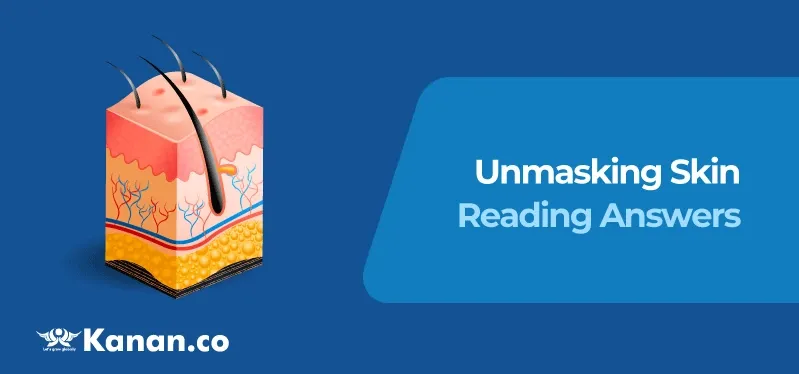
B. This impervious yet permeable barrier, less than a millimeter thick in places, is composed of three layers. The outermost layer is the bloodless epidermis. The dermis includes collagen, elastin, and nerve endings. The innermost layer, subcutaneous fat, contains tissue that acts as an energy source, cushion and insulator for the body.
C. From these familiar characteristics of skin emerge the profound mysteries of touch, arguably our most essential source of sensory stimulation. We can live without seeing or hearing – in fact, without any of our other senses. But babies born without effective nerve connections between skin and brain can fail to thrive and may even die.
D. Laboratory experiments decades ago, now considered unethical and inhumane, kept baby monkeys from being touched by their mothers. It made no difference that the babies could see, hear and smell their mothers; without touching, the babies became apathetic, and failed to progress.
E. For humans, insufficient touching in early years can have lifelong results. "In touching cultures, adult aggression is low, whereas, in cultures where touch is limited, adult aggression is high," writes Tiffany Field, director of the Touch Research Institutes at the University of Miami School of Medicine. Studies of a variety of cultures show a correspondence between high rates of physical affection in childhood and low rates of adult physical violence.
F. While the effects of touching are easy to understand, the mechanics of it are less so. "Your skin has millions of nerve cells of various shapes at different depths," explains Stanley Bolanowski, a neuroscientist and associate director of the Institute for Sensory Research at Syracuse University. "When the nerve cells are stimulated, physical energy is transformed into energy used by the nervous system and passed from the skin to the spinal cord and brain. It's called transduction, and no one knows exactly how it takes place." Suffice it to say that the process involves the intricate, split-second operation of a complex system of signals between neurons in the skin and brain.
G. This is starting to sound very confusing until Bolanowski says: "In simple terms, people perceive three basic things via skin: pressure, temperature, and pain." And then I'm sure he's wrong. "When I get wet, my skin feels wet," I protest. "Close your eyes and lean back," says Bolanowski.
H. Something cold and wet is on my forehead – so wet, in fact, that I wait for water to start dripping down my cheeks. "Open your eyes." Bolanowski says, showing me that the sensation comes from a chilled, but dry, metal cylinder. The combination of pressure and cold, he explains, is what makes my skin perceive wetness. He gives me a surgical glove to put on and has me put a finger in a glass of cold water. My finger feels wet, even though I have visual proof that it's not touching water. My skin, which seemed so reliable, has been deceiving me my entire life. When I shower or wash my hands, I now realize, my skin feels pressure and temperature. It's my brain that says I feel wet.
I. Perceptions of pressure, temperature and pain manifest themselves in many different ways. Gentle stimulation of pressure receptors can result in ticklishness; gentle stimulation of pain receptors, in itching. Both sensations arise from a neurological transmission, not from something that physically exists. Skin, I'm realizing, is under constant assault, both from within the body and from forces outside. Repairs occur with varying success.
J. Take the spot where I nicked myself with a knife while slicing fruit. I have a crusty scab surrounded by pink tissue about a quarter inch long on my right palm. Under the scab, epidermal cells are migrating into the wound to close it up. When the process is complete, the scab will fall off to reveal new epidermis. It's only been a few days, but my little self-repair is almost complete. Likewise, we recover quickly from slight burns. If you ever happen to touch a hot burner, just put your finger in cold water. The chances are you will have no blisters, little pain and no scar. Severe burns, though, are a different matter.
IELTS Academic Reading Questions
Questions 1-4
The passage has 10 paragraphs A-J. Which paragraph contains the following information?
1. the features of human skin, on and below the surface
2. an experiment in which the writer can see what is happening
3. advice on how you can avoid damage to the skin
4. cruel research methods used in the past
Read the IELTS reading locating information
Questions 5 and 6
Choose the correct letter A, B, C or D.
5. How does a lack of affectionate touching affect children?
A. It makes them apathetic.
B. They are more likely to become violent adults.
C. They will be less aggressive when they grow up.
D. We do not really know.
6. After the ‘wetness’ experiments, the writer says that
A. His skin is not normal.
B. His skin was wet when it felt wet.
C. he knew why it felt wet when it was dry
D. the experiments taught him nothing new.
Check out the IELTS reading multiple choice question
Questions 7-11
Complete each sentence with the correct ending A-J from the box below.
7. Touch is unique among the five senses
8. A substance may feel wet
9. Something may tickle
10. The skin may itch
11. A small cut heals up quickly
| A.Because it is both cold and painful |
| B. because the outer layer of the skin can mend itself. |
| C. because it can be extremely thin |
| D. because there is light pressure on the skin. |
| E. because we do not need others to survive. |
| F. because there is a good blood supply to the skin. ` |
| G. because of a small amount of pain. |
| H. because there is a low temperature and pressure |
| I. because it is hurting a lot. |
| J. because all humans are capable of experiencing it. |
Read the IELTS reading sentence completion
Questions 12-14
Do the following statements agree with the information given in Reading Passage 1? Write
- TRUE if the statement agrees with the information
- FALSE if the statement contradicts the information
- NOT GIVEN if there is no information on this
12. Even scientists have difficulty understanding how our sense of touch works.
13. The skin is more sensitive to pressure than to temperature or pain.
14. Human skin is always good at repairing itself.
Also, check out the IELTS reading true false not given
Answers with Explanations for IELTS Academic Practice Test
Below we have given the accurate solutions to evaluate your answers with explanations
Question 1: the features of human skin, on and below the surface
Answer: Paragraph B
Keywords: Skin, Epidermis, Collagen, Nerves, Outermost, Innermost, Tissues, elastin
Keyword location: Paragraph B, line 2 - 4
Explanation: The given information is located in paragraph B in 2-4 lines, as “The outermost layer is the bloodless epidermis. The dermis includes collagen, elastin, and nerve endings. The innermost layer, subcutaneous fat, contains tissue that acts as an energy source, cushion and insulator for the body.”
Question 2: An experiment in which the writer can see what is happening
Answer: Paragraph H
Keywords: Cold, Wet, Cylinder, Surgical Gloves, Water, feels, dry
Keyword location: Paragraph h, line 3 - 4
Explanation: The given answer is located in paragraph H in 1- 6 lines. “Something cold and wet is on my forehead – so wet, in fact, that I wait for water to start dripping down my cheeks. "Open your eyes." Bolanowski says, showing me that the sensation comes from a chilled, but dry, metal cylinder. The combination of pressure and cold, he explains, is what makes my skin perceive wetness. He gives me a surgical glove to put on and has me put a finger in a glass of cold water.”
Question 3: Advice on how you can avoid damage to the skin
Answer: Paragraph J
Keywords: Burn, Cold Water, Repair, Pain, Scar, hot burner
Keyword location: Paragraph J, line 5 - 6
Explanation: In paragraph J, instructions for handling minor skin burns are detailed. It advises promptly cooling the burnt area with cold water to mitigate blistering, scarring, and pain. “If you ever happen to touch a hot burner, just put your finger in cold water. The chances are you will have no blisters, little pain and no scar”. The given answer is located in paragraph J in the last 3 lines.
Question 4: Cruel research methods used in the past
Answer: Paragraph J
Keywords: Laboratory, Experiments, Inhumane, baby monkeys, unethical, touched, mothers
Keyword location: Paragraph D, line 1
Explanation: “Laboratory experiments decades ago, now considered unethical and inhumane, kept baby monkeys from being touched by their mothers”. The given answer is located in paragraph D in 1-2 lines.
Question 5: How does a lack of affectionate touching affect children?
Answer: B - They are more likely to become violent adults
Keywords: Touching, Cultures, Adult, Aggression, High
Keyword location: Paragraph E, line 2, 3
Explanation: The given answer is located in paragraph E in 1-3 lines as "In touching cultures, adult aggression is low, whereas, in cultures where touch is limited, adult aggression is high, writes Tiffany Field”
Question 6: After the ‘wetness’ experiments, the writer says that,
Answer: C – he knew why it felt wet when it was dry
Keywords: Fingers, Proof, Touching, Skin, deceiving, deceiving
Keyword location: Paragraph H, line 5 - 6
Explanation: The given answer is located in paragraph H in 6-7 lines as, “My finger feels wet, even though I have visual proof that it's not touching water. My skin, which seemed so reliable, has been deceiving me my entire life”.
Question 7: Touch is unique among the five senses
Answer: E- because we do not need the others to survive
Keywords: Seeing, hearing, senses, babies, nerve, brain, skin, die, connections
Keyword location: Paragraph C, line 2 - 4
Explanation: “We can live without seeing or hearing – in fact, without any of our other senses. But babies born without effective nerve connections between skin and brain can fail to thrive and may even die.” The given answer is located in paragraph C in the 2-5 line.
Question 8: A substance may feel wet
Answer: H- because there is a low temperature and pressure
Keywords: Pressure, Cold, Water, Skin, wetness
Keyword location: Paragraph H, line 3
Explanation: “The combination of pressure and cold, he explains, is what makes my skin perceive wetness”, the given answer is located in paragraph H in 4th line.
Question 9: Something may tickle
Answer: D - because there is light pressure on the skin
Keywords: Gentle, Stimulation, Pressure, Ticklishness, receptors
Keyword location: Paragraph I, line 2
Explanation: The given answer is located in paragraph I in 2nd line as, “Gentle stimulation of pressure receptors can result in ticklishness,”
Question 10: The skin may itch
Answer: G - because of a small amount of pain
Keywords: Itching, pain, receptors, ticklishness
Keyword location: Paragraph I, line 2, 3
Explanation: “Gentle stimulation of pressure receptors can result in ticklishness;” the given answer is located in paragraph I in 2rd line.
Question 11: A small cut heals up quickly
Answer: B - because the outer layer of the skin can mend itself
Keywords: Epidermal, cells, Wound, new, self- repair, migrating
Keyword location: Paragraph J, line 2 - 4
Explanation: The given answer is located in paragraph J in 3-5 lines as “Under the scab, epidermal cells are migrating into the wound to close it up. When the process is complete, the scab will fall off to reveal new epidermis. It's only been a few days, but my little self-repair is almost complete”
Question 12: Even scientists have difficulty understanding how our sense of touch works.
Answer: True
Keywords: No, physical energy, senses, brain, spinal cords, transduction etc.
Keyword location: Paragraph F, line 4 - 5
Explanation: "When the nerve cells are stimulated, physical energy is transformed into energy used by the nervous system and passed from the skin to the spinal cord and brain. It's called transduction, and no one knows exactly how it takes place." The given answer is located in paragraph F in the 4-7 lines.
Question 13: The skin is more sensitive to pressure than to temperature or pain
Answer: Not Given
Explanation: There is no relevant information in the given reading passage.
Question 14: The human skin is always good at repairing itself
Answer: False
Keywords: Severe, Different, burns
Keyword location: Paragraph J, line 7
Explanation: The given answer is located in paragraph I in the last line, Severe burns though, are a different matter.
Other Reading Answers

About Author Dinesh Pandiyan
Dinesh is a highly experienced content writer who specializes in language proficiency tests like IELTS, GRE, PTE, TOEFL, and study abroad. He provides valuable insights and tips to students on various modules of these tests, including reading, writing, speaking, and listening. His articles are well-researched, informative, and engaging, offering practical guidance to students looking to succeed in their academic pursuits. Additionally, Dinesh has coordinated with IELTS trainers to prepare test preparation materials, guides, practice tests, and mock tests, and worked closely with counsellors for study abroad consultancy, providing guidance on choosing the right institution, preparing for interviews, and writing effective statements of purpose (SOP) and letters of recommendation (LOR). Students can benefit from Dinesh's comprehensive knowledge and experience by checking out his articles.
Kanan International is a study abroad consultancy that offers reliable services, products, and solutions for students and education institutions. We support students throughout their study abroad journey, ensuring a hassle-free experience. Our expertise and commitment to excellence make us the go-to partner for expanding global horizons. The company provides coaching for IELTS, GRE, TOEFL, and SAT exams and services like visa consultation, accommodation, scholarship assistance, and education loans.
Free Online Mock Test 2026
Practice our mock test worth Rs. 25000 for Free and know your IELTS score!








Global Headquarters
Kanan Int EdTech Inc
320 Bay Street, Suite 321 (Spaces), Toronto ON, Canada M5B 1N9
Indian Headquarters
Kanan International Pvt. Ltd.
D-wing, 2nd Floor, Trident Complex, Ellora Park Vadiwadi Road, Vadodara, Gujarat 390007
IT/ Digital Campus
Kanan International Pvt. Ltd
Old, New No 3, 2nd Floor, 1A, Dr Sadasivam Rd, T. Nagar, Chennai, Tamil Nadu 600017
Our branches
- Bardoli
- Bharuch
- Chennai
- Dehradun
- Gurugram
- Himatnagar
- Karnal
- Nadiad
- Navsari
- Palanpur
- Rajkot
- Vadodara
- Valsad
- Vallabh Vidyanagar
- Vapi
Study Abroad
Test Prep
Top Universities
Consultants
IELTS Centers
GRE Centers
TOEFL Centers
SAT Centers
Language Courses in Vadodara
Study Abroad Calculators
Featured Blogs
Study Abroad Consultants in Chennai
Study Abroad Consultants in Surat
Study Abroad Consultants in Navsari
Study Abroad Consultants in Bardoli
Study Abroad Consultants in Ahmedabad
Study Abroad Consultants in Anand
Study Abroad Consultants in Khanna
Study Abroad Consultants in Nadiad
Study Abroad Consultants in Vadodara
Study abroad consultants in Valsad
Copyright © 2026 KANAN.CO All rights reserved.