Solutions for English Heritage Blue Plaques


Author
16-09-2025


Check out the English Heritage blue plaques reading answers given in the answer table.
Check out our YouTube Channel to Practice Full-Length IELTS Reading Tests Daily

Answer Table
| 1. H | 8. Characters |
| 2. E | 9. Border |
| 3. C | 10. 5 inches/495 mm |
| 4. B | 11. True |
| 5. D | 12. Not Given |
| 6. A | 13. False |
| 7. Blue Glaze |

Exam Review
Find the English Heritage Blue Plaques Reading Answers with location, in the section below.
English Heritage Blue Plaques
- The blue plaques scheme has been running for over 140 years and is one of the oldest of its kind in the world. Q 6 The idea of erecting ‘memorial tablets’ was first proposed by William Ewart MP in the House of Commons in 1863. It had an immediate impact on the public imagination, and in1866 the Society of Arts (later Royal Society of Arts) founded an official plaques scheme. The Society erected its first plaque–to the poet Lord Byron–in 1867. In all, the Society of Arts erected 35 plaques; today, less than half of them survive, the earliest of which commemorates Napoleon III (1867). In 1901, the plaques scheme was taken over by London Country Council (LCC), which erected nearly 250 plaques over the next 64 years and gave the scheme its popular appeal. Q 13 It was under the LCC that the blue plaque design as we know it today was adopted, and the selection criteria were formalized. On the abolition of the LCC in 1965, the plaques scheme passed to the Greater London Council (GLC). The scheme changed little, but the GLC was keen to broaden the range of people commemorated. Q 11 The 262 plaques erected by the GLC include those to figures such as Sylvia Pankhurst, campaigner for women’s rights; Samuel Coleridge–Taylor, composer of the Song of Hiawatha; and Mary Seacole, the Jamaican nurse, and heroine of the Crimean War. Since 1986, English Heritage has managed the blue plaques scheme. So far, English Heritage has erected nearly 300 plaques, bringing the total number to over 800.
- English Heritage receives about 100 suggestions for blue plaques each year, almost all of which come from members of the public. The background of each case is very different. Q 4 Each nominated person has to meet basic selection criteria before they can be considered. Most importantly, they must have been dead for 20 years or have passed the centenary of their birth, whichever is earlier. This delay allows a person’s reputation to mature and ensures that their fame is long-lasting.
- Q 3 English Heritage’s Blue Plaques Panel–representatives of various disciplines from across the country –considers all the suggestions which meet the basic criteria; on average, around 1 in 3 proposals are accepted. If a figure is rejected, proposers must wait a further 10 years before their suggestion can be considered again. Detailed research is carried out into the surviving addresses of shortlisted candidates, using sources such as autobiographies, electoral registers, and post office directories.
- Q 5 As only one plaque is allowed per person, the house to be commemorated has to be chosen very carefully. Factors that are considered include the length of residence and the accomplishments of a candidate during the relevant years. A significant place of work can also be considered.
- Before a plaque can be erected, the owners and tenants of the building in question have to give their consent. Where listed buildings are involved, Listed Building Consent is sought from the relevant local authority. If such consent is granted, the plaque is designed and then produced by a specialist manufacturer. It is normally ready within about two months. Plaques are set into the fabric of the building, flush with the wall face. The cost of plaque manufacture and installation is borne entirely by English Heritage. Q 2 In all, it can take between 2 and 5 years from the initial suggestion to the erection of a plaque.
- The exact form of the blue plaque, as we see it now, was a relatively late development, though certain guiding principles had been in place from the outset. The earliest plaques, erected in 1867, were blue. Their format, a circle with the name of the Society of Arts worked into a pattern around the edge, was used consistently by the Society over its 35 years of management.
- Manufacture of each plaque is undertaken by mixing and pouring a thick clay slip into a casting mould. When sufficiently dry, the cast is removed and the outline of the inscription and border is piped onto the face of the plaque and filled with white glaze. Q 7 The blue glaze is then applied to the background before firing. Q 8 This process produces gently raised characters and Q 9 borders, a unique feature of English Heritage plaques. After firing, plaques usually have a thickness of 2 inches (50mm) and Q 10 a final diameter of 19.5 inches (495mm), although smaller diameter plaques are sometimes used to meet special circumstances.
- Q 1 Plaques have been found to be extremely durable and have an almost indefinite life expectancy. Similar plaques erected by the Society of Arts have lasted, perfectly legible, for over one hundred years. Due to the slightly domed design, they are self-cleansing and require virtually no maintenance.
Questions 1 - 6
Reading Passage has eight paragraphs A - H. Which paragraph contains the following information?
Write the correct letter, A - H, in boxes 1 - 6 on your answer sheet.
- The plaque’s toughness
Answer: H (Locate) - The amount of time spent producing a plaque
Answer: E (Locate) - The functioning of the Blue Plaques Panel
Answer: C (Locate) - The conditions that must be fulfilled in every case
Answer: B (Locate) - The criteria for choosing a house that has to be honored
Answer: D (Locate) - How the Blue Plaques program began initially
Answer: A (Locate)
Questions 7 - 10
Complete the diagram below.
Choose NO MORE THAN TWO WORDS AND/OR A NUMBER from the passage for each answer.
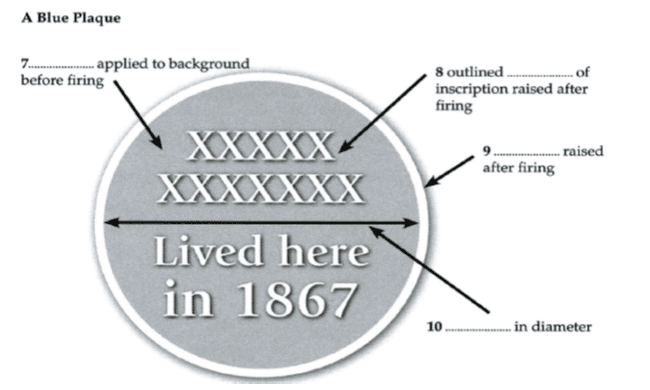
7. Answer: Blue glaze (Locate)
8. Answer: Characters (Locate)
9. Answer: Border (Locate)
10. Answer: 19.5 inches/495 mm (Locate)
Questions 11 - 13
Do the following statements agree with the information in Reading Passage? Write
TRUE: if the statement agrees with the information
FALSE: if the statement contradicts the information
NOT GIVEN: if there is no information about the statement
11. Compared to English Heritage, the GLC did not put up as many plaques.
Answer: True (Locate)
12. Rejected proposals are provided with a detailed explanation for their rejection.
Answer: Not Given
13. The blue plaque's shape is unchanged ever since it was first created.
Answer: False (Locate)

About Author Roshan Sunthar
Roshan Sunthar is a study abroad expert as well as a renowned writer and author in international education. His academic excellence and 5+ years of work experience give him in-depth knowledge of international standardised exams and test preparation in IELTS, TOEFL, GRE, PTE, SAT, etc. The study materials he prepares incorporate exam-like questions. He’s also an expert in writing Statement of Purposes (SOPs) and Letter of Recommendations (LORs) for college admissions. He usually spends his leisure time watching English classics and documentaries, travelling, etc.
Kanan.co is a trusted study abroad consultancy offering comprehensive services, resources, and solutions for students and education institutions. We support students at every stage of their global education journey, ensuring a smooth and guided experience. Along with test preparation for IELTS, GRE, TOEFL, and SAT, we provide expert services such as SOP writing, visa guidance, accommodation support, scholarship assistance, and education loan support. Our expertise and commitment to excellence make us a reliable partner for students pursuing international education.
Free Online Mock Test 2026
Practice our mock test worth Rs. 25000 for Free and know your IELTS score!








Global Headquarters
Kanan Int EdTech Inc
320 Bay Street, Suite 321 (Spaces), Toronto ON, Canada M5B 1N9
Indian Headquarters
Kanan International Pvt. Ltd.
D-wing, 2nd Floor, Trident Complex, Ellora Park Vadiwadi Road, Vadodara, Gujarat 390007
IT/ Digital Campus
Kanan International Pvt. Ltd
Old, New No 3, 2nd Floor, 1A, Dr Sadasivam Rd, T. Nagar, Chennai, Tamil Nadu 600017
Our branches
- Bardoli
- Bharuch
- Chennai
- Dehradun
- Gurugram
- Himatnagar
- Karnal
- Nadiad
- Navsari
- Palanpur
- Rajkot
- Vadodara
- Valsad
- Vallabh Vidyanagar
- Vapi
Study Abroad
Test Prep
Top Universities
Consultants
IELTS Centers
GRE Centers
TOEFL Centers
SAT Centers
Language Courses in Vadodara
Study Abroad Calculators
Featured Blogs
Study Abroad Consultants in Chennai
Study Abroad Consultants in Surat
Study Abroad Consultants in Navsari
Study Abroad Consultants in Bardoli
Study Abroad Consultants in Ahmedabad
Study Abroad Consultants in Anand
Study Abroad Consultants in Khanna
Study Abroad Consultants in Nadiad
Study Abroad Consultants in Vadodara
Study abroad consultants in Valsad
Copyright © 2026 KANAN.CO All rights reserved.