- Study Abroad
- / ielts
- / silbo gomero the whistle language of the canary islands reading answers
Silbo Gomero the Whistle Language of the Canary Islands Reading Answers


Author
19-09-2025

In this article, we have provided Silbo Gomero the Whistle Language of the Canary Islands reading answers below. It contains 13 questions. This article will assist you in locating the answers so that you will know the difficulty level of the passages in the reading exam.
Table of contents:
- Solution for Silbo Gomero the Whistle Language of the Canary Islands
- Silbo Gomero the Whistle Language of the Canary Islands IELTS Reading Practice Test
- Passage
- Questions
- Answers with Explanations
Solution for Silbo Gomero the Whistle Language of the Canary Islands
The following table contains Silbo Gomero the Whistle Language of the Canary Islands reading answers. You may cross-check your answers.
Answer Table
| 14. NOT GIVEN | 18. FALSE | 22. DIRECTION | 26. AWARD |
| 15. FALSE | 19. TRUE | 23. COMMANDS | |
| 16. TRUE | 20. WORDS | 24. FIRES | |
| 17. FALSE | 21. FINGER | 25. TECHNOLOGY |

Silbo Gomero the Whistle Language of the Canary Islands IELTS Reading Practice Test - Exam Review
Check out our YouTube Channel to Practice Full-Length IELTS Reading Tests Daily

The applicants must attempt all the questions to complete the Silbo Gomero the Whistle Language of the Canary Islands Reading Answers. This article will help the candidates to build time management skills which is an important element of the IELTS Reading test.
Passage
We have provided a Implementing The Cycle Of Success: A Case Study reading passage below, read it carefully and answer the questions 14-26. Make sure to check the Silbo Gomero the Whistle Language of the Canary Islands reading answers with location.
Silbo Gomero the Whistle Language of the Canary Islands
- La Gomera is one of the Canary Islands situated in the Atlantic Ocean off the northwest coast of Africa. This small volcanic island is mountainous, with steep rocky slopes and deep, wooded ravines, rising to 1,487 metres at its highest peak. It is also home to the best known of the world's whistle languages', a means of transmitting information over long distances which is perfectly adapted to the extreme terrain of the island.
- This 'language, known as 'Silbo' or 'Silbo Gomero - from the Spanish word for 'whistle' - is now shedding light on the language-processing abilities of the human brain, according to scientists. Researchers say that silbo activates parts of the brain normally associated with spoken language, suggesting that the brain is remarkably flexible in its ability to interpret sounds as language.
- 'Science has developed the idea of brain areas that are dedicated to language, and we are starting to understand the scope of signals that can be recognised as language, says David Corina, co-author of a recent study and associate professor of psychology at the University of Washington in Seattle.
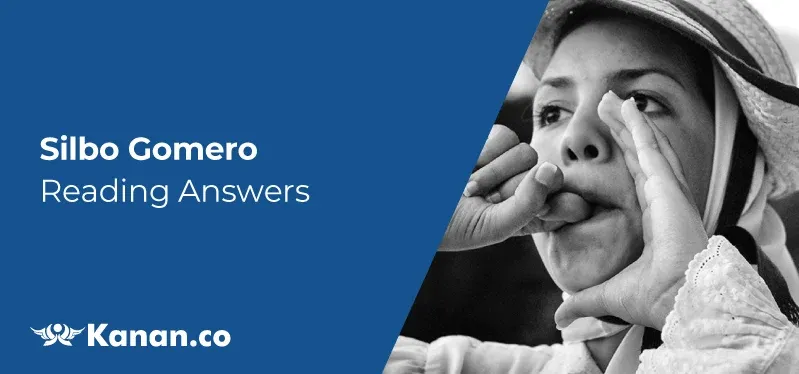
- Silbo is a substitute for Spanish, with individual words recorded into whistles which have high- and low-frequency tones. A whistler or silbador puts a finger in his or her mouth to increase the whistle's pitch, while the other hand can be cupped to adjust the direction of the sound."
- There is much more ambiguity in the histled signal than in the spoken signal, explains lead researcher Manuel Carreiras, psychology professor at the University of La Laguna on the Canary island of Tenerife. Because whistled 'words' can be hard to distinguish, silbadores rely on repetition, as well as awareness of context, to make themselves understood.
- The silbadores of Gomera are traditionally shepherds and other isolated mountain folk, and their novel means of staying in touch allows them to communicate over distances of up to 10 kilometers. Carreiras explains that silbadores are able to pass a surprising amount of information via their whistles. 'In daily life they use whistles to communicate short commands, but any Spanish sentence could be whistled' Silbo has proved particularly useful when fires have occurred on the island and rapid communication across large areas has been vital.
- The study team used neuroimaging equipment to contrast the brain activity of silbadores while listening to whistled and spoken Spanish. Results showed the left temporal lobe of the brain, which is usually associated with spoken language, was engaged during the processing of Silbo. The researchers found that other key regions in the brain's frontal lobe also responded to the whistles, including those activated in response to sign language among deaf people. When the experiments were repeated with non-whistlers, however, activation was observed in all areas of the brain.
- Our results provide more evidence about the flexibility of human capacity for language in a variety of forms, Gorina says. "These data suggest that left-hemisphere language regions are uniquely adapted for communicative purposes, independent of the modality of signal. The non- Silbo speakers were not recognising Silbo as a language. They had nothing to grab onto, so multiple areas of their brains were activated'
- Carreiras says the origins of Silbo Gomero remain obscure, but that indigenous Canary Islanders, who were of North African origin, already had a whistled language when Spain conquered the volcanic islands in the 15th century Whistled languages survive-today in Papua New Guinea, Mexico, Vietnam, Guyana, China, Nepal, Senegal, and a few mountainous pockets in southern Europe. There are thought to be as many as 70 whistled languages still in use, though only 12 have been described and studied scientifically.
- This form of communication is an adaptation found among cultures where people are often isolated from each other, according to Julien Meyer, a researcher at the Institute of Human Sciences in Lyon, France. They are mostly used in mountains or dense forests, he says. 'Whistled languages are quite clearly defined and represent an original adaptation of the spoken language for the needs of isolated human groups.’
- But with modern communication technology now widely available, researchers say whistled languages like Silbo are threatened with extinction. With dwindling numbers of Gomera islanders still fluent in the language, Canaries' authorities are taking steps to try to ensure its survival. Since 1999, Silbo Gomero has been taught in all of the island's elementary schools. In addition, locals are seeking assistance from the United Nations Educational, Scientific and Cultural Organization (UNESCO). The local authorities are trying to get an award from the organization to declare (Silbo Gomero) as something that should be preserved for humanity, Carreiras adds.
Questions
Questions 14-19
Do the following statements agree with the information given in the Reading Passage?
TRUE if the statement is true
FALSE if the statement is false
NOT GIVEN if the information is not given in the passage
14. La Gomera is the most mountainous of all the Canary Islands.
15. Silbo is only appropriate for short and simple messages.
16. In the brain-activity study, silbadores and non-whistlers produced different results.
17. The Spanish introduced Silbo to the islands in the 15th century.
18. There is precise data available regarding all of the whistle languages in existence today.
19. The children of Gomera now learn Silbo.
Questions 20-26
Complete the notes below. Choose ONE WORD ONLY from the passage for each answer.
Silbo Gomero
How Silbo is produced
high-and low-frequency tones represent different sounds in Spanish (20)...........
The pitch of the whistle is controlled using silbador (21)........
(22).......... is changed with a cupped hand
How Silbo is used
has long been used by shepherds and people living in secluded locations
in everyday use for the transmission of brief (23)........
can relay essential information quickly, e.g. to inform people about (24)........
The future of Silbo
future under threat because of new (25).........
Canaries' authorities hoping to receive a UNESCO (26)........to help preserve it
Answers for Silbo Gomero the Whistle Language of the Canary Islands with Explanations
Silbo Gomero the Whistle Language of the Canary Islands reading answers with Explanations are given below. It will assist you in understanding how reading answers works and will allow you to correct your errors.
14. Answer: NOT GIVEN
Explanation: N/A
15. Answer: FALSE
Explanation: In paragraph F, Carreiras asserts that they use whistles to communicate brief instructions in daily life, yet any Spanish sentence might be whistled. The author claims that silbadores' whistles may convey a very large amount of information. Whistles, also known as silbo, can therefore be used to send any message, not only quick ones. Simply said, daily communication is more frequently short and to the point. As a result, the given assertion is untrue.
16. Answer: TRUE
Explanation: The results of the investigation on brain activity are described in lines 2-3 of paragraph G. Silbadores caused a response in the left temporal lobe and other significant regions of the frontal lobe of the brain. According to these lines, silbadores and non-whistlers create a range of outcomes. As a result, the statement is accurate.
17. Answer: FALSE
Explanation: The volcanic islands were taken by Spain in the 15th century, according to lines 1 through 3 of paragraph I. The native inhabitants of the Canary Islands at the time already spoke a whistled language. As a result, the claim might be viewed as false.
18. Answer: FALSE
Explanation: Lines 5 and 6 of paragraph 9 state that there are still up to 70 whistled languages in existence. Despite this, just 12 have been found and scientifically studied. Therefore, the aforementioned claim might be regarded as false.
19. Answer: TRUE
Explanation: The last sentence of paragraph 11 highlights the measures made by the Canary Island government to safeguard Silbo's existence. Since 1999, Silbo Gomero has been taught in all of the island's elementary schools. Therefore, it seems sense that children are still being taught Silbo today. Therefore, it may be claimed that the Gomera youngsters have now mastered Silbo. This makes the aforementioned assertion a TRUE one.
20. Answer: WORDS
Explanation: According to paragraph 4, Silbo is a substitute for Spanish that uses whistles in place of specific words. Both of the whistles produce high- and low-frequency tones. Therefore, it may be claimed that high- and low-frequency tones specify various sounds in Spanish words.
21. Answer: FINGER
Explanation: The whistler has the ability to increase the pitch. As indicated in lines 2-3 of paragraph 4, they can do this by putting their finger in their mouth. In other words, you could say that the silbador's finger may be used to increase the whistle's pitch passively. The whistle's pitch may therefore be adjusted using Silbador's finger.
22. Answer: DIRECTION
Explanation: Whistling can be done at a higher pitch, according to the third sentence of paragraph 4. To do this, they can insert a finger inside the victim's mouth. However, the sound may be redirected by cupping the opposite hand. Therefore, it may be said that the cupped hand can shift the sound's direction.
23. Answer: COMMANDS
Explanation: The whistles are frequently employed by the silbadores, as stated in line 4 of paragraph 6. They utilized it to communicate quick instructions in daily life, but it could also be used to whistle any Spanish sentence. Whistles are therefore frequently employed in daily life to provide clear instructions. Therefore, it may be claimed that the Silbo is utilized in daily life to transmit quick orders.
24. Answer: FIRES
Explanation: The sixth paragraph's fifth and sixth sentences imply that Silbo has been particularly successful. It is during times of island-wide fires that prompt communication over large regions has been essential. It means that silbo may be used to alert the public of important events like fires. As a result, silbo can instantly communicate critical information, such as warning others of a fire.
25. Answer: TECHNOLOGY
Explanation: According to the first two paragraphs of paragraph 11, experts think whistled languages like Silbo are in danger of going extinct. This is due to the increased accessibility of modern communication technology. The implication of this remark is that modern, cutting-edge communication technology has put Silbo in peril. As a result, technology poses a threat to silbo's future.
26. Answer: AWARD
Explanation: In line 6-8 of paragraph 11, it is implied that the local government is striving to win the organization's approval. They are attempting to declare Silbo Gomero as a location that requires protection for mankind. UNESCO is referred to as the "organization" in this context. The government of the Canaries is seeking to win a UNESCO prize to support its preservation.
Other Reading Tests

About Author Manimegalai Samidurai
Manimegalai is a multifaceted professional, excelling as an author, writer, and study-abroad expert. Her vast knowledge of English proficiency exams, including IELTS, GRE, SAT, and PTE, and exceptional content writing skills make her a go-to resource for students seeking guidance and support in their foreign education journey. She is a trusted authority in writing content related to these test-prep exams, making her an invaluable resource for those seeking guidance. With her well-researched and informative blogs, articles, and study materials, Manimegalai has helped countless students achieve their desired band scores and get admissions to top-notch colleges & universities in countries like Canada, USA, UK, Australia, Ireland, etc.
Kanan.co is a trusted study abroad consultancy offering comprehensive services, resources, and solutions for students and education institutions. We support students at every stage of their global education journey, ensuring a smooth and guided experience. Along with test preparation for IELTS, GRE, TOEFL, and SAT, we provide expert services such as SOP writing, visa guidance, accommodation support, scholarship assistance, and education loan support. Our expertise and commitment to excellence make us a reliable partner for students pursuing international education.
Free Online Mock Test 2026
Practice our mock test worth Rs. 25000 for Free and know your IELTS score!








Global Headquarters
Kanan Int EdTech Inc
320 Bay Street, Suite 321 (Spaces), Toronto ON, Canada M5B 1N9
Indian Headquarters
Kanan International Pvt. Ltd.
D-wing, 2nd Floor, Trident Complex, Ellora Park Vadiwadi Road, Vadodara, Gujarat 390007
IT/ Digital Campus
Kanan International Pvt. Ltd
Old, New No 3, 2nd Floor, 1A, Dr Sadasivam Rd, T. Nagar, Chennai, Tamil Nadu 600017
Our branches
- Bardoli
- Bharuch
- Chennai
- Dehradun
- Gurugram
- Himatnagar
- Karnal
- Nadiad
- Navsari
- Palanpur
- Rajkot
- Vadodara
- Valsad
- Vallabh Vidyanagar
- Vapi
Study Abroad
Test Prep
Top Universities
Consultants
IELTS Centers
GRE Centers
TOEFL Centers
SAT Centers
Language Courses in Vadodara
Study Abroad Calculators
Featured Blogs
Study Abroad Consultants in Chennai
Study Abroad Consultants in Surat
Study Abroad Consultants in Navsari
Study Abroad Consultants in Bardoli
Study Abroad Consultants in Ahmedabad
Study Abroad Consultants in Anand
Study Abroad Consultants in Khanna
Study Abroad Consultants in Nadiad
Study Abroad Consultants in Vadodara
Study abroad consultants in Valsad
Copyright © 2026 KANAN.CO All rights reserved.