- Study Abroad
- / ielts
- / the kuiper belt reading answers
The Kuiper belt reading answers


Author
19-09-2025

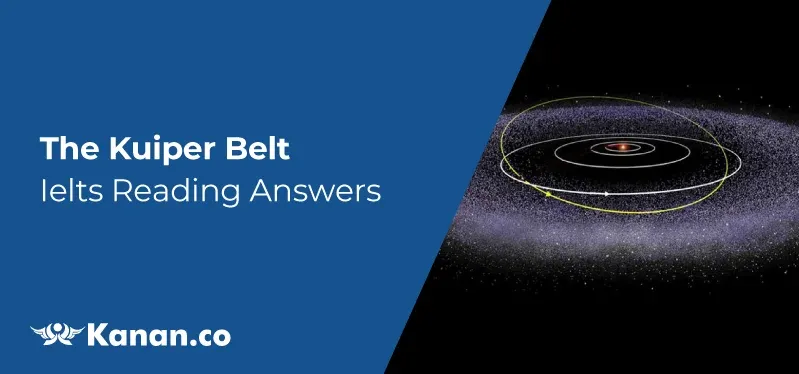
We have given the Kuiper belt reading practice, test questions with key answers and explanations. In the complete set of 9 questions, it has 2 different question types. There are short answer question form and true or false questions form.
Table of contents:
- Solution for the Kuiper belt
- The Kuiper belt IELTS reading practice test.
- Passage.
- Questions
- Answers with explanations.
Solution for the Kuiper belt
Here you can find the answers for the Kuiper belt reading answers, in table format.
Answer Table
| 1. 70,000 | 4. orbital resonance | 7. True |
| 2. 42-48 AU | 5. Pluto | 8. False |
| 3. 100AU | 6. True | 9. True |

The Kuiper belt IELTS reading practice test - Exam Review
Check out our YouTube Channel to Practice Full-Length IELTS Reading Tests Daily

Go through the given passage for the Kuiper belt IELTS reading answers to improve your reading skill. Read the complete passage to find some keywords to answer the question.
Passage
Examine the given, the Kuiper belt reading answers with location, to know your answers.
The Kuiper belt
Part One
Located in the region of the Solar System beyond the planets (from 30 AU At Neptune’s orbit to circa 55 AU from the sun), the Kuiper Belt, or Edgeworth – Kuiper Belt as many scientists prefer to call it, is similar to an asteroid belt though far greater in size, being 20 times as wide and potentially 200 time as massive.
Like asteroid belts, the Kuiper is composed of small celestial bodies, the scattered remnants – the leftover junk if you like – from the formation of the Solar System, but unlike asteroid belts whose objects are largely composed of rock and metal, De Kuiper’s objects consist of what are termed ‘frozen volatiles’: methane, ammonia, and water in ice form, for example. Another significant differentiating factor between the Kuiper and asteroid belts is the presence in the former of at least dwarf planets, the most well-known of which is Pluto, which, until 2006, was actually classed as a planet in its own right.
The belt has also previously been home to other large objects such as Saturn’s moon Phoebe and Neptune’s triton, which originated in the region before coming under the influence of the gravitational force of their respective planets.
Part Two
Though the existence of a phenomenon like a belt had been hypothesized for some time, its existence wasn’t officially confirmed until 1992, since then over a thousand Kuiper Belt objects(KBOs) have been officially observed. On the basis of what we know about the region, it is speculated that the actual number of KBOs measuring over 100km in diameter is far in excess of 70,000.
Initially, it was speculated that the Kuiper region was responsible for the appearance of most periodic comets (comets whose orbit lasts less than 200 years), but studies conducted in the mid-90s appear to contradict this assumption and cast the Kuiper region as one which is dynamically stable and, thus, not the repository of periodic comets on now thought to be in the father regions of the Solar System outside of the Kuiper belt in an area referred to as the scattered disc, thought to have been created by the outward motion of Neptune several billion years ago.
Scattered-disc objects are KBO-like bodies with orbits that take them as far as 100 AU from the sun, far beyond the 50 AU boundary of the Kuiper Belt itself.
Part Three
Pluto is the largest-known
Kuiper Belt orbits and also the tenth most massive body served directly orbiting the sun. It was reclassified as a Dwarf planet after it was discovered to be more similar compositionally to KBOs than the major planets, being composed of rock and ice. Its orbital period is also identical to that of another group of KBOS, referred to as plutinos in its honor. Alongside Pluto, a further three dwarf planets have now been observed within the Kuiper Belt, and these are collectively referred to as plutoids: another patent tribute to the former plane.
The Kuiper’s close proximity to Neptune has a profound effect on its structure due to the consequent orbital resonance gravitation influence) at work on it. Neptune’s gravity destabilized the orbits of objects lying within certain regions of the Kuiper, doing one of two things: either sending them farther out into the scattered disc region of interstellar space or into the linear Solar System.
For this reason, the Kuiper is characterized by a series of pronounced gaps in the current layout, similar to the gaps present in the asteroid belt on which gravitational forces are also constantly at work.
Part Four
The classical belt is the region of the Kuiper between 42-48 AU. Here the gravitational influence of Neptune is negligible, so KBOs are largely unmolested. This region accounts for about two-thirds of all KBOS observed to date. Within the classical belt are two distinct populations of KBO defined by their differing orbits. The ‘dynamically hot’ population is characterized by more pronounced elliptical orbits.
Not only are the populations at odds in their orbits, but they are also compositionally distinct. The cold population has a red hue not evident in the hot population (the name cold population is not in any way indicative of temperature). It is thought that the hot population therefore formed in a different region near Jupiter before being injected outward by movement among the gas giants, whereas the cold formed roughly where it is still situated, just outside of the orbital range of Neptune.
Questions
Question 1-5
- Following are a few statements given from the passage above. You have to check the answers from the passage and write them correctly.
1. It is speculated that the actual number of KBOs measuring over 100km in diameter is far in excess of _________.
2. The classical belt is the region of the Kuiper between ___________.
3. Scattered-disc objects are KBO-like bodies with orbits which take them as far as ____________from the sun.
4. The Kuiper’s close proximity to Neptune has a profound effect on its structure due to the consequent ____________.
5. Alongside ___________, a further three dwarf planets have now been observed within the Kuiper Belt
Question 6-9
- Look at the statements below and after reading them, write TRUE or FALSE in front of them.
- TRUE – If the statement agrees with the information that is given above in the passage.
- FALSE – If the statement disagrees with the information that is given above in the passage.
6. The dwarf planets in the Kuiper belt are collectively termed plutoids.
7. The Kuiper is characterized by a series of pronounced gaps in the current layout, similar to the gaps present in the asteroid belt
8. Thousand Kuiper Belt objects(KBOs) have been officially observed since 1800.
9. The Kuiper is composed of small celestial bodies, the scattered remnants – from the formation of the Solar System
Answers for the Kuiper belt with explanation
We have provided the Kuiper belt reading answers with explanations, check out it to rectify the errors.
(Note: The text in italics mentions the location and referring lines written in the reading passage)
- Answer:70,000
Explanation: It is speculated that the actual number of KBOs measuring over 100km in diameter is far in excess of 70,000. The given answer is located in the last line of the 1st paragraph under part two. - Answer:42-48 AU
Explanation: The classical belt is the region of the Kuiper between 42-48 AU. The given answer is located in the first line of the 1st paragraph under part Four. - Answer: 100 AU
Explanation: Scattered-disc objects are KBO-like bodies with orbits that take them as far as 100 AU from the sun, far beyond the 50 AU boundary of the Kuiper Belt itself. The given answer is located in the last line under part two. - Answer: Orbital resonance
Explanation:The Kuiper’s close proximity to Neptune has a profound effect on its structure due to the consequent orbital resonance gravitation influence) at work. The given answer is located in the 8-9 lines of paragraph under part three. - Answer: Pluto
Explanation: Alongside Pluto, a further three dwarf planets have now been observed within the Kuiper Belt. The given answer is located in the 5-6 lines of paragraph 1 under part three. - Answer: True
Explanation: Dwarf planets have now been observed within the Kuiper Belt, and these are collectively referred to as plutoids. The given answer is located in the 5-6 lines of paragraph 1 under part three. - Answer: True
Explanation: The Kuiper is characterized by a series of pronounced gaps in the current layout, similar to the gaps present in the asteroid belt. The given answer is located in the last 2 lines of paragraph under part three. - Answer: False
Explanation: Until 1992, since then over a thousand Kuiper Belt objects(KBOs) have been officially observed. The given answer is located in the 2-3 lines of 1st paragraph under part two. - Answer: True
Explanation: The Kuiper is composed of small celestial bodies, the scattered remnants – the leftover junk if you like – from the formation of the Solar System, but unlike asteroid belts whose objects are largely composed of rock and metal, De Kuiper’s objects consist of what are termed ‘frozen volatiles’: The given answer is located in the 1-4 lines of 2nd paragraph under part one.
Other reading test

About Author Gayathri Nagarajan
Gayathri, a trusted study-abroad expert, with expertise in standardized tests like IELTS, TOEFL, PTE, GRE, and GMAT. With a strong tech background from SASTRA University, she excels in software testing and has a passion for content writing and digital marketing. She aids students in finding the perfect academic fit, offering guidance on course selection, LOR and SOP writing. She remains up-to-date with the latest trends in higher education, delivering credible, accurate information on international education, including courses and test prep materials. As a trusted Study abroad expert at Kanan International, explore her latest blogs and articles for comprehensive insights into studying abroad and realizing your academic aspirations.
Kanan.co is a trusted study abroad consultancy offering comprehensive services, resources, and solutions for students and education institutions. We support students at every stage of their global education journey, ensuring a smooth and guided experience. Along with test preparation for IELTS, GRE, TOEFL, and SAT, we provide expert services such as SOP writing, visa guidance, accommodation support, scholarship assistance, and education loan support. Our expertise and commitment to excellence make us a reliable partner for students pursuing international education.
Free Online Mock Test 2026
Practice our mock test worth Rs. 25000 for Free and know your IELTS score!








Global Headquarters
Kanan Int EdTech Inc
320 Bay Street, Suite 321 (Spaces), Toronto ON, Canada M5B 1N9
Indian Headquarters
Kanan International Pvt. Ltd.
D-wing, 2nd Floor, Trident Complex, Ellora Park Vadiwadi Road, Vadodara, Gujarat 390007
IT/ Digital Campus
Kanan International Pvt. Ltd
Old, New No 3, 2nd Floor, 1A, Dr Sadasivam Rd, T. Nagar, Chennai, Tamil Nadu 600017
Our branches
- Bardoli
- Bharuch
- Chennai
- Dehradun
- Gurugram
- Himatnagar
- Karnal
- Nadiad
- Navsari
- Palanpur
- Rajkot
- Vadodara
- Valsad
- Vallabh Vidyanagar
- Vapi
Study Abroad
Test Prep
Top Universities
Consultants
IELTS Centers
GRE Centers
TOEFL Centers
SAT Centers
Language Courses in Vadodara
Study Abroad Calculators
Featured Blogs
Study Abroad Consultants in Chennai
Study Abroad Consultants in Surat
Study Abroad Consultants in Navsari
Study Abroad Consultants in Bardoli
Study Abroad Consultants in Ahmedabad
Study Abroad Consultants in Anand
Study Abroad Consultants in Khanna
Study Abroad Consultants in Nadiad
Study Abroad Consultants in Vadodara
Study abroad consultants in Valsad
Copyright © 2026 KANAN.CO All rights reserved.