Describe when you spoke with someone in a foreign language IELTS Cue Card


Author
24-06-2025

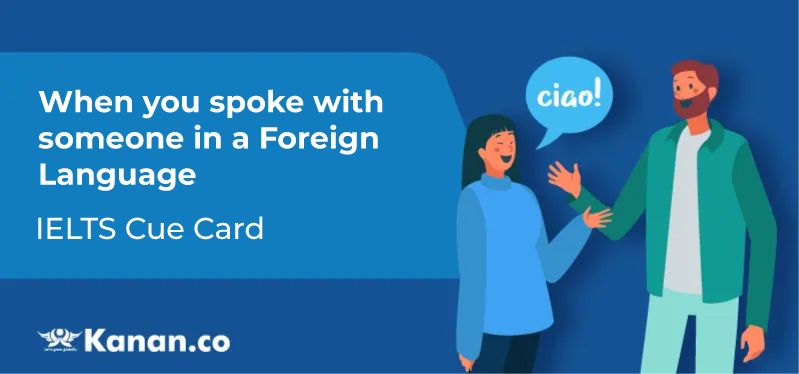
In the article “Describe when you spoke with someone in a foreign language,” you will get 4 sample answers for the Cue card (IELTS Speaking). As the IELTS exam consists of 3 sections, including the introduction part, cue card round and follow-up discussion, you must express your views and demonstrate your speaking skills to an examiner for 11-15 minutes. Moreover, 6 Follow-up questions with answers are included here to help you answer properly and to generate ideas.

IELTS Speaking Part 2 - IELTS Cue Card
Check Out our YouTube Channel to Practice Full-Length IELTS Listening Tests Daily
In the real IELTS speaking exam, you have one minute to prepare, after which you must talk for around two to three minutes to receive a higher score on the IELTS speaking cue card. Based on the topic, the IELTS speaking section 3 has a follow-up discussion part. Here, the supporting questions for the topic "Describe when you spoke with someone in a foreign language" are available. You can use them extensively to enhance your lexical resources and linkers.
Describe when you spoke with someone in a foreign language
You should say
When it was
With whom you talked
What language you used
And describe how you felt about it.
Describe when you spoke with someone in a foreign language - Model answer and Follow up questions
Model cue card answer for the “When you spoke with someone in a foreign language” topic is given and the corresponding IELTS speaking cue card part 3 follow-up questions are given below for your reference.
Describe when you spoke with someone in a foreign language Model answer 1
Introduction
Travelling is a great source of enjoyment, but when I visit foreign regions, I am frequently unable to communicate. Last month, I visited Canada. I was required to communicate in French, which was difficult for me.
When it was
I am a Canadian college student who has recently completed my first year of study. In this aspect, I am currently a sophomore. Prior to beginning my senior year of college, I planned a trip to France. I just had three days to make the journey. Consequently, I made it in the final three days of October.
With whom you talked
I visited the state's most popular sites and enjoyed them. In addition, I captured images of the most beautiful and renowned locations. I was pleased with the food presentation and the serving procedure. But I had difficulty with the language. I forgot that my host was French and a close friend of my father. Therefore, I did not make any hotel reservations. However, he felt awkward speaking English. So I was perplexed regarding our conversation.
What language you used
As someone of French origin, he cannot speak well, and the majority of his pronunciations are unintelligible to me. Therefore, I opted to use French. Even though I learned French in school, I have forgotten the majority of the language. So it was rather challenging for me to communicate with him. In reality, my French language abilities were poor, and I merely chose a few phrases to communicate my emotions. He understood everything that was happening in the city and took me to the locations I desired.
Describe how you felt about it. And Conclusion
I felt uneasy about the circumstances when I used the term. Initially, I was incapable of speaking French as fluently as native speakers. It took me some time to prepare the speech and deliver it. I was therefore a late speaker. I comprehended the majority of the French instructions but lacked the ability to articulate myself. For the first time in my adult life, I utilised my French language skills to communicate with a native speaker.
Describe when you spoke with someone in a foreign language Model answer 2
Introduction
- India is a diverse nation, and it is difficult to learn all of its languages because they vary from region to region.
- In the case of a foreign language, it is quite difficult to learn and speak the language of another country.
When it was
- I believe the first time I spoke a foreign language was in the third grade.
With whom you talked
- My English teacher required me to converse with another student in English about myself.
- I had learned the English alphabet in kindergarten and was even able to write simple words at that point.
- However, I had never spoken out loud before.
- Thus, I was really anxious.
- It took me considerable time to choose what I should say.
What language you used
- I believe I eventually discussed my name, my hobbies, my parent's names and their occupations.
- I believe that it was a three-sentence introduction.
- My instructor guided me and corrected my errors whenever I made them.
- The first sentence took me longer than thirty seconds, but as I continued to speak, I became increasingly at ease.
- My classmates applauded after each sentence, which further bolstered my confidence.
- After I completed the task, my teacher had the remaining pupils do the same.
- She assigned everyone to a pair and required them to share information about themselves.
- I could see that everyone was experiencing the same emotions as I was.
Describe how you felt about it. And Conclusion
- My other classmates were also nervous like me, some of them were even sweating.
- I couldn’t wait to reach home and tell my mother how I spoke English.
- Gradually, I got more and more comfortable with English.
Describe when you spoke with someone in a foreign language Model answer 3
Introduction
The ability to speak or communicate in a foreign language intrigues me. In any case, I know only one other foreign language in addition to English, and I would like to share my initial experience with this language today.
When it was
The foreign language I speak is Japanese, which I studied as a young university student approximately seven years ago. Obviously, learning this language was motivated by my desire to continue my education in Japan after completing high school. However, I had to adjust my plans because my parents did not approve. Consequently, as a result of this plan adjustment, my motivation to study Japanese reduced. But I had no idea at the time that I would need to speak this language in my hometown one day!
With whom you talked And what language you used
Well, I happened to be in the same supermarket where a few Japanese visitors were doing some grocery shopping, so I could tell exactly what had happened. At one point, one of them came to me and asked to borrow my phone to contact his friends who were staying at the same hotel. I asked them in their native tongue if they were Japanese. Apparently, because I was conversing in Japanese, he appeared so enthusiastic in return. I also became eager and told him to use my phone for as long as he needed to in Japanese.
Describe how you felt about it. And Conclusion
When I first had the opportunity to use the Japanese language, I felt incredibly excited and emotional. In reality, I believed that my important efforts and time spent learning a foreign language had not been wasted. Nonetheless, I also lamented the fact that I did not study the language further in order to feel more confident in my Japanese language skills.
Describe when you spoke with someone in a foreign language Model answer 4
Introduction
- Today, I would like to share an instance when I used a foreign language to communicate with a child.
When it was
- This was my cousin's birthday party.
- My maternal uncle and his family visited France for 10 days four months ago.
- He is employed by an IT company over there.
- His family consists of three members: his uncle, his wife, and his five-year-old son.
- My uncle and aunt speak and comprehend our language fluently, although his son is bilingual in English and French.
With whom you talked And What language you used
- I spoke to his son.
- I had to use a foreign language because he only spoke two languages.
- I enrolled in French language classes five months ago since I am hoping to relocate to Canada to pursue additional education. Fortunately, I have a basic understanding of French.
- I know simple words such as Bonjour and Merci, among others.
And describe how you felt about it. And Conclusion
- So when I was with my uncle's boy, I occasionally answered his few questions.
- Even though the English alphabet is used in French, the French alphabet is more difficult.
- I experience intense anxiety when speaking French.
- Thus, that was the first time I ever spoke French.
IELTS speaking part 3 - Describe when you spoke with someone in a foreign language follow-up questions
The discussion round is conducted for about 4-5 minutes where you have to discuss questions on a general topic or question on your cue card. You can refer to the Follow-up questions for “When you spoke with someone in a foreign language” which are given below.
1.At what age should children start learning a foreign language?
I believe that studying a foreign language as early as possible is optimal. Therefore, I believe that primary school is the finest time to begin studying a foreign language. Young children have fewer inhibitions and talk without hesitation. Additionally, there is a great deal of academic pressure in secondary school.
2.Which skill is more important speaking or writing?
I believe both are of equal importance. A few years ago, I would have argued that speaking is more important than writing. However, with the advent of the internet, we have begun interacting via emails and chats, so writing is now just as crucial.
3.Does a person still need to learn another language if he is good at English?
Learning a second language is usually advantageous. Children that are bilingual are better at multitasking and creative thinking. The acquisition of a second language aids in the mental development of youngsters. I believe I have read in numerous places that bilingual children perform better academically than monolingual youngsters.
4.Do you think minority languages will disappear?
Yes, unfortunately. I believe that is already occurring. There are numerous reasons for this, but the fundamental reason is that English is favoured in most nations since it provides a competitive advantage in the labour market. In addition, linguists around the world are not doing enough to save minority languages. Minor features of languages like English and French are studied, whilst minority languages are largely ignored.
5.What do you do to keep up to date with your foreign language skills?
There are several ways to acquire and maintain foreign language skills. To become fluent in a foreign language, you might read online newspapers, view films to learn the accent, read books, listen to music, and even communicate with your friends.
6.What difficulty do people face when learning a language?
I believe the greatest challenge is learning new words and phrases. This may occur if we speak with native speakers, which would result in a limited vocabulary. So many new words and phrases are difficult to memorise.
Related IELTS cue card topics
Check out the other IELTS cue card topics to practise.
- Describe a time when you are waiting for something special
- Talk about a prize you want to win
- Describe a mistake you have made
- Describe someone or something that made a lot of noise
- Describe a place you would like to visit
- Describe a traditional object of your country
- Describe a town or city where you would like to live in the future
- Describe an occasion when many people were smiling
- Describe a live sports match that you have watched
- Talk about something you enjoy doing in a group
- Describe a time when your computer broke down
Conclusion
You can enhance your grammar and lexical resources by reviewing the article “When you spoke with someone in a foreign language”. Moreover, you can practise more speaking cue cards on different topics by referring to the above links.

About Author Roshan Sunthar
Roshan Sunthar is a study abroad expert as well as a renowned writer and author in international education. His academic excellence and 5+ years of work experience give him in-depth knowledge of international standardised exams and test preparation in IELTS, TOEFL, GRE, PTE, SAT, etc. The study materials he prepares incorporate exam-like questions. He’s also an expert in writing Statement of Purposes (SOPs) and Letter of Recommendations (LORs) for college admissions. He usually spends his leisure time watching English classics and documentaries, travelling, etc.
Kanan.co is a trusted study abroad consultancy offering comprehensive services, resources, and solutions for students and education institutions. We support students at every stage of their global education journey, ensuring a smooth and guided experience. Along with test preparation for IELTS, GRE, TOEFL, and SAT, we provide expert services such as SOP writing, visa guidance, accommodation support, scholarship assistance, and education loan support. Our expertise and commitment to excellence make us a reliable partner for students pursuing international education.
Free Online Mock Test 2026
Practice our mock test worth Rs. 25000 for Free and know your IELTS score!








Global Headquarters
Kanan Int EdTech Inc
320 Bay Street, Suite 321 (Spaces), Toronto ON, Canada M5B 1N9
Indian Headquarters
Kanan International Pvt. Ltd.
D-wing, 2nd Floor, Trident Complex, Ellora Park Vadiwadi Road, Vadodara, Gujarat 390007
IT/ Digital Campus
Kanan International Pvt. Ltd
Old, New No 3, 2nd Floor, 1A, Dr Sadasivam Rd, T. Nagar, Chennai, Tamil Nadu 600017
Our branches
- Bardoli
- Bharuch
- Chennai
- Dehradun
- Gurugram
- Himatnagar
- Karnal
- Nadiad
- Navsari
- Palanpur
- Rajkot
- Vadodara
- Valsad
- Vallabh Vidyanagar
- Vapi
Study Abroad
Test Prep
Top Universities
Consultants
IELTS Centers
GRE Centers
TOEFL Centers
SAT Centers
Language Courses in Vadodara
Study Abroad Calculators
Featured Blogs
Study Abroad Consultants in Chennai
Study Abroad Consultants in Surat
Study Abroad Consultants in Navsari
Study Abroad Consultants in Bardoli
Study Abroad Consultants in Ahmedabad
Study Abroad Consultants in Anand
Study Abroad Consultants in Khanna
Study Abroad Consultants in Nadiad
Study Abroad Consultants in Vadodara
Study abroad consultants in Valsad
Copyright © 2026 KANAN.CO All rights reserved.