- Study Abroad
- / ielts
- / stainless steel reading answers
Stainless Steel Reading Answers


Author
16-09-2025

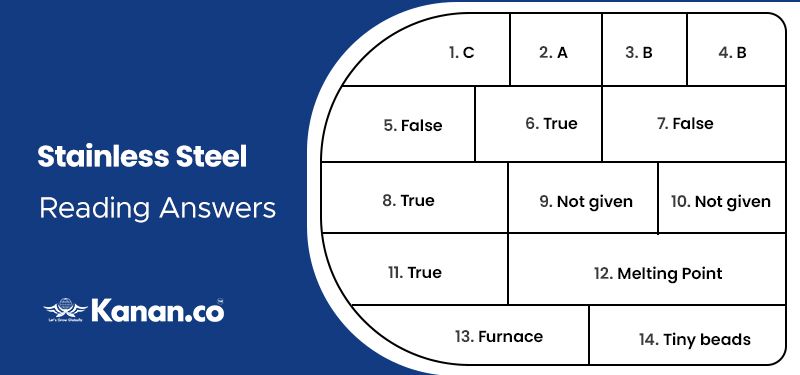
Below we have given the stainless steel reading answers with answers and explanations. In the total 14 questions, there are 3 different kinds of questions; 4 are from multiple choice questions form, 7 are from true, false, or not given questions and 2 are of matching features questions form.
Check out our YouTube Channel to Practice Full-Length IELTS Reading Tests Daily

Table of contents:
- Solution for stainless steel reading answers
- Stainless steel IELTS reading practice test
- Passage
- Questions
- Answers with explanations
Solution for Stainless Steel Reading Answers
Answers for the stainless steel reading answers, are given below in table format.

Answer Table
| 1. C | 5. False | 9. Not given | 13. Furnace |
| 2. A | 6. True | 10. Not given | 14. Tiny beads. |
| 3. B | 7. False | 11. True | |
| 4. B | 8. True | 12. Melting point |
Stainless Steel Reading Answers IELTS Reading Practice Test-Exam Review
The passage for stainless steel IELTS reading answers is provided below to enrich your reading skill, with a practice test section which may help you to enhance your answering skill.
Passage
Check out the given passage for a stainless steel reading answers with location, it helps you to get some important keywords to answer the questions.
Stainless steel reading answers
Uses
A In any ordinary kitchen, there are numerous items made from stainless steel, including cutlery, utensils, and appliances. ‘Inox’ or ‘18/10’ may be stamped on the base of a good stainless steel pot: ‘Inox’ is short for the French inoxydable; while 18 refers to the percentage of chromium in the stainless steel, and 10 to its nickel content.
B In hospitals, laboratories and factories, stainless steel is used for many instruments and pieces of equipment because it can easily be sterilized, and it remains relatively bacteria-free, thus improving hygiene. Since it is mostly rust-free, stainless steel also does not need painting, so it proves cost-effective.
C As a decorative element, stainless steel has been incorporated into skyscrapers, like the Chrysler Building in New York, and the Jin Mao Building in Shanghai, the latter considered one of the most stunning contemporary structures in China. Bridges, monuments, and sculptures are often stainless steel; and, cars, trains, and aircraft contain stainless steel parts.
Recent alloys
D As most pure metals serve little practical purpose, they are often combined or alloyed. Some examples of ancient alloys are bronze (copper + tin) and brass (copper + zinc). Carbon steel (iron + carbon), first made in small quantities in China in the sixth century AD, was produced industrially only in mid-nineteenth-century Europe. Stainless steel, which retains the strength of carbon steel with some added benefits, consists of iron, carbon, chromium, and nickel, and may contain trace elements. Stainless steel is a new invention – Austenitic stainless steel was patented by German engineers in 1912, the same year that Americans created ferritic stainless steel, while Martensitic stainless steel was patented as late as 1919.
Properties
E The name, stainless steel, is misleading since, where there is very little oxygen or a great amount of salt, the alloy will, indeed, stain. In addition, stainless steel parts should not be joined together with stainless steel nuts or bolts as friction damages the elements; another alloy, like bronze, or pure aluminum or titanium must be used.
F In general, stainless steel does not deteriorate as ordinary carbon steel does, which rusts in air and water. Rust is a layer of iron oxide that forms when oxygen reacts with the iron in carbon steel. Because iron oxide molecules are larger than those of iron alone, they wear down the steel, causing it to flake and eventually snap. Stainless steel, however, contains between 13-26% chromium, and, with exposure to oxygen, forms chromium oxide, which has molecules the same size as the iron ones beneath, meaning they bond strongly to form an invisible film that prevents oxygen or water from penetrating.
As a result, the surface of stainless steel neither rusts nor corrodes. Furthermore, if scratched, the protective chromium-oxide layer of stainless steel repairs itself in a process known as passivation, which also occurs with aluminum, titanium, and zinc.
Varieties
G There are over 150 grades of stainless steel with various properties, each distinguished by its crystalline structure. Austenitic stainless steel, comprising 70% of global production, is barely magnetic, but ferritic and Martensitic stainless steel function as magnets because they contain more nickel or manganese. Ferritic stainless steel – soft and slightly corrosive – is cheap to produce, and has many applications, while Martensitic stainless steel, with more carbon than the other types, is incredibly strong, so it is used in fighter jet bodies but is also the costliest to produce.
Recyclability
H Stainless steel can be recycled completely, and these days, the average stainless steel object comprises around 60% of recycled material.
Cutting-edge application
I In the last few years, 3D printers have become widespread, and stainless steel infused with bronze is the hardest material that a 3D printer can currently use.
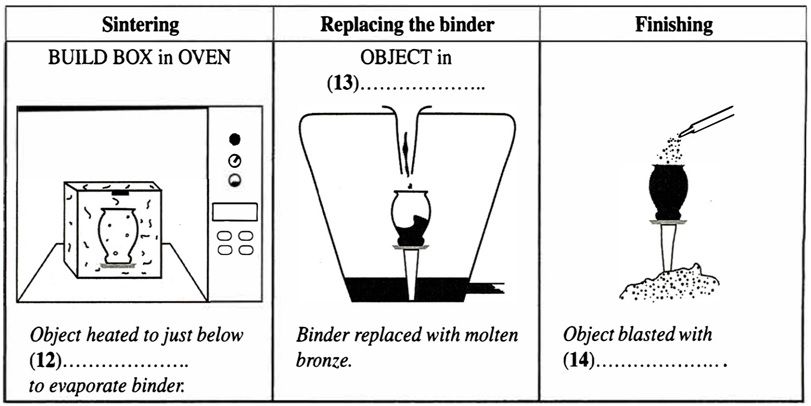
J In 3D printing, an inkjet head deposits alternate layers of stainless steel powder and organic binder into a build box. After each layer of binder is spread, overhead heaters dry the object before another layer of powder is added. Upon completion of printing, the whole object, still in its build box, is sintered in an oven, which means the object is heated to just below the melting point, so the binder evaporates. Next, the porous object is placed in a furnace so that molten bronze can replace the binder. To finish, the object is blasted with tiny beads that smooth the surface.
Appraisal
K In less than a century, stainless steel has become essential due to its relatively cheap production cost, its durability, and its renewability. Used in the new manufacturing process of 3D printing, its future looks bright.
3D printing using stainless steel and bronze
Answers for stainless steel with explanation
Below we have provided the stainless steel reading answers with explanations, go through it to assess your errors.
(Note: The text in italics mentions the location and referring lines written in the reading passage)
1. Answer: C
Explanation: ‘Inox’ or ‘18/10’ may be stamped on the base of a good stainless steel pot: ‘Inox’ is short for the French inoxydable; while 18 refers to the percentage of chromium in the stainless steel, and 10 to its nickel content. This line explains that a stainless steel pot with “18/10” stamped on it contains 18% chromium and 10% nickel. Hence the given answer is located in the last 3 lines of paragraph A.
2. Answer: A
Explanation: In hospitals, laboratories and factories, stainless steel is used for many instruments and pieces of equipment because it can easily be sterilized, and it remains relatively bacteria-free, thus improving hygiene. In this line it is clear that hospitals and laboratories use stainless steel equipment because it is easily sterilized. Hence the given answer is located in the first 3 lines of paragraph B.
3. Answer: B
Explanation: As a decorative element, stainless steel has been incorporated into skyscrapers, like the Chrysler Building in New York, and the Jin Mao Building in Shanghai, the latter considered one of the most stunning contemporary structures in China. This line proves that stainless steels have been used in some famous buildings for their beauty. Hence the given answer is located in the first 3 lines of paragraph C.
4. Answer: B
Explanation: Austenitic stainless steel was patented by German engineers in 1912. From this line it is clear that the first type of stainless steel was patented in Germany in 1912. Hence the given answer is located in the 7th line of paragraph D.
5. Answer: False
Explanation: The name, stainless steel, is misleading since, where there is very little oxygen or a great amount of salt, the alloy will, indeed, stain. With these lines it is shown that the statement contradicts the information that stainless steel does stain irrespective of its name. Hence the given answer is located in the first 2 lines of paragraph E.
6. Answer: True
Explanation: In general, stainless steel does not deteriorate as ordinary carbon steel does, which rusts in air and water. Rust is a layer of iron oxide that forms when oxygen reacts with the iron in carbon steel. From these lines it is clear that the statement agrees with the information. Hence the given answer is located in the 1-3 lines of paragraph F.
7. Answer: False
Explanation: Furthermore, if scratched, the protective chromium-oxide layer of stainless steel repairs itself in a process known as passivation, which also occurs with aluminum, titanium, and zinc. From this line it is clear that passivation is not unique to stainless steel as it occurs with aluminum, titanium, and Zinc. Hence the given answer is located in the last 3 lines of paragraph F.
8. Answer:True
Explanation: Austenitic stainless steel, comprising 70% of global production, is barely magnetic…, it is clear that Austenitic stainless steel is the most commonly produced type as it accounts for 70% of the global production. Hence the given answer is located in the 2-3 lines of paragraph G
9. Answer: Not given
10. Answer: Not given
11. Answer: True
Explanation: Stainless steel can be recycled completely, and these days, the average stainless steel object comprises around 60% of recycled material. In this line it is clear that close to two-thirds of a stainless steel object is made up of recycled metal. Hence the given answer is located in paragraph H.
12. Answer: Melting point
Explanation: Upon completion of printing, the whole object, still in its build box, is sintered in an oven, which means the object is heated to just below the melting point, so the binder evaporates. From this line we can conclude that the object in the build box is heated to just below the melting point to evaporate the binder. Hence the given answer is located in the 3-5 lines of paragraph J.
13. Answer: Furnace
Explanation: Next, the porous object is placed in a furnace so that molten bronze can replace the binder. From this line we can conclude that the porous object is placed in the furnace so that the binder can be replaced with molten bronze. Hence the given answer is located in the 5-6 lines of paragraph J.
14. Answer: Tiny beads.
Explanation: To finish, the object is blasted with tiny beads that smooth the surface. This line indicates that as the finishing touch, the object is blasted with tiny beads. Hence the given answer is located in the last 2 lines of paragraph J.
Other reading answers

About Author Gayathri Nagarajan
Gayathri, a trusted study-abroad expert, with expertise in standardized tests like IELTS, TOEFL, PTE, GRE, and GMAT. With a strong tech background from SASTRA University, she excels in software testing and has a passion for content writing and digital marketing. She aids students in finding the perfect academic fit, offering guidance on course selection, LOR and SOP writing. She remains up-to-date with the latest trends in higher education, delivering credible, accurate information on international education, including courses and test prep materials. As a trusted Study abroad expert at Kanan International, explore her latest blogs and articles for comprehensive insights into studying abroad and realizing your academic aspirations.
Kanan.co is a trusted study abroad consultancy offering comprehensive services, resources, and solutions for students and education institutions. We support students at every stage of their global education journey, ensuring a smooth and guided experience. Along with test preparation for IELTS, GRE, TOEFL, and SAT, we provide expert services such as SOP writing, visa guidance, accommodation support, scholarship assistance, and education loan support. Our expertise and commitment to excellence make us a reliable partner for students pursuing international education.
Free Online Mock Test 2026
Practice our mock test worth Rs. 25000 for Free and know your IELTS score!








Global Headquarters
Kanan Int EdTech Inc
320 Bay Street, Suite 321 (Spaces), Toronto ON, Canada M5B 1N9
Indian Headquarters
Kanan International Pvt. Ltd.
D-wing, 2nd Floor, Trident Complex, Ellora Park Vadiwadi Road, Vadodara, Gujarat 390007
IT/ Digital Campus
Kanan International Pvt. Ltd
Old, New No 3, 2nd Floor, 1A, Dr Sadasivam Rd, T. Nagar, Chennai, Tamil Nadu 600017
Our branches
- Bardoli
- Bharuch
- Chennai
- Dehradun
- Gurugram
- Himatnagar
- Karnal
- Nadiad
- Navsari
- Palanpur
- Rajkot
- Vadodara
- Valsad
- Vallabh Vidyanagar
- Vapi
Study Abroad
Test Prep
Top Universities
Consultants
IELTS Centers
GRE Centers
TOEFL Centers
SAT Centers
Language Courses in Vadodara
Study Abroad Calculators
Featured Blogs
Study Abroad Consultants in Chennai
Study Abroad Consultants in Surat
Study Abroad Consultants in Navsari
Study Abroad Consultants in Bardoli
Study Abroad Consultants in Ahmedabad
Study Abroad Consultants in Anand
Study Abroad Consultants in Khanna
Study Abroad Consultants in Nadiad
Study Abroad Consultants in Vadodara
Study abroad consultants in Valsad
Copyright © 2026 KANAN.CO All rights reserved.