- Study Abroad
- / ielts
- / these invasive species are ruining the retail ecosystem reading answers
These Invasive Species are Ruining the Retail Ecosystem Reading Answers


Author
16-09-2025

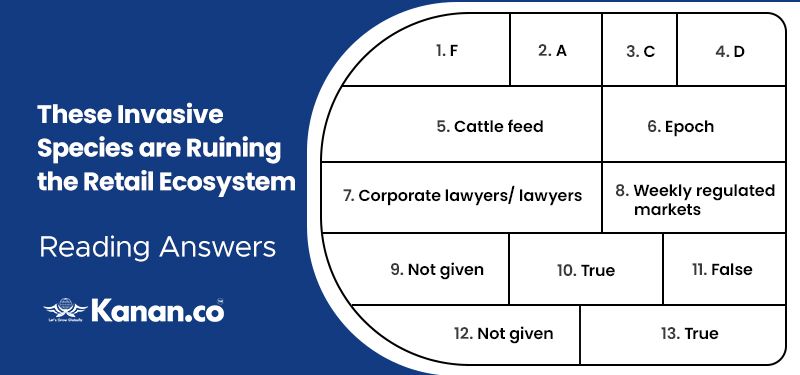
We have given These Invasive Species are Ruining the Retail Ecosystem reading answers as a practice test in this article. We have also given the answers along with explanations. This topic has 13 questions in 3 different types namely - 4 questions are from matching information and 4 questions are from sentence completion and 5 questions as true, false or not given.
Check out our YouTube Channel to Practice Full-Length IELTS Reading Tests Daily

Table of contents:
- Solution for These Invasive Species are Ruining the Retail Ecosystem
- These Invasive Species are Ruining the Retail Ecosystem IELTS reading practice test
- Passage
- Questions
- Answers with explanations
Solution for These Invasive Species are Ruining the Retail Ecosystem
Here we have given These Invasive Species are Ruining the Retail Ecosystem reading answers, in the table given below.

Answer table
| 1. F | 4. D | 7. Corporate lawyers/lawyers | 10. True | 13. True |
| 2. A | 5. Cattle feed | 8. Weekly regulated markets | 11. False | |
| 3. C | 6. Epoch | 9. Not given | 12. Not given |
These Invasive Species are Ruining the Retail Ecosystem IELTS Reading Practice Test- Exam Review
Here we have given These Invasive Species are Ruining the Retail Ecosystem IELTS reading answers, as a sample article for IELTS reading practice test. This article will help you to crack your exam with band scores. Scrutinize the given passage to answer the questions.
Passage
We have given These Invasive Species are Ruining the Retail Ecosystem reading answers with location. Be careful while reading the passage and answer the questions.
These Invasive Species are Ruining the Retail Ecosystem reading answers
A
Invasive species often triumph as a result of good intentions gone wrong. Take Japanese knotweed (Fallopia japonica), introduced to Britain by enthusiastic Victorian gardeners who thought it an ornamental delight that doubled as cattle feed. But from just a scrap of root no bigger than a pea it could grow through tarmac, pavements, and brick walls. A century later, its spread is considered such a threat that planting or dumping knotweed is a crime, knotweed is so hated because it suffocates other plants, replacing them with an unproductive, leafy monotony.
Then there is the Nile perch (Lates niloticus), branded one of the world’s worst invaders by conservationists. It is a freshwater fish that can grow to huge proportions. Again, with good intentions, it was introduced in 1954 to Lake Victoria, straddling Tanzania. Kenya, and Uganda. Since then, it has helped push over 200 well-established local fish species to extinction. Like the Nile perch, the cane toad (Bufo marinus) eats almost anything it gets its mouth around. Introduced for pest control, it turned out to be noisy, fast spreading, and a greater pest itself.
B
As it is in nature, so it is in the economy. Big superstores and chain retailers were allowed to spread by planners, town councils, and governments in awe of big business. But then it started to go wrong. The chains became the economic equivalent of invasive species: hungry, indiscriminate, often antisocial and destructive. When no one was paying much attention, the superstores and cloned shops grew to dominate and suffocate the economic ecosystem.
They passed through planning regulations as easily as knotweed pushes through tarmac, devoured smaller and independent retailers with as much reflection as the Nile perch cleansing Lake Victoria of competition. They were often introduced to provide a specific service but outgrew their habitats until their cash till song could be heard on every street corner, forecourt, roundabout, and out of town shopping centre. Neither in balance, nor even a boom bust cycle with other similar, local species of shop; they began permanently to displace them.
C
Natural scientists use a whole new term to describe the current epoch of comprehensive global human interference in ecosystems. Our time, they say, should be called the “Homogocene” to describe the way that distinctiveness and difference are being eroded. A combination of the creep of invasive species and habitats destroyed by development is driving a mass extinction. The World Conservation Union warns that such invasions are leading to the irretrievable loss of native biodiversity. Typical characteristics of an invasive species include the absence of predators, hardiness, and a generalist diet. Whatever the reason for their arrival and proliferation, invasive species
tend to cause a disruption of the ecosystem that is catastrophic for native species.
D
The big, centralized logistical operations of the supermarkets are likewise driving the homogenisation of business, shopping, eating, farming, food, the landscape, the environment, and our daily lives. In the process, Britain is being sucked into a vortex of US-style, chain-store-led. clone retailing, both in towns and in soulless “big box” out-of-town shopping parks — what they call in the US, with its associated suburban sprawl, the “dead zone”.
They are spreading in the way “invasive species” spread in nature, lacking checks and balances, killing off diversity and “native” (in other words, local) species. Tesco is not the only guilty party (think of McDonald’s. Starbucks, and Gap), but it is possibly the largest driving force. With around 2.000 stores in Britain, almost one third of the grocery market, and rapid international growth, city analysts believe the brand has the land and resources in place already to double its UK floor space. Can anything stop it?
E
Bear in mind those characteristics of an invasive species: the absence of predators (real commercial competition or effective regulators to hold them back); hardiness (the legions of corporate lawyers, financial leverage, and endless commercial cost cutting); and a generalist diet (supermarkets will sell virtually anything, and chain stores operate according to a low common denominator). If you want diversity in your world rather than one kind of plant in your garden, one kind of fish in your lake and only one type of venomous, croaking toad under your shed, then you have to manage for that outcome. When we garden, we hold back aggressive, opportunistic plants in order to keep space open for a celebration of variety and colour.
F
Like it or not (and it is something about which most policy makers and economists are in deep denial), weakly regulated markets give free rein to economic invasive species and hence tend towards monopoly. This is the great modern economic irony. Advocates of free markets argue against checks and balances to counter the power of big business, but in doing so ultimately destroy the possibility of markets that could meaningfully be called free, or, rather, “open”.
They resist anti-monopoly regulation in the name of providing consumer choice, and in the process they ultimately destroy it. In some important ways, we are returning to an earlier phase of corporatism. Henry Ford told customers they could have any colour of car, as long as it was black. The scale and seriousness of Tesco’s ambition mean that, before long, unless we recognise what is happening and have regulators up to the job, one day we will be able to shop anywhere we like, as long as it is Tesco.
Questions
Questions 1-4
- The text has 6 paragraphs A-F
- Find out which paragraph contains each of the following pieces of information?
1. The suggestion that the government should legislate to control invasive species of a corporate nature.
2. Examples of the problems with the spread of specific invasive species in nature.
3. A description of how invasive species in nature are different from other ones.
4. Examples of companies that can be considered invasive species.
Questions 5-8
- Complete the following sentences using
- No more than three words from the text for each gap.
Japanese knotweed was used for decoration and as 5…………………
“Homogocene” is the word used by natural scientists to describe the 6………. we are living in.
7……………………, plenty of money, and cost-cutting increase the strength of big supermarkets.
The article suggests that 8……………. allow economically invasive species to do what they want and eventually lead to monopolies.
Questions 9-13
- Do the following statements agree with the information given in Reading Passage 1?
- In boxes 9-13 on your answer sheer, write.
- True if the statements agrees with the information
- False if the statement contradicts the information
- Not given if there is no information on this
9. The Nile perch was introduced to Lake Victoria as a source of food for local people.
10. Planning regulations have been ineffective against big supermarkets.
11. Supermarkets in Britain sell a limited range of products.
12. Chain stores only sell low-quality goods.
13. The writer is against the domination of big supermarkets.
Answers for These Invasive Species are Ruining the Retail Ecosystem with explanation
We have given These Invasive Species are Ruining the Retail Ecosystem reading answers with explanation, this will help you to identify your mistakes in the answering process.
1. Answer: F
Explanation: “Like it or not (and it is something about which most policy makers and economists are in deep denial), weakly regulated markets give free rein to economic invasive species and hence tend towards monopoly.” These lines form paragraph F explains that most policy makers and economists are in denial and weakly regulated markets are allowing economic invasive species to monopolize. Hence the given answer is located in the 1-3 lines of paragraph F.
2. Answer: A
Explanation: “Take Japanese knotweed (Fallopia japonica), introduced to Britain by enthusiastic Victorian gardeners who thought it an ornamental delight that doubled as cattle feed”, “Then there is the Nile perch (Lates niloticus), branded one of the world’s worst invaders by conservationists”,. “ Like the Nile perch, the cane toad (Bufo marinus) eats almost anything it gets its mouth around”. From these lines it is clear that paragraph A provides the examples of problems with the spread of specific invasive species in nature. Hence the given answer is located in paragraph A.
3. Answer: C
Explanation: “Typical characteristics of an invasive species include the absence of predators, hardiness, and a generalist diet. Whatever the reason for their arrival and proliferation, invasive species tend to cause a disruption of the ecosystem that is catastrophic for native species”. From these lines it is clear that paragraph C explains the features that make the invasive species different from the others in nature. Hence the given answer is located in the last 4 lines of paragraph C.
4. Answer: D
Explanation: “They are spreading in the way “invasive species” spread in nature, lacking checks and balances, killing off diversity and “native” (in other words, local) species. Tesco is not the only guilty party (think of McDonald’s. Starbucks, and Gap), but it is possibly the largest driving force ". From these lines it is clear that paragraph D provides the examples of companies that can be considered invasive species. Hence the given answer is located in the 7-10 lines of paragraph D.
5. Answer: Cattle feed
Explanation: “Take Japanese knotweed (Fallopia japonica), introduced to Britain by enthusiastic Victorian gardeners who thought it an ornamental delight that doubled as cattle feed.” These lines explain that Japanese Knotweed was used for decorations and cattle feed. Hence the given answer is located in the 1-3 lines of paragraph A.
6. Answer: Epoch
Explanation: “Natural scientists use a whole new term to describe the current epoch of comprehensive global human interference in ecosystems. Our time, they say, should be called the “Homogocene.” From these lines it is clear that the word “Homogocene” is used by natural scientists to describe the epoch. Hence the given answer is located in the 1-3 lines of paragraph C.
7. Answer: Corporate lawyers/lawyers
Explanation: “Bear in mind those characteristics of an invasive species: the absence of predators (real commercial competition or effective regulators to hold them back); hardiness (the legions of corporate lawyers, financial leverage, and endless commercial cost cutting)” From these lines it is clear that the factors like corporate lawyers have plenty of money and cost-cutting enables big supermarkets to increase their strength. Hence the given answer is located in the 1-3 lines of paragraph E.
8. Answer: Weakly regulated market.
Explanation: “Like it or not (and it is something about which most policy makers and economists are in deep denial), weakly regulated markets give free rein to economic invasive species and hence tend towards monopoly.” These lines explain that weakly regulated markets are the reason allowing economic invasive species. Hence the given answer is located the 1-3 lines of paragraph F
9. Answer: Not given.
10. Answer: True.
Explanation: “Big superstores and chain retailers were allowed to spread by planners, town councils, and governments in awe of big business. But then it started to go wrong”. From these lines it is clear that even a big superstores were allowed to spread by planners in the end it became ineffective. Hence, the given answer is located in the 1-3 lines of paragraph B.
11. Answer: False.
Explanation: “a generalist diet (supermarkets will sell virtually anything, and chain stores operate according to a low common denominator).” From these lines it is clear that supermarkets in Britain sell a limited range of products contradicting the information that they sell everything. Hence the given answer is located in the 4-5 lines of paragraph E.
12. Answer: Not given
13. Answer: True.
Explanation: In the entire passage, the writer provides various points against the monopolization of the big supermarkets through comparison with natural invasive species. Hence the answer is true.
Other reading answers

About Author Roshan Sunthar
Roshan Sunthar is a study abroad expert as well as a renowned writer and author in international education. His academic excellence and 5+ years of work experience give him in-depth knowledge of international standardised exams and test preparation in IELTS, TOEFL, GRE, PTE, SAT, etc. The study materials he prepares incorporate exam-like questions. He’s also an expert in writing Statement of Purposes (SOPs) and Letter of Recommendations (LORs) for college admissions. He usually spends his leisure time watching English classics and documentaries, travelling, etc.
Kanan.co is a trusted study abroad consultancy offering comprehensive services, resources, and solutions for students and education institutions. We support students at every stage of their global education journey, ensuring a smooth and guided experience. Along with test preparation for IELTS, GRE, TOEFL, and SAT, we provide expert services such as SOP writing, visa guidance, accommodation support, scholarship assistance, and education loan support. Our expertise and commitment to excellence make us a reliable partner for students pursuing international education.
Free Online Mock Test 2026
Practice our mock test worth Rs. 25000 for Free and know your IELTS score!








Global Headquarters
Kanan Int EdTech Inc
320 Bay Street, Suite 321 (Spaces), Toronto ON, Canada M5B 1N9
Indian Headquarters
Kanan International Pvt. Ltd.
D-wing, 2nd Floor, Trident Complex, Ellora Park Vadiwadi Road, Vadodara, Gujarat 390007
IT/ Digital Campus
Kanan International Pvt. Ltd
Old, New No 3, 2nd Floor, 1A, Dr Sadasivam Rd, T. Nagar, Chennai, Tamil Nadu 600017
Our branches
- Bardoli
- Bharuch
- Chennai
- Dehradun
- Gurugram
- Himatnagar
- Karnal
- Nadiad
- Navsari
- Palanpur
- Rajkot
- Vadodara
- Valsad
- Vallabh Vidyanagar
- Vapi
Study Abroad
Test Prep
Top Universities
Consultants
IELTS Centers
GRE Centers
TOEFL Centers
SAT Centers
Language Courses in Vadodara
Study Abroad Calculators
Featured Blogs
Study Abroad Consultants in Chennai
Study Abroad Consultants in Surat
Study Abroad Consultants in Navsari
Study Abroad Consultants in Bardoli
Study Abroad Consultants in Ahmedabad
Study Abroad Consultants in Anand
Study Abroad Consultants in Khanna
Study Abroad Consultants in Nadiad
Study Abroad Consultants in Vadodara
Study abroad consultants in Valsad
Copyright © 2026 KANAN.CO All rights reserved.