- Study Abroad
- / ielts
- / the discovery of uranus reading answers
The Discovery Of Uranus Reading Answers


Author
16-09-2025

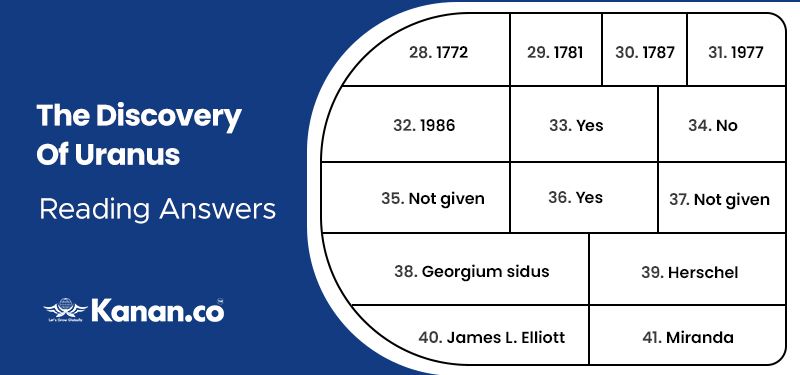
Below we have given the The discovery of Uranus reading answers practice test with answers and explanations. In the total 14 questions- 5 questions are in the table completion, 5 questions are in yes, no or not given questions form and 4 questions are in sentence completion questions form.
Check out our YouTube Channel to Practice Full-Length IELTS Reading Tests Daily

Table of contents:
- Solution for the discovery of Uranus reading answers
- The discovery of Uranus IELTS reading practice test
- Passage
- Questions
- Answers with explanations
Solution for The Discovery Of Uranus Reading Answers
Answers for The discovery of Uranus reading answers are given below in table format.

Answer Table
| 28. 1772 | 32. 1986 | 36. Yes | 40. James L. Elliott |
| 29. 1781 | 33. Yes | 37. Not given | 41. Miranda |
| 30. 1787 | 34. No | 38. Georgium sidus | |
| 31. 1977 | 35. Not given | 39. Herschel |
The Discovery Of Uranus Reading Answers IELTS Reading Practice Test-Exam Review
Here The discovery of Uranus IELTS reading answers passage is provided below to enrich your reading skill, with a practice test section which may help you to enhance your answering skill.
Passage
Here we have given The discovery of Uranus reading answers with location. Go through the passage completely, it helps you to get some important keywords to answer the questions.
The Discovery of Uranus Reading Answers
- Someone once put forward an attractive though unlikely theory. Throughout the Earth’s annual revolution around the sun, there is one point of space always hidden from our eyes. This point is the opposite part of the Earth’s orbit, which is always hidden by the sun. Could there be another planet there, essentially similar to our own, but always invisible?
- If a space probe today sent back evidence that such a world existed it would cause not much more sensation than Sir William Herschel’s discovery of a new planet, Uranus, in 1781. Herschel was an extraordinary man — no other astronomer has ever covered so vast a field of work — and his career deserves study. He was born in Hanover in Germany in 1738, left the German army in 1757, and arrived in England the same year with no money but quite exceptional music ability. He played the violin and oboe and at one time was organist in the Octagon Chapel in the city of Bath. Herschel’s was an active mind, and deep inside he was conscious that music was not his destiny; he, therefore, read widely in science and the arts, but not until 1772 did he come across a book on astronomy. He was then 34, middle-aged by the standards of the time, but without hesitation he embarked on his new career, financing it by his professional work as a musician. He spent years mastering the art of telescope construction, and even by present-day standards, his instruments are comparable with the best.
- The serious observation began in 1774. He set himself the astonishing task of ‘reviewing the heavens’ in other words, pointing his telescope to every accessible part of the sky and recording what he saw. The first review was made in 1775; the second, and most momentous, in 1780-81. It was during the latter part of this that he discovered Uranus. Afterwards, supported by the royal grant in recognition of his work, he was able to devote himself entirely to astronomy. His final achievements spread from the sun and moon to remote galaxies (of which he discovered hundreds), and papers flooded from his pen until his death in 1822. Among these, there was one sent to the Royal Society in 1781, entitled An Account of a Comet. In his own words:
- On Tuesday the 13th of March, between ten and eleven in the evening, while I was examining the small stars in the neighbourhood of H Geminorum, I perceived one that appeared visibly larger than the rest; being struck with its uncommon magnitude, I compared it to H Geminorum and the small star in the quartile between Auriga and Gemini, and finding it to be much larger than either of them, suspected it to be a comet.
- Herschel’s care was the hallmark of a great observer; he was not prepared to jump to any conclusions. Also, to be fair, the discovery of a new planet was the last thought in anybody’s mind. But further observation by other astronomers besides Herschel revealed two curious facts. For the comet, it showed a remarkably sharp disc; furthermore, it was moving so slowly that it was thought to be a great distance from the sun, and comets are only normally visible in the immediate vicinity of the sun. As its orbit came to be worked out the truth dawned that it was a new planet far beyond Saturn’s realm and that the ‘reviewer of the heavens’ had stumbled across an unprecedented prize. Herschel wanted to call it Georgian sidus (Star of George) in honour of his royal patron King George III of Great Britain. The planet was later for a time called Herschel in honour of its discoverer. The name Uranus, which was first proposed by the German astronomer Johann Elert Bode, was in use by the late 19th century.
- Uranus is a giant in construction, but not so much in size; its diameter compares unfavourably with that of Jupiter and Saturn, though on the terrestrial scale it is still colossal. Uranus’s atmosphere consists largely of hydrogen and helium, with a trace of methane. Through a telescope, the planet appears as a small bluish-green disc with a faint green periphery. In 1977, while recording the occultation 1 of a star behind the planet, the American astronomer James L. Elliot discovered the presence of five rings encircling the equator of Uranus. Four more rings were discovered in January 1986 during the exploratory flight of Voyager 2 2, In addition to its rings, Uranus has 15 satellites (‘moons’), the last 10 discovered by Voyager 2 on the same flight; all revolve about its equator and move with the planet in an east-west direction. The two largest moons, Titania and Oberon, were discovered by Herschel in 1787. The next two, Umbriel and Ariel, were found in 1851 by the British astronomer William Lassell. Miranda, thought before 1986 to be the innermost moon, was discovered in 1948 by the American astronomer Gerard Peter Kuiper.
Questions
Questions 28-32
- Complete the table below. Write a date for each answer.
- Write your answers in boxes 28-32 on your answer sheet.
| Event | Date |
| Example: William Herschel was born | Answer: 1738 |
| Herschel began investigating astronomy | 28___________ |
| Discover of the planet Uranus | 29___________ |
| Discovery of the moons Titania and Oberon | 30___________ |
| The first discovery of Uranus’s rings | 31___________ |
| Discovery of last 10 moons of Uranus | 32____________ |
Questions 33-37
- Do the following statements reflect the claims of the writer of the reading passage?
- In boxes 33-37 on your answer sheet writer.
- Yes if the statement reflects the claims of the writer.
- No if the statement contradicts the writer.
- Not given if it's impossible to say what the writer feels about it.
Example: Herschel was multitalented. Answer – Yes
33. It is improbable that there is a planet hidden behind the sun.
34. Herschel knew immediately that he had found a new planet.
35. Herschel collaborated with other astronomers of his time.
36. Herschel’s newly-discovered object was considered to be too far from the sun to be a comet.
37. Herschel’s discovery was the most important find of the last three hundred years.
Questions 38 – 41
- Complete each of the following statements and write your answers in the answer sheet.
The suggested names of the new planet started with 38____________, then 39___________ before finally settling on Uranus. The first five rings around Uranus were discovered by 40___________ From 1948 until 1986, the moon 41___________ was believed to be the moon closest to the surface of Uranus.
Answers for The discovery of Uranus with Explanation
We have provided The discovery of Uranus reading answers with explanations, go through it to assess your errors.
28. Answer: 1772
Explanation: “Herschel was an active mind, and deep inside he was conscious that music was not his destiny; he, therefore, read widely in science and the arts, but not until 1772 did he come across a book on astronomy”. This line explains that Hershel widely read books related to science and arts until 1772 and he came across a book on astronomy when he became deeply interested in it. Hence the given answer is located in the 8-11 lines of paragraph B.
29. Answer:1781
Explanation: “The first review was made in 1775; the second, and most momentous, was in 1780-81. It was during the latter part of this that he discovered Uranus”. In these lines it is clear that Hershal began observation in 1774, he made his first review in 1775 and in the latter part of the second review in 1780-1781. Hence the given answer is located in the 3-5 lines of paragraph C.
30. Answer: 1787
Explanation: “The two largest moons, Titania and Oberon, were discovered by Herschel in 1787”. From this line it is clear that Uranus has 15 moons that revolve around its equator. These moons were explored with the help of an aircraft Voyager 2 in 1787. Hence the given answer is located in the 11- 12 lines of paragraph F.
31. Answer: 1977
Explanation: In 1977, while recording the occultation 1 of a star behind the planet, the American astronomer James L. Elliot discovered the presence of five rings encircling the equator of Uranus. This line explains that when accessed with the help of a telescope, the Uranus had a small bluish-green disc with a faint green periphery. Hence the given answer is located in the 5-7 lines of paragraph F.
32. Answer: 1986
Explanation: Four more rings were also discovered in January 1986 during the exploratory flight of Voyager 22. In addition to its rings, Uranus has 15 satellites ('moons'), the last 10 moons were discovered with the help of Voyager 2 on the same flight; all revolve around its equator and move with the planet in an east-west direction. These lines explain that with the discovery of the rings around Uranus, 15 moons revolving around Uranus as the satellites were found. In these 15 moons, the last ten moons were explored by Voyager 2 in the same year 1986. Hence the given answer is located in the 7-11 lines in paragraph F.
33. Answer: Yes
Explanation: Throughout the Earth's annual revolution around the sun, there is one point of space always hidden from our eyes. This point is the opposite part of the Earth's orbit, which is always hidden by the sun. These lines explain that during the revolution of the planets around the sun, only a part of the revolution is hidden from our eyes behind the sun. hence the given answer is located in the 1-4 lines of paragraph A.
34. Answer: No
Explanation: “The first review was made in 1775; the second, and most momentous, was in 1780-81. It was during the latter part of this that he discovered Uranus”. In these lines it is clear that Hershal began observation in 1774, he made his first review in 1775 and in the latter part of the second review in 1780-1781. Hence the given answer is located in the 3-5 lines of paragraph C.
35. Answer: Not given
36. Answer: Yes
Explanation: His final achievements spread from the sun and moon to remote galaxies (of which he discovered hundreds), and papers flooded from his pen until he died in 1822. Among these, there was one sent to the Royal Society in 1781, entitled An Account of a Comet. These lines explain that after the discovery of Uranus, Herschel made many explorations in this field from the sun and moon to faraway galaxies of the universe and all these achievements were supported by Royal Grant. He published different papers and one of them was sent to the Royal Society in 1781 entitled “An Account of a Comet”. Hence the given answer is located in the last 4 lines of paragraph C.
37. Answer:Not given
38. Answer: Georgium sidus
Explanation: Herschel wanted to call it Georgian Sidus (Star of George) in honor of his royal patron King George III of Great Britain. From this line it is explained that after finding that planet, Sir William Herschel wanted to name that newly found planet Georgium Sidus in the honor of the King of Great Britain, George III. But later the name Uranus was propounded by German astronomer Johann Elert Bode. hence the given answer is located in the 9-11 lines of paragraph E.
39. Answer: Herschel
Explanation: The planet was later for a time called Herschel in honor of its discoverer. The name Uranus, which was first proposed by the German astronomer Johann Elert Bode, was in use by the late 19th century. These lines explain that after Herschel has discovered that planet, names were proposed for that discovered planet, the second name suggested for that explored planet was Herschel after the name of the discovered Sir William Herschel. Hence the given answer is located in the last 3 lines of paragraph E.
40. Answer: James L. Elliott
Explanation: In 1977, while recording the occultation 1 of a star behind the planet, an American astronomer James L. Elliot found the presence of five rings encircling the equator of Uranus. These lines explain that an American astronomer James L.Elliot found some five rings around Uranus while recording the occlusion of the stars in 1977. Hence the given answer is located in the 5-7 lines of paragraph F.
41. Answer: Miranda
Explanation: Miranda, thought before 1986 to be the innermost moon, was explored in 1948 by the American astronomer Gerard Peter Kuiper. This line explains that out of the 15 moons found by scientists encircling Uranus, the innermost moon was Miranda, which was found by an AMerican astronomer, Gerard Peter Kuiper in 1948. Hence the given answer is located in the last 3 lines of paragraph F.
Other Reading Answers

About Author Gayathri Nagarajan
Gayathri, a trusted study-abroad expert, with expertise in standardized tests like IELTS, TOEFL, PTE, GRE, and GMAT. With a strong tech background from SASTRA University, she excels in software testing and has a passion for content writing and digital marketing. She aids students in finding the perfect academic fit, offering guidance on course selection, LOR and SOP writing. She remains up-to-date with the latest trends in higher education, delivering credible, accurate information on international education, including courses and test prep materials. As a trusted Study abroad expert at Kanan International, explore her latest blogs and articles for comprehensive insights into studying abroad and realizing your academic aspirations.
Kanan.co is a trusted study abroad consultancy offering comprehensive services, resources, and solutions for students and education institutions. We support students at every stage of their global education journey, ensuring a smooth and guided experience. Along with test preparation for IELTS, GRE, TOEFL, and SAT, we provide expert services such as SOP writing, visa guidance, accommodation support, scholarship assistance, and education loan support. Our expertise and commitment to excellence make us a reliable partner for students pursuing international education.
Free Online Mock Test 2026
Practice our mock test worth Rs. 25000 for Free and know your IELTS score!








Global Headquarters
Kanan Int EdTech Inc
320 Bay Street, Suite 321 (Spaces), Toronto ON, Canada M5B 1N9
Indian Headquarters
Kanan International Pvt. Ltd.
D-wing, 2nd Floor, Trident Complex, Ellora Park Vadiwadi Road, Vadodara, Gujarat 390007
IT/ Digital Campus
Kanan International Pvt. Ltd
Old, New No 3, 2nd Floor, 1A, Dr Sadasivam Rd, T. Nagar, Chennai, Tamil Nadu 600017
Our branches
- Bardoli
- Bharuch
- Chennai
- Dehradun
- Gurugram
- Himatnagar
- Karnal
- Nadiad
- Navsari
- Palanpur
- Rajkot
- Vadodara
- Valsad
- Vallabh Vidyanagar
- Vapi
Study Abroad
Test Prep
Top Universities
Consultants
IELTS Centers
GRE Centers
TOEFL Centers
SAT Centers
Language Courses in Vadodara
Study Abroad Calculators
Featured Blogs
Study Abroad Consultants in Chennai
Study Abroad Consultants in Surat
Study Abroad Consultants in Navsari
Study Abroad Consultants in Bardoli
Study Abroad Consultants in Ahmedabad
Study Abroad Consultants in Anand
Study Abroad Consultants in Khanna
Study Abroad Consultants in Nadiad
Study Abroad Consultants in Vadodara
Study abroad consultants in Valsad
Copyright © 2026 KANAN.CO All rights reserved.