- Study Abroad
- / ielts
- / the falkirk wheel reading answers
The Falkirk Wheel Reading Answers


Author
18-09-2025

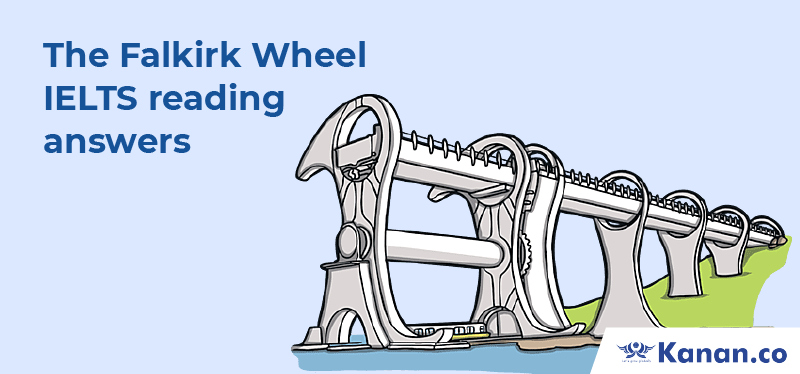
Cambridge 11 Test 1, Reading Passage 2 - The Falkirk Wheel Reading Answers is discussed in this article. This reading passage has 13 questions. These questions fall under True/False/Not Given and Diagram Labelling question type. For your quick reference the answers are given in the table format below. To know the explanation for the answers scroll down!.
Solution for The Falkirk Wheel
| 1. FALSE | 5. FALSE | 9. axle | 13. locks |
| 2. NOT GIVEN | 6. TRUE | 10. cogs | |
| 3. TRUE | 7. gates | 11. aqueduct | |
| 4. NOT GIVEN | 8. clamp | 12. wall |

Reading Passage
Check Out our YouTube Channel to Practice Full-Length IELTS Reading Tests Daily

The Falkirk Wheel
The Falkirk Wheel in Scotland is the world's first and only rotating boat lift. Opened in 2002, it is central to the ambitious £84.5m Millennium Link project to restore navigability across Scotland by reconnecting the historic waterways of the Forth & Clyde and Union Canals.
The major challenge of the project lays in the fact that the Forth & Clyde Canal is situated 35 metres below the level of the Union Canal. Historically, the two canals had been joined near the town of Falkirk by a sequence of 11 locks - enclosed sections of canal in which the water level could be raised or lowered - that stepped down across a distance of 1.5 km. This had been dismantled in 1933, thereby breaking the link.
When the project was launched in 1994, the British Waterways authority were keen to create a dramatic twenty-first-century landmark which would not only be a fitting commemoration of the Millennium, but also a lasting symbol of the economic regeneration of the region.
Numerous ideas were submitted for the project, including concepts ranging from rolling eggs to tilting tanks, from giant seesaws to overhead monorails. The eventual winner was a plan for the huge rotating steel boat lift which was to become The Falkirk Wheel. The unique shape of the structure is claimed to have been inspired by various sources, both manmade and natural, most notably a Celtic double headed axe, but also the vast turning propeller of a ship, the ribcage of a whale or the spine of a fish.
The various parts of The Falkirk Wheel were all constructed and assembled, like one giant toy building set, at Butterley Engineering's Steelworks in Derbyshire, some 400 km from Falkirk.
A team there carefully assembled the 1,200 tonnes of steel, painstakingly fitting the pieces together to an accuracy of just 10 mm to ensure a perfect final fit. In the summer of 2001, the structure was then dismantled and transported on 35 lorries to Falkirk, before all being bolted back together again on the ground, and finally lifted into position in five large sections by crane. The Wheel would need to withstand immense and constantly changing stresses as it rotated, so to make the structure more robust, the steel sections were bolted rather than welded together. Over 45,000 bolt holes were matched with their bolts, and each bolt was hand-tightened.
The Wheel consists of two sets of opposing axe-shaped arms, attached about 25 metres apart to a fixed central spine.
Two diametrically opposed water-filled 'gondolas', each with a capacity of 360,000 litres, are fitted between the ends of the arms. These gondolas always weigh the same, whether or not they are carrying boats.
This is because, according to Archimedes' principle of displacement, floating objects displace their own weight in water. So when a boat enters a gondola, the amount of water leaving the gondola weighs exactly the same as the boat. This keeps the Wheel balanced and so, despite its enormous mass, it rotates through 180° in five and a half minutes while using very little power. It takes just 1.5 kilowatt-hours (5.4 MJ) of energy to rotate the Wheel -roughly the same as boiling eight small domestic kettles of water.
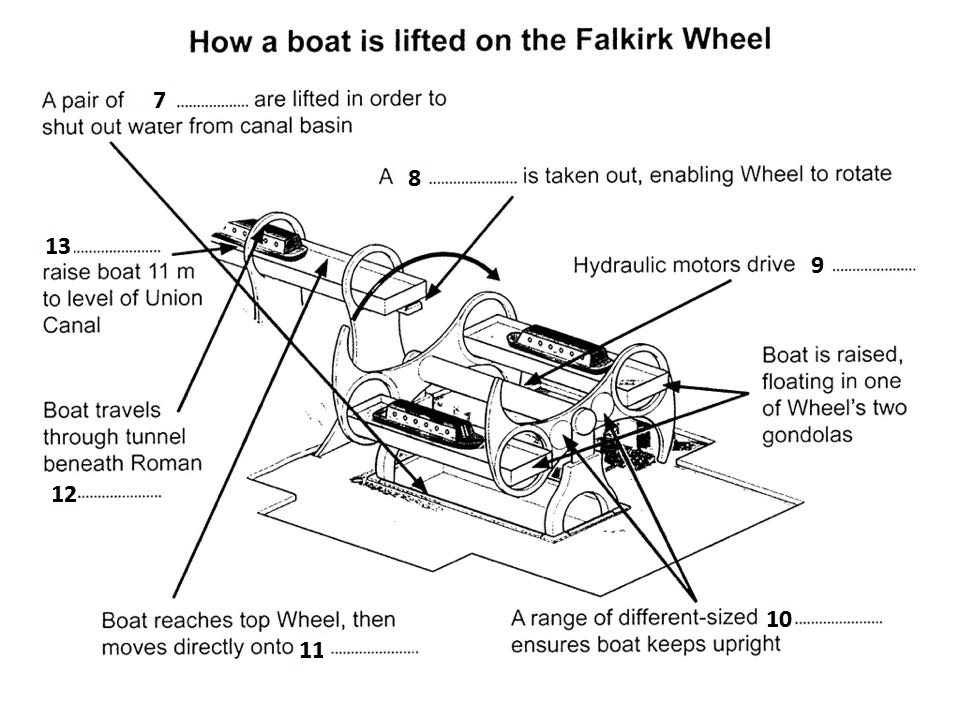
Boats needing to be lifted up enter the canal basin at the level of the Forth & Clyde Canal and then enter the lower gondola of the Wheel. Two hydraulic steel gates are raised, so as to seal the gondola off from the water in the canal basin. The water between the gates is then pumped out. A hydraulic clamp, which prevents the arms of the Wheel moving while the gondola is docked, is removed, allowing the Wheel to turn. In the central machine room an array of ten hydraulic motors then begins to rotate the central axle. The axle connects to the outer arms of the Wheel, which begin to rotate at a speed of 1/8 of a revolution per minute. As the wheel rotates, the gondolas are kept in the upright position by a simple gearing system. Two eight-metre-wide cogs orbit a fixed inner cog of the same width, connected by two smaller cogs travelling in the opposite direction to the outer cogs - so ensuring that the gondolas always remain level. When the gondola reaches the top, the boat passes straight onto the aqueduct situated 24 metres above the canal basin.
The remaining 11 metres of lift needed to reach the Union Canal is achieved by means of a pair of locks. The Wheel could not be constructed to elevate boats over the full 35-metre difference between the two canals, owing to the presence of the historically important Antonine Wall, which was built by the Romans in the second century AD.
Boats travel under this wall via a tunnel, then through the locks, and finally on to the Union Canal.
Questions
Questions 1-6
Do the following statements agree with the information given in Reading Passage?
in boxes 1-6 on your answer sheet, write
TRUE if the statement agrees with the information
FALSE if the statement contradicts the information
NOT GIVEN if there is no information on this
1. The Falkirk Wheel has linked the Forth & Clyde Canal with the Union Canal for the first time in their history.
2. There was some opposition to the design of the Falkirk Wheel at first.
3. The Falkirk Wheel was initially put together at the location where its components were manufactured.
4. The Falkirk Wheel is the only boat lift in the world which has steel sections bolted together by hand.
5. The weight of the gondolas varies according to the size of boat being carried.
6. The construction of the Falkirk Wheel site took into account the presence of a nearby ancient monument.
Questions 7-13
Label the diagram below.
Choose ONE WORD from the passage for each answer.
Write your answers in boxes 7-13 on your answer sheet.
The Falkirk Wheel Reading Answers
For the above questions 1-13, the answers are given with explanation below.
(Note: The text in italics is from the reading passage and shows the location from where the answer is taken or inferred. The text in regular font style explains the answer in detail.)
1. Answer: False
Explanation: In paragraph 2, “Historically, the two canals had been joined near the town of Falkirk by a sequence of 11 locks - enclosed sections of canal in which the water level could be raised or lowered - that stepped down across a distance of 1.5 km. This had been dismantled in 1933, thereby breaking the link.” From these lines it is evident that before 2002, canals are already linked and dismantled in 1993. So the answer is False.
2. Answer: Not Given
Explanation: From the above passage , it is clear that there is no evidence of Falkirk wheel design submission and rejection.
3. Answer: True
Explanation: “The various parts of The Falkirk Wheel were all constructed and assembled, like one giant toy building set, at Butterley Engineering's Steelworks in Derbyshire, some 400 km from Falkirk.” From these lines, we can confirm that the parts of the Falkirk wheel were assembled into a single piece at a location. So the answer is true.
4. Answer: Not Given
Explanation: In the above passage we could not find any reference about the steel section fixed by hands. So it can be concluded as “Not Given”.
5. Answer: False
Explanation: “Two diametrically opposed water-filled 'gondolas', each with a capacity of 360,000 litres, are fitted between the ends of the arms. These gondolas always weigh the same, whether or not they are carrying boats.” From this sentence it is evidence that the Gondolas weigh the same, whether they carry the boat or not .
So the statement is false.
6. Answer: True
Explanation: “The Wheel could not be constructed to elevate boats over the full 35-metre difference between the two canals, owing to the presence of the historically important Antonine Wall, which was built by the Romans in the second century AD.”
The wheels are not constructed to elevate boats to the full metre difference, because of the presence of the historical Antonine Wall. Hence the above statement is true.
7. Answer: Gates
Explanation: “Gates are raised, so as to seal the gondola off from the water in the canal basin”. With this supporting sentence it is clear that gates are used to seal. Hence the answer is gates.
8. Answer: Clamp
Explanation: “clamp, which prevents the arms of the Wheel moving while the gondola is docked, is removed, allowing the Wheel to turn”. To allow the wheel to run, clamp is used.
9. Answer: Axle
Explanation: “in the central machine room an array of ten hydraulic motors then begins to rotate the central axle”. So it means that the hydraulic motors drive, or control the axle by rotating it.
10. Answer: Cogs
Explanation: “as the wheel rotates, the gondolas are kept in the upright position by a simple gearing system. Two eight-metre-wide cogs orbit a fixed inner cog of the same width connected by two smaller cogs….” . It is clear that Cogs helps in keeping the gondolas in upright position. So the answer is cogs.
11. Answer: Aqueduct
Explanation: “When the gondola reaches the top, the boat passes straight onto the aqueduct situated 24 metres above the canal basin”.
12. Answer: Wall
Explanation: Here at the end of the text we got the answer for this. in the last line of the last paragraph, the writer says, “boats travel under this wall via a tunnel…”. This indicates the Antonine Wall as per the previous line. Hence the answer is wall.
13. Answer: Locks
Explanation: “the remaining 11 metres of lift needed to reach the union canal is achieved by a pair of locks.” . It is clear that locks helps the boat to reach the top wheel.
Check the other IELTS Reading Answers
Click to check the other important IELTS Reading Answers listed below,

About Author Gayathri Nagarajan
Gayathri, a trusted study-abroad expert, with expertise in standardized tests like IELTS, TOEFL, PTE, GRE, and GMAT. With a strong tech background from SASTRA University, she excels in software testing and has a passion for content writing and digital marketing. She aids students in finding the perfect academic fit, offering guidance on course selection, LOR and SOP writing. She remains up-to-date with the latest trends in higher education, delivering credible, accurate information on international education, including courses and test prep materials. As a trusted Study abroad expert at Kanan International, explore her latest blogs and articles for comprehensive insights into studying abroad and realizing your academic aspirations.
Kanan.co is a trusted study abroad consultancy offering comprehensive services, resources, and solutions for students and education institutions. We support students at every stage of their global education journey, ensuring a smooth and guided experience. Along with test preparation for IELTS, GRE, TOEFL, and SAT, we provide expert services such as SOP writing, visa guidance, accommodation support, scholarship assistance, and education loan support. Our expertise and commitment to excellence make us a reliable partner for students pursuing international education.
Free Online Mock Test 2026
Practice our mock test worth Rs. 25000 for Free and know your IELTS score!








Global Headquarters
Kanan Int EdTech Inc
320 Bay Street, Suite 321 (Spaces), Toronto ON, Canada M5B 1N9
Indian Headquarters
Kanan International Pvt. Ltd.
D-wing, 2nd Floor, Trident Complex, Ellora Park Vadiwadi Road, Vadodara, Gujarat 390007
IT/ Digital Campus
Kanan International Pvt. Ltd
Old, New No 3, 2nd Floor, 1A, Dr Sadasivam Rd, T. Nagar, Chennai, Tamil Nadu 600017
Our branches
- Bardoli
- Bharuch
- Chennai
- Dehradun
- Gurugram
- Himatnagar
- Karnal
- Nadiad
- Navsari
- Palanpur
- Rajkot
- Vadodara
- Valsad
- Vallabh Vidyanagar
- Vapi
Study Abroad
Test Prep
Top Universities
Consultants
IELTS Centers
GRE Centers
TOEFL Centers
SAT Centers
Language Courses in Vadodara
SOP Blogs
Featured Blogs
Study Abroad Consultants in Chennai
Study Abroad Consultants in Surat
Study Abroad Consultants in Navsari
Study Abroad Consultants in Bardoli
Study Abroad Consultants in Ahmedabad
Study Abroad Consultants in Anand
Study Abroad Consultants in Khanna
Study Abroad Consultants in Nadiad
Study Abroad Consultants in Vadodara
Study abroad consultants in Valsad
Copyright © 2026 KANAN.CO All rights reserved.