- Study Abroad
- / ielts
- / tidal power reading answers
Tidal power Reading Answers - Cambridge 9 Reading test 3 Reading Passage 2


Author
18-09-2025

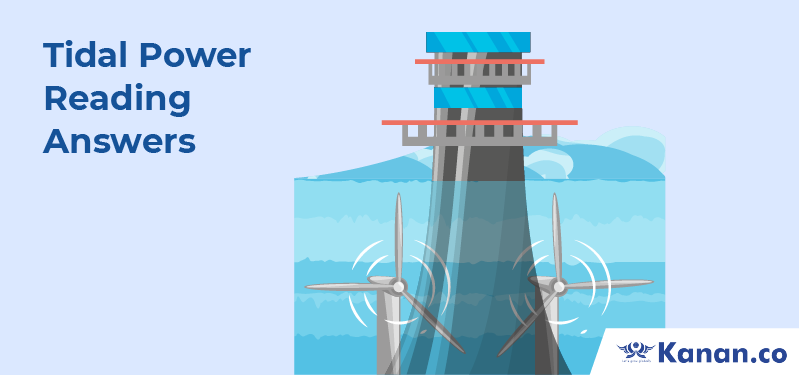
Here you can check your answers with ease by comparing the Tidal power reading answers mentioned below.
Solution for Tidal power
| Q14. C | Q18. A | Q22. J | Q26. cavitation |
| Q15. E | Q19. D | Q23. maintenance | |
| Q16. A | Q20. E | Q24. slow or slow turning | |
| Q17. C | Q21. F | Q25. low pressure |

All your answers got right? Perfect! Try a different passage with the same topic given here, and answer some extra questions as well to see your level of IELTS reading preparation.
When you are done checking your answers with the Tidal power reading answers - Cambridge 9 Reading test 3 Reading Passage 2, you will get to know your performance level. Because all your basic and required skills will be tested using this passage. In the IELTS reading test, you will find different question types with various question types.
Cambridge 9 Reading test 3 Reading Passage 2 is about the marine turbines, their functions, and their uses. You will have the complete passage with a similar topic here. Try to answer all the three different questions given below the passage. Click to check other IELTS reading question types.
- IELTS reading locating information
- IELTS reading yes/no/not given
- IELTS reading multiple choice questions
Check Out our YouTube Channel to Practice Full-Length IELTS Reading Tests Daily

9 thoughts about the presence of Tidal power passage in most practice tests
Below are some primary reasons for the often existence of the passage, Tidal power - Cambridge 9 Reading test 3 Reading Passage 2 in the IELTS practice test.
- Cambridge 9 Reading test 3 Reading Passage 2 contains the detailed information about the undersea turbine, its processes, and its uses,
- It is important to pay close attention to the details as this passage has important information like numbers, distance, and name. Do not miss even a little information.
- Attempting the different question types of the reading module will help you to perform better in the final IELTS reading test.
- In this article, you will have a passage on the same topic with three various question types involving some challenging questions.
- Tidal power reading answers with location are given here with the aim of developing your answering experience.
- Improve your preparation level by trying out all the questions given in this blog. Because it tests your focus, comprehension, and language skills.
- You can find the Tidal power IELTS reading pdf file which includes the passage, questions as well as answers with explanation.
- This entire passage and its solution are taken from the Cambridge 9 Reading Test 3 Reading passage 2.
- Tidal power reading answers with location will make you motivate yourself to achieve a good band score in the IELTS reading test.
After reading the above points, you would have understood the significance of the passage of Cambridge 9 Reading test 3 Reading Passage 2.
Before attempting to write the Tidal power reading answers, check the IELTS reading tips
Tidal power reading passage
Read the given passage and answer all the questions (14 - 26). Then, verify your answers immediately with the Tidal power reading answers.
Tidal Power
Undersea turbines that generate electricity from waves are becoming a major source of renewable energy for Britain. It is still too earlier to anticipate the extent of the consequence they may have, but there are all indications that they may play an important role in the future.
- Operating according to the same principle as wind turbines, Ans for Q18 the force of sea turbines comes from wave currents, which turn blades like propellers on ships, but, unlike wind, the waves are predictable and the power input is stable. Ans for Q15 The technology increases the possibility of Britain becoming self-sufficient in renewable energy and drastically lowers its carbon dioxide emissions. If tidal, wind and tidal power all grow, Britain will be able to close gas, coal, and nuclear power plants and export renewable energy to other parts of Europe. Ans for Q16 Not like wind power, which Britain first created and then quit 20 years later, letting the Dutch turn it into a large industry, submarine turbines could generate large export revenue for island nations like Japan and New Zealand.
- Tidal bases have already been determined that will deliver one-sixth or more of the UK's energy and reduce the cost of competing with current gas turbines and the already dilapidated nuclear industry. One site alone, Ans for Q17 Pentland Firth, between Orkney and Scotland's mainland, could generate 10% of the country's electricity from the shores of submarine turbines, and three times more than the 1,200 megawatts at Britain's biggest and unknown nuclear power plant on the Channel Islands, Alderney. , Sizewell B, in Suffolk. Ans for Q14 Further sites identified contain the Bristol Canal and the west coast of Scotland, especially between Campbelltown and Northern Ireland.
- Ans for Q19 Work on the plans for the latest turbine blades and bases is well underway at the University of Southampton's Sustainable Energy Research Committee. The first station is desired to be set up soon in Lynmouth, Devon, to test the technology in an effort to co-finance trade and industry and the EU. Abubakr Bahaj, who is the head of the Southampton study, says the potential for energy from tidal currents is much better than from wind because water flows are predictable and stable. Technology for dealing with seawater hostile salinity was formed in the North Sea oil industry and is already known for turbine blade design due to wind and ship propulsion. There are some technical issues, but I hope that in the next five to ten years we will establish commercial sea turbine farms. Ans for Q20 Southampton was awarded £ 215,000 over three years to build the turbines and is functioning with IT power subsidiary Marine Current Turbines on the Lynmouth project. EU research has now determined possible sites for 106 wave power, with 80% located around the UK coast. Ans for Q22 The finest sites are between islands or about more inland beaches where there are powerful tidal currents.
- A sea turbine blade should be only one-third the size of a wind turbine generator to deliver thrice as much power. Ans for Q23 The blades are about 20 meters in diameter, so about 30 meters of water is needed. Unlike wind energy, environmental resistance is unlikely. Fish and other creatures are thought to be less likely to be endangered by relatively slow-moving blades. Ans for Q24 Each turbine will be placed on a tower, which will be connected to the national power supply grid through undersea cables. The towers are designed to stick out of the water and burn, alert shipping, Ans for Q25 take it out of the water for maintenance, and to clean the sponge from blades.
- Dr. Bahaj has accomplished a lot of work on the Alderney site, where there are strong currents. The single-submarine turbine farm will create more power than the Channel Islands need, and most will be injected into the French grid and re-imported to Britain through cable under the channel.
- Technical difficulty is cavitation, where low pressure causes air bubbles behind the turning plate. These can generate vibrations and damage the blades of the turbines. Dr. Bahaj stated, 'We need to sample several blade types to prevent this from occurring or at least make sure it does not harm the turbines or lower performance. Ans for Q26 One more minor problem is the submerged waste floating on the blades. So far, we couldn’t get to know the level of consequence it might be. The turbines need to be made stronger because the sea is a hostile environment, but all indications are good that it can be done.
Tidal Power IELTS reading questions
Question (14 - 17)
This reading passage has six paragraphs, A–F.
Which paragraph contains the following information?
Write the correct letter, A-F, as your answer to each question.
Note: You may use any letter more than once.
14. Other sites identified contain the Bristol Canal and the west coast of Scotland.
Answer is Paragraph B
15. Technology raises the chance of Britain becoming self-sufficient in renewable energy and drastically lowers its carbon dioxide emissions.
Answer is Paragraph A
16. Unlike wind power, which Britain first created and then quit 20 years later.
Answer is Paragraph A
17. Pentland Firth, between Orkney and Scotland's mainland, could generate 10% of the country's electricity from the shores of submarine turbines.
Answer is Paragraph B
Question (18 - 22)
Do the following statements agree with the information given in the Reading Passage?
Write
YES if the statement agrees with the claims of the writer
NO, if the statement contradicts the claims of the writer
NOT GIVEN if it is impossible to say what the writer thinks about this
18. The force of sea turbines comes from wave currents, which turn blades like propellers on ships.
Answer is Yes
19. Work on the plans for the old turbine blades and bases is well underway at the University of Southampton's Sustainable Energy Research Committee.
Answer is No
20. Southampton was awarded £ 216,000 over three years to build the turbines
Answer is No
21. Undersea turbines can replace all other types of energy in the UK.
Answer is Not given
22. The best sites are between islands or more inland beaches where there are powerful tidal currents.
Answer is Yes
Question (23 - 26)
Choose the correct letter, A - D
23. The blades are about 20 meters in diameter, so about
A. 20 meters of water required
B. 25 meters of water needed
C. 30 meters of water is needed
D. 10 meters of water is needed
Answer is C. 30 meters of water is needed
24. Each turbine will be placed on a tower, connected to the national power supply grid through
A. undersea cables
B. channel
C. turning plate
D. turbine blades
Answer is A. undersea cables
25. Towers take out of the water for maintenance, and to clean the
A. turbine
B. cables
C. sea
D. sponge from blades
Answer is D. sponge from blades
13. One more minor drawback is the submerged waste
A. floating on the blades
B. found in the sea
C. observed by the turbine
D. stuck in the blades
Answer is A. floating on the blades
Click to know more about IELTS reading multiple choice questions
Tidal power IELTS reading answers with explanations
Get the Tidal power IELTS reading answers key with precise explanations given below for your reference.
(Note: The text in italics is from the reading passage and shows the location from where the answer is taken or inferred. The text in the regular font explains the answer in detail.)
Questions (14 - 17): IELTS Reading Locating Information
Question no. 14: Other sites identified contain the Bristol Canal and the west coast of Scotland.
Solution for Q14 - Paragraph B
Keywords for the question: identified, Bristol Canal, west coast, Scotland
Explanation: Further sites identified contain the Bristol Canal and the west coast of Scotland, especially between Campbelltown and Northern Ireland.
Question no. 15: Technology raises the chance of Britain becoming self-sufficient in renewable energy and drastically lowers its carbon dioxide emissions.
Solution for Q15 - Paragraph A
Keywords for the question: Technology, Britain, self-sufficient, carbon dioxide emissions
Explanation: The technology increases the possibility of Britain becoming self-sufficient in renewable energy and drastically lowers its carbon dioxide emissions.
Question no. 16: Unlike wind power, which Britain first created and then quit 20 years later.
Solution for Q16 - Paragraph A
Keywords for the question: wind power, Britain, 20 years
Explanation: Not like wind power, which Britain first created and then quit 20 years later, letting the Dutch turn it into a large industry, submarine turbines could generate large export revenue for island nations like Japan and New Zealand.
Question no. 17: Pentland Firth, between Orkney and Scotland's mainland, could generate 10% of the country's electricity from the shores of submarine turbines.
Solution for Q17 - Paragraph B
Keywords for the question: Pentland Firth, Orkney, Scotland's mainland, 10%
Explanation: One site alone, Pentland Firth, between Orkney and Scotland's mainland, could generate 10% of the country's electricity from the shores of submarine turbines,...
Questions (18 - 22): IELTS Reading Yes/No/Not given
Question no. 18: The force of sea turbines comes from wave currents, which turn blades like propellers on ships.
Solution for Q18 - Yes
Keywords for the question: force, sea turbines, wave currents, propellers
Explanation: Operating according to the same principle as wind turbines, the force of sea turbines comes from wave currents, which turn blades like propellers on ships, but, unlike wind, the waves are predictable and the power input is stable.
Question no. 19: Work on the plans for the old turbine blades and bases is well underway at the University of Southampton's Sustainable Energy Research Committee.
Solution for Q19 - No
Keywords for the question: old turbine blades, underway, University of Southampton's
Explanation: Work on the plans for the latest turbine blades and bases is well underway at the University of Southampton's Sustainable Energy Research Committee.
Question no. 20: Southampton was awarded £ 216,000 over three years to build the turbines
Solution for Q20 - No
Keywords for the question: Southampton, awarded £ 216,000, turbines
Explanation: Southampton was awarded £ 215,000 over three years to build the turbines and is functioning with IT power subsidiary Marine Current Turbines on the Lynmouth project.
Question no. 21: Undersea turbines can replace all other types of energy in the UK.
Solution for Q21 - Not given
Keywords for the question: Undersea turbines, replace, other types of energy, UK
Explanation: Such statement is NOT FOUND in the Cambridge 9 Reading test 3 Reading Passage 2
Question no. 22: The best sites are between islands or more inland beaches where there are powerful tidal currents.
Solution for Q22 - Yes
Keywords for the question: islands, inland beaches, powerful tidal currents
Explanation: The finest sites are between islands or more inland beaches where there are powerful tidal currents.
Questions (23 - 26): IELTS Reading Multiple choice questions
Question no. 23: The blades are about 20 meters in diameter, so about
Keywords for the question: blades, 20 meters, diameter
Solution for 23 - C. 30 meters of water is needed
Explanation: The blades are about 20 meters in diameter, so about 30 meters of water is needed.
Question no. 24: Each turbine will be placed on a tower, connected to the national power supply grid through
Keywords for the question: turbine, tower, connected, national power supply grid
Solution for Q24 - A. undersea cables
Explanation: Each turbine will be placed on a tower, which will be connected to the national power supply grid through undersea cables.
Questions no. 25: Towers take out of the water for maintenance, and to clean the
Keywords for the questions: third strategy, nurses, sick leave, identified, counselled.
Solution for Q25 - D. sponge from blades
Explanation: The towers are designed to stick out of the water and burn, alert shipping, take it out of the water for maintenance, and to clean the sponge from blades.
Question no. 26: One more minor drawback is the submerged waste
Keywords for the question: minor, drawback, submerged
Solution for Q26 - A. floating on the blades
Explanation: One more minor problem is the submerged waste floating on the blades. So far, we couldn’t get to know the level of consequence it might be.
Check answers for (Cambridge 9 Test 3)
Get the solutions for the remaining two passages of Cambridge 2 Reading test 3 which are provided below,
Cambridge 9 Reading test 3 Reading Passage 1 - Attitudes to language IELTS reading answers
1. Yes
2. No
3. Yes
4. Not given
5. Yes
6. Yes
7. No
8. Yes
9. H
10. F
11. A
12. C
13. B
Cambridge 9 Reading test 3 Reading Passage 3 - The information theory - the big idea reading answers
27. D
28. F
29. B
30. E
31. A
32. C
33. Jupiter, Saturn
34. Solar system
35. Sensors, Circuits
36. Spares
37. Radio dish
38. True
39. True
40. False
Check the other reading passages (h4)
Click to check the other important reading passages listed below,
- Beyond The Blue Horizon Reading Answers
- Venus In Transit Reading Answers
- Advantages of Public Transport Reading Answers
Conclusion
Ultimately, practice is the major key to success. So, keep practicing. Hopefully, “Tidal power reading answers” and the exercise Cambridge 9 Reading test 3 Reading Passage 2 given in this blog will be beneficial for you to increase your score on the IELTS reading test.

About Author Manimegalai Samidurai
Manimegalai is a multifaceted professional, excelling as an author, writer, and study-abroad expert. Her vast knowledge of English proficiency exams, including IELTS, GRE, SAT, and PTE, and exceptional content writing skills make her a go-to resource for students seeking guidance and support in their foreign education journey. She is a trusted authority in writing content related to these test-prep exams, making her an invaluable resource for those seeking guidance. With her well-researched and informative blogs, articles, and study materials, Manimegalai has helped countless students achieve their desired band scores and get admissions to top-notch colleges & universities in countries like Canada, USA, UK, Australia, Ireland, etc.
Kanan.co is a trusted study abroad consultancy offering comprehensive services, resources, and solutions for students and education institutions. We support students at every stage of their global education journey, ensuring a smooth and guided experience. Along with test preparation for IELTS, GRE, TOEFL, and SAT, we provide expert services such as SOP writing, visa guidance, accommodation support, scholarship assistance, and education loan support. Our expertise and commitment to excellence make us a reliable partner for students pursuing international education.
Free Online Mock Test 2026
Practice our mock test worth Rs. 25000 for Free and know your IELTS score!








Global Headquarters
Kanan Int EdTech Inc
320 Bay Street, Suite 321 (Spaces), Toronto ON, Canada M5B 1N9
Indian Headquarters
Kanan International Pvt. Ltd.
D-wing, 2nd Floor, Trident Complex, Ellora Park Vadiwadi Road, Vadodara, Gujarat 390007
IT/ Digital Campus
Kanan International Pvt. Ltd
Old, New No 3, 2nd Floor, 1A, Dr Sadasivam Rd, T. Nagar, Chennai, Tamil Nadu 600017
Our branches
- Bardoli
- Bharuch
- Chennai
- Dehradun
- Gurugram
- Himatnagar
- Karnal
- Nadiad
- Navsari
- Palanpur
- Rajkot
- Vadodara
- Valsad
- Vallabh Vidyanagar
- Vapi
Study Abroad
Test Prep
Top Universities
Consultants
IELTS Centers
GRE Centers
TOEFL Centers
SAT Centers
Language Courses in Vadodara
Study Abroad Calculators
Featured Blogs
Study Abroad Consultants in Chennai
Study Abroad Consultants in Surat
Study Abroad Consultants in Navsari
Study Abroad Consultants in Bardoli
Study Abroad Consultants in Ahmedabad
Study Abroad Consultants in Anand
Study Abroad Consultants in Khanna
Study Abroad Consultants in Nadiad
Study Abroad Consultants in Vadodara
Study abroad consultants in Valsad
Copyright © 2026 KANAN.CO All rights reserved.