- Study Abroad
- / ielts
- / the fertility bust reading answers
The Fertility Bust Reading Answers


Author
17-09-2025

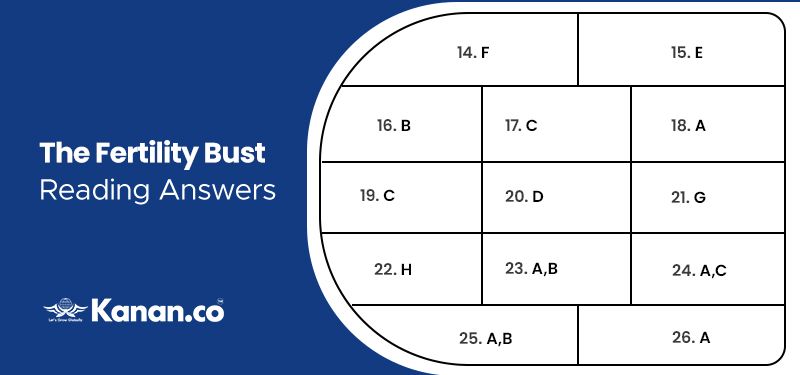
Here, we have given the fertility bust reading answers as a practice test for the IELTS reading practice test. This article has 13 questions based on the given passage in 3 different types namely - 4 questions as matching headings, 5 questions as multiple choice and 4 questions as multiple choice questions.
Check out our YouTube Channel to Practice Full-Length IELTS Reading Tests Daily

Table of content:
- Solution for the fertility bust
- The fertility bust IELTS reading practice test
- Passage
- Questions
- Answers with explanation
Solution for The Fertility Bust
Below, we have given the answers for the fertility bust reading answers in the table form.

Answer Table
| 14. F | 17. C | 20. D | 23. A,B | 26. A |
| 15. E | 18. A | 21. G | 24. A,C | |
| 16. B | 19. C | 22. H | 25. A,B |
The Fertility Bust IELTS Reading Answers - Exam Review
In this article we have given The Fertility Bust IELTS reading answers it will help you to attain a band score in your major exam. Read the passage carefully and answer the given questions.
Passage
We have given The Fertility Bust reading answers with location. Read the passage completely and answer your questions.
The Fertility Bust reading answers
- Falling populations – the despair of state pension systems – are often regarded with calmness, even a secret satisfaction, by ordinary people. Europeans no longer need large families to gather the harvest or to look after parents. They have used their good fortune to have fewer children, thinking this will make their lives better. Much of Europe is too crowded as it is. Is this all that is going on? Germans have been agonising about recent European Union estimates suggesting that 30% of German women are, and will remain, childless. The number is a guess: Germany does not collect figures like this. Even if the share is 25%, as other surveys suggest, it is by far the highest in Europe.
- Germany is something of an oddity in this. In most countries with low fertility, young women have their first child late, and stop at one. In Germany, women with children often have two or three, but many have none at all. Germany is also odd in experiencing low fertility for such a long time. Europe is demographically polarised. Countries in the north and west saw fertility fall early, in the 1960s. Recently, they have seen it stabilise or rise back towards replacement level (i.e. 2.1 births per woman). Countries in the south and east, on the other hand, saw fertility rates fall much faster, more recently (often to below 1.3, a rate at which the population falls by half every 45 years). Germany combines both. Its fertility rate fell below 2 in 1971. However, it has stayed low and is still only just above 1.3. This challenges the notion that European fertility is likely to stabilise at tolerable levels. It raises questions about whether the low birth rates of Italy and Poland, say, really are, as some have argued, merely temporary.
- The list of explanations for why German fertility has not rebounded is long. Michael Teitelbaum, a demographer at the Sloan Foundation in New York ticks them off: poor childcare; unusually extended higher education; inflexible labour laws; high youth unemployment; and non-economic or cultural factors. One German writer, Gunter Grass, wrote a novel, “Headbirths”, in 1982, about Harm and Dorte Peters, “a model couple” who disport themselves on the beaches of Asia rather than invest time and trouble in bringing up a baby. “They keep a cat,” writes Mr. Grass, “and still have no child.” The novel is subtitled “The Germans Are Dying Out”. With the exception of this cultural factor, none of these features is peculiar to Germany. If social and economic explanations account for persistent low fertility there, then they may well produce the same persistence elsewhere.
- The reason for hoping otherwise is that the initial decline in southern and eastern Europe was drastic, and may be reversible. In the Mediterranean, demographic decline was associated with freeing young women from the constraints of traditional Catholicism, which encouraged large families. In eastern Europe, it was associated with the collapse in living standards and the ending of pro-birth policies. In both regions, as such temporary factors fade, fertility rates might, in principle, be expected to rise. Indeed, they may already be stabilising in Italy and Spain. Germany tells you that reversing these trends can be hard. There, and elsewhere, fertility rates did not merely fall; they went below what people said they wanted. In 1979, Eurobarometer asked Europeans how many children they would like. Almost everywhere, the answer was two: the traditional two-child ideal persisted even when people were not delivering it. This may have reflected old habits of mind. Or people may really be having fewer children than they claim to want.
- A recent paper suggests how this might come about. If women postpone their first child past their mid-30s, it may be too late to have a second even if they want one (the average age of first births in most of Europe is now 30). If everyone does the same, one child becomes the norm: a one-child policy by example rather than coercion, as it were. If women wait to start a family until they are established at work, they may end up postponing children longer than they might otherwise have chosen. When birth rates began to fall in Europe, this was said to be a simple matter of choice. That was true, but it is possible that fertility may overshoot below what people might naturally have chosen. For many years, politicians have argued that southern Europe will catch up from its fertility decline because women, having postponed their first child, will quickly have a second and third. The overshoot theory suggests there may be only partial recuperation. Postponement could permanently lower fertility, not just redistribute it across time.
- There is a twist. If people have fewer children than they claim to want, how they see the family may change, too. Research by Tomas Sobotka of the Vienna Institute of Demography suggests that, after decades of low fertility, a quarter of young German men and a fifth of young women say they have no intention of having children and think that this is fine. When Eurobarometer repeated its poll about ideal family size in 2001, support for the two-child model had fallen everywhere. Parts of Europe, then, may be entering a new demographic trap. People restrict family size from choice. Social, economic, and cultural factors then cause this natural fertility decline to overshoot. This changes expectations, to which people respond by having even fewer children. That does not necessarily mean that birth rates will fall even more: there may yet be some natural floor, but it could mean that recovery from very low fertility rates proves to be slow or even non-existent.
Questions
Questions 14-17
- The text has 6 paragraphs (A – F).
- Which paragraph does each of the following headings best fit?
14. Even further falls?
15. One-child policy
16. Germany differs
17. Possible reasons
Questions 18-22
- According to the text, FIVE of the following statements are true.
- Write the corresponding letters in answer boxes 18 to 22 in any order.
A. Germany has the highest percentage of childless women.
B. Italy and Poland have high birth rates.
C. Most of the reasons given by Michael Teitelbaum are not unique to Germany.
D. Governments in eastern Europe encouraged people to have children.
E. In 1979, most families had one or two children.
F. European women who have a child later usually have more soon after.
G. In 2001, people wanted fewer children than in 1979, according to Eurobarometer research.
H. Here may be a natural level at which birth rates stop declining.
Questions 23-26
- According to the information given in the text, choose the correct answer or answers from the choices given.
23. Reasons that ordinary Europeans do not think it is necessary to have as many children include
- less labour needed to farm land.
- the feeling that Europe is too crowded.
- a general dislike of children
24. Michael Teitelbaum adds the following reasons:
- poor child care facilities.
- longer working hours.
- high unemployment amongst young adults.
25. Initial declines in southern and eastern Europe were because (of)
- the reduced influence of the Catholic church.
- lower standards of living.
- governments encouraged smaller families.
26. People may have fewer children than they want because
- Women are having children at a later age.
- They are following the example of other people.
- Politicians want them to.
Answers for the fertility bust with explanations
We have given The Fertility Bust reading answers with explanations, It will help you to identify your mistakes in the answering process.
14. Answer: F
Explanation: “When Eurobarometer repeated its poll about ideal family size in 2001, support for the two-child model had fallen everywhere. Parts of Europe, then, may be entering a new demographic trap. People restrict family size from choice. Social, economic, and cultural factors then cause this natural fertility decline to overshoot. This changes expectations, to which people respond by having even fewer children”. With this line it is clear that paragraph F fits with the given heading Even further falls?. Hence the given answer is located in the 5-10 lines of paragraph F.
15. Answer: E
Explanation: “If everyone does the same, one child becomes the norm: a one-child policy by example rather than coercion, as it were”. With this line it is clear that paragraph E fits with the given heading One-child policy. Hence the given answer is located in the 3-5 lines of paragraph E.
16. Answer: B
Explanation: “Germany is something of an oddity in this. In most countries with low fertility, young women have their first child late, and stop at one. In Germany, women with children often have two or three, but many have none at all. Germany is also odd in experiencing low fertility for such a long time”. With this line it is clear that paragraph B fits with the given heading Germany differs. Hence the given answer is located in the first 4 lines of paragraph B.
17. Answer: C
Explanation: “The list of explanations for why German fertility has not rebounded is long. Michael Teitelbaum, a demographer at the Sloan Foundation in New York ticks them off: poor childcare; unusually extended higher education; inflexible labour laws; high youth unemployment; and non-economic or cultural factors”. With this line it is clear that paragraph C fits with the given heading Possible reasons. Hence the given answer is located in the first 4 lines of paragraph C.
18. Answer: A
Explanation: “Germany does not collect figures like this. Even if the share is 25%, as other surveys suggest, it is by far the highest in Europe”. With this line it is clear that Germany has the highest percentage of childless women. Hence the given answer in the last 2 lines of paragraph A.
19. Answer: C
Explanation: “The list of explanations for why German fertility has not rebounded is long. Michael Teitelbaum, a demographer at the Sloan Foundation in New York ticks them off: poor childcare; unusually extended higher education; inflexible labour laws; high youth unemployment; and non-economic or cultural factors. One German writer, Gunter Grass, wrote a novel, “Headbirths”, in 1982, about Harm and Dorte Peters, “a model couple” who disport themselves on the beaches of Asia rather than invest time and trouble in bringing up a baby. “They keep a cat,” writes Mr. Grass, “and still have no child.” The novel is subtitled “The Germans Are Dying Out”. With the exception of this cultural factor, none of these features is peculiar to Germany”. With this line it is clear that most of the reasons given by Michael Teitelbaum are not unique to Germany. Hence the given answer is located in paragraph C.
20. Answer: D
Explanation: “In eastern Europe, it was associated with the collapse in living standards and the ending of pro-birth policies. In both regions, as such temporary factors fade, fertility rates might, in principle, be expected to rise”. With this line it is clear that Governments in eastern Europe encouraged people to have children. Hence the given answer is located in the 4-7 lines of paragraph D.
21. Answer: G
Explanation: “In 1979, Eurobarometer asked Europeans how many children they would like. Almost everywhere, the answer was two: the traditional two-child ideal persisted even when people were not delivering it” and “When Eurobarometer repeated its poll about ideal family size in 2001, support for the two-child model had fallen everywhere”. With this line it is clear that in 2001, people wanted fewer children than in 1979, according to Eurobarometer research. Hence the given answer is located in the 10-11 lines of paragraph D and 5-7 lines of paragraph F.
22. Answer: H
Explanation: “That does not necessarily mean that birth rates will fall even more: there may yet be some natural floor, but it could mean that recovery from very low fertility rates proves to be slow or even non-existent”. With this line it is clear that may be a natural level at which birth rates stop declining. Hence the given answer is located in the last 4 lines of paragraph F.
23. Answer: A,B
Explanation: “Europeans no longer need large families to gather the harvest or to look after parents. They have used their good fortune to have fewer children, thinking this will make their lives better. Much of Europe is too crowded as it is”. With this line it is clear that ordinary Europeans do not think it is necessary to have as many children include less labour needed to farm land and the feeling that Europe is too crowded. Hence the given answer is located in the 2-5 lines of paragraph A.
24. Answer: A,C
Explanation: “Michael Teitelbaum, a demographer at the Sloan Foundation in New York ticks them off: poor childcare; unusually extended higher education; inflexible labour laws; high youth unemployment; and non-economic or cultural factors”. With this line it is clear that Michael Teitelbaum adds the following reasons are poor child care facilities and high unemployment amongst young adults. Hence the given answer is located in the 2-5 lines of paragraph C.
25. Answer: A,B
Explanation: “The reason for hoping otherwise is that the initial decline in southern and eastern Europe was drastic, and may be reversible. In the Mediterranean, demographic decline was associated with freeing young women from the constraints of traditional Catholicism, which encouraged large families. In eastern Europe, it was associated with the collapse in living standards and the ending of pro-birth policies”. With this line it is clear that Initial declines in southern and eastern Europe were because (of) the reduced influence of the Catholic church and governments encouraged smaller families. Hence the given answer is located in the 1-6 lines of paragraph D.
26. Answer: A
Explanation: “A recent paper suggests how this might come about. If women postpone their first child past their mid-30s, it may be too late to have a second even if they want one (the average age of first births in most of Europe is now 30)”. With this line it is clear that People may have fewer children than they want because women are having children at a later age. Hence the given answer is located in the first 3 lines of paragraph E.
Other reading answers

About Author Gayathri Nagarajan
Gayathri, a trusted study-abroad expert, with expertise in standardized tests like IELTS, TOEFL, PTE, GRE, and GMAT. With a strong tech background from SASTRA University, she excels in software testing and has a passion for content writing and digital marketing. She aids students in finding the perfect academic fit, offering guidance on course selection, LOR and SOP writing. She remains up-to-date with the latest trends in higher education, delivering credible, accurate information on international education, including courses and test prep materials. As a trusted Study abroad expert at Kanan International, explore her latest blogs and articles for comprehensive insights into studying abroad and realizing your academic aspirations.
Kanan.co is a trusted study abroad consultancy offering comprehensive services, resources, and solutions for students and education institutions. We support students at every stage of their global education journey, ensuring a smooth and guided experience. Along with test preparation for IELTS, GRE, TOEFL, and SAT, we provide expert services such as SOP writing, visa guidance, accommodation support, scholarship assistance, and education loan support. Our expertise and commitment to excellence make us a reliable partner for students pursuing international education.
Free Online Mock Test 2026
Practice our mock test worth Rs. 25000 for Free and know your IELTS score!








Global Headquarters
Kanan Int EdTech Inc
320 Bay Street, Suite 321 (Spaces), Toronto ON, Canada M5B 1N9
Indian Headquarters
Kanan International Pvt. Ltd.
D-wing, 2nd Floor, Trident Complex, Ellora Park Vadiwadi Road, Vadodara, Gujarat 390007
IT/ Digital Campus
Kanan International Pvt. Ltd
Old, New No 3, 2nd Floor, 1A, Dr Sadasivam Rd, T. Nagar, Chennai, Tamil Nadu 600017
Our branches
- Bardoli
- Bharuch
- Chennai
- Dehradun
- Gurugram
- Himatnagar
- Karnal
- Nadiad
- Navsari
- Palanpur
- Rajkot
- Vadodara
- Valsad
- Vallabh Vidyanagar
- Vapi
Study Abroad
Test Prep
Top Universities
Consultants
IELTS Centers
GRE Centers
TOEFL Centers
SAT Centers
Language Courses in Vadodara
Study Abroad Calculators
Featured Blogs
Study Abroad Consultants in Chennai
Study Abroad Consultants in Surat
Study Abroad Consultants in Navsari
Study Abroad Consultants in Bardoli
Study Abroad Consultants in Ahmedabad
Study Abroad Consultants in Anand
Study Abroad Consultants in Khanna
Study Abroad Consultants in Nadiad
Study Abroad Consultants in Vadodara
Study abroad consultants in Valsad
Copyright © 2026 KANAN.CO All rights reserved.