- Study Abroad
- / ielts
- / the first anti gravity machine reading answers
The First Anti gravity Machine reading Answers


Author
16-09-2025

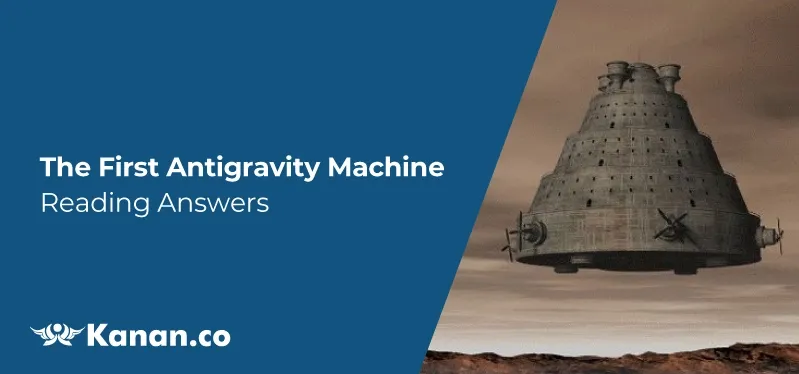
The First Anti Gravity Machine reading answers’ practice test is provided with answers and explanations. This passage comprises 14 questions divided into three question types that are Diagram completion, Classify the following, True/False/Not given.
Table of contents:
- Solution for The First Antigravity Machine
- The First Anti Gravity Machine IELTS Reading Practice Test
- Passage
- Questions
- Answers with Explanations
Solution for The First Antigravity Machine
The First Anti gravity Machine reading answers are listed in the table below. Verify your answers with our answer table, then correct your mistakes.
Answer Table
| 27. (Sensitive) Balance | 31. B | 35. B | 39. True |
| 28. 5000 Revolutions per minute | 32. A | 36. False | 40. False |
| 29. Liquid Nitrogen | 33. C | 37. True | |
| 30. Glass Tube | 34. A | 38. Not given |

The First Anti Gravity Machine IELTS Reading Practice Test - Exam Review
Check out our YouTube Channel to Practice Full-Length IELTS Reading Tests Daily

The First Anti gravity Machine reading answers are given here, which will help you practise your reading module. This IELTS reading practice test is to make you ready for the actual IELTS examination. Skimming and scanning will help you to figure out the key ideas in the passage. Additionally, having a strong vocabulary can aid in identifying the right answers
Passage
We’ve provided the reading passage of The first antigravity machine. Read the passage and carefully complete the questions.
The First Antigravity Machine
A. It was one of the biggest science stories of the 1990s. Even now, the facts behind it remain hotly disputed. And small wonder, for if the claims made for the small disc, the focus of the controversy, are true, it may be possible to break through one of the great barriers in the scientific world and control the most potent of cosmic forces: gravity. Huge innovations in flight and space travel could arise from that.
B. The first gravity-blocking system to be taken seriously by scientists appeared in a laboratory in Tampere University of Technology, Finland. A Russian scientist named Dr. Evgeny Podkletnov created a disc 275mm across, made from a substance which combined copper, barium and the ‘rare Earth metal’ called yttrium, which is known to be a high-temperature superconductor (a substance that conducts electricity without resistance). When chilled with liquid nitrogen at -196° C (a high temperature compared with other superconductors), this material loses all its electrical resistance and can levitate (lift) in a magnetic field. That may seem amazing for a ceramic-like material – and it won a Nobel Prize for the scientists Karl Muller and Johannes Bednorz, who first demonstrated it in the 1980s. But according to Podkletnov, the disc had another far more astounding property.
In 1992, while experimenting with rotating superconductors, Podkletnov noticed that pipe-smoke from a nearby researcher was drifting into a vertical column above the spinning disc. Intrigued by this phenomenon, he decided to devise an experiment to investigate further. A superconductive disc, surrounded by liquid nitrogen was magnetically levitated and rotated at high speed – up to 5,000 revolutions per minute (rpm) in a magnetic field. An object was suspended from a sensitive balance above the disc. It was enclosed in a glass tube to shield it from any effects of air currents. During the course of a series of tests, Podkletnov was able to observe that the object lost a variable amount of weight from less than 0.5 percent to 2 percent of its total weight. The effect was noted with a range of materials from ceramics to wood. The effect was slight, yet the implications were revolutionary: the disc appeared to be partly shielding the object from the gravitational pull of the earth.
C. This was just the start, claimed Podkletnov. While far short of the 100 percent reduction in weight needed to send astronauts into space, for example, it was infinitely greater than the amount predicted by the best theory of gravity currently in existence. Einstein’s theory of general relativity (GR), published in 1905. According to Einstein, gravity is not some kind of ‘force field’ like magnetism, which can – in principle at least – be screened out. Instead, GR views gravity as a distortion in the very fabric of space and time that permeates the whole cosmos. As such, any claim to have shielded objects from gravity is to defy Einstein himself.
Podkletnov’s claims were subjected to intense scrutiny when he submitted them for publication. The UK Institute of Physics had Podkletnov’s paper checked by three independent referees, but none could find a fatal flaw. His research was set to appear in the respected Journal of Physics D when events took an unexpected turn. The claims were leaked to the media, sparking worldwide coverage of his apparent breakthrough. Then Podkletnov suddenly withdrew the paper from publication and refused to talk to the press.
Rumours began to circulate of unknown backers, demanding silence until the device had been fully patented. But for many scientists, the strange events were all too familiar. Podkletnov was just the latest in a long line of people to have made claims about defying gravity. Most of these have come from madcap inventors, with bizarre devices, often with some kind of spinning disc. But occasionally respectable academics have made such claims as well.
D. One instance of this occurred in the late 198Os when scientists at Tohoku University, Japan, made headlines with research suggesting that apparatus known as the gyroscope, lost 0.01 percent of its weight when spinning at up to 13,000 rpm. Oddly the effect only appeared if the gyroscope was spinning anticlockwise – raising suspicions that some mechanical peculiarity was to blame. Attempts by scientists at the University of Colorado to replicate the effect failed.
E. Then Professor Giovanni Modanese, an Italian theoretical physicist, became interested. He had read an earlier paper by Podkletnov, hinting at a connection between superconductivity and gravity shielding. Modenese wondered if the magnetic field surrounding the superconductive disc might somehow assimilate part of the gravitational field under it. He published some calculations based on his idea in 1995 – and soon discovered that taking ‘antigravity’ seriously was a career-limiting move.
F. The revelations about Podkletnov’s antigravity research led to reports of major corporations setting up their own studies. In 2000, the UK defence contractor BAE systems were said to have launched “Project Greenglow” to investigate Podkletnov’s gravity shield effect. Then it emerged that the US aircraft builder Boeing was also investigating, suggesting it too had an interest in the effect. Groups in other countries were also rumoured to be carrying out studies. Yet not one of the teams had reported confirmation of the original findings. Some projects have been wound up without producing results either way. So for the time being, it seems that the dream of controlling gravity will remain precisely that.
Questions
Question 27 – 30
Label the diagram below. Choose NO MORE THAN THREE WORDS AND/OR A NUMBER from the passage for each answer.

27. ______ to measure weight loss
28. ______ superconductive disc rotating at max
cooling 29._______
30. _______ to protect object from disturbance
Questions 31-35
Classify the following findings as belonging to
A Podkletnov
B Tohoku University
C Modanese
Write the correct letter A, B or C in boxes 31 – 35 on your answer sheet.
ABC31. The experiment only works if the equipment moves in a particular direction.
31. The experiment only works if the equipment moves in a particular direction.
32. Varying amounts of weight are lost as a result of the test.
33. Gravity could be absorbed by a magnetic field.
34. Superconductive material seems to screen an object from gravity.
35. Weight loss occurs when the equipment rotates at speeds reaching 13,000 rpm.
Question 36-40
Do the following statements agree with information given in Reading Passage 3?
In boxes 36 – 40 on your answer sheet, write
TRUE if the statement agrees with the information
FALSE if the statement contradicts the information
NOT GIVEN if there is no information on this.
36. Podkletnov won a prize for his initial work on superconductive substances.
37. A chance observation led Podkletnov to experiment with gravity blocking.
38. Einstein challenged earlier experiments on antigravity.
39. Modanese suffered professionally after following up Podkletnov’s findings.
40. An aircraft company announced that it had replicated Podkletnov’s results.
Answers for The First Anti Gravity Machine With Explanations
The First Anti gravity Machine reading answers with explanations is given below. Refer to the following answers with an explanation section in order to correct your errors.
(Note: The text in italics mentions the location and referring lines written in the reading passage.)
27. Answer: (Sensitive) Balance
Explanation: In the sixteenth line of paragraph B, “object was suspended from a sensitive balance above the disc”.
28. Answer: 5,000 revolutions per minute
Explanation: In the fifteenth line of paragraph of B, “5,000 revolutions per minute”.
29. Answer: Liquid Nitrogen
Explanation: In the sixth line of paragraph B, “When chilled with liquid nitrogen at -196° C (a high temperature compared with other”.
30. Answer: Glass tube
Explanation: In the last sixth line of paragraph paragraph B, “It was enclosed in a glass tube”.
31. Answer: B
Explanation: In the last three lines of paragraph D, “Oddly the effect only appeared if the gyroscope was spinning anticlockwise – raising suspicions that some mechanical peculiarity was to blame. Attempts by scientists at the University of Colorado to replicate the effect failed”.
32. Answer: A
Explanation: In the last third and fourth line of paragraph B, “Podkletnov was able to observe that the object lost a variable amount of weight from less than 0.5 percent to 2 percent of its total weight”.
33. Answer: C
Explanation: In the entire paragraph E, “Then Professor Giovanni Modanese, an Italian theoretical physicist, became interested. He had read an earlier paper by Podkletnov, hinting at a connection between superconductivity and gravity shielding. Modenese wondered if the magnetic field surrounding the superconductive disc might somehow assimilate part of the gravitational field under it. He published some calculations based on his idea in 1995 – and soon discovered that taking ‘antigravity’ seriously was a career-limiting move”.
34. Answer: A
Explanation: In the fourteenth,fifteenth and sixteenth line of paragraph B, “A superconductive disc, surrounded by liquid nitrogen was magnetically levitated and rotated at high speed – up to 5,000 revolutions per minute (rpm) in a magnetic field. An object was suspended from a sensitive balance above the disc”.
35. Answer: B
Explanation: In the first three lines of paragraph D, “scientists at Tohoku University, Japan, made headlines with research suggesting that apparatus known as the gyroscope, lost 0.01 percent of its weight when spinning at up to 13,000 rpm”.
36. Answer: False
Explanation: In the third, fourth and fifth lines of paragraph B, “Dr. Evgeny Podkletnov created a disc 275mm across, made from a substance which combined copper, barium and the ‘rare Earth metal’ called yttrium, which is known to be a high-temperature superconductor”.
37. Answer: True
Explanation: In the eleventh till nineteenth lines of paragraph B, “In 1992, while experimenting with rotating superconductors, Podkletnov noticed that pipe-smoke from a nearby researcher was drifting into a vertical column above the spinning disc. Intrigued by this phenomenon, he decided to devise an experiment to investigate further. A superconductive disc, surrounded by liquid nitrogen was magnetically levitated and rotated at high speed – up to 5,000 revolutions per minute (rpm) in a magnetic field. An object was suspended from a sensitive balance above the disc. It was enclosed in a glass tube to shield it from any effects of air currents. During the course of a series of tests, Podkletnov was able to observe that the object lost a variable amount of weight from less than 0.5 percent to 2 percent of its total weight”.
38. Answer: Not given
Explanation: —
39. Answer: True
Explanation: In the last four lines of paragraph E, “Modenese wondered if the magnetic field surrounding the superconductive disc might somehow assimilate part of the gravitational field under it. He published some calculations based on his idea in 1995 – and soon discovered that taking ‘antigravity’ seriously was a career-limiting move”.
40. Answer: False
Explanation: In the first few lines of paragraph F, “The revelations about Podkletnov’s antigravity research led to reports of major corporations setting up their own studies. In 2000, the UK defence contractor BAE systems were said to have launched “Project Greenglow” to investigate Podkletnov’s gravity shield effect. Then it emerged that the US aircraft builder Boeing was also investigating, suggesting it too had an interest in the effect”.
Other Reading Tests

About Author Dinesh Pandiyan
Dinesh is a highly experienced content writer who specializes in language proficiency tests like IELTS, GRE, PTE, TOEFL, and study abroad. He provides valuable insights and tips to students on various modules of these tests, including reading, writing, speaking, and listening. His articles are well-researched, informative, and engaging, offering practical guidance to students looking to succeed in their academic pursuits. Additionally, Dinesh has coordinated with IELTS trainers to prepare test preparation materials, guides, practice tests, and mock tests, and worked closely with counsellors for study abroad consultancy, providing guidance on choosing the right institution, preparing for interviews, and writing effective statements of purpose (SOP) and letters of recommendation (LOR). Students can benefit from Dinesh's comprehensive knowledge and experience by checking out his articles.
Kanan International is a study abroad consultancy that offers reliable services, products, and solutions for students and education institutions. We support students throughout their study abroad journey, ensuring a hassle-free experience. Our expertise and commitment to excellence make us the go-to partner for expanding global horizons. The company provides coaching for IELTS, GRE, TOEFL, and SAT exams and services like visa consultation, accommodation, scholarship assistance, and education loans.
Free Online Mock Test 2026
Practice our mock test worth Rs. 25000 for Free and know your IELTS score!








Global Headquarters
Kanan Int EdTech Inc
320 Bay Street, Suite 321 (Spaces), Toronto ON, Canada M5B 1N9
Indian Headquarters
Kanan International Pvt. Ltd.
D-wing, 2nd Floor, Trident Complex, Ellora Park Vadiwadi Road, Vadodara, Gujarat 390007
IT/ Digital Campus
Kanan International Pvt. Ltd
Old, New No 3, 2nd Floor, 1A, Dr Sadasivam Rd, T. Nagar, Chennai, Tamil Nadu 600017
Our branches
- Bardoli
- Bharuch
- Chennai
- Dehradun
- Gurugram
- Himatnagar
- Karnal
- Nadiad
- Navsari
- Palanpur
- Rajkot
- Vadodara
- Valsad
- Vallabh Vidyanagar
- Vapi
Study Abroad
Test Prep
Top Universities
Consultants
IELTS Centers
GRE Centers
TOEFL Centers
SAT Centers
Language Courses in Vadodara
Study Abroad Calculators
Featured Blogs
Study Abroad Consultants in Chennai
Study Abroad Consultants in Surat
Study Abroad Consultants in Navsari
Study Abroad Consultants in Bardoli
Study Abroad Consultants in Ahmedabad
Study Abroad Consultants in Anand
Study Abroad Consultants in Khanna
Study Abroad Consultants in Nadiad
Study Abroad Consultants in Vadodara
Study abroad consultants in Valsad
Copyright © 2026 KANAN.CO All rights reserved.