- Study Abroad
- / ielts
- / the hidden histories of exploration exhibition reading answers
The Hidden Histories of Exploration Exhibition Reading Answers


Author
17-09-2025

Here we have given the Hidden Histories of Exploration exhibition reading practice test as a sample one for the IELTS reading practice test. This article has 13 questions based on the given passage in 2 different types namely- 7 questions as true, false or not given and 6 questions as locating information.
Check out our YouTube Channel to Practice Full-Length IELTS Reading Tests Daily

Table of content:
- Solution for the hidden histories of exploration exhibition
- The Hidden Histories of Exploration exhibition IELTS reading practice test
- Passage
- Questions
- Answers with explanation
Solution for The Hidden Histories of Exploration Exhibition
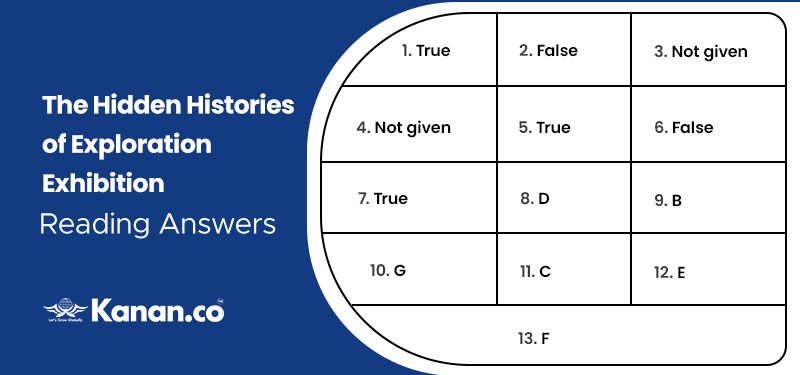
Answers for the Hidden Histories of Exploration exhibition reading answers is given below in the table form.

Answer Table
| 1. True | 4. Not given | 7. True | 10. G | 13. F |
| 2. False | 5. True | 8. D | 11. C | |
| 3. Not given | 6. False | 9. B | 12. E |
The Hidden Histories of Exploration Exhibition IELTS reading practice test - Exam Review
Here we have given the Hidden Histories of Exploration exhibition IELTS reading answers. This article will help to be excellent in the IELTS reading practice to challenge your reading skill and read the given passage to answer the questions.
Passage
We have given the Hidden Histories of Exploration exhibition reading answers with location. Go through the given passage carefully and answer the questions.
The Hidden Histories of Exploration Exhibition
- We have all heard tales of lone, heroic explorers, but what about the local individuals who guided and protected European explorers in many different parts of the globe? Or the go-betweens – including interpreters and traders – who translated the needs and demands of explorers into a language that locals could understand? Such questions have received surprisingly little attention in standard histories, where European explorers are usually the heroes, sometimes the villains. The Hidden Histories of Exploration exhibition at Britain’s Royal Geographical Society in London sets out to present an alternative view, in which exploration is a fundamentally collective experience of work, involving many different people. Many of the most famous examples of explorers said to have been ‘lone travelers’ – say, Mungo Park or David Livingstone in Africa – were anything but ‘alone’ on their travels. They depended on local support of various kinds – for food, shelter, protection, information, guidance, and solace – as well as on other resources from elsewhere.
- The Royal Geographical Society (RGS) seeks to record this story in its Hidden Histories project, using its astonishingly rich collections. The storage of geographical information was one of the main rationales for the foundation of the RGS in 1830, and the Society’s collections now contain more than two million individual items, including books, manuscripts, maps, photographs art-works, artifacts, and film – a rich storehouse of material reflecting the wide geographical extent of British interest across the globe. In addition to their remarkable scope and range, these collections contain a striking visual record of exploration: the impulse to collect the world is reflected in a large and diverse image archive. For the researcher, this archive can yield many surprises: materials gathered for one purpose – say, maps relating to an international boundary dispute or photographs taken on a scientific expedition – may today be put to quite different uses.
- In their published narratives, European explorers rarely portrayed themselves as vulnerable or dependent on others, despite the fact that without this support they were quite literally lost. Archival research confirms that Europeans were not merely dependent on the work of porters soldiers translators, cooks, pilots, guides, hunters, and collectors: they also relied on local expertise. Such assistance was essential in identifying potential dangers of poisonous species, unpredictable rivers, and uncharted territories – which could mean the difference between life and death. The assistants themselves were usually in a strong bargaining position. In the Amazon, for example, access to entire regions would depend on the willingness of local crew members and other assistants to enter areas inhabited by relatively powerful Amerindian groups. In an account of his journey across South America published in 1836, William Smyth thus complained of frequent desertion by his helpers: without them, it was impossible to get on.
- Those providing local support and information to explorers were themselves often not ‘locals’. For example, the history of African exploration in the nineteenth century is dominated by the use of Zanzibar as a recruiting station for porters, soldiers, and guides who would then travel thousands of miles across the continent. In some accounts, the leading African members of expedition parties – the ‘officers’ or ‘foremen’ – are identified, and their portraits are published alongside those of European explorers.
- The information provided by locals and intermediaries was of potential importance to geographical science. How was this evidence judged? The formal procedures of scientific evaluation provided one framework. Alongside these were more ‘common sense’ notions of veracity and reliability, religiously inspired judgments about the authenticity of testimony, and the routine procedures for cross-checking empirical observations developed in many professions.
- Given explorers’ need for local information and support, it was in their interests to develop effective working partnerships with knowledgeable intermediaries who could act as brokers in their dealings with local inhabitants. Many of these people acquired far more experience in exploration than most Europeans could hope to attain. Some managed large groups of men and women, piloted the explorers’ river craft, or undertook mapping work. The tradition was continued with the Everest expeditions in the 1920s and 1930s, which regularly employed the Tibetan interpreter Karma Paul. In Europe, exploration was increasingly thought of as a career; the same might be said of the non-Europeans on whom their expeditions depended.
- These individuals often forged close working relationships with European explorers. Such partnerships depended on mutual respect, though they were not always easy or intimate, as is particularly clear from the history of the Everest expeditions depicted in the Hidden Histories exhibition. The entire back wall is covered by an enlarged version of a single sheet of photographs of Sherpas taken during the 1936 Everest expedition. The document is a powerful reminder of the manpower on which European mountaineering expeditions depended, and also of the importance of local knowledge and assistance. Transformed from archive to wall display, it tells a powerful story through the medium of individual portraits – including Karma Paul, a veteran of previous expeditions, and the young Tensing Norgay, 17 years before his successful 1953 ascent. This was a highly charged and transitional moment as the contribution of the Sherpas, depicted here with identity tags around their necks, was beginning to be much more widely recognized. These touching portraits encourage us to see them as agents rather than simply colonial subjects or paid employees. Here is a living history, which looks beyond what we already know about exploration: a larger history in which we come to recognize the contribution of everyone involved.
Questions
Questions 1-7
- Do the following statements agree with the information given in the Reading Passage?
- In boxes 1-7 on your answer sheet,
- write true if the statement agrees with the information
- FALSE if the statement contradicts the information
- NOT GIVEN if there is no information on this
1. The Hidden Histories of Exploration exhibition aims to show the wide range of people involved in expeditions.
2. The common belief about how Park and Livingstone traveled is accurate.
3. The RGS has organized a number of exhibitions since it was founded.
4. Some of the records in the RGS archives are more useful than others.
5. Materials owned by the RGS can be used in ways that were not originally intended.
6. In their publications, European explorers often describe their dependence on their helpers.
7. Local helpers refused to accompany William Smyth during parts of his journey.
Questions 8-13
- Reading Passage 1 has seven paragraphs, A-G. Which paragraph contains the following information?
8. Reference to the distances that some non-European helpers traveled
9. Description of a wide range of different types of documents
10. Belief about the effect of an exhibition on people seeing it
11. Examples of risks explorers might have been unaware of without local help
12. Reference to various approaches to assessing data from local helpers
13. Reference to people whose long-term occupation was to organize local assistance for European explorers
Answers for The Hidden Histories of Exploration Exhibition with Explanation
1. Answer: True
Explanation: “The Hidden Histories of Exploration exhibition at Britain’s Royal Geographical Society in London sets out to present an alternative view, in which exploration is a fundamentally collective experience of work, involving many different people. Many of the most famous examples of explorers said to have been ‘lone travelers’ – say, Mungo Park or David Livingstone in Africa – were anything but ‘alone’ on their travels”. With this line, it is clear that the Hidden Histories of Exploration exhibition aims to show the wide range of people involved in expeditions. Hence the given answer is located in the 7-12 lines of paragraph A.
2. Answer: False
Explanation: “Many of the most famous examples of explorers said to have been ‘lone travelers’ – say, Mungo Park or David Livingstone in Africa – were anything but ‘alone’ on their travels”. With this line, it is clear that the given statement contradicts with the given information. Hence the given answer is located in the 10-12 lines of paragraph A.
3. Answer: Not given
4. Answer: Not given
5. Answer: True
Explanation: “For the researcher, this archive can yield many surprises: materials gathered for one purpose – say, maps relating to an international boundary dispute or photographs taken on a scientific expedition – may today be put to quite different uses”. With this line, it is clear that materials owned by the RGS can be used in ways that were not originally intended. Hence the given answer is located in the last 3 lines of paragraph B.
6. Answer: False
Explanation: “In their published narratives, European explorers rarely portrayed themselves as vulnerable or dependent on others, despite the fact that without this support they were quite literally lost”. With this line it is clear that the given statement contradicts with the given information. Hence the given answer is located in the first 3 lines of paragraph C.
7. Answer: True
Explanation: “In an account of his journey across South America published in 1836, William Smyth thus complained of frequent desertion by his helpers: without them, it was impossible to get on”. With this line it is clear that local helpers refused to accompany William Smyth during parts of his journey. Hence the given answer is located in the last 3 lines of paragraph C.
8. Answer: D
Explanation: “The history of African exploration in the nineteenth century is dominated by the use of Zanzibar as a recruiting station for porters, soldiers, and guides who would then travel thousands of miles across the continent. In some accounts, the leading African members of expedition parties – the ‘officers’ or ‘foremen’ – are identified, and their portraits are published alongside those of European explorers”. With this line, it is clear that paragraph D states about reference to the distances that some non-European helpers traveled. Hence the given answer is located in the 2-7 lines of paragraph D.
9. Answer: B
Explanation: “The storage of geographical information was one of the main rationales for the foundation of the RGS in 1830, and the Society’s collections now contain more than two million individual items, including books, manuscripts, maps, photographs art-works, artifacts, and film – a rich storehouse of material reflecting the wide geographical extent of British interest across the globe”. With this line it is clear that paragraph B states about description of a wide range of different types of documents. Hence the given answer is located in the 2-7 lines of paragraph B.
10. Answer: G
Explanation: “These touching portraits encourage us to see them as agents rather than simply colonial subjects or paid employees. Here is a living history, which looks beyond what we already know about exploration: a larger history in which we come to recognize the contribution of everyone involved”. With this line it is clear that paragraph G states about the belief about the effect of an exhibition on people seeing it. Hence the given answer is located in the last 4 lines of paragraph G.
11. Answer: C
Explanation: “Such assistance was essential in identifying potential dangers of poisonous species, unpredictable rivers, and uncharted territories – which could mean the difference between life and death”. With this line it is clear that paragraph C states about examples of risks explorers might have been unaware of without local help. Hence the given answer is located in the 5-8 lines of paragraph C.
12. Answer: E
Explanation: “The information provided by locals and intermediaries was of potential importance to geographical science. How was this evidence judged? The formal procedures of scientific evaluation provided one framework. Alongside these were more ‘common sense’ notions of veracity and reliability, religiously inspired judgments about the authenticity of testimony, and the routine procedures for cross-checking empirical observations developed in many professions”. With this line it is clear that paragraph E states about reference to various approaches to assessing data from local helpers. Hence the given answer is located in paragraph E.
13. Answer: F
Explanation: “Many of these people acquired far more experience in exploration than most Europeans could hope to attain. Some managed large groups of men and women, piloted the explorers’ river craft, or undertook mapping work. The tradition was continued with the Everest expeditions in the 1920s and 1930s, which regularly employed the Tibetan interpreter Karma Paul”. With this line it is clear that paragraph F states about the reference to people whose long-term occupation was to organize local assistance for European explorers. Hence the given answer is located in the 3-8 lines of paragraph F.
Other reading answers

About Author Manimegalai Samidurai
Manimegalai is a multifaceted professional, excelling as an author, writer, and study-abroad expert. Her vast knowledge of English proficiency exams, including IELTS, GRE, SAT, and PTE, and exceptional content writing skills make her a go-to resource for students seeking guidance and support in their foreign education journey. She is a trusted authority in writing content related to these test-prep exams, making her an invaluable resource for those seeking guidance. With her well-researched and informative blogs, articles, and study materials, Manimegalai has helped countless students achieve their desired band scores and get admissions to top-notch colleges & universities in countries like Canada, USA, UK, Australia, Ireland, etc.
Kanan.co is a trusted study abroad consultancy offering comprehensive services, resources, and solutions for students and education institutions. We support students at every stage of their global education journey, ensuring a smooth and guided experience. Along with test preparation for IELTS, GRE, TOEFL, and SAT, we provide expert services such as SOP writing, visa guidance, accommodation support, scholarship assistance, and education loan support. Our expertise and commitment to excellence make us a reliable partner for students pursuing international education.
Free Online Mock Test 2026
Practice our mock test worth Rs. 25000 for Free and know your IELTS score!








Global Headquarters
Kanan Int EdTech Inc
320 Bay Street, Suite 321 (Spaces), Toronto ON, Canada M5B 1N9
Indian Headquarters
Kanan International Pvt. Ltd.
D-wing, 2nd Floor, Trident Complex, Ellora Park Vadiwadi Road, Vadodara, Gujarat 390007
IT/ Digital Campus
Kanan International Pvt. Ltd
Old, New No 3, 2nd Floor, 1A, Dr Sadasivam Rd, T. Nagar, Chennai, Tamil Nadu 600017
Our branches
- Bardoli
- Bharuch
- Chennai
- Dehradun
- Gurugram
- Himatnagar
- Karnal
- Nadiad
- Navsari
- Palanpur
- Rajkot
- Vadodara
- Valsad
- Vallabh Vidyanagar
- Vapi
Study Abroad
Test Prep
Top Universities
Consultants
IELTS Centers
GRE Centers
TOEFL Centers
SAT Centers
Language Courses in Vadodara
Study Abroad Calculators
Featured Blogs
Study Abroad Consultants in Chennai
Study Abroad Consultants in Surat
Study Abroad Consultants in Navsari
Study Abroad Consultants in Bardoli
Study Abroad Consultants in Ahmedabad
Study Abroad Consultants in Anand
Study Abroad Consultants in Khanna
Study Abroad Consultants in Nadiad
Study Abroad Consultants in Vadodara
Study abroad consultants in Valsad
Copyright © 2026 KANAN.CO All rights reserved.