- Study Abroad
- / ielts
- / the lake erie canal reading answers
The Lake Erie Canal Reading Answers


Author
16-09-2025

The Lake Erie Canal reading practice test is provided with answers and explanations. This passage comprises 13 questions divided into three question types -Multiple choice questions, Diagram labelling, and, Short answer questions.
Check out our YouTube Channel to Practice Full-Length IELTS Reading Tests Daily

Table of contents:
- Solution for the Lake Erie Canal
- The Lake Erie Canal IELTS Reading Practice Test
- Passage
- Questions
- Answers with Explanations
Solution for the Lake Erie Canal
The lake erie canal reading answers are listed in the table below. Verify your answers against our answer table, then correct any inaccuracies.
Answer Table
| 1. B,D,F,H,I,K IN ANY ORDER | 5. B,D,F,H,I,K IN ANY ORDER | 9. Valves | 13. (Canal) tolls |
| 2. B,D,F,H,I,K IN ANY ORDER | 6. B,D,F,H,I,K IN ANY ORDER | 10. Fertile land | |
| 3. B,D,F,H,I,K IN ANY ORDER | 7. (Sluice) gates | 11. Flour | |
| 4. B,D,F,H,I,K IN ANY ORDER | 8. (the) chamber | 12. 8 years |

The Lake Erie Canal IELTS Reading Practice Test - Exam Review
The Lake Erie Canal Reading Answer is given here, which will help you excel in the IELTS reading practice test to challenge your reading skills. Paraphrasing can help you to understand the ideas clearly which makes you able to answer the questions efficiently.
Passage
We’ve provided the reading passage of the lake erie canal. Read the passage and carefully complete the questions. Check the answers with our The Lake Erie Canal reading answers with locations.
The Lake Erie Canal
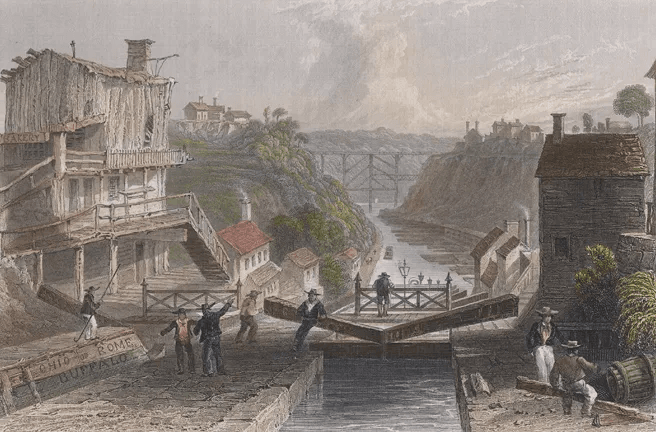
Begun in 1817 and opened in its entirety in 1825, the Erie Canal is considered by some to be the engineering marvel of the nineteenth century. When the federal government concluded that the project was too ambitious to undertake, the State of New York took on the task of carving 363 miles of canal through the wilderness, with nothing but the muscle power of men and horses.
Once derided as ‘Clinton’s Folly’ for the Governor who lent his vision and political muscle to the project, the Erie Canal experienced unparalleled success almost overnight. The iconic waterway established settlement patterns for most of the United States during the nineteenth century, made New York the financial capital of the world, provided a critical supply line that helped the North win the Civil War, and precipitated a series of social and economic changes throughout a young America.
Explorers had long searched for a water route to the west. Throughout the eighteenth and nineteenth centuries, the lack of an efficient and safe transportation network kept populations and trade largely confined to coastal areas. At the beginning of the nineteenth century, the Allegheny Mountains were the Western Frontier. The Northwest Territories that would later become Illinois, Indiana, Michigan and Ohio were rich in timber, minerals, and fertile land for farming, but it took weeks to reach these things. Travellers were faced with rutted turnpike roads that baked to hardness in the summer sun. In the winter, the roads dissolved into mud.
An imprisoned flour merchant named Jesse Hawley envisioned a better way: a canal from Buffalo on the eastern shore of Lake Erie to Albany on the upper Hudson River, a distance of almost 400 miles. Long a proponent of efficient water transportation, Hawley had gone bankrupt trying to move his products to market. Hawley’s ideas caught the interest of Assemblyman Joshua Forman, who submitted the first state legislation related to the Erie Canal in 1808, calling for a series of surveys to be made examining the practicality of a water route between Lake Erie and the Hudson River. In 1810, Thomas Eddy, and State Senator Jonas Platt, hoping to get plans for the canal moving forward, approached influential Senator De Witt Clinton, former mayor of New York City, to enlist his support. Though Clinton had been recruited to the canal effort by Eddy and Platt, he quickly became one of the canal’s most active supporters and went on to successfully tie his very political fate to its success.
On April 15th, 1817, the New York State Legislature finally approved construction of the Erie Canal. The Legislature authorised $7 million for construction of the 363-mile long waterway, which was to be 40 feet wide and eighteen feet deep. Construction began on July 4th 1817 and took eight years.
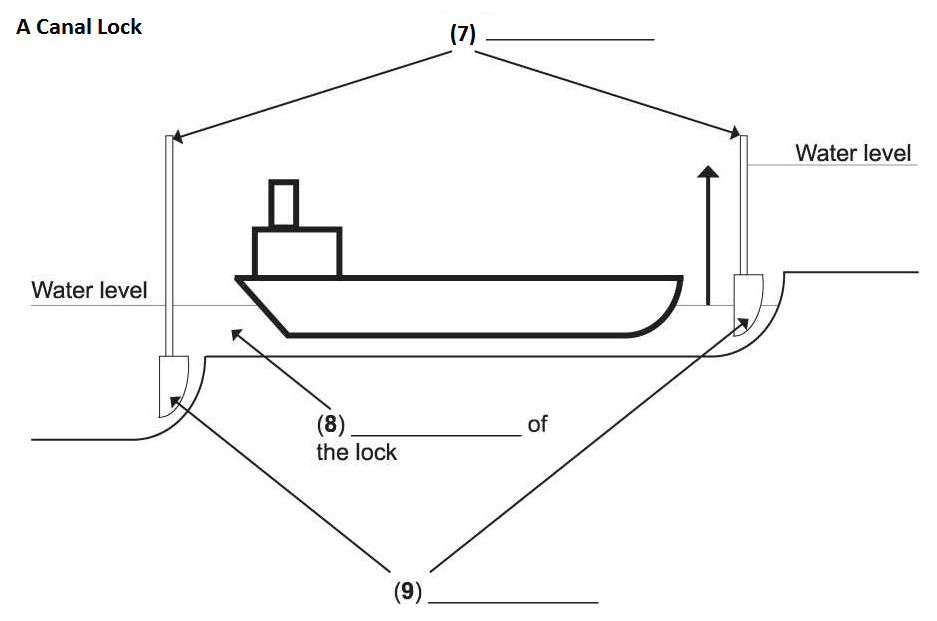
Like most canals, the Erie Canal depended on a lock system in order to compensate for changes in water levels over distance. A lock is a section of canal or river that is closed off to control the water level, so that boats can be raised or lowered as they pass through it. Locks have two sets of sluice gates (top and bottom), which seal off and then open the entrances to the chamber, which is where a boat waits while the movement up or down takes place. In addition, locks also have valves at the bottom of the sluice gates and it is by opening these valves that water is allowed into and out of the chamber to raise or lower the water level, and hence the boat.
The effect of the Erie Canal was both immediate and dramatic, and settlers poured west.
The explosion of trade prophesied by Governor Clinton began, spurred by freight rates from Buffalo to New York of $10 per ton by canal, compared with $100 per ton by road. In 1829, there were 3,640 bushels of wheat transported down the canal from Buffalo. By 1837, this figure had increased to 500,000 bushels and, four years later, it reached one million. In nine years, canal tolls more than recouped the entire cost of construction. Within 15 years of the canal’s opening, New York was the busiest port in America, moving tonnages greater than Boston, Baltimore and New Orleans combined. Today, it can still be seen that every major city in New York State falls along the trade route established by the Erie Canal and nearly 80 per cent of upstate New York’s inhabitants live within 25 miles of the Erie Canal.
The completion of the Erie Canal spurred the first great westward movement of American settlers, gave access to the resources west of the Appalachians and made New York the preeminent commercial city in the United States. At one time, more than 50,000 people depended on the Erie Canal for their livelihood. From its inception, the Erie Canal helped form a whole new culture revolving around canal life. For those who travelled along the canal in packet boats or passenger vessels, the canal was an exciting place. Gambling and entertainment were frequent pastimes, and often families would meet each year at the same locations to share stories and adventures. Today, the canal has returned to its former glory and is filled with pleasure boats, fishermen, holidaymakers and cyclists riding the former towpaths where mules once trod. The excitement of the past is alive and well.
Questions
Questions 1-6
- Write the correct letter, A-K, in any order in boxes 1-6 on your answer sheet.
- Choose SIX letters, A-K.
- What SIX of the following were the effects of the Lake Erie Canal?
A. It brought building materials to expand the city of Chicago.
B. It established the financial dominance of New York City.
C. It generated taxes that stimulated the whole region.
D. It helped the North win the US Civil War.
E. It was used for training troops in World War One.
F. It helped boost a politician’s career.
G. It stimulated the shipbuilding industry.
H. It led to cheaper distribution for goods.
I. It influenced New York State’s population distribution.
J. It allowed damaging species of fish to travel to different ecosystems.
K. It became a boost for tourism.
Questions 7-9
- Label the diagram below.
- Write NO MORE THAN TWO WORDS from the text for each answer.
- Write your answers in boxes 7-9 on your answer sheet.
Questions 10-13
- Answer the questions below.
- Write NO MORE THAN TWO WORDS AND/OR A NUMBER from the text for each answer.
- Write your answers in boxes 10-13 on your answer sheet.
10. What was the beneficial factor for productive agriculture in the Northwest Territories at the beginning of the nineteenth century?
11. In what commodity did the person who first came up with the idea of the Erie Canal trade?
12. How long did it take to build the Erie Canal?
13. How were the Erie Canal’s building costs recovered?
Answers for The Lake Erie Canal with Explanations
The Lake Erie Canal Reading answers with explanations are given below. Refer to the following answers with an explanation section to correct your errors.
(Note: The text in italics mentions the location and referring lines written in the reading passage.)
1. Answer: B, D, F, H, I, K IN ANY ORDER
Explanations: Located in the 2nd line of the 2nd paragraph, The iconic waterway established settlement patterns for most of the United States during the nineteenth century.
2. Answer: B, D, F, H, I, K IN ANY ORDER
Explanations: Located in the 2nd line of the 2nd paragraph, made New York the financial capital of the world, provided a critical supply line that helped the North win the Civil War.
3. Answer: B, D, F, H, I, K IN ANY ORDER
Explanations: Located in the 8th line of the 4th paragraph, approached influential Senator De Witt Clinton, former mayor of New York City, to enlist his support.
4. Answer: B, D, F, H, I, K IN ANY ORDER
Explanations: Located in the 1-2 line of the 7th paragraph, The explosion of trade prophesied by Governor Clinton began, spurred by freight rates from Buffalo to New York of $10 per ton by canal, compared with $100 per ton by road.
5. Answer: B, D, F, H, I, K IN ANY ORDER
Explanations: Located in the last 2 lines of the 7th paragraph, Today, it can still be seen that every major city in New York State falls along the trade route established by the Erie Canal and nearly 80 percent of upstate New York’s inhabitants live within 25 miles of the Erie Canal.
6. Answer: B, D, F, H, I, K IN ANY ORDER
Explanations: Located in the 3-10 line of the 8th paragraph, Today, the canal has returned to its former glory and is filled with pleasure boats, fishermen, holidaymakers and cyclists riding the former towpaths where mules once trod.
7. Answer: (Sluice) gates
Explanations: Located in the 3-5 line of the 6th paragraph, Locks have two sets of sluice gates (top and bottom), which seal off and then open the entrances to the chamber, which is where a boat waits while the movement up or down takes place.
8. Answer: (the) chamber
Explanations: Located in the 3-5 line of the 6th paragraph, Locks have two sets of sluice gates (top and bottom), which seal off and then open the entrances to the chamber, which is where a boat waits while the movement up or down takes place.
9. Answer: Valves
Explanations: Located in the last 3 lines of the 6th paragraph, In addition, locks also have valves at the bottom of the sluice gates and it is by opening these valves that water is allowed into and out of the chamber to raise or lower the water level, and hence the boat.
10. Answer: Fertile land
Explanations: Located in the 4-6 line of the 3rd paragraph, The Northwest Territories that would later become Illinois, Indiana, Michigan and Ohio were rich in timber, minerals, and fertile land for farming, but it took weeks to reach these things.
11. Answer: Flour
Explanations: Located in the first 2 lines of the 4th paragraph, An imprisoned flour merchant named Jesse Hawley envisioned a better way: a canal from Buffalo on the eastern shore of Lake Erie to Albany on the upper Hudson River, a distance of almost 400 miles.
12. Answer: 8 Years
Explanations: Located in the last line of the 5th paragraph, Construction began on July 4th 1817 and took eight years.
13. Answer: (Canals) tools
Explanations: Located in the 4-5 line of the 7th paragraph, In nine years, canal tolls more than recouped the entire cost of construction.
Other Reading Tests

About Author Arivarasi
Arivarasi is an experienced author with expertise in the study abroad industry and preparing test materials for exams like IELTS, TOEFL, GRE, SAT, PTE, etc. She stays up-to-date with university and college requirements for international students which allows her to provide guidance on course selection, documents like SOP, LOR, and scholarship opportunities. She has written numerous articles on study abroad exams, destinations, universities & colleges requirements, admission procedures, and the entire process of studying abroad. Collaborating with industry experts and counselors, she crafts informative articles that make students take the right decisions.
Kanan.co is a trusted study abroad consultancy offering comprehensive services, resources, and solutions for students and education institutions. We support students at every stage of their global education journey, ensuring a smooth and guided experience. Along with test preparation for IELTS, GRE, TOEFL, and SAT, we provide expert services such as SOP writing, visa guidance, accommodation support, scholarship assistance, and education loan support. Our expertise and commitment to excellence make us a reliable partner for students pursuing international education.
Free Online Mock Test 2026
Practice our mock test worth Rs. 25000 for Free and know your IELTS score!








Global Headquarters
Kanan Int EdTech Inc
320 Bay Street, Suite 321 (Spaces), Toronto ON, Canada M5B 1N9
Indian Headquarters
Kanan International Pvt. Ltd.
D-wing, 2nd Floor, Trident Complex, Ellora Park Vadiwadi Road, Vadodara, Gujarat 390007
IT/ Digital Campus
Kanan International Pvt. Ltd
Old, New No 3, 2nd Floor, 1A, Dr Sadasivam Rd, T. Nagar, Chennai, Tamil Nadu 600017
Our branches
- Bardoli
- Bharuch
- Chennai
- Dehradun
- Gurugram
- Himatnagar
- Karnal
- Nadiad
- Navsari
- Palanpur
- Rajkot
- Vadodara
- Valsad
- Vallabh Vidyanagar
- Vapi
Study Abroad
Test Prep
Top Universities
Consultants
IELTS Centers
GRE Centers
TOEFL Centers
SAT Centers
Language Courses in Vadodara
Study Abroad Calculators
Featured Blogs
Study Abroad Consultants in Chennai
Study Abroad Consultants in Surat
Study Abroad Consultants in Navsari
Study Abroad Consultants in Bardoli
Study Abroad Consultants in Ahmedabad
Study Abroad Consultants in Anand
Study Abroad Consultants in Khanna
Study Abroad Consultants in Nadiad
Study Abroad Consultants in Vadodara
Study abroad consultants in Valsad
Copyright © 2026 KANAN.CO All rights reserved.