- Study Abroad /
- IELTS
- / The First Aircraft Reading Answers


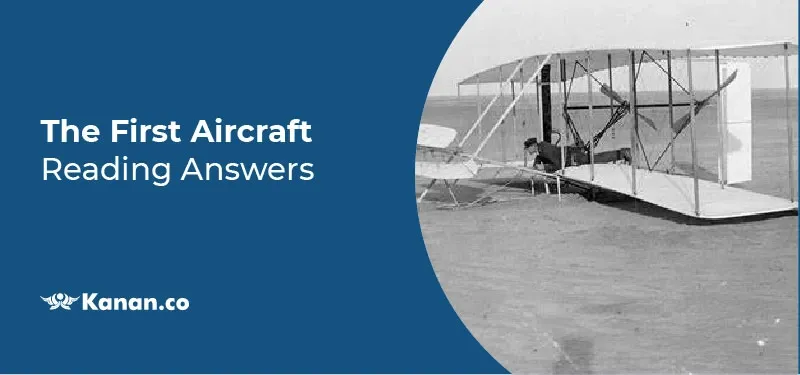
The The First Aircraft reading answers are provided below for your reference.
Answers for The First Aircraft Reading Passage
| 1. cruciform (tail) |
| 2. Kite |
| 3. 6 degrees |
| 4. (the) wings |
| 5. Rudder |
| 6. Propellers |
| 7. Pitch |
| 8. Roll |

The IELTS exam consists of four modules, out of which IELTS reading is a time-consuming module. To help you formulate a technique for answering, we have given you The First Aircraft reading answers with locations, it will help you find the correct location of answers.
In this article 1 IELTS Reading question types are there. They are listed below.
- Diagram Labelling
Table of Contents
IELTS Reading Passage - The First Aircraft
You should spend approximately 20 minutes on Questions 1-12, which are based on the Reading Passage below.
The First Aircraft
The dream of flying has been nurtured since humans lay their eyes on birds. In ancient times, people tried flying by emulating the birds. They constructed ornithopters, flying machines with wings, to take off like birds. However, this did not work since it was obvious that a larger machine was required to lift the body from the ground and propel it forward. In 1783, some daring aeronauts were able to fly using balloons filled with hydrogen or hot r which were lighter than air. But the flight was possible only when the wind would blow in a desired direction. Although these “aerostatic machines'' did not make any technical contributions to manned heavier-than-air flight, they postulated the theory that humans fly.
It was in 1799 that Sir George Cayley, a baronet from yorkshire,came up with the basic concept of the airplane - a flying machine with fixed wings, movable control surfaces, and a propulsion system. The Cayley silver disc, where he inscribed his idea, is preserved in the Science Museum of London. He also made the first true airplane which was actually a glider with a kite fixed on a pole at an angle of incidence of 6 degrees and had a movable cruciform tail attached with universal joints. Cayley separated the concepts of lift and thrust against the convention of earlier scientists that both can be generated by the propulsion system, and he set into motion a century of aeronautical development that resulted into the first ever aircraft by the Wright brothers.
Building in the pioneering works of Sir George Cayley, engineers and scientists began building and experimenting with airplanes. In 1849, a boy became the first person to fly in a glider designed by Cayley. Louis Charles Letur built and tested a parachute glider. This was the first attempt of a controlled flight in a heavier-than-air machine. After several successful descents, Letur met with a serious accident and succumbed to injuries. Felix Du Temple and his brother Louis who flew a model monoplane with propellers driven by a steam engine made the first successful flight of a powered aircraft. The plane took off under its own power for a short distance and glided to a safe landing. Sir Hiram Maxim made the first successful take off in an uncontrolled flight in 1894. Otto Lilienthal made controlled flights by shifting his weight to steer a small glider. This success inspired the Wright brothers Wilbur and Orville Wright to experiment with aerodynamic surfaces to control an airplane in flight. These experiments led them to come up with the first controlled and sustained flight of a powered heavier-than-aircraft in 1903 in Kitty Hawk, North Carolina.
From the beginning of their experiments, the two brothers focused on developing a reliable pilot control that was key to solving the flying problem. The main breakthrough of the brothers was understanding and applying the concept of the three-axis control to fly a aircraft, which allowed them to steer the aircraft effectively and to maintain its
The Wright brothers' 1903 airplane was made up of the wings that generated most of the lift and held the plane in the air. They used twin pusher propellers that were located behind the wings and turned by a small gasoline-powered internal combustion motor. The propellers were meant to overcome the airplane drag and generate the thrust. To achieve the three-axis control, the Wright brothers used different mechanisms. The aircraft had an all-moving elevator at the front that controlled the up and down movement of the nose which is called pitch. At the rear of the aircraft was a rudder which controlled the side-to-side movement of the nose,also called yaw.The rudder also allowed the coordinated turns. The up and down movement of the wings known as roll was provided by twisting the tips of the wings to change the lift on the outer sections of the wings.The body of the airplane that held all the parts together was made of a light framed structure that was not covered due to the low flight speed. The captain of the plane would lie on the wing next to the engine since this aircraft had no seats.
The Wright’s first powered airplane flew at Kitty Hawk on DECEMBER 17,1903. The plane made a 12-second flight and travelled ft. Oliver was the pilot. The flight of the day was with Wilbur at the controls that covered 852 ft. in 59 seconds.The Wright brothers were the pioneers of the basic techniques of modern aeronautical engineering, After their breakthrough, more scientists were involved in the perfection of the basic design,and this led to the evolvement of the modern day aircraft.
The First Aircraft Reading Questions
Questions 1-8
Label the diagrams below
Choose NO MORE THAN TWO WORDS AND/OR A NUMBER from the passage for each answer
Sir George Cayley’s Airplane

The Wright brothers’ 1903 Airplane

The First Aircraft Reading Answers with Explanation
The First Aircraft reading answers with explanations will assist you in correcting errors and identifying the required information for your answer.
1. cruciform (tail)
2. Kite
3. 6 degrees
Explanation: Paragraph 2- He also made the first true airplane which was actually a glider with a (2) kite fixed on a pole at an (3)angle of incidence of 6 degrees and had a (1) movable cruciform tail attached with universal joints.
4. (the) wings
Explanation: Paragraph 5 - The Wrights brothers' 1903 airplane was made up of the wings that generated most of the lift and held the plane in the air.
5. Rudder
Explanation: Paragraph 5- At the rear of the aircraft was a rudder which controlled the side to-side movement of the nose, also called yaw.
6. Propellers
Explanation: Paragraph 5- They used twin pusher propellers that were located behind the wings and turned by a small gasoline-powered internal combustion motor. The propellers were meant to overcome the airplane drag and generate the thrust.
7. Pitch
Explanation: Paragraph 5- The aircraft had an all-moving elevator at the front that controlled the up and down movement of the nose which is called pitch.
8. Roll
Explanation: Paragraph 5- The up and down movement of the wings known as roll was provided by twisting the tips of the wings to change the lift on the outer sections of the wing.
Conclusion
We hope you assessed your solutions with our “The First Aircraft reading answers”. You can improve your answering skills by figuring out the errors in your The First Aircraft reading solutions.
Check the Other Reading Answers
Click to get the other reading answers similar to The First Aircraft reading answers
Free Online Mock Test 2026
Practice our mock test worth Rs. 25000 for Free and know your IELTS score!








Global Headquarters
Kanan Int EdTech Inc
320 Bay Street, Suite 321 (Spaces), Toronto ON, Canada M5B 1N9
Indian Headquarters
Kanan International Pvt. Ltd.
D-wing, 2nd Floor, Trident Complex, Ellora Park Vadiwadi Road, Vadodara, Gujarat 390007
IT/ Digital Campus
Kanan International Pvt. Ltd
Old, New No 3, 2nd Floor, 1A, Dr Sadasivam Rd, T. Nagar, Chennai, Tamil Nadu 600017
Our branches
- Bardoli
- Bharuch
- Chennai
- Dehradun
- Gurugram
- Himatnagar
- Karnal
- Nadiad
- Navsari
- Palanpur
- Rajkot
- Vadodara
- Valsad
- Vallabh Vidyanagar
- Vapi
Study Abroad
Test Prep
Top Universities
Consultants
IELTS Centers
GRE Centers
TOEFL Centers
SAT Centers
Language Courses in Vadodara
Study Abroad Calculators
Featured Blogs
Study Abroad Consultants in Chennai
Study Abroad Consultants in Surat
Study Abroad Consultants in Navsari
Study Abroad Consultants in Bardoli
Study Abroad Consultants in Ahmedabad
Study Abroad Consultants in Anand
Study Abroad Consultants in Khanna
Study Abroad Consultants in Nadiad
Study Abroad Consultants in Vadodara
Study abroad consultants in Valsad
Copyright © 2026 KANAN.CO All rights reserved.