- Study Abroad
- / ielts
- / the olympic torch reading answers
The Olympic Torch Reading Answers


Author
19-09-2025

You can find The Olympic Torch reading answers here. The reading passage from The Olympic Torch consists of ten paragraphs. Following are the 14 question types that compose The Olympic Torch Reading Answers: Summary Completion, Matching Features and Diagram Labelling.
Table of Contents:
- Solution for The Olympic Torch
- The Olympic Torch IELTS Reading Practice Test
- Passage
- Questions
- Answers with Explanations
Solution for The Olympic Torch
For convenience, we have provided The Olympic Torch reading answers in the table below.
Answer Table
| 1. Severe weather conditions | 5. F | 9. C | 13. Propane and butane |
| 2. Aesthetic and practical | 6. B | 10. (a/tiny) fuel tank | 14. Double flame |
| 3. (treasurable) Souvenir | 7. D | 11. Openings | |
| 4. E | 8. H | 12. Handle |

The Olympic Torch IELTS Reading Practice Test - Exam Review
Check out our YouTube Channel to Practice Full-Length IELTS Reading Tests Daily

The Olympic Torch Reading Answers provided here will enhance your ability to manage your time strategically and solve reading tasks. It will also help you improve your reading and analytical abilities. For the IELTS reading section, use the appropriate tricks and techniques.
Passage
You should spend 20 minutes answering questions 1–14 for the The Olympic Torch reading passage. For your convenience, we have provided The Olympic Torch reading answers with locations.
The Olympic Torch
Since 776 B.C., when the Greek people held their first-ever Olympic Games, the Games were hosted every four years at the Olympia city. Back then, a long journey for the Olympic torch was made before the opening ceremony of each Olympic Games. The Greek people would light a cauldron of flames on the altar, a ritual devoted to Hera, the Greek Goddess of birth and marriage.
The reintroduction of flame to the Olympics occurred at the Amsterdam 1928 Games, for which a cauldron was lit yet without a torch relay. The 1936 Berlin Summer Games held the first Olympic torch relay, which was not resumed in the Winter Olympics until 1952. However, in that year the torch was lit not in Olympia, Greece, but in Norway, which was considered as the birthplace of skiing. Until the Innsbruck 1964 Winter Olympics in Austria, the Olympic flame was reignited at Olympia.
The torch is originally an abstract concept of a designer or groups of designers. A couple of design groups hand in their drafts to the Olympic Committee in the hope that they would get the chance to create the torch. The group that wins the competition will come up with a design for a torch that has both aesthetic and practical value. After the torch is completed, it has to succeed in going through all sorts of severe weather conditions. The appearance of the modem Olympic torch is attributed to a Disney artist John Hench, who designed the torch for the 1960 Winter Olympics in Squaw Valley, California. His design laid a solid foundation for all the torches in the future.
The long trip to the Olympic area is not completed by one single torch, but by thousands of them, so the torch has to be replicated many times. Approximately 10,000 to 15,000 torches are built to fit thousands of runners who take the torches through every section of the Olympic relay. Every single runner can choose to buy his or her torch as a treasurable souvenir when he or she finishes his or her part of the relay.
The first torch in the modem Olympics (the 1936 Berlin Games) was made from a slender steel rod with a circular platform at the top and a circular hole in the middle to jet flames.
The name of the runner was also inscribed on the platform as a token of thanks. In the earlier days, torches used everything from gunpowder to olive oil as fuels. Some torches adopted a combination of hexamine and naphthalene with a flammable fluid. However, these materials weren’t exactly the ideal fuel sources, and they could be quite hazardous sometimes. In the 1956 Olympics, the torch in the final relay was ignited by magnesium and aluminium, but some flaming pieces fell off and seared the runner’s arms.
To promote the security rate, liquid fuels made its first appearance at the 1972 Munich Games. Since then, torches have been using fuels which are pressurised into the form of a liquid. When the fuels are burnt, they turn into gas to produce a flame. Liquid fuel becomes safer for the runner and can be stored in a light container. The torch at the 1996 Atlanta Summer Olympics is equipped with an aluminium base that accommodates a tiny fuel tank. As the fuel ascends through the modified handle, it is squeezed through a brass valve that has thousands of little openings. As the fuel passes through the tiny openings, it accumulates pressure. Once it makes its way through the openings, the pressure decreases and the liquid becomes gas so it can bum up.
The torch in 1996 was fuelled by propylene, a type of substance that could give out a bright flame. However, since propylene was loaded with carbon, it would produce plenty of smoke which was detrimental to the environment. In 2000, the designers of the Sydney Olympic torch proposed a lighter and cheaper design, which was harmless to the environment. For the fuel, they decided to go with a combination of 35 per cent propane (a gas that is used for cooking and heating) and 65 per cent butane (a gas that is obtained from petroleum), thus creating a powerful flame without generating much smoke.
Both the 1996 and 2000 torches adopted a double flame burning system, enabling the flames to stay lit even in severe weather conditions. The exterior flame bums at a slower rate and at a lower temperature. It can be perceived easily with its big orange flame, but it is unstable. On the other hand, the interior flame bums faster and hotter, generating a small blue flame with great stability, due to the internal site offering protection from the wind. Accordingly, the interior flame would serve as a pilot light, which could relight the external flame if it should go out.
As for the torch of the 2002 Olympics in Salt Lake City, the top section was made of glass in which the flame burned, for the purpose of echoing the theme of ‘Light the Fire Within’ of that Olympics. This torch was of great significance for the following designs of the torches.
Questions
Questions 1-3
Complete the summary below.
Choose NO MORE THAN THREE WORDS from the passage for each answer.
Write your answers in boxes 1-3 on your answer sheet.
The Olympic torch, as requested by the Olympic Committee, will be carefully designed so that it is capable of withstanding all kinds of 1. _______________. Generally, the design of the modern Olympic torch enjoys the 2. _______________ value. The torch must be copied, and thousands of torches are constructed to accommodate thousands of runners who will carry them through each leg of the Olympic relay. Each runner has an opportunity to purchase the torch as a(n) 3. ________________at the end of his or her leg of the relay.
Questions 4-9
Look at the following statements (Questions 4-9) and the list of Olympic torches below.
Match each statement with the correct Olympic torch, A-H.
Write the correct letter, A-H, in boxes 4-9 on your answer sheet.
|
List of Olympic Torches
|
4. First liquid fuel.
5. Not environmentally friendly.
6. Beginning to record the runners’ name.
7. Potentially risky as it burnt the runner’s arms.
8. Special for a theme of ‘Light’.
9. Not lit in Greek.
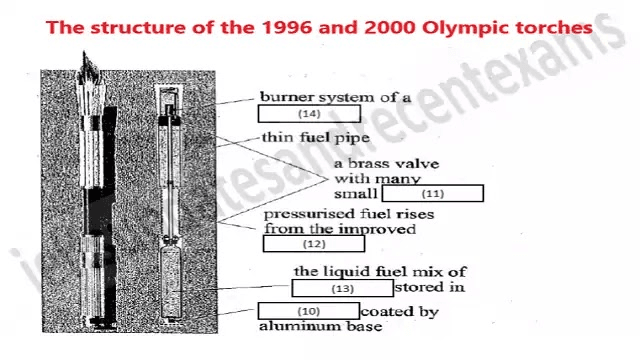
Questions 10-14
Label the diagram below.
Choose NO MORE THAN THREE WORDS from the passage for each answer.
Write your answers in boxes 10-14 on your answer sheet.
Answers for The Olympic Torch With Explanations
We have delivered The Olympic Torch reading answers with explanations below. Rectifying the answers will be beneficial in your answering process.
(Note: The language highlighted in bold refers to the location and answer in the passage. The explanatory sentences from the reading passage are shown in italics.)
1. Answer: Severe weather conditions
Explanation: It is explained in Paragraph 3 that the torch was originally an abstract concept of a designer or group of designers. A couple of design groups handed in their draughts to the Olympic Committee in the hope that they would get the chance to create the torch. The group that wins the competition will come up with a design for a torch that has both aesthetic and practical value. After the torch is completed, it has to go through all sorts of severe weather conditions. This implies that numerous teams of designers submit their rough drafts to the Olympic Committee in anticipation that they will be granted the opportunity to design the torch. The team that succeeds in the competition will create a torch design that is both aesthetically pleasing and useful. When the torch is finished, it must survive a variety of extreme weather conditions.
2. Answer: Aesthetic and practical
Explanation: It is clearly stated in Paragraph 3, fourth line, that a couple of design groups handed in their draughts to the Olympic Committee in the hope that they would get the chance to create the torch. The group that wins the competition will come up with a design for a torch that has both aesthetic and practical value. After the torch is completed, it has to go through all sorts of severe weather conditions. This suggests that several design teams submit their rough drafts to the Olympic Committee in the hopes that they will be given the opportunity to design the torch. The team that wins the competition will create a torch design that is both aesthetically pleasing and useful. Therefore, the design of the modern Olympic torch has both aesthetic and practical value.
3. Answer: (treasurable) Souvenir
Explanation: According to Paragraph 4, the long trip to the Olympic area is not completed by one single torch, but by thousands of them, so the torch has to be replicated many times. Approximately 10,000 to 15,000 torches are built to fit thousands of runners who take the torches through every section of the Olympic relay. Every single runner can choose to buy his or her torch as a treasurable souvenir when he or she finishes his or her part of the relay. This indicates that the torch must be copied, and thousands of torches are constructed to accommodate thousands of runners who will carry them through each leg of the Olympic relay. Each runner has an opportunity to purchase the torch as a(n) treasurable souvenir at the end of his or her leg of the relay.
4. Answer: E
Explanation: It is demonstrated in Paragraph 7, the introductory line, that to promote the security rate, liquid fuels made their first appearance at the 1972 Munich Games. So, the first liquid fuel appeared in the Munich Games torch (1972).
5. Answer: F
Explanation: It is quoted in Paragraph 7, fourth line, that the torch at the 1996 Atlanta Summer Olympics is equipped with an aluminium base that accommodates a tiny fuel tank. This sentence infers that the torch at the 1996 Atlanta Summer Olympics is not environmentally friendly.
6. Answer: B
Explanation: It is illustrated in Paragraph 2 that the 1936 Berlin Summer Games held the first Olympic torch relay, which was not resumed in the Winter Olympics until 1952. However, in that year, the torch was lit not in Olympia, Greece, but in Norway, which was considered the birthplace of skiing. Until the 1964 Winter Olympics in Innsbruck, Austria, the Olympic flame was reignited at Olympia. This suggests that it was the beginning of recording the runners’ names.
7. Answer: D
Explanation: Paragraph 6, last line, reveals the information that in the 1956 Olympics, the torch in the final relay was ignited by magnesium and aluminium, but some flaming pieces fell off and seared the runner’s arms. This means that it was potentially risky, as it burned the runner’s arms.
8. Answer: H
Explanation: In Paragraph 10, it is discussed that, as for the torch of the 2002 Olympics in Salt Lake City, the top section was made of glass in which the flame burned, for the purpose of echoing the theme of ‘Light the Fire Within’ of that Olympics. This indicates that it was special for the theme of light.
9. Answer: C
Explanation: It is illustrated in Paragraph 2, the last second line, that the torch was lit not in Olympia, Greece, but in Norway, which was considered the birthplace of skiing. This sentence clearly implies that the torch was not lit in Greece but in Norway.
10. Answer: (a/tiny) fuel tank
Explanation: It is apparent from the fourth line of Paragraph 7 that the torch at the 1996 Atlanta Summer Olympics is equipped with an aluminium base that accommodates a tiny fuel tank. From this sentence, it can be understood that the Olympic torch fuel tank was coated with an aluminium base.
11. Answer: Openings
Explanation: It is clearly stated in Paragraph 7 that the torch at the 1996 Atlanta Summer Olympics is equipped with an aluminium base that accommodates a tiny fuel tank. As the fuel ascends through the modified handle, it is squeezed through a brass valve that has thousands of little openings. It is evident that the Olympic torch fuel tank was coated with an aluminium base and had a brass valve with many small openings.
12. Answer: Handle
Explanation: It is pointed out in Paragraph 7, fifth line, that the torch at the 1996 Atlanta Summer Olympics is equipped with an aluminium base that accommodates a tiny fuel tank. As the fuel ascends through the modified handle, it is squeezed through a brass valve that has thousands of little openings. Here, the Olympic torch fuel tank was coated with an aluminium base and had a brass valve with many small openings; further, the pressurised fuel rose from the improved handle.
13. Answer: Propane and butane
Explanation: Paragraph 8, line 4, talks about the liquid fuel mix of Propane and butane that was stored. For the fuel, they decided to go with a combination of 35 percent propane (a gas that is used for cooking and heating) and 65 percent butane (a gas that is obtained from petroleum), thus creating a powerful flame without generating much smoke.
14. Answer: Double flame
Explanation: In the initial line of Paragraph 9, it says that both the 1996 and 2000 torches adopted a double-flame burning system, enabling the flames to stay lit even in severe weather conditions. Hence, the Olympic torch fuel tank was coated with an aluminium base and had a brass valve with many small openings; further, the pressurised fuel rose from the improved handle; the liquid fuel mix of Propane and butane was stored in it; and in order to enable the flames to stay lit in severe weather conditions, a double flame burning system was adopted.
Other Reading Tests

About Author Roshan Sunthar
Roshan Sunthar is a study abroad expert as well as a renowned writer and author in international education. His academic excellence and 5+ years of work experience give him in-depth knowledge of international standardised exams and test preparation in IELTS, TOEFL, GRE, PTE, SAT, etc. The study materials he prepares incorporate exam-like questions. He’s also an expert in writing Statement of Purposes (SOPs) and Letter of Recommendations (LORs) for college admissions. He usually spends his leisure time watching English classics and documentaries, travelling, etc.
Kanan.co is a trusted study abroad consultancy offering comprehensive services, resources, and solutions for students and education institutions. We support students at every stage of their global education journey, ensuring a smooth and guided experience. Along with test preparation for IELTS, GRE, TOEFL, and SAT, we provide expert services such as SOP writing, visa guidance, accommodation support, scholarship assistance, and education loan support. Our expertise and commitment to excellence make us a reliable partner for students pursuing international education.
Free Online Mock Test 2026
Practice our mock test worth Rs. 25000 for Free and know your IELTS score!








Global Headquarters
Kanan Int EdTech Inc
320 Bay Street, Suite 321 (Spaces), Toronto ON, Canada M5B 1N9
Indian Headquarters
Kanan International Pvt. Ltd.
D-wing, 2nd Floor, Trident Complex, Ellora Park Vadiwadi Road, Vadodara, Gujarat 390007
IT/ Digital Campus
Kanan International Pvt. Ltd
Old, New No 3, 2nd Floor, 1A, Dr Sadasivam Rd, T. Nagar, Chennai, Tamil Nadu 600017
Our branches
- Bardoli
- Bharuch
- Chennai
- Dehradun
- Gurugram
- Himatnagar
- Karnal
- Nadiad
- Navsari
- Palanpur
- Rajkot
- Vadodara
- Valsad
- Vallabh Vidyanagar
- Vapi
Study Abroad
Test Prep
Top Universities
Consultants
IELTS Centers
GRE Centers
TOEFL Centers
SAT Centers
Language Courses in Vadodara
Study Abroad Calculators
Featured Blogs
Study Abroad Consultants in Chennai
Study Abroad Consultants in Surat
Study Abroad Consultants in Navsari
Study Abroad Consultants in Bardoli
Study Abroad Consultants in Ahmedabad
Study Abroad Consultants in Anand
Study Abroad Consultants in Khanna
Study Abroad Consultants in Nadiad
Study Abroad Consultants in Vadodara
Study abroad consultants in Valsad
Copyright © 2026 KANAN.CO All rights reserved.