- Study Abroad
- / ielts
- / mystery in easter island reading answers
Mystery in Easter Island Reading Answers


Author
19-09-2025

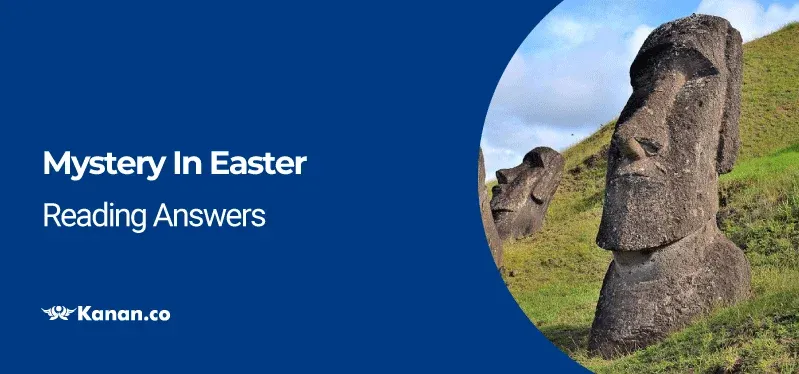
Mystery in Easter Island reading practice test consists of 14 questions, including three question types. It not only provides answers but also explains them with their corresponding locations. This article offers valuable information to improve your understanding and help you find the correct answers more easily.
Given question types are, Match the headings, Summary Completion Questions, and True/False or Not Given.
Table of contents:
- Solution for Mystery in Easter Island
- Mystery in Easter Island IELTS reading practice Test
- Passage
- Questions
- Answers with Explanations
Solution for Mystery in Easter Island
To enhance your understanding and problem-solving skills, it is recommended to compare your answers with the provided Mystery in Easter Island reading answers. You can use the provided answers to check your own and identify any mistakes you may have made. This exercise will help you improve your ability to comprehend and answer comprehension questions effectively.
Answer Table
| v | Not Given | Not Given | archeological and historical |
| ii | TRUE | TRUE | inhuman behaviour |
| iii | FALSE | growing population | |
| viii | FALSE | racist assumption |

Mystery in Easter Island IELTS Reading Practice Test - Exam Review
Check out our YouTube Channel to Practice Full-Length IELTS Reading Tests Daily

The answers provided for Mystery in Easter Island IELTS reading answers will serve as valuable resources to enhance your skills. In order to solve Matching the headings, prefer to solve this question type at the end of the passage, so that you can get the idea about the information of the paragraphs, and read only 2 or 3 sentences of the paragraph to find the heading. For Summary Completion and True/False or Not given, focus on keywords and the meaning of sentences. Through regular practice and dedication, you can achieve your target band score.
Passage
The reading passage of Mystery in Easter Island is provided here. Read the whole passage and respond to the questions carefully, and check your responses with Mystery in Easter Island answers with location.
Mystery in Easter Island
- One of the World's most famous yet least visited archaeological sites, Easter Island is a small, hilly, now treeless island of volcanic origin. Located in the Pacific Ocean at 27 degrees south of the equator and some 2200 miles (3600 kilometres) off the coast of Chile, it is considered to be the world’s most remote inhabited island. The island is, technically speaking, a single massive volcano rising over ten thousand feet from the Pacific Ocean floor. The island received its most well-known current name, Easter Island, from the Dutch sea captain Jacob Roggeveen who became the first European to visit Easter Sunday, April 5, 1722.
- In the early 1950s, the Norwegian explorer Thor Heyerdahl popularised the idea that the island had been originally settled by advanced societies of Indians from the coast of South America. Extensive archaeological, ethnographic and linguistic research has conclusively shown this hypothesis to be inaccurate. It is now recognized that the original inhabitants of Easter Island are of Polynesian stock (DNA extracts from skeletons have confirmed this), that they most probably came from the Marquesas or Society islands, and that they arrived as early as 318 AD (carbon dating of reeds from a grave confirms this). At the time of their arrival, much of the island was forested, teeming with land birds, and was perhaps the most productive breeding site for seabirds in the Polynesia region. Because of the plentiful bird, fish and plant food sources, the human population grew and gave rise to a rich religious and artistic culture.
- That culture’s most famous features are its enormous stone statues called moai, at least 288 of which once stood upon massive stone platforms called ahu. There are some 250 of these ahu platforms spaced approximately one-half mile apart and creating an almost unbroken line around the perimeter of the island. Another 600 moai statues, in various stages of completion, are scattered around the island, either in quarries or along ancient roads between the quarries and the coastal areas where the statues were most often erected. Nearly all the moai are carved from the tough stone of the Rano Raraku volcano. The average statue is 14 feet and 6 inches tall and weighs 14 tons. Some moai were as large as 33 feet and weighed more than 80 tons. Depending upon the size of the statues, it has been estimated that between 50 and 150 people were needed to drag them across the countryside on sledges and rollers made from the island’s trees.
- Scholars are unable to definitively explain the function and use of the moai statues. It is assumed that their carving and erection derived from an idea rooted in similar practices found elsewhere in Polynesia but which evolved in a unique way on Easter Island. Archaeological and iconographic analysis indicates that the statue cult was based on an ideology of male, lineage-based authority incorporating anthropomorphic symbolism. The statues were thus symbols of authority and power, both religious and political. But they were not only symbols. To the people who erected and used them, they were actual repositories of sacred spirit. Carved stone and wooden objects in ancient Polynesian religions, when properly fashioned and ritually prepared, were believed to be charged by a magical spiritual essence called mana. The ahu platforms of Easter Island were the sanctuaries of the people, and the moai statues were the ritually charged sacred objects of those sanctuaries.
- Besides its more well-known name, Easter Island is also known as Te-Pito-O-Te-Henuab, meaning ‘The Navel of the World’, and as Mata-Ki-Te-Rani, meaning ‘Eyes Looking at Heaven’. These ancient names and a host of mythological details ignored by mainstream archaeologists point to the possibility that the remote island may once have been a geodetic marker and the site of an astronomical observatory of a long-forgotten civilization. In his book, Heaven’s Mirror, Graham Hancock suggests that Easter Island may once have been a significant scientific outpost of this antediluvian civilization and that its location had extreme importance in a planet-spanning, mathematically precise grid of sacred sites. Two other alternative scholars, Christopher Knight and Robert Lomas, have extensively studied the location and possible function of these geodetic markers. In their fascinating book, Uriel’s Machine, they suggest that one purpose of the geodetic markers was as part of a global network of sophisticated astronomical observatories dedicated to predicting and preparing for future commentary impacts and crystal displacement cataclysms.
- In the latter years of the 20th century and the first years of the 21st century, various writers and scientists have advanced theories regarding the rapid decline of Easter Island’s magnificent civilization around the time of the first European contact. Principal among these theories, and now shown to be inaccurate, is that postulated by Jared Diamond in his book Collapse: How Societies Choose to Fail or Survive. Basically, these theories state that a few centuries after Easter Island’s initial colonisation the resource needs of the growing population had begun to outpace the island’s capacity to renew itself ecologically. By the 1400s the forests had been entirely cut, the rich ground cover had eroded away, the springs had dried up, and the vast flocks of birds coming to roost on the island had disappeared. With no logs to build canoes for offshore fishing, with depleted bird and wildlife food sources, and with declining crop yields because of the erosion of good soil, the nutritional intake of the people plummeted. First famine, then cannibalism, set in. Because the island could no longer feed the chiefs, bureaucrats and priests who kept the complex society running, the resulting chaos triggered a social and cultural collapse. By 1700 the population dropped to between one-quarter and one-tenth of its former number, and many of the statues were toppled during supposed “clan wars” of the 1600 and 1700s.
- The faulty notions presented in these theories began with the racist assumptions of Thor Heyerdahl and have been perpetuated by writers, such as Jared Diamond, who do not have sufficient archaeological and historical understanding of the actual events which occurred on Easter Island. The real truth regarding the tremendous social devastation which occurred on Easter Island is that it was a direct consequence of the inhumane behaviour of many of the first European visitors, particularly the slavers who raped and murdered the islanders, introduced smallpox and other diseases, and brutally removed the natives to mainland South America.
Questions
Questions 1-4
Choose the correct heading for paragraphs A-G from the list below.
Write the correct number, i-xi, in boxes 1-4 on your answer sheet.
NB There are more headings than paragraphs
List of headings
- The famous moai
- The status represented symbols of combined purposes
- The ancient spots which indicate the scientific application
- The story of the name
- Early immigrants, rise and prosperity
- The geology of Easter Island
- The begin of Thor Heyerdahl’s discovery
- The countering explanation to the misconceptions politically manipulated
- Symbols of authority and power
- The Navel of the World
- The Norwegian Invaders’ legacy
Example: Paragraph A iv
1. Paragraph B
Example: Paragraph C i
2. Paragraph D
3. Paragraph E
4. Paragraph G
Questions 5-10
Do the following statements agree with the information given in the Reading Passage?
TRUE if the statement is true
FALSE if the statement is false
NOT GIVEN if the information is not given in the passage
5. The first inhabitants of Easter Island are Polynesian, from the Marquesas or Society islands.
6. Construction of some moai statues on the island was not finished.
7. The Moai can be found not only on Easter Island but also elsewhere in Polynesia.
8. Most archaeologists recognised the religious and astronomical functions for an ancient society.
9. The structures of Easter Island work as an astronomical outpost for extraterrestrial visitors.
10. The theory that depleted natural resources leading to the failure of Easter Island actually has a distorted perspective.
Questions 11-14
Complete the following summary of the paragraphs of Reading Passage
Using NO MORE THAN THREE WORDS from the Reading Passage for each answer.
Many theories speculated that Easter Island’s fall occurred around the era of the initial European contact. Some say the resources are depleted by a 11. _________ The erroneous theories began with a root of the 12. ___________ advanced by some scholars. Early writers did not have adequate 13. ____________ understandings to comprehend the true nature of events on the island. The social devastation was, in fact, a direct result of 14. ___________ of the first European settlers.
Answers For Mystery in Easter Island With Explanations
To improve your learning and problem-solving skills, it is beneficial to review the answers and explanations given for the questions about the Mystery in Easter Island reading answers with explanations. By understanding the correct answers and where they can be found in the passage, you can enhance your overall understanding and performance. Practising this will help you grasp the information more effectively.
1. Answer: v
Explanation: In Paragraph B, the writers mentioned that, ‘It is now recognized that the original inhabitants of Easter Island are of Polynesian stock (DNA extracts from skeletons have confirmed this), that they most probably came from the Marquesas or Society islands, and that they arrived as early as 318 AD (carbon dating of reeds from a grave confirms this). At the time of their arrival, much of the island was forested, teeming with land birds, and was perhaps the most productive breeding site for seabirds in the Polynesia region.’ The paragraph also mentions how the human population grew on the island, leading to the development of a rich religious and artistic culture.
2. Answer: ii
Explanation: In Paragraph D, the writers mentioned that, ‘Archaeological and iconographic analysis indicates that the statue cult was based on an ideology of male, lineage-based authority incorporating anthropomorphic symbolism. The statues were thus symbols of authority and power, both religious and political. But they were not only symbols. To the people who erected and used them, they were actual repositories of sacred spirit.’ Therefore, the moai statues represented a combination of purposes: as symbols of authority and power, as well as objects believed to hold sacred spiritual energy.
3. Answer: iii
Explanation: In Paragraph E, the writers mentioned that, ‘These ancient names and a host of mythological details ignored by mainstream archaeologists point to the possibility that the remote island may once have been a geodetic marker and the site of an astronomical observatory of a long-forgotten civilization…In their fascinating book, Uriel’s Machine, they suggest that one purpose of the geodetic markers was as part of a global network of sophisticated astronomical observatories dedicated to predicting and preparing for future commentary impacts and crystal displacement cataclysms.’ These lines suggest that the mythological details and alternative theories are ignored by mainstream archaeologists, suggesting that Easter Island's ancient names and its location may indicate its role as an important scientific outpost.
4. Answer: viii
Explanation: In Paragraph G, the writers mentioned that, ‘The faulty notions presented in these theories began with the racist assumptions of Thor Heyerdahl and have been perpetuated by writers, such as Jared Diamond, who do not have sufficient archaeological and historical understanding of the actual events which occurred on Easter Island. The real truth regarding the tremendous social devastation which occurred on Easter Island is that it was a direct consequence of the inhumane behaviour of many of the first European visitors,...’ The paragraph indicates that these alternative theories and misconceptions have been politically manipulated, possibly to divert attention from the true causes of the social devastation.
5. Answer: Not Given
Explanation: There is no related information given here.
6. Answer: True
Explanation: In Paragraph C, the writers mentioned that, ‘Another 600 moai statues, in various stages of completion, are scattered around the island, either in quarries or along ancient roads between the quarries and the coastal areas where the statues were most often erected.’ It states that the construction of some moai statues on the island was indeed not finished.
7. Answer: False
Explanation: In Paragraph C, the writers mentioned that, ‘The average statue is 14 feet and 6 inches tall and weighs 14 tons. Some moai were as large as 33 feet and weighed more than 80 tons. Depending upon the size of the statues, it has been estimated that between 50 and 150 people were needed to drag them across the countryside on sledges and rollers made from the island’s trees.’ The passage only mentions the location and characteristics of the Moai statues on Easter Island, such as their number, size, and the materials used to construct them. Thus, it states that Moai statues are unique to Easter Island and not found elsewhere in Polynesia.
8. Answer: False
Explanation: In Paragraph D, the writers mentioned that, ‘The statues were thus symbols of authority and power, both religious and political. But they were not only symbols. To the people who erected and used them, they were actual repositories of sacred spirit.’ Therefore, based on the information provided in the passage, it cannot be concluded that most archaeologists recognized such functions for the society.
9. Answer: Not Given
Explanation: There is no related information given here.
10. Answer: True
Explanation: In Paragraph F, the writers mentioned that, ‘Principal among these theories, and now shown to be inaccurate, is that postulated by Jared Diamond in his book Collapse: How Societies Choose to Fail or Survive. Basically, these theories state that a few centuries after Easter Island’s initial colonisation the resource needs of the growing population had begun to outpace the island’s capacity to renew itself ecologically…The real truth regarding the tremendous social devastation which occurred on Easter Island is that it was a direct consequence of the inhumane behaviour of many of the first European visitors, particularly the slavers who raped and murdered the islanders, introduced smallpox and other diseases, and brutally removed the natives to mainland South America.’ Thus, the passage presents the theory of depleted natural resources as having a distorted perspective and provides an alternative explanation for the decline of Easter Island's civilization.
11. Answer: growing population
Explanation: In Paragraph F, the writers mentioned that, ‘Basically, these theories state that a few centuries after Easter Island’s initial colonisation the resource needs of the growing population had begun to outpace the island’s capacity to renew itself ecologically.’
12. Answer: racist assumption
Explanation: In Paragraph G, the writers mentioned that, ‘The faulty notions presented in these theories began with the racist assumptions of Thor Heyerdahl and have been perpetuated by writers, such as Jared Diamond, who do not have sufficient archaeological and historical understanding of the actual events which occurred on Easter Island.’
13. Answer: archeological and historical
Explanation: In Paragraph G, the writers mentioned that, ‘The faulty notions presented in these theories began with the racist assumptions of Thor Heyerdahl and have been perpetuated by writers, such as Jared Diamond, who do not have sufficient archaeological and historical understanding of the actual events which occurred on Easter Island.’
14. Answer: inhuman behaviour
Explanation: In Paragraph G, the writers mentioned that, ‘The real truth regarding the tremendous social devastation which occurred on Easter Island is that it was a direct consequence of the inhumane behaviour of many of the first European visitors,...’
Other reading tests
- Envy without reason reading answers
- The olympic torch reading answers
- Mystery in Easter Island Reading Answers

About Author Manimegalai Samidurai
Manimegalai is a multifaceted professional, excelling as an author, writer, and study-abroad expert. Her vast knowledge of English proficiency exams, including IELTS, GRE, SAT, and PTE, and exceptional content writing skills make her a go-to resource for students seeking guidance and support in their foreign education journey. She is a trusted authority in writing content related to these test-prep exams, making her an invaluable resource for those seeking guidance. With her well-researched and informative blogs, articles, and study materials, Manimegalai has helped countless students achieve their desired band scores and get admissions to top-notch colleges & universities in countries like Canada, USA, UK, Australia, Ireland, etc.
Kanan.co is a trusted study abroad consultancy offering comprehensive services, resources, and solutions for students and education institutions. We support students at every stage of their global education journey, ensuring a smooth and guided experience. Along with test preparation for IELTS, GRE, TOEFL, and SAT, we provide expert services such as SOP writing, visa guidance, accommodation support, scholarship assistance, and education loan support. Our expertise and commitment to excellence make us a reliable partner for students pursuing international education.
Free Online Mock Test 2026
Practice our mock test worth Rs. 25000 for Free and know your IELTS score!








Global Headquarters
Kanan Int EdTech Inc
320 Bay Street, Suite 321 (Spaces), Toronto ON, Canada M5B 1N9
Indian Headquarters
Kanan International Pvt. Ltd.
D-wing, 2nd Floor, Trident Complex, Ellora Park Vadiwadi Road, Vadodara, Gujarat 390007
IT/ Digital Campus
Kanan International Pvt. Ltd
Old, New No 3, 2nd Floor, 1A, Dr Sadasivam Rd, T. Nagar, Chennai, Tamil Nadu 600017
Our branches
- Bardoli
- Bharuch
- Chennai
- Dehradun
- Gurugram
- Himatnagar
- Karnal
- Nadiad
- Navsari
- Palanpur
- Rajkot
- Vadodara
- Valsad
- Vallabh Vidyanagar
- Vapi
Study Abroad
Test Prep
Top Universities
Consultants
IELTS Centers
GRE Centers
TOEFL Centers
SAT Centers
Language Courses in Vadodara
SOP Blogs
Featured Blogs
Study Abroad Consultants in Chennai
Study Abroad Consultants in Surat
Study Abroad Consultants in Navsari
Study Abroad Consultants in Bardoli
Study Abroad Consultants in Ahmedabad
Study Abroad Consultants in Anand
Study Abroad Consultants in Khanna
Study Abroad Consultants in Nadiad
Study Abroad Consultants in Vadodara
Study abroad consultants in Valsad
Copyright © 2026 KANAN.CO All rights reserved.